Page 181 of 268
IN CASE OF EMERGENCY
Have a flat tire or a burnt-out bulb?
At times, a problem such as these may
interfere with your driving experience.
The pages on emergencies can help
you to deal with critical situations
independently and with calm.
In an emergency, we recommend that
you call the phone number found in the
Warranty Book.
You may also consider contacting your
nearest authorized dealer.HAZARD WARNING LIGHTS . . . .180
BULB REPLACEMENT.........180
FUSES .................. .186
TIRE REPAIR KIT —
IF EQUIPPED ..............192
EMERGENCYSTARTING ......196
REFUELING IN EMERGENCY . . . .198
ENGINE OVERHEATING .......199
TOWING A DISABLED VEHICLE . .200
TOW HOOKS ..............201
ENHANCED ACCIDENT
RESPONSE SYSTEM (EARS) . . . .203
EVENT DATA RECORDER (EDR) . .203
179
Page 182 of 268
HAZARD WARNING
LIGHTS
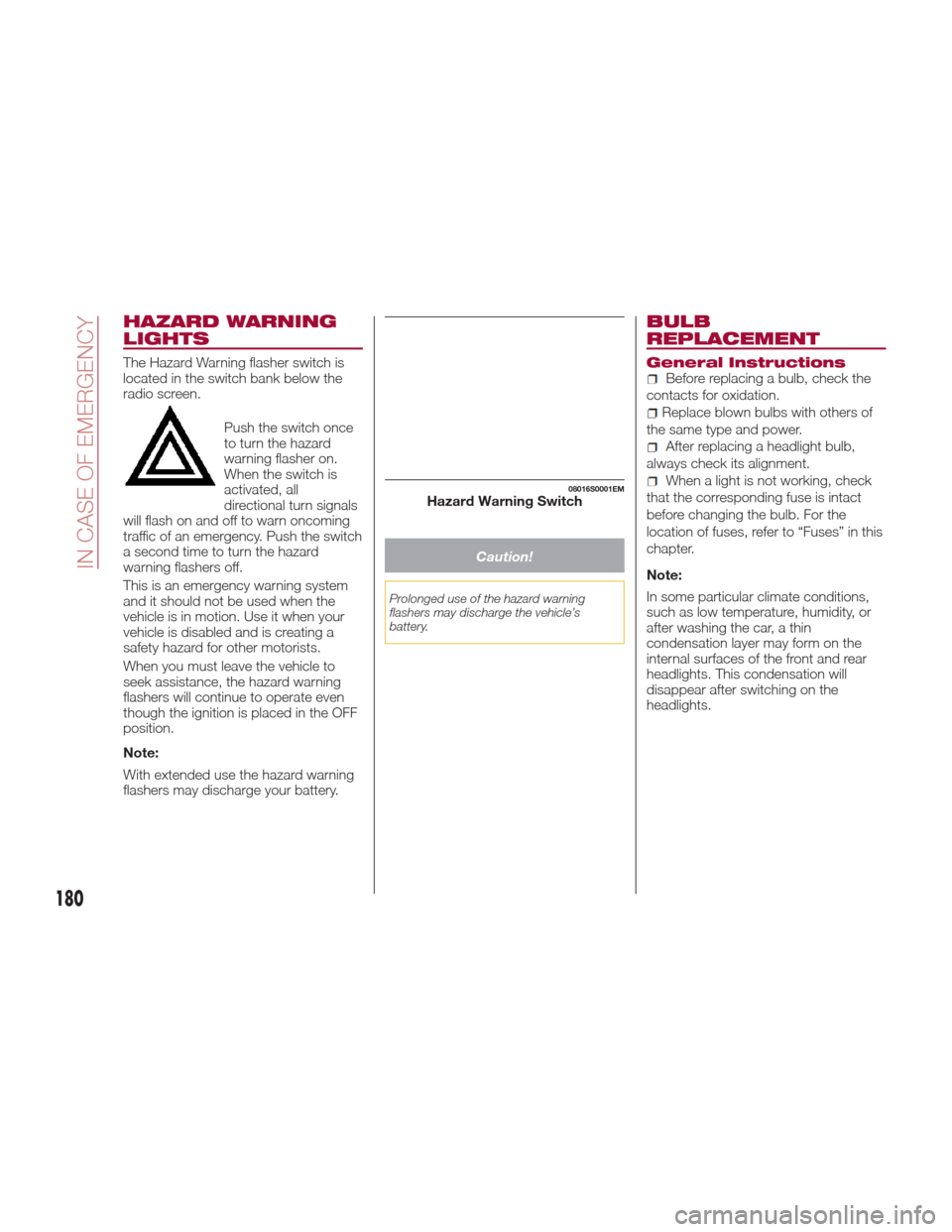
The Hazard Warning flasher switch is
located in the switch bank below the
radio screen.Push the switch once
to turn the hazard
warning flasher on.
When the switch is
activated, all
directional turn signals
will flash on and off to warn oncoming
traffic of an emergency. Push the switch
a second time to turn the hazard
warning flashers off.
This is an emergency warning system
and it should not be used when the
vehicle is in motion. Use it when your
vehicle is disabled and is creating a
safety hazard for other motorists.
When you must leave the vehicle to
seek assistance, the hazard warning
flashers will continue to operate even
though the ignition is placed in the OFF
position.
Note:
With extended use the hazard warning
flashers may discharge your battery.
Caution!
Prolonged use of the hazard warning
flashers may discharge the vehicle’s
battery.
BULB
REPLACEMENT
General InstructionsBefore replacing a bulb, check the
contacts for oxidation.
Replace blown bulbs with others of
the same type and power.
After replacing a headlight bulb,
always check its alignment.
When a light is not working, check
that the corresponding fuse is intact
before changing the bulb. For the
location of fuses, refer to “Fuses” in this
chapter.
Note:
In some particular climate conditions,
such as low temperature, humidity, or
after washing the car, a thin
condensation layer may form on the
internal surfaces of the front and rear
headlights. This condensation will
disappear after switching on the
headlights.08016S0001EMHazard Warning Switch
180
IN CASE OF EMERGENCY
Page 184 of 268
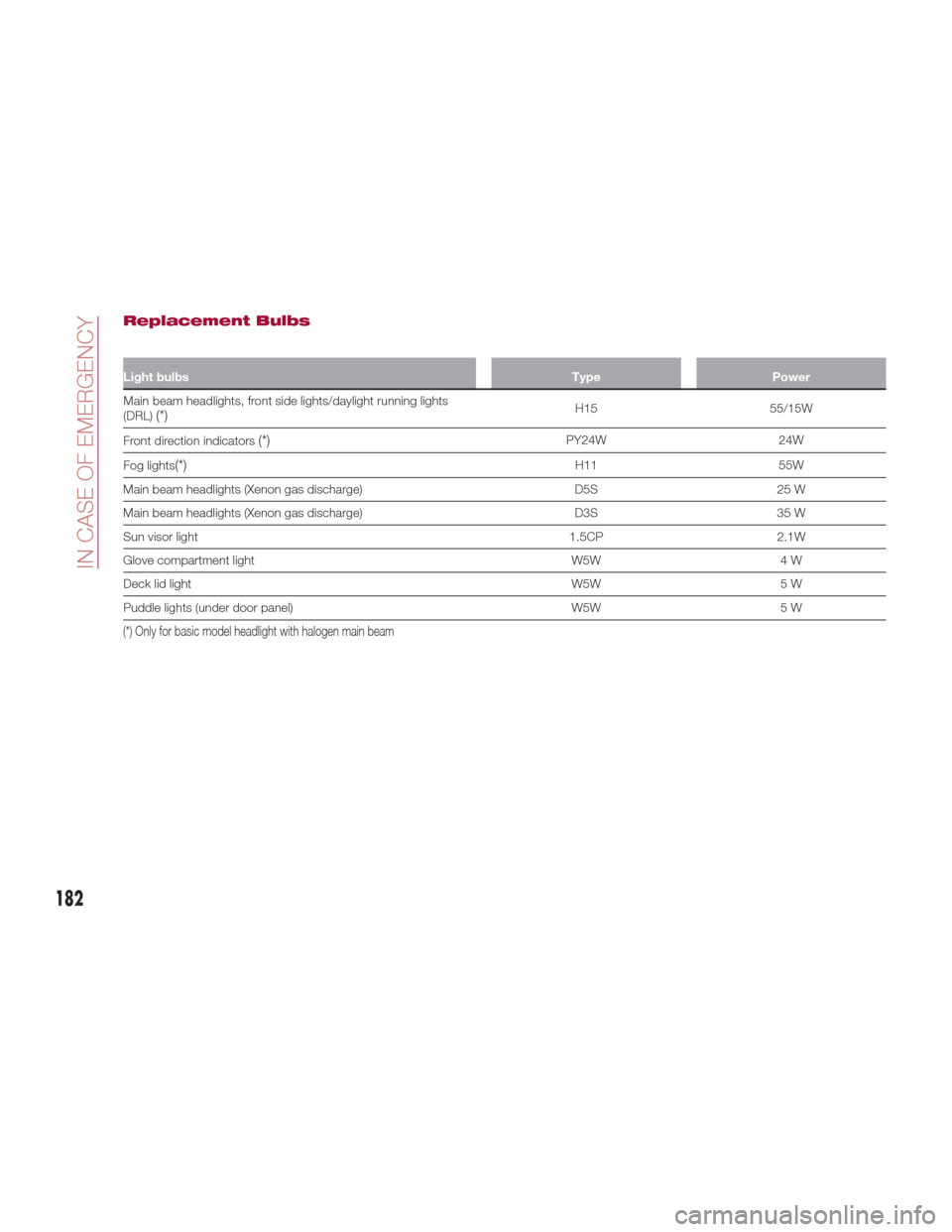
Replacement Bulbs
Light bulbsTypePower
Main beam headlights, front side lights/daylight running lights
(DRL)
(*)H15 55/15W
Front direction indicators
(*)PY24W 24W
Fog lights
(*)H11 55W
Main beam headlights (Xenon gas discharge) D5S25 W
Main beam headlights (Xenon gas discharge) D3S35 W
Sun visor light 1.5CP2.1W
Glove compartment light W5W4 W
Deck lid light W5W5 W
Puddle lights (under door panel) W5W5 W
(*) Only for basic model headlight with halogen main beam
182
IN CASE OF EMERGENCY
Page 185 of 268
Replacing Exterior
Bulbs
Note:Only replace the bulb when the
engine is off. Also ensure that the
engine is cold, to prevent the risk of
burns.
Direction Indicators
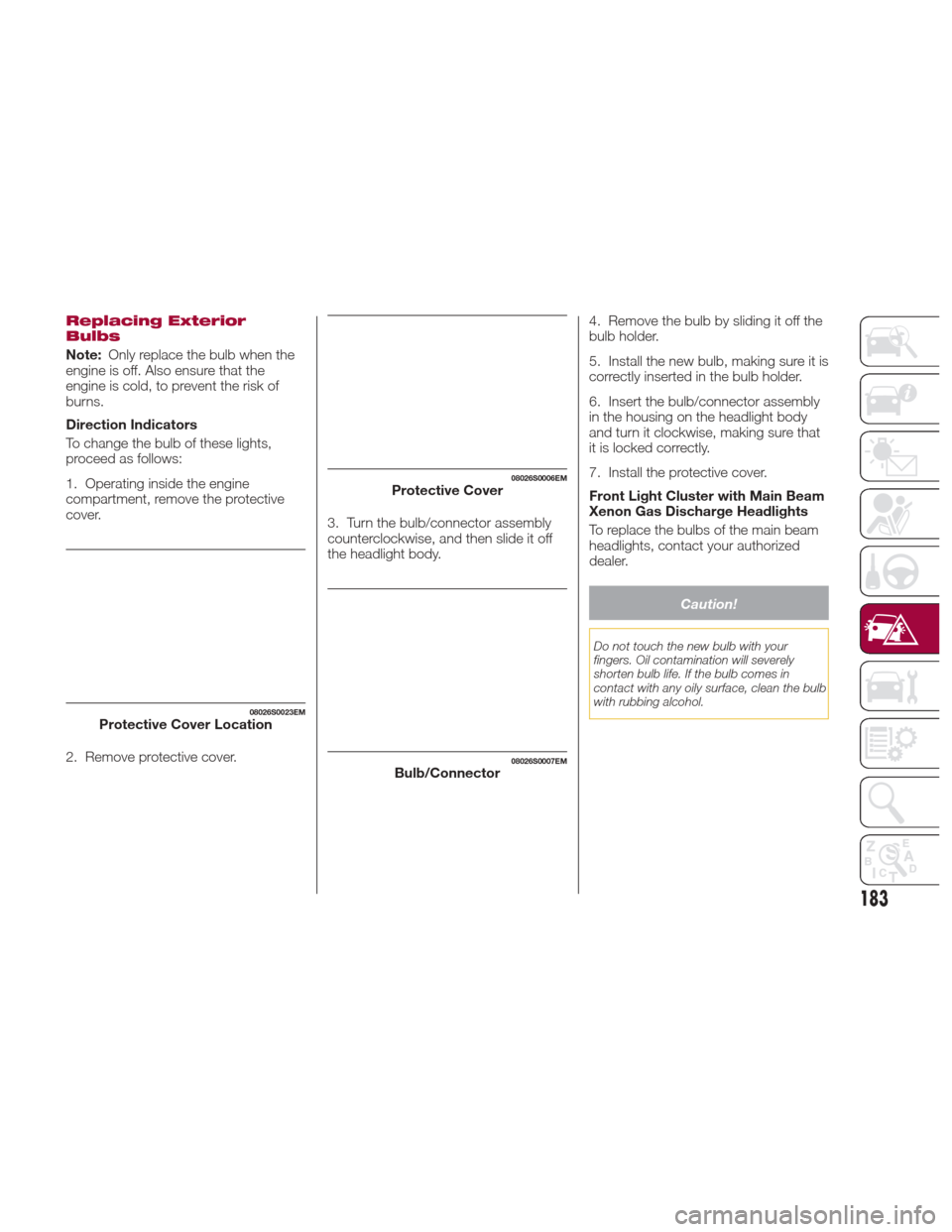
To change the bulb of these lights,
proceed as follows:
1. Operating inside the engine
compartment, remove the protective
cover.
2. Remove protective cover. 3. Turn the bulb/connector assembly
counterclockwise, and then slide it off
the headlight body.
4. Remove the bulb by sliding it off the
bulb holder.
5. Install the new bulb, making sure it is
correctly inserted in the bulb holder.
6. Insert the bulb/connector assembly
in the housing on the headlight body
and turn it clockwise, making sure that
it is locked correctly.
7. Install the protective cover.
Front Light Cluster with Main Beam
Xenon Gas Discharge Headlights
To replace the bulbs of the main beam
headlights, contact your authorized
dealer.
Caution!
Do not touch the new bulb with your
fingers. Oil contamination will severely
shorten bulb life. If the bulb comes in
contact with any oily surface, clean the bulb
with rubbing alcohol.
08026S0023EMProtective Cover Location
08026S0006EMProtective Cover
08026S0007EMBulb/Connector
183
Page 186 of 268
Replacing Interior Bulbs
Courtesy Mirror Light
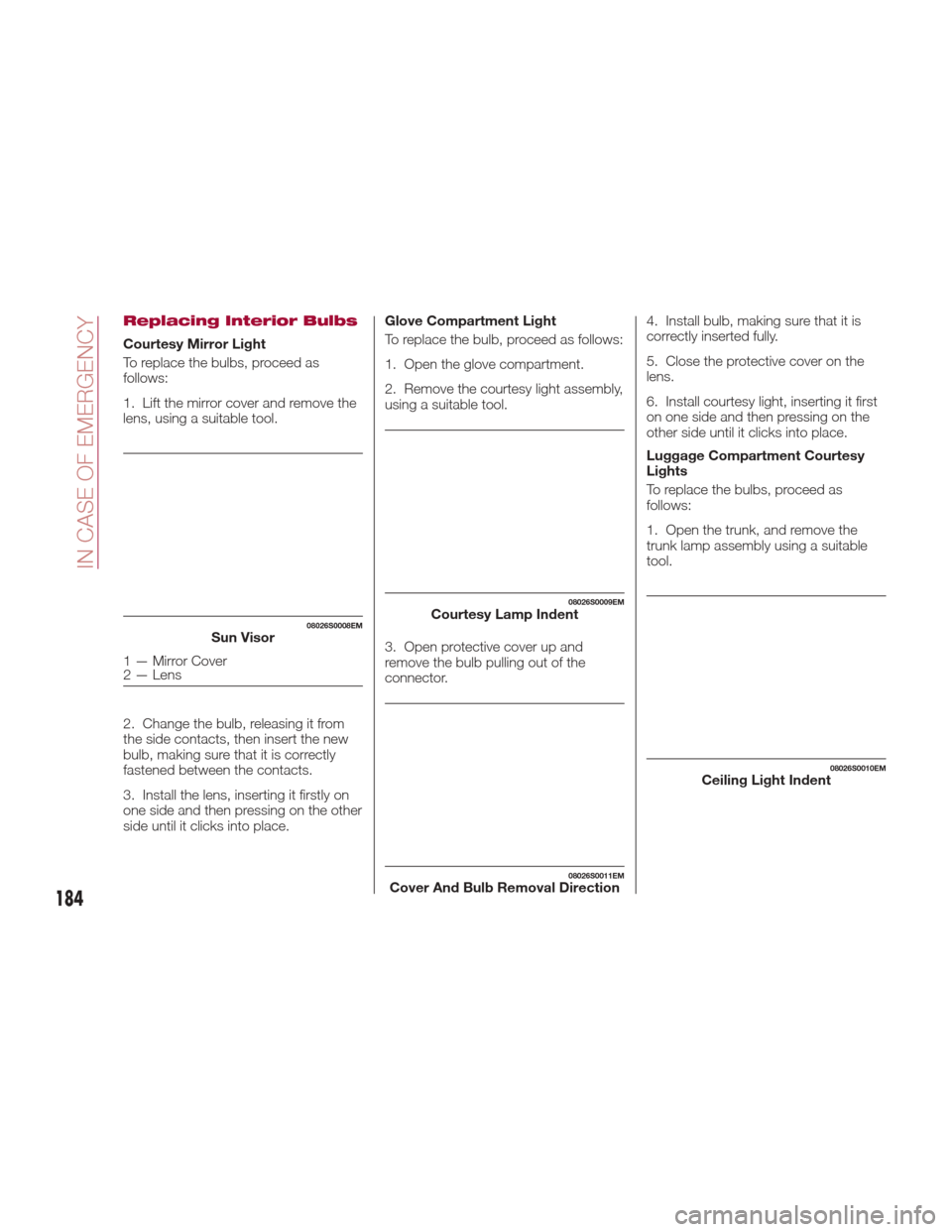
To replace the bulbs, proceed as
follows:
1. Lift the mirror cover and remove the
lens, using a suitable tool.
2. Change the bulb, releasing it from
the side contacts, then insert the new
bulb, making sure that it is correctly
fastened between the contacts.
3. Install the lens, inserting it firstly on
one side and then pressing on the other
side until it clicks into place.Glove Compartment Light
To replace the bulb, proceed as follows:
1. Open the glove compartment.
2. Remove the courtesy light assembly,
using a suitable tool.
3. Open protective cover up and
remove the bulb pulling out of the
connector.
4. Install bulb, making sure that it is
correctly inserted fully.
5. Close the protective cover on the
lens.
6. Install courtesy light, inserting it first
on one side and then pressing on the
other side until it clicks into place.
Luggage Compartment Courtesy
Lights
To replace the bulbs, proceed as
follows:
1. Open the trunk, and remove the
trunk lamp assembly using a suitable
tool.
08026S0008EMSun Visor
1 — Mirror Cover
2 — Lens
08026S0009EMCourtesy Lamp Indent
08026S0011EMCover And Bulb Removal Direction
08026S0010EMCeiling Light Indent
184
IN CASE OF EMERGENCY
Page 187 of 268
2. Open protective cover up and
remove the bulb pulling out of the
connector.
3. Install bulb, making sure that it is
correctly inserted fully.
4. Close the protective cover on the
lens.
5. Install trunk lamp in the correct
position, inserting it firstly on one side,
and then pressing on the other side
until it clicks into place.Puddle Lights On Door Panel
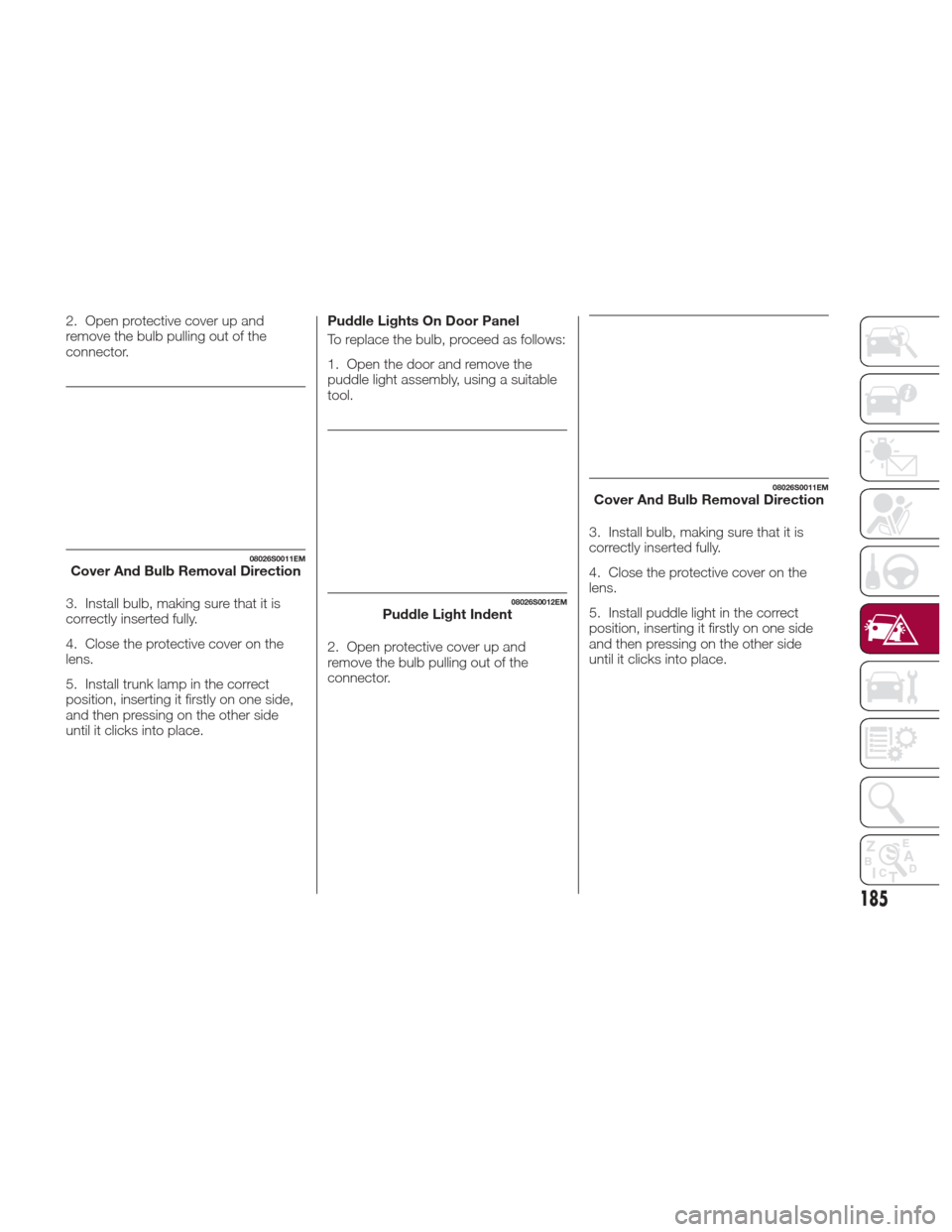
To replace the bulb, proceed as follows:
1. Open the door and remove the
puddle light assembly, using a suitable
tool.
2. Open protective cover up and
remove the bulb pulling out of the
connector.
3. Install bulb, making sure that it is
correctly inserted fully.
4. Close the protective cover on the
lens.
5. Install puddle light in the correct
position, inserting it firstly on one side
and then pressing on the other side
until it clicks into place.
08026S0011EMCover And Bulb Removal Direction
08026S0012EMPuddle Light Indent
08026S0011EMCover And Bulb Removal Direction
185
Page 197 of 268
12. Apply the adhesive label from the
sealant bottle where it can be easily
seen by the driver as a reminder that
the tire has been treated with a Tire
Repair Kit, as well as not to exceed the
speed restriction for the treated tire.
Warning!
Do not adhere the speed restriction sticker
to the padded area on the steering wheel.
Adhering the speed restriction sticker to
the padded area on the steering wheel is
dangerous because the air bag may not
operate (deploy) normally resulting in
serious injury. In addition, do not adhere
the sticker to areas where warning lights or
the speedometer cannot be viewed.
Checking And Restoring
Tire Pressure
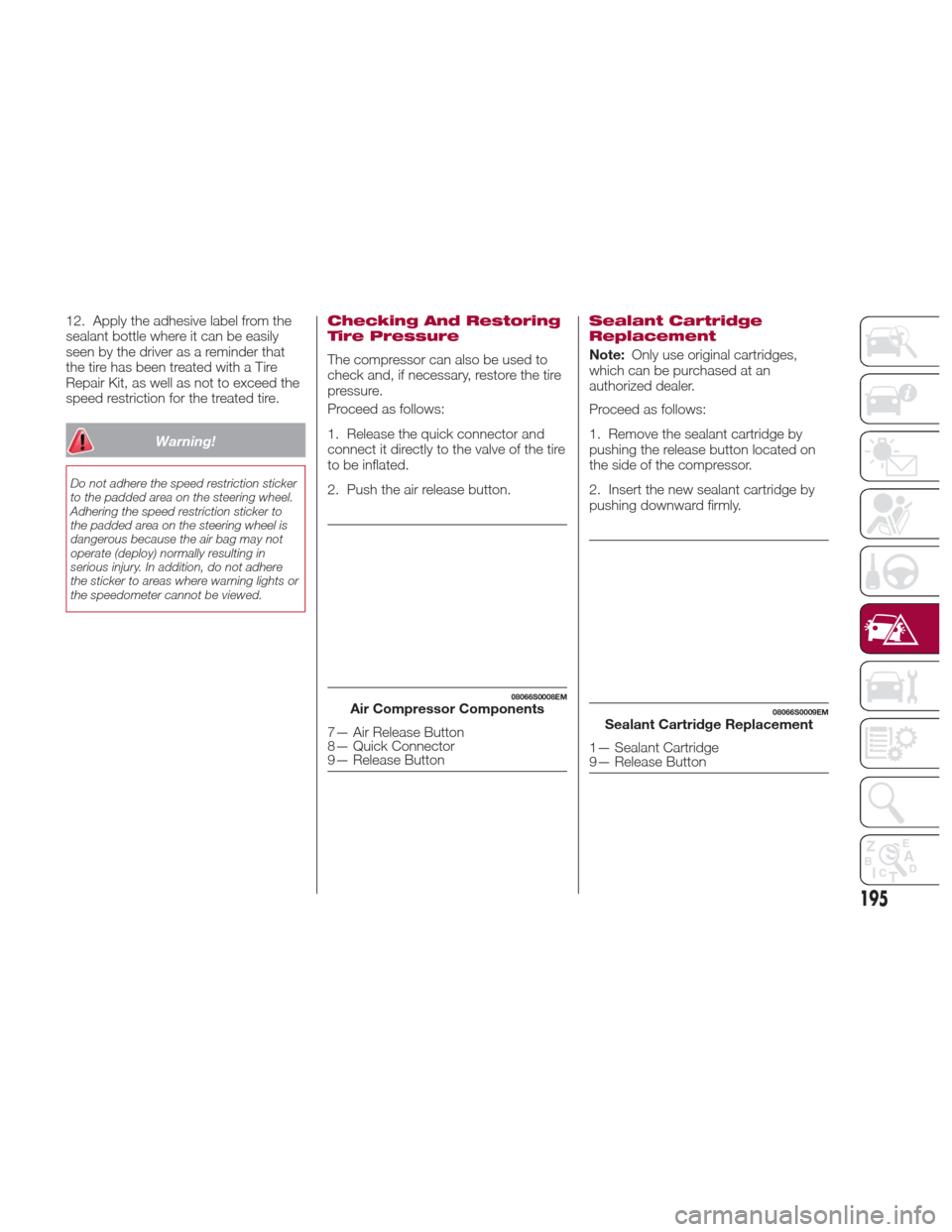
The compressor can also be used to
check and, if necessary, restore the tire
pressure.
Proceed as follows:
1. Release the quick connector and
connect it directly to the valve of the tire
to be inflated.
2. Push the air release button.
Sealant Cartridge
Replacement
Note:Only use original cartridges,
which can be purchased at an
authorized dealer.
Proceed as follows:
1. Remove the sealant cartridge by
pushing the release button located on
the side of the compressor.
2. Insert the new sealant cartridge by
pushing downward firmly.
08066S0008EMAir Compressor Components
7— Air Release Button
8— Quick Connector
9— Release Button
08066S0009EMSealant Cartridge Replacement
1— Sealant Cartridge
9— Release Button
195
Page 201 of 268
ENGINE
OVERHEATING
Engine overheating may occur in
situations of extreme environmental
temperatures, frequent engine
stops/starts, or driving in heavy traffic. If
the engine becomes overheated, the
Engine Temperature Warning Light in
the instrument cluster will illuminate
along with a dedicated message. Refer
to "Warning Lights And Messages" in
the "Getting To Know Your Instrument
Panel" for more information.
In any of the following situations, you
can reduce the potential for overheating
by taking the appropriate action.
On the highways — slow down.
In city traffic — while stopped, place
the transmission in NEUTRAL, but do
not increase engine idle speed.
Note:
There are steps that you can take to
slow down an impending overheat
condition:
If your air conditioner (A/C) is on,
turn it off. The A/C system adds heat
to the engine cooling system and
turning the A/C off can help remove
this heat.
You can also turn the temperature
control to maximum heat, the mode
control to floor and the blower control
to high. This allows the heater core to
act as a supplement to the radiator
and aids in removing heat from the
engine cooling system.
Warning!
You or others can be badly burned by hot
engine coolant (antifreeze) or steam from
your radiator. If you see or hear steam
coming from under the hood, do not open
the hood until the radiator has had time to
cool. Never try to open a cooling system
pressure cap when the radiator or coolant
bottle is hot.
Caution!
Driving with a hot cooling system could
damage your vehicle. If temperature gauge
reads “H”, pull over and stop the vehicle.
Idle the vehicle with the air conditioner
turned off until the pointer drops back into
the normal range. If the pointer remains on
the “H”, turn the engine off immediately,
and call for service.
If Steam Is Coming From The
Engine Compartment
Do not go near the front of the vehicle.
Stop the engine. Wait until the steam
dissipates. Then, open the hood and
start the engine.
If Neither Coolant Nor Steam Is
Escaping
Open the hood and idle the engine until
it cools.
Note:
If the cooling fan does not operate
while the engine is running, the engine
temperature will increase. Stop the
engine and contact your authorized
dealer.
If the engine continues to overheat
or frequently overheats, have the
cooling system inspected. The engine
could be seriously damaged unless
repairs are made. Contact your
authorized dealer.
199