Page 259 of 664

259
2-3. Operating the lights and wipers
2
When driving
VERSO_EE_OM64590E
● Vehicles with smart entry & start system:
If the wiper switch is turned to the position while the “ENGINE
START STOP” switch is in IGNITION ON mode, the wiper will operate
once to show that AUTO mode is activated.
If the wiper sensitivity is adjusted to higher, the wiper may operate once to
indicate the change of sensitivity.
● If the temperature of the raindrop sensor is 85°C (185°F) or higher, or
-40°C (-40°F) or lower, automatic operation may not occur. In this case,
operate the wipers in any mode other than AUTO.
■ If no windshield washer fluid sprays
Check that the washer nozzles are not blocked and if there is washer fluid in
the windshield washer fluid reservoir.
WARNING
■ Caution regarding the use of windshield wipers in AUTO mode
The windshield wipers may operate unexpectedly if the sensor is touched or
the windshield is subject to vibration in AUTO mode. Take care that your fin-
gers or anything else do not become caught in the windshield wipers.
■ Caution regarding the use of washer fluid
When it is cold, do not use the washer fluid until the windshield becomes
warm. The fluid may freeze on the winds hield and cause low visibility. This
may lead to an accident, resulting in death or serious injury.
NOTICE
■ When the windshield is dry
Do not use the wipers, as they may damage the windshield.
■ When the washer fluid tank is empty
Do not use the washer when the washer fluid tank is empty. This may cause
the washer fluid pump to overheat.
■ When there is no windshield washer fluid spray from the nozzle
Damage to the washer fluid pump may be caused if the lever is pulled
toward you and held continually.
Page 260 of 664
260
2-3. Operating the lights and wipers
VERSO_EE_OM64590E
Rear window wiper and washer
■The rear window wiper and washer can be operated when
Vehicles without smart entry & start system
The engine switch is in the “ON” position.
Vehicles with smart entry & start system
The “ENGINE START STOP” switch is in IGNITION ON mode.
NOTICE
■ When the rear window is dry
Do not use the wipers, as they may damage the rear window.
■ When the washer fluid tank is empty
Do not use the washer when the washer fluid tank is empty. This may cause
the washer fluid pump to overheat.
Intermittent window
wiper operation
Normal window wiper
operation
Washer/wiper dual
operation
Washer/wiper dual
operation
Page 265 of 664
265
2-4. Toyota Safety Sense
2
When driving
VERSO_EE_OM64590E
NOTICE
■ Front sensor
Observe the following to ensure that the sensor operates correctly:
● Do not attach window tinting to the windshield.
● On cold days when there is a large temperature difference between the
vehicle interior and outside air temperatures, the windshield fogs up easily.
If the part of the windshield in front of the front sensor becomes fogged up
or covered with condensation or ice, the system temporarily stops working
and the PCS warning light flashes or illuminates. In that case, use the front
defroster to remove the fog, condensation, or ice. ( P. 334, 344)
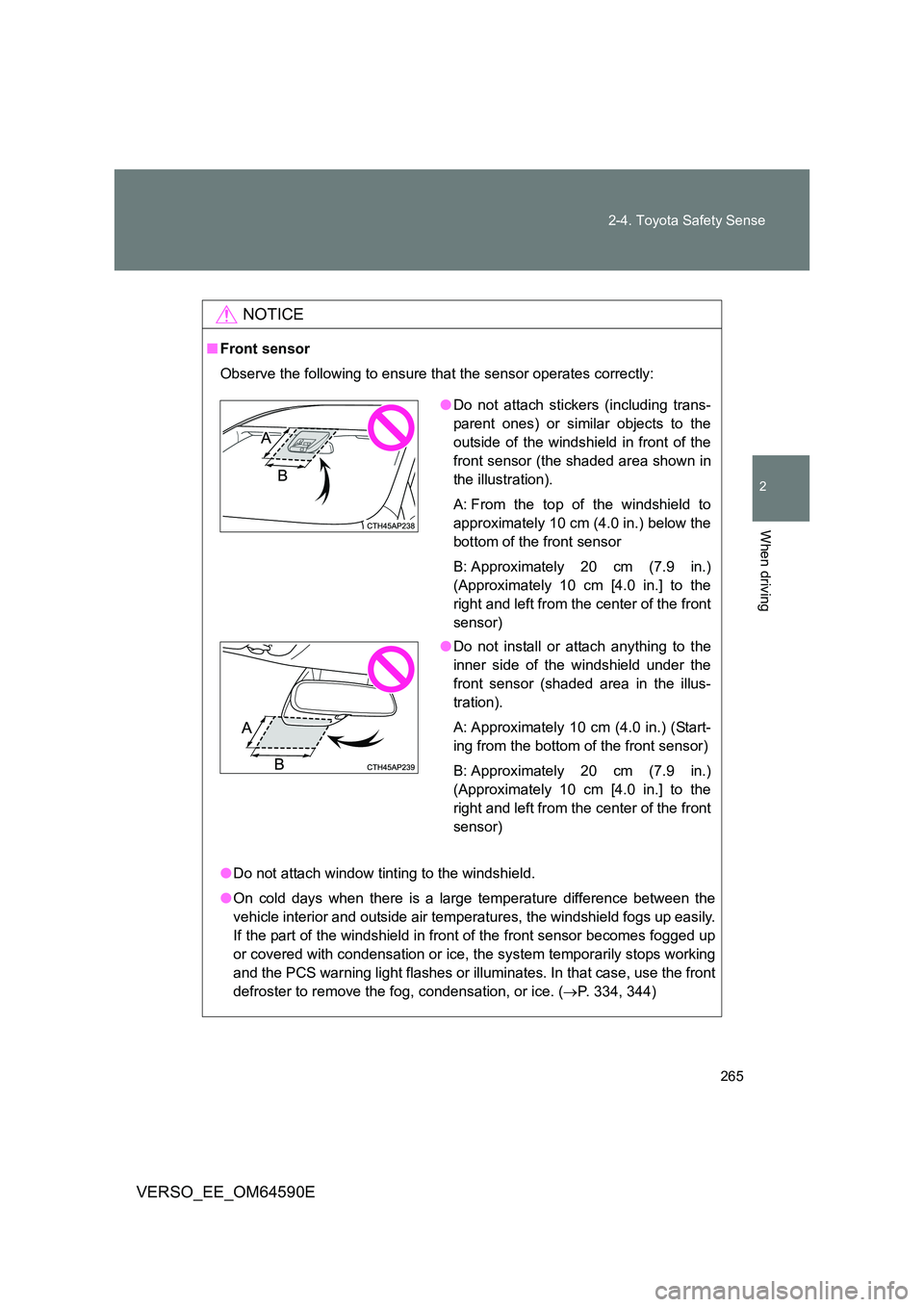
●Do not attach stickers (including trans-
parent ones) or similar objects to the
outside of the windshield in front of the
front sensor (the shaded area shown in
the illustration).
A: From the top of the windshield to
approximately 10 cm (4.0 in.) below the
bottom of the front sensor
B: Approximately 20 cm (7.9 in.)
(Approximately 10 cm [4.0 in.] to the
right and left from the center of the front
sensor)
● Do not install or attach anything to the
inner side of the windshield under the
front sensor (shaded area in the illus-
tration).
A: Approximately 10 cm (4.0 in.) (Start-
ing from the bottom of the front sensor)
B: Approximately 20 cm (7.9 in.)
(Approximately 10 cm [4.0 in.] to the
right and left from the center of the front
sensor)
Page 266 of 664
266
2-4. Toyota Safety Sense
VERSO_EE_OM64590E
NOTICE
● Keep the windshield clean at all times. Also, if there are water droplets,
etc. in front of the front sensor, use the wipers to remove them.
The pre-collision system may not func tion properly if dirt, oil, water drop-
lets, snow and other foreign matter is not completely removed.
If the inner side of the windshield where the front sensor is installed is dirty,
do not attempt to remove the front sensor. Contact any authorized Toyota
dealer or repairer, or another dul y qualified and equipped professional.
● If the windshield needs to be replaced, contact any authorized Toyota
dealer or repairer, or another dul y qualified and equipped professional.
● Replace the wiper blades immediately when necessary. If the area in front
of the front sensor is not appropriately wiped clean, the performance of the
sensor may decline.
When replacing the wiper blades is necessary, consult any authorized
Toyota dealer or repairer, or another duly qualified and equipped profes-
sional.
● Do not install an antenna in front of the sensor.
● Do not spill liquid onto the sensor.
● Do not allow bright lights to shine into the sensor.
● Do not damage or let the lenses of the front sensor get dirty.
When cleaning the inner side of the windshield, do not let glass cleaner
contact the lenses. Also, do not touch the lenses.
For proper care of the lenses of the front sensor, contact any authorized
Toyota dealer or repairer, or another duly qualified and equipped profes-
sional.
● Do not change the installation position or direction of the sensor or remove
it. The direction of the sensor is precisely adjusted.
● Do not subject the sensor to strong impact or disassemble it.
● Do not install an electronic device or device that emits strong electric
waves near the front sensor.
● Do not place reflective objects on top of the instrument panel.
Page 269 of 664
269
2-4. Toyota Safety Sense
2
When driving
VERSO_EE_OM64590E
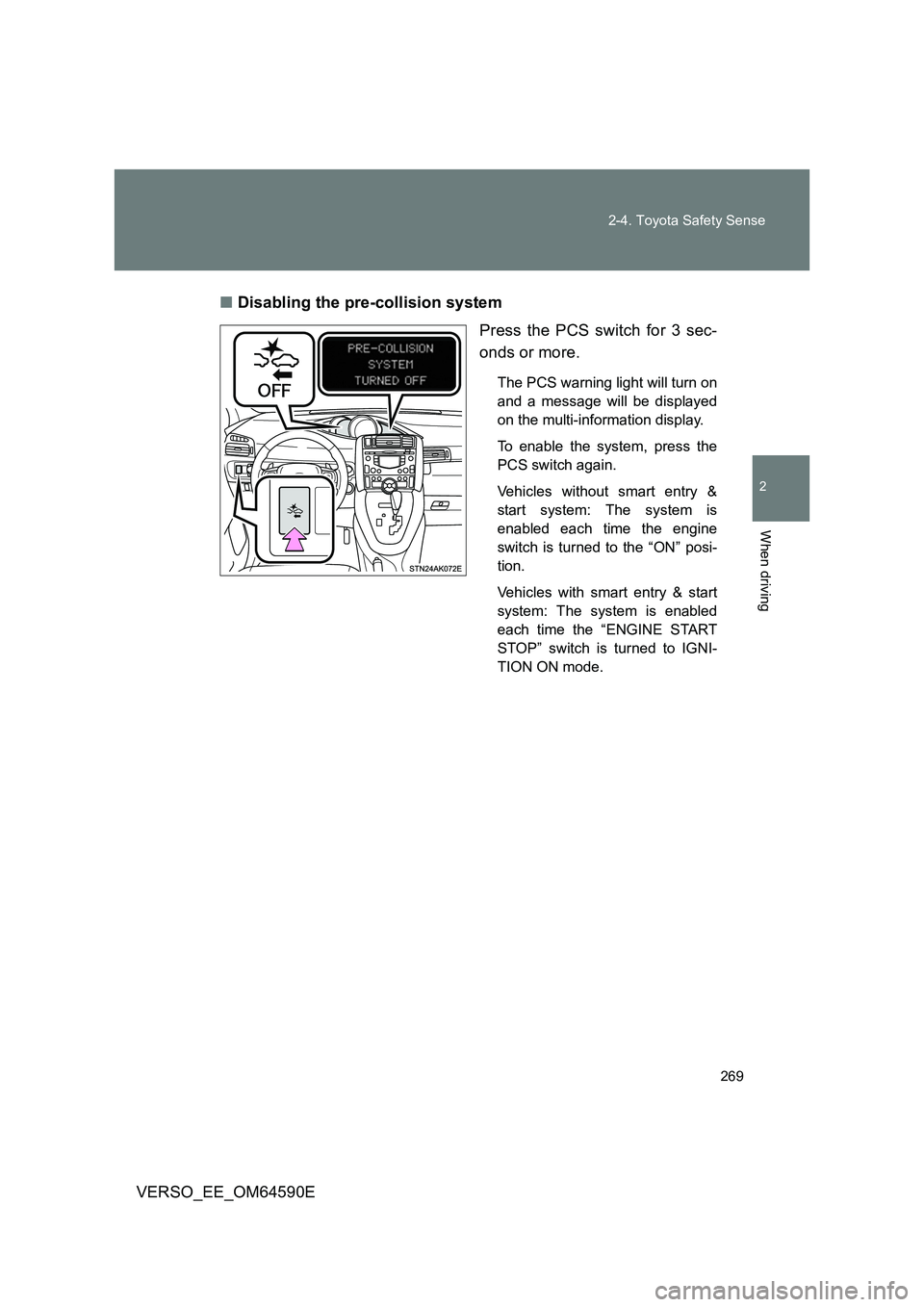
■ Disabling the pre-collision system
Press the PCS switch for 3 sec-
onds or more.
The PCS warning light will turn on
and a message will be displayed
on the multi-information display.
To enable the system, press the
PCS switch again.
Vehicles without smart entry &
start system: The system is
enabled each time the engine
switch is turned to the “ON” posi-
tion.
Vehicles with smart entry & start
system: The system is enabled
each time the “ENGINE START
STOP” switch is turned to IGNI-
TION ON mode.
Page 270 of 664
270
2-4. Toyota Safety Sense
VERSO_EE_OM64590E
■ Operational conditions
The pre-collision system is enabled and determines that the possibility of a
frontal collision with a vehicle (except motorcycles and bicycles) is high.
● Pre-collision warning:
• Vehicle speed is approximately 15 to 140 km/h (10 to 86 mph).
• The relative speed between your vehicle and the vehicle ahead is
greater than approximately 15 km/h (10 mph).
● Pre-collision brake assist:
• Vehicle speed is approximately 30 to 80 km/h (19 to 49 mph).
• The relative speed between your vehicle and the vehicle ahead is
greater than approximately 30 km/h (19 mph).
● Pre-collision braking:
• Vehicle speed is approximately 10 to 80 km/h (7 to 49 mph).
• The relative speed between your vehicle and the vehicle ahead is
greater than approximately 10 km/h (7 mph).
When the brake pedal is stepped on, the system judges if evasion actions
are being done by the driver and the start timing for pre-collision braking
may be delayed.
During the following, the driver oper ations takes precedence and the system
may not operate:
● The accelerator pedal is depressed strongly.
● The steering wheel is turned sharply or abruptly.
In case of the following, the system will not operate:
● If a battery terminal has been disconnected and reconnected and then
the vehicle has not been driven for a certain amount of time
● If VSC is disabled (only the pre-collision warning function will be opera-
tional)
● If the PCS warning light is flashing or illuminated
● When the shift position is in “R”
Page 272 of 664
272
2-4. Toyota Safety Sense
VERSO_EE_OM64590E
When there is an object (traffic sign, guard rail, etc.) by the roadside at the
entrance of a curve
When passing an oncoming vehicle on a curve
When passing an oncoming vehicle while making a left or right turn
When rapidly closing on a preceding vehicle
When rapidly closing on an electric to ll gate barrier, parking area barrier,
or other barrier that opens and closes
When approaching an overpass, traffic sign, billboard, etc.
When the front part of the vehicle is raised or lowered
When the sensor is misaligned due to a strong impact being applied to the
sensor, etc.
When there is a structural object (billboard, street light, etc.) at the top of
an uphill road
When there is a metal object (manhole cove r, steel plate, etc.) at the bot-
tom of a downhill road
When approaching a low hanging object that may contact the vehicle,
such as a banner or tree branches
When driving through dense fog or smok e, or when a preceding vehicle is
kicking up water, snow, etc.
When there is a reflective object, bump, protrusion, etc. on the road sur-
face
When the vehicle is being parked in a place where there is a low hanging
object at the height of the front sensor
When passing extremely close to an object (stopped vehicle, guardrail,
etc.)
When the windshield is dirty or covered with raindrops, condensation, ice,
snow, etc.
Page 273 of 664
273
2-4. Toyota Safety Sense
2
When driving
VERSO_EE_OM64590E
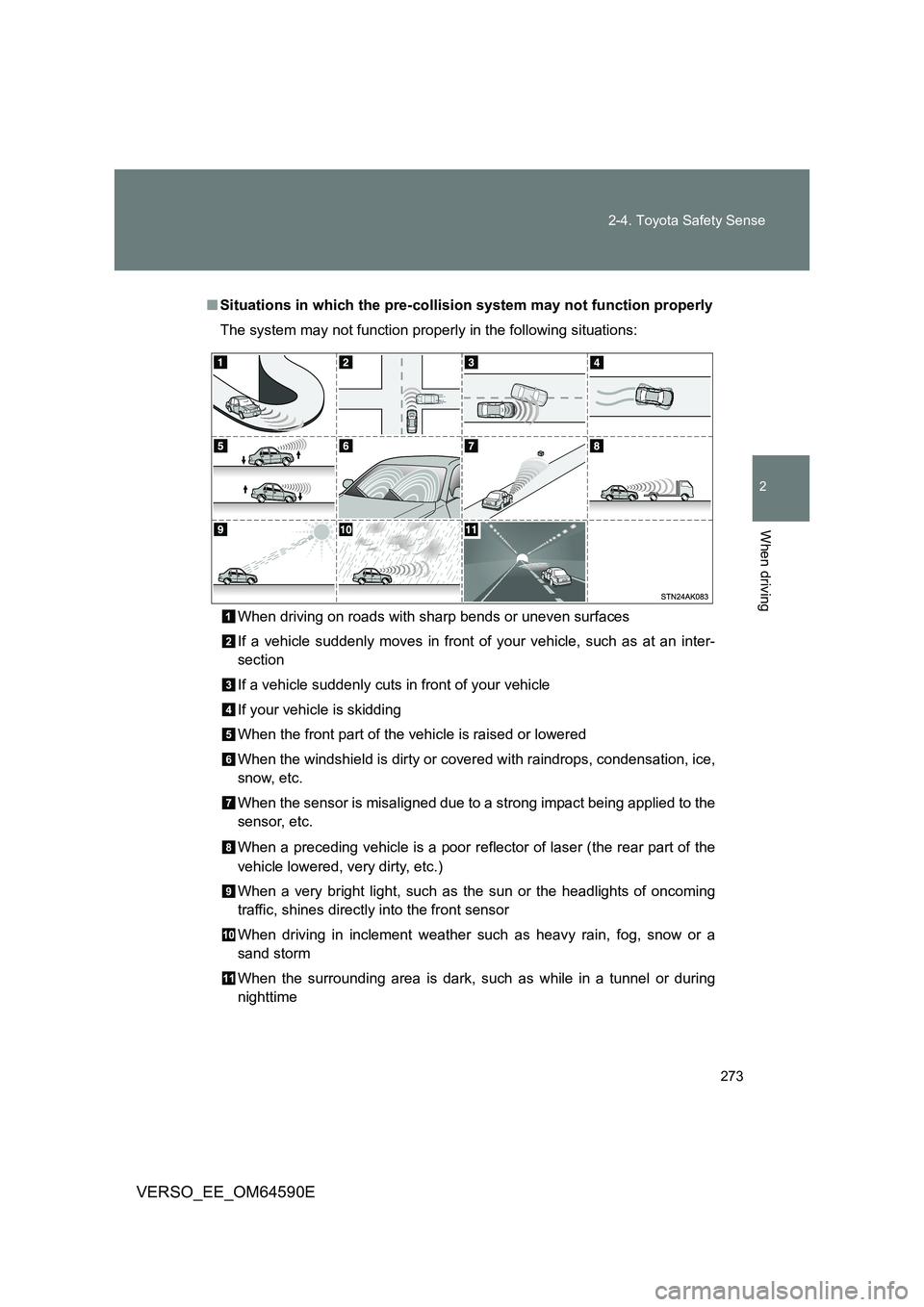
■ Situations in which the pre-collision system may not function properly
The system may not function properly in the following situations:
When driving on roads with sharp bends or uneven surfaces
If a vehicle suddenly moves in front of your vehicle, such as at an inter-
section
If a vehicle suddenly cuts in front of your vehicle
If your vehicle is skidding
When the front part of the vehicle is raised or lowered
When the windshield is dirty or covered with raindrops, condensation, ice,
snow, etc.
When the sensor is misaligned due to a strong impact being applied to the
sensor, etc.
When a preceding vehicle is a poor reflector of laser (the rear part of the
vehicle lowered, very dirty, etc.)
When a very bright light, such as the sun or the headlights of oncoming
traffic, shines directly into the front sensor
When driving in inclement weather such as heavy rain, fog, snow or a
sand storm
When the surrounding area is dark, such as while in a tunnel or during
nighttime