Page 184 of 620

184
PRIUS v_OM_OM47B12U_(U)
4-2. Driving procedures
■About engine braking
When shift position B is selected, releasing the accelerator pedal will apply
engine braking.
• When the vehicle is driven at high speeds, compared to ordinary gasoline-
fueled vehicles, the engine braking deceleration is felt less than that of
other vehicles.
• The vehicle can be accelerated even when shift position B is selected.
If the vehicle is driven continuously in the B position, fuel efficiency will
become low. Usually, select the D position.
■Automatically P position selection function
When the shift position is in a position other than P, pressing the power switch
with the vehicle stopped completely will cause the shift position to change to
P automatically, and then the power switch will turn off.
■If the shift position cannot be shifted from P
There is a possibility that the 12-volt battery is discharged. Check the 12-volt
battery in this situation. (P. 538)
■After recharging/reconnecting the 12-volt battery
P. 440
■Customization
Settings (e.g. Reverse warning buzzer) can be changed.
(Customizable features: P. 575)
Page 261 of 620

PRIUS v_OM_OM47B12U_(U)
2614-6. Driving tips
4
Driving
◆When braking
Make sure to operate the brakes gently and in a timely manner. A
greater amount of electrical energy can be regenerated when slow-
ing down.
◆Delays
Repeated acceleration and deceleration, as well as long waits at
traffic lights, will lead to bad fuel economy. Check traffic reports
before leaving and avoid delays as much as possible. When driving
in a traffic jam, gently release the brake pedal to allow the vehicle to
move forward slightly while avoiding overuse of the accelerator
pedal. Doing so can help control excessive gasoline consumption.
◆Highway driving
Control and maintain the vehicle at a constant speed. Before stop-
ping at a toll booth or similar, allow plenty of time to release the
accelerator and gently apply the brakes. A greater amount of elec-
trical energy can be regenerated when slowing down.
◆Air conditioning
Use the air conditioning only when necessary. Doing so can help
reduce excessive gasoline consumption.
In summer: When the ambient temperature is high, use the recircu-
lated air mode. Doing so will help to reduce the burden on the air
conditioning system and reduce fuel consumption as well.
In winter: Because the gasoline engine will not automatically cut out
until it and the interior of the vehicle are warm, it will consume fuel.
Fuel consumption can be improved by avoiding overuse of the
heater.
◆Checking tire inflation pressure
Make sure to check the tire inflation pressure frequently. Improper
tire inflation pressure can cause poor fuel economy.
Also, as snow tires can cause large amounts of friction, their use on
dry roads can lead to poor fuel economy. Use tires that are appro-
priate for the season.
Page 263 of 620

263
PRIUS v_OM_OM47B12U_(U)
4-6. Driving tips
4
Driving
Winter driving tips
●Use fluids that are appropriate to the prevailing outside tempera-
tures.
• Engine oil
• Engine/power control unit coolant
• Washer fluid
●Have a service technician inspect the condition of the 12-volt bat-
tery.
●Have the vehicle fitted with four snow tires or purchase a set of tire
chains for the front tires.
Ensure that all tires are the same size and brand, and that chains match
the size of the tires.
Perform the following according to the driving conditions:
●Do not try to forcibly open a window or move a wiper that is frozen.
Pour warm water over the frozen area to melt the ice. Wipe away
the water immediately to prevent it from freezing.
●To ensure proper operation of the climate control system fan,
remove any snow that has accumulated on the air inlet vents in
front of the windshield.
●Check for and remove any excess ice or snow that may have accu-
mulated on the exterior lights, vehicle’s roof, chassis, around the
tires or on the brakes.
●Remove any snow or mud from the bottom of your shoes before
getting in the vehicle.
Carry out the necessary preparations and inspections before
driving the vehicle in winter. Always drive the vehicle in a man-
ner appropriate to the prevailing weather conditions.
Preparation for winter
Before driving the vehicle
Page 405 of 620
405
PRIUS v_OM_OM47B12U_(U)
7Maintenance and care
7-1. Maintenance and care
Cleaning and protecting
the vehicle exterior .......... 406
Cleaning and protecting
the vehicle interior ........... 410
7-2. Maintenance
Maintenance
requirements ................... 413
General maintenance........ 415
Emission inspection and
maintenance (I/M)
programs......................... 418
7-3. Do-it-yourself maintenance
Do-it-yourself service
precautions ..................... 419
Hood ................................. 421
Positioning a floor jack ...... 423
Engine compartment ......... 425
12-volt battery ................... 439
Tires .................................. 443
Tire inflation pressure ....... 452
Wheels .............................. 455
Air conditioning filter.......... 457
Wiper rubber
replacement .................... 459
Electronic key battery........ 461
Checking and replacing
fuses ............................... 463
Light bulbs......................... 466
Page 415 of 620
415
PRIUS v_OM_OM47B12U_(U)
7-2. Maintenance
7
Maintenance and care
General maintenance
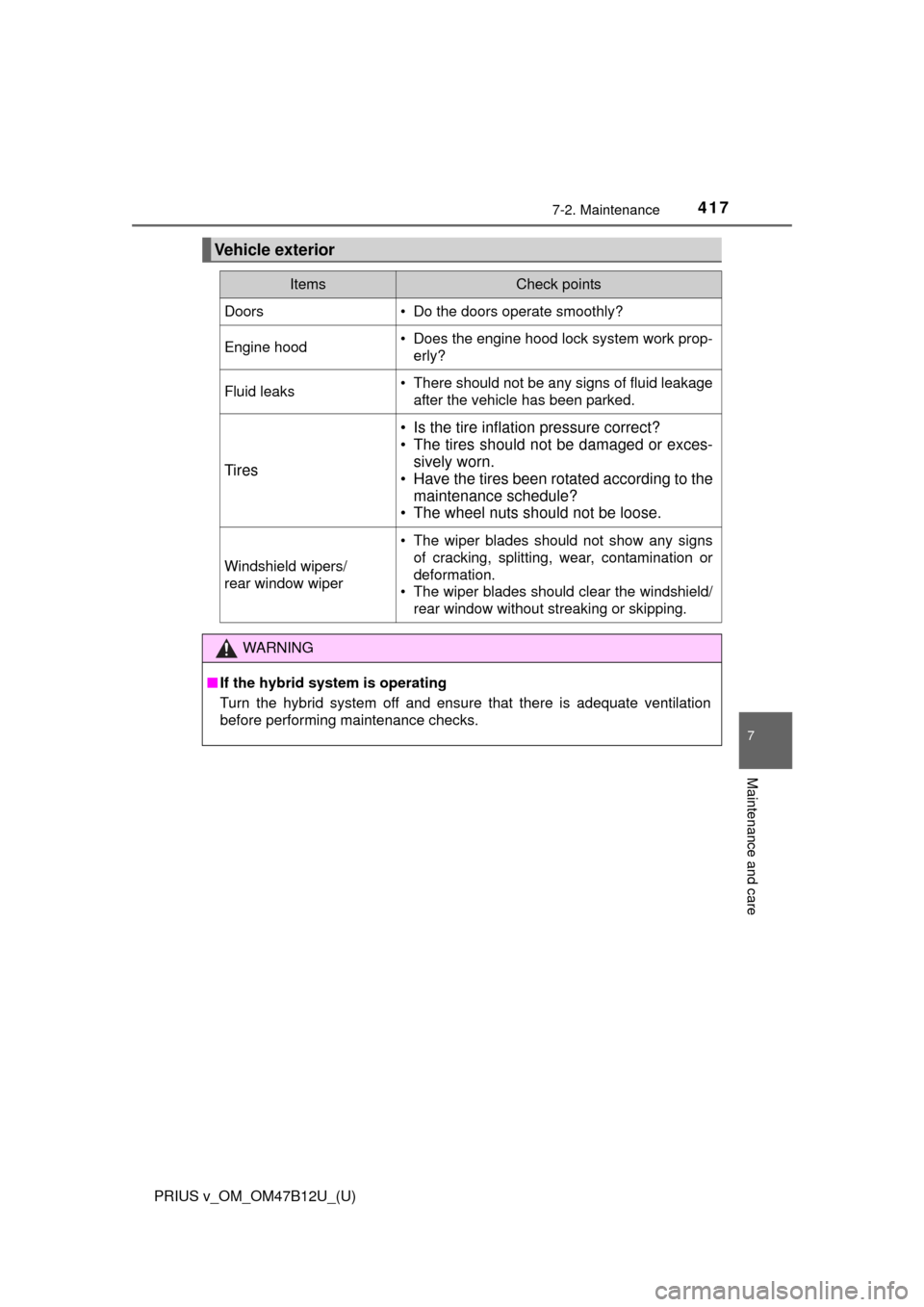
Listed below are the general maintenance items that should be
performed at the intervals specified in the “Owner’s Warranty
Information Booklet” or “Owner’s Manual Supplement/Sched-
uled Maintenance Guide”. It is recommended that any problem
you notice should be brought to the attention of your Toyota
dealer or qualified service shop for advice.
Engine compartment
ItemsCheck points
Brake fluidIs the brake fluid at the correct level? (P. 434)
Engine/power control
unit coolantIs the engine/power control unit coolant at the
correct level? (P. 431)
Engine oilIs the engine oil at the correct level? (P. 427)
Exhaust systemThere should not be any fumes or strange
sounds.
Radiator/condenserThe radiator and condenser should be free from
foreign objects. (P. 433)
Washer fluidIs there sufficient washer fluid? (P. 437)
Luggage compartment
ItemsCheck points
12-volt batteryCheck the connections. (P. 439)
Page 417 of 620
PRIUS v_OM_OM47B12U_(U)
4177-2. Maintenance
7
Maintenance and care
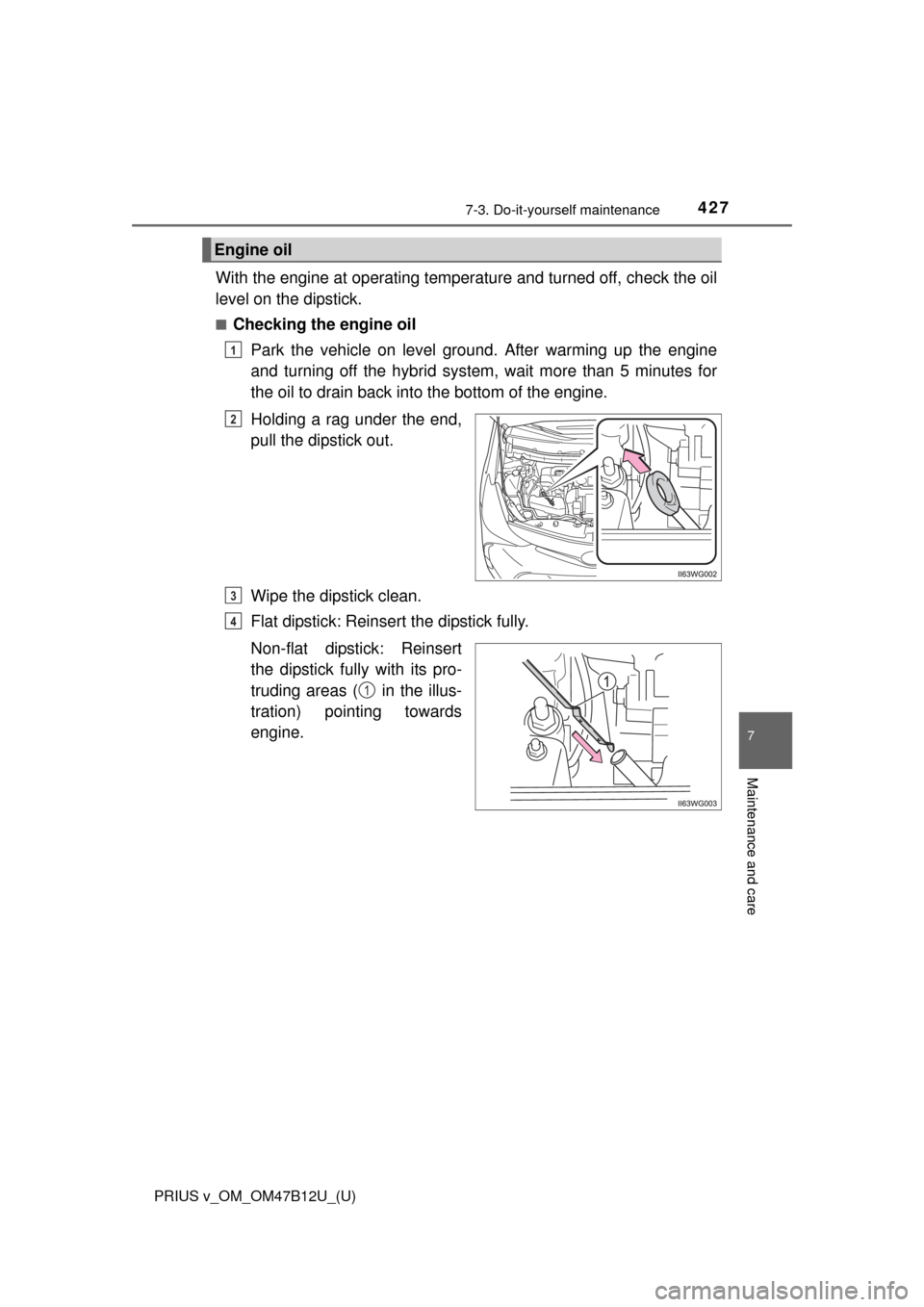
Vehicle exterior
ItemsCheck points
Doors• Do the doors operate smoothly?
Engine hood• Does the engine hood lock system work prop-
erly?
Fluid leaks• There should not be any signs of fluid leakage
after the vehicle has been parked.
Tires
• Is the tire inflation pressure correct?
• The tires should not be damaged or exces-
sively worn.
• Have the tires been rotated according to the
maintenance schedule?
• The wheel nuts should not be loose.
Windshield wipers/
rear window wiper
• The wiper blades should not show any signs
of cracking, splitting, wear, contamination or
deformation.
• The wiper blades should clear the windshield/
rear window without streaking or skipping.
WARNING
■If the hybrid system is operating
Turn the hybrid system off and ensure that there is adequate ventilation
before performing maintenance checks.
Page 427 of 620
PRIUS v_OM_OM47B12U_(U)
4277-3. Do-it-yourself maintenance
7
Maintenance and care
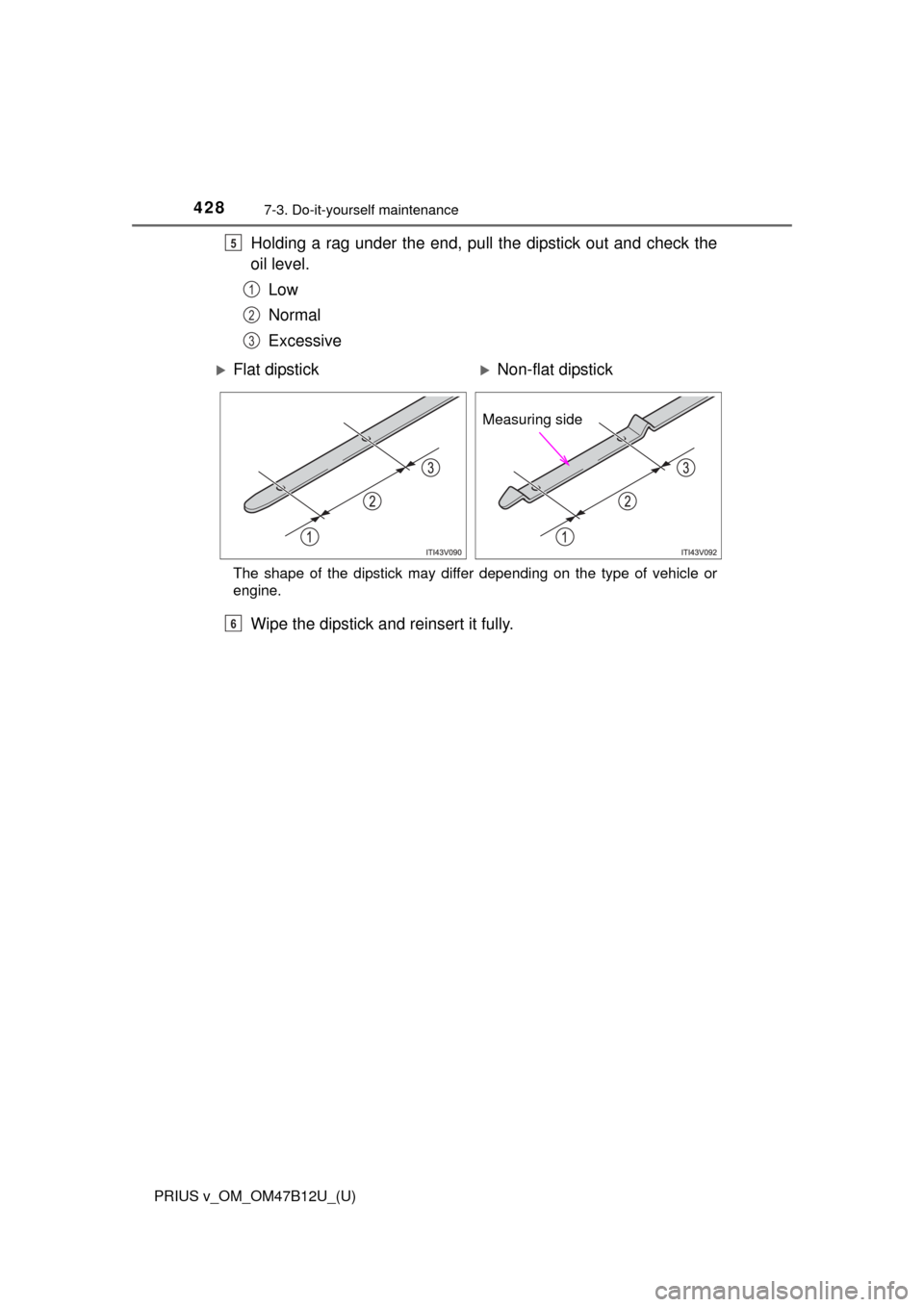
With the engine at operating temperature and turned off, check the oil
level on the dipstick.
■Checking the engine oil
Park the vehicle on level ground. After warming up the engine
and turning off the hybrid system, wait more than 5 minutes for
the oil to drain back into the bottom of the engine.
Holding a rag under the end,
pull the dipstick out.
Wipe the dipstick clean.
Flat dipstick: Reinsert the dipstick fully.
Non-flat dipstick: Reinsert
the dipstick fully with its pro-
truding areas ( in the illus-
tration) pointing towards
engine.
Engine oil
1
2
3
4
1
Page 428 of 620
428
PRIUS v_OM_OM47B12U_(U)
7-3. Do-it-yourself maintenance
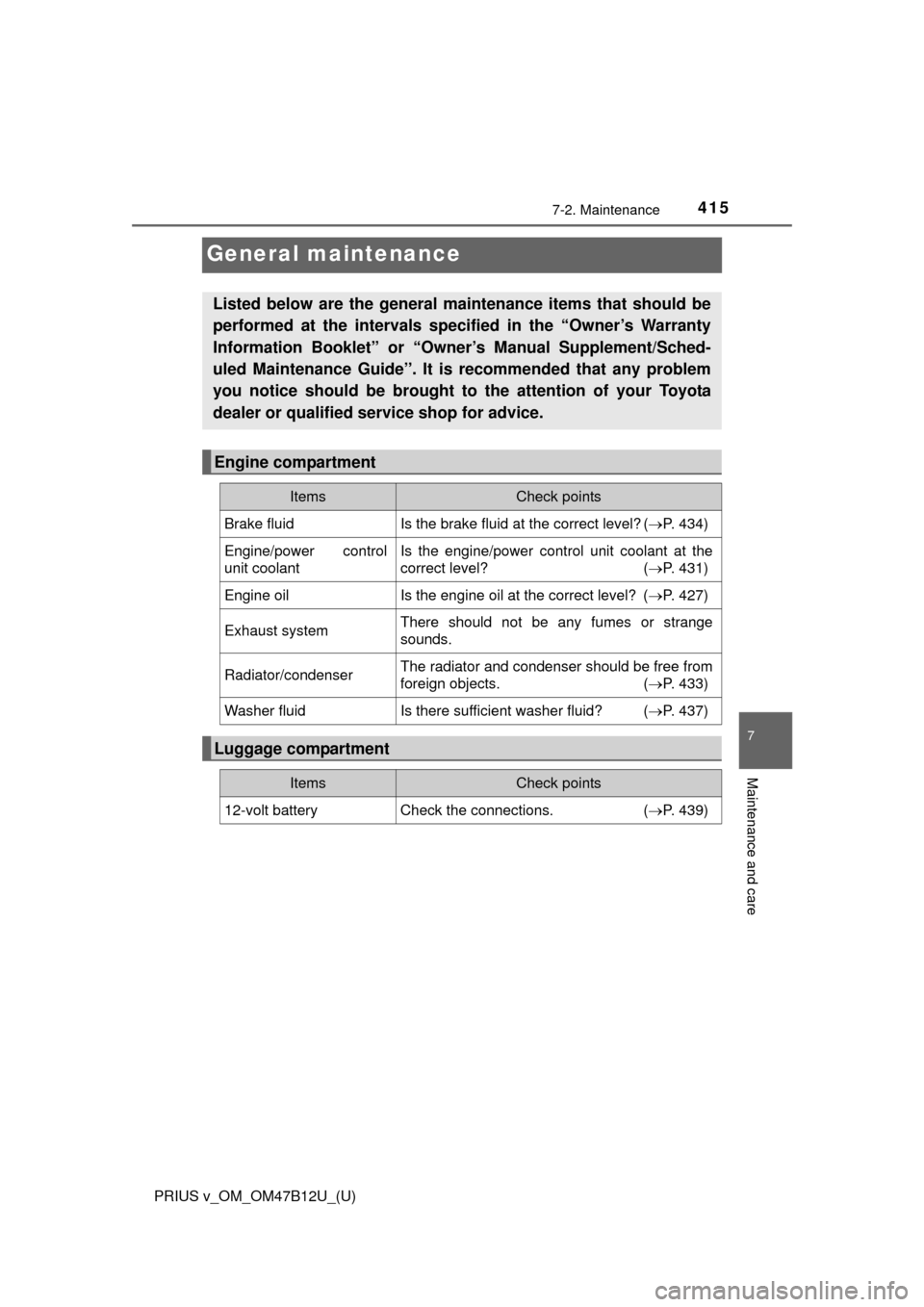
Holding a rag under the end, pull the dipstick out and check the
oil level.
Low
Normal
Excessive
The shape of the dipstick may differ depending on the type of vehicle or
engine.
Wipe the dipstick and reinsert it fully.
5
1
2
3
Flat dipstickNon-flat dipstick
Measuring side
6