Page 346 of 608
346
LC200_OM_OM60M88U_(U)
4-5. Using the driving support systems
WARNING
■Handling the radar sensor
One Blind Spot Monitor sensor is installed inside the left and right side of
the vehicle rear bumper respectively. Observe the following to ensure the
Blind Spot Monitor can function correctly.
●Do not subject a sensor or its surrounding area on the rear bumper to a
strong impact.
If a sensor is moved even slightly off position, the system may malfunction
and vehicles may not be detected correctly.
In the following situations, have your vehicle inspected by your Toyota
dealer.
• A sensor or its surrounding area is subject to a strong impact.
• If the surrounding area of a sensor is scratched or dented, or part of it
has become disconnected.
● Do not disassemble the sensor.
● Do not attach accessories or stickers to the sensor or surrounding area on
the bumper.
● Do not modify the sensor or surrounding area on the bumper.
● Do not paint the sensor or surrounding area on the bumper.
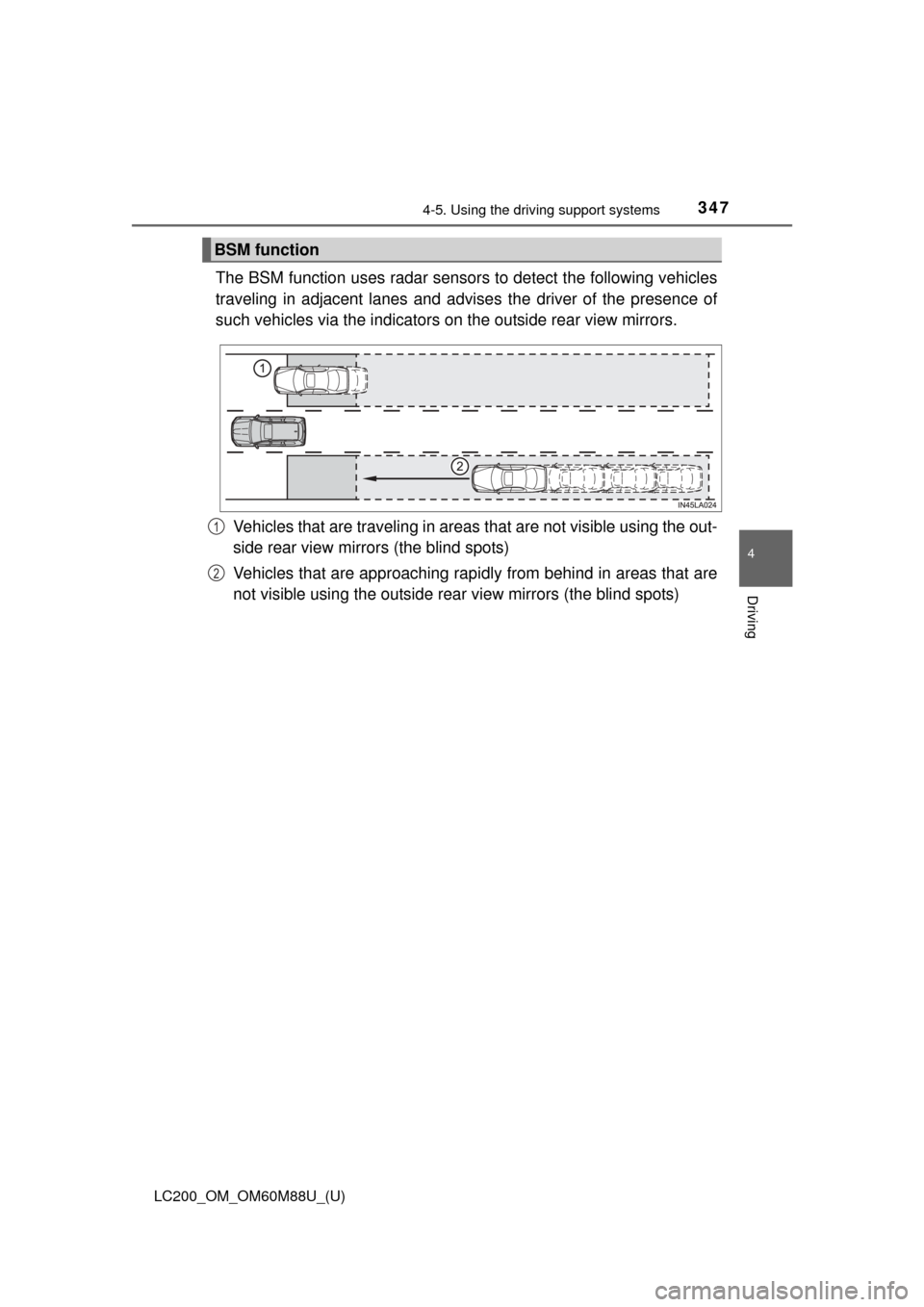
●Keep the sensor and its surrounding area
on the bumper clean at all times.
If a sensor or its surrounding area on the
rear bumper is dirty or covered with snow,
the Blind Spot Monitor may not operate
and a warning message ( P. 345) will be
displayed. In this situation, clear off the
dirt or snow and drive the vehicle with the
operation conditions of the BSM function
( P. 349) satisfied for approximately 10
minutes. If the warning message does not
disappear, have the vehicle inspected by
your Toyota dealer.
Page 347 of 608
LC200_OM_OM60M88U_(U)
3474-5. Using the driving support systems
4
Driving
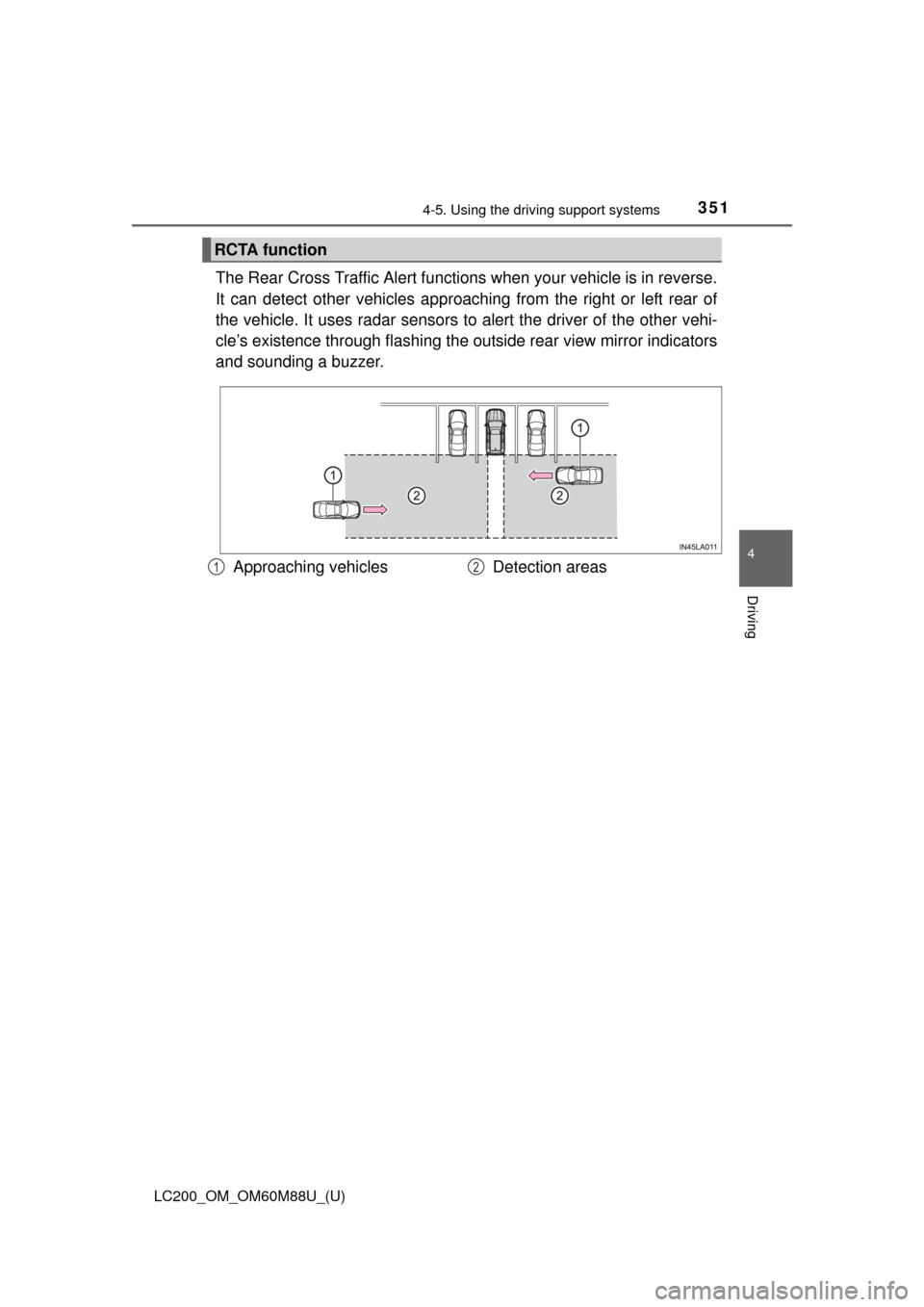
The BSM function uses radar sensor s to detect the following vehicles
traveling in adjacent lanes and advise s the driver of the presence of
such vehicles via the indicators on the outside rear view mirrors.
Vehicles that are traveling in areas that are not visible using the out-
side rear view mirrors (the blind spots)
Vehicles that are approaching rapi dly from behind in areas that are
not visible using the outside rear view mirrors (the blind spots)
BSM function
1
2
Page 350 of 608

350
LC200_OM_OM60M88U_(U)
4-5. Using the driving support systems
■Conditions under which the BSM function may not function correctly
●The BSM function may not detect vehicles correctly in the following situa-
tions:
• When the sensor is misaligned due to a strong impact to the sensor or its
surrounding area
• When mud, snow, ice, a sticker, etc. is covering the sensor or surround-
ing area on the rear bumper
• When driving on a road surface that is wet with standing water during bad weather, such as heavy rain, snow, or fog
• When multiple vehicles are approaching with only a small gap between each vehicle
• When the distance between your vehicle and a following vehicle is short
• When there is a significant difference in speed between your vehicle and the vehicle that enters the detection area
• When the difference in speed between your vehicle and another vehicle
is changing
• When a vehicle enters a detection area traveling at about the same speed as your vehicle
• As your vehicle starts from a stop, a vehicle remains in the detection area
• When driving up and down consecutive steep inclines, such as hills, dips in the road, etc.
• When driving on roads with sharp bends, consecutive curves, or uneven surfaces
• When vehicle lanes are wide, or when driving on the edge of a lane, and
the vehicle in an adjacent lane is far away from your vehicle
• When a bicycle carrier or other accessor y is installed to the rear of the
vehicle
• When there is a significant difference in height between your vehicle and the vehicle that enters the detection area
• Immediately after the BSM main switch is turned on
● Instances of the BSM function unnecessarily detecting a vehicle and/or
object may increase in the following situations:
• When the sensor is misaligned due to a strong impact to the sensor or its
surrounding area
• When the distance between your vehicle and a guardrail, wall, etc. that enters the detection area is short
• When driving up and down consecutive steep inclines, such as hills, dips in the road, etc.
• When vehicle lanes are narrow, or when driving on the edge of a lane,
and a vehicle traveling in a lane other than the adjacent lanes enters the
detection area
• When driving on roads with sharp bends, consecutive curves, or uneven
surfaces
• When the tires are slipping or spinning
• When the distance between your vehicle and a following vehicle is short
• When a bicycle carrier or other accessor y is installed to the rear of the
vehicle
Page 351 of 608
LC200_OM_OM60M88U_(U)
3514-5. Using the driving support systems
4
Driving
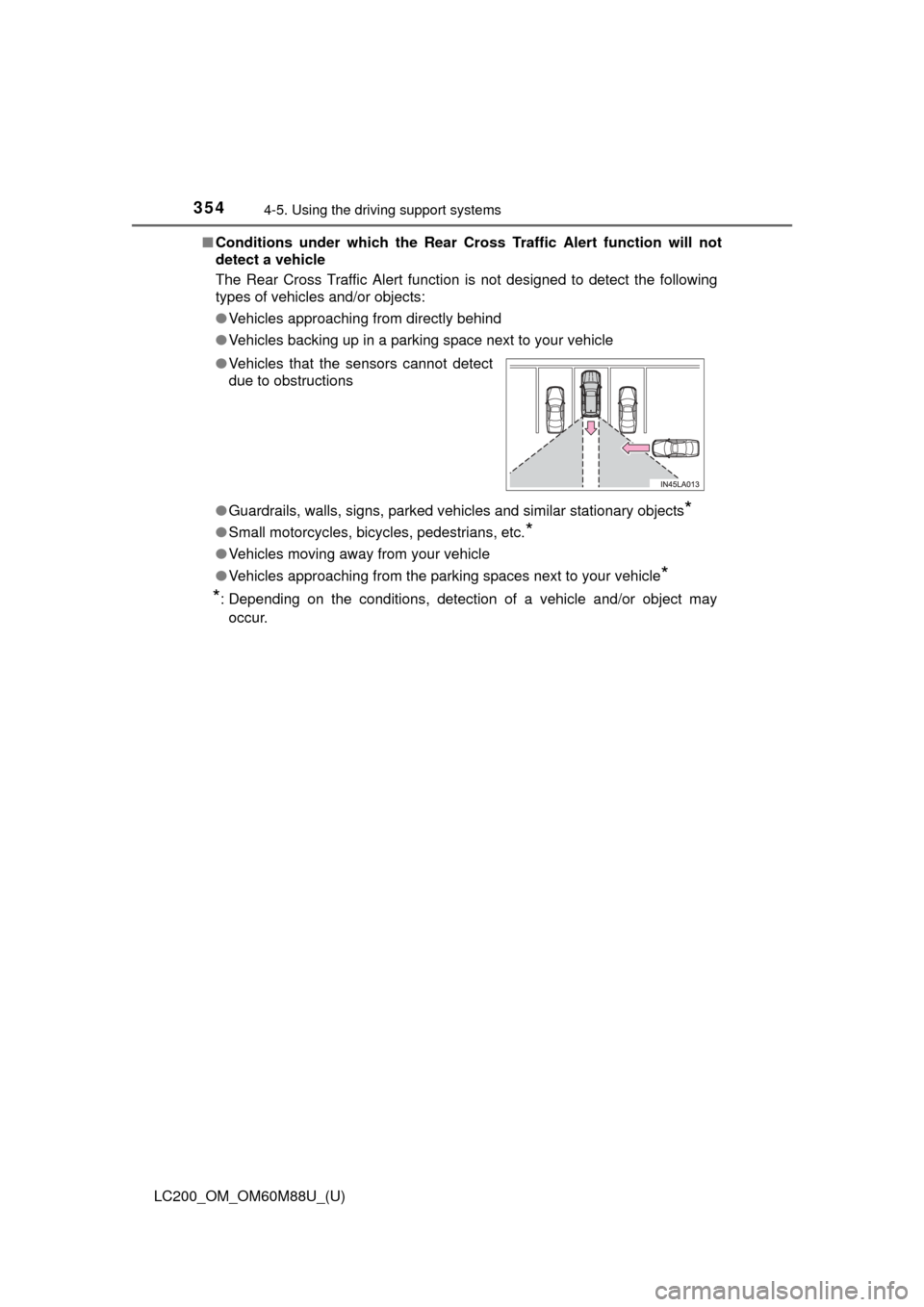
The Rear Cross Traffic Alert functions when your vehicle is in reverse.
It can detect other vehicles approaching from the right or left rear of
the vehicle. It uses radar sensors to alert the driver of the other vehi-
cle’s existence through fl ashing the outside rear view mirror indicators
and sounding a buzzer.
RCTA function
Approaching vehicles Detection areas12
Page 354 of 608
354
LC200_OM_OM60M88U_(U)
4-5. Using the driving support systems
■Conditions under which the Rear Cr oss Traffic Alert function will not
detect a vehicle
The Rear Cross Traffic Alert function is not designed to detect the following
types of vehicles and/or objects:
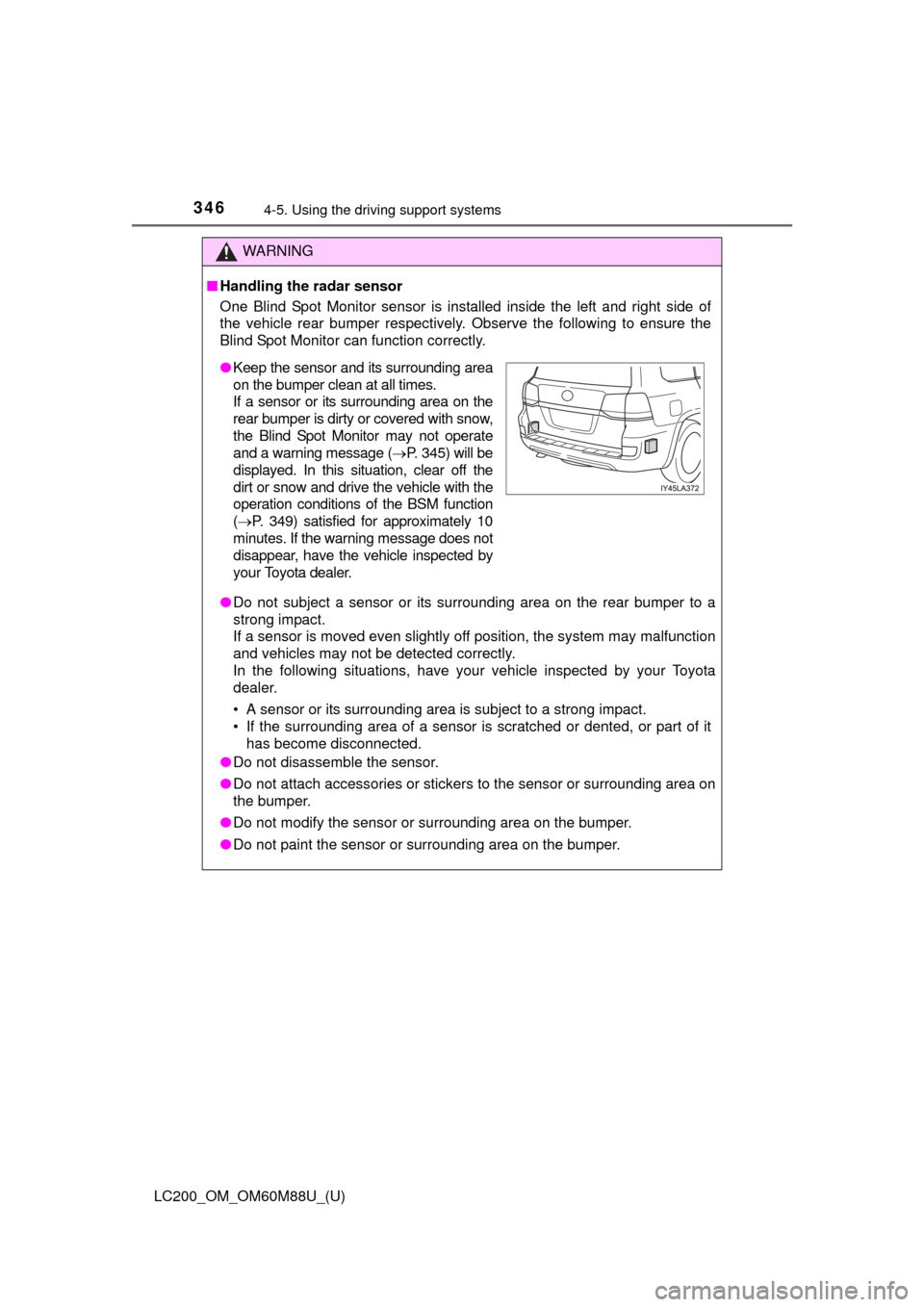
● Vehicles approaching from directly behind
● Vehicles backing up in a parking space next to your vehicle
● Guardrails, walls, signs, parked vehicles and similar stationary objects
*
●Small motorcycles, bicycles, pedestrians, etc.*
●Vehicles moving away from your vehicle
● Vehicles approaching from the parking spaces next to your vehicle
*
*
: Depending on the conditions, detection of a vehicle and/or object may
occur.
●
Vehicles that the sensors cannot detect
due to obstructions
Page 355 of 608
LC200_OM_OM60M88U_(U)
3554-5. Using the driving support systems
4
Driving
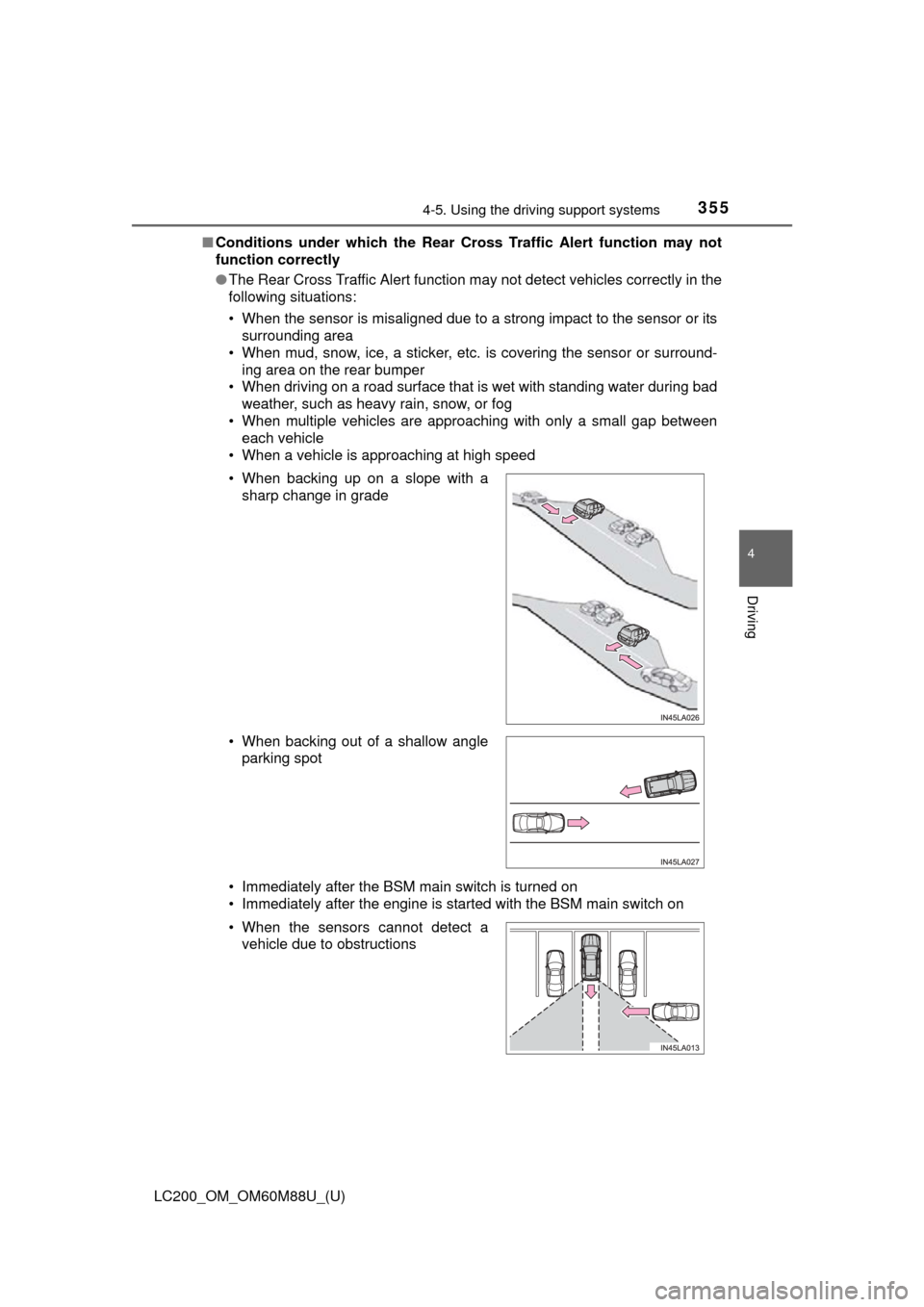
■Conditions under which the Rear Cross Traffic Alert function may not
function correctly
● The Rear Cross Traffic Alert function ma y not detect vehicles correctly in the
following situations:
• When the sensor is misaligned due to a strong impact to the sensor or its surrounding area
• When mud, snow, ice, a sticker, etc. is covering the sensor or surround- ing area on the rear bumper
• When driving on a road surface that is wet with standing water during bad
weather, such as heavy rain, snow, or fog
• When multiple vehicles are approaching with only a small gap between each vehicle
• When a vehicle is approaching at high speed
• Immediately after the BSM main switch is turned on
• Immediately after the engine is started with the BSM main switch on • When backing up on a slope with a sharp change in grade
• When backing out of a shallow angle parking spot
• When the sensors cannot detect a vehicle due to obstructions
Page 435 of 608
LC200_OM_OM60M88U_(U)
4356-1. Maintenance and care
6
Maintenance and care
■Notes for a smart key system (if equipped)
●If the door handle becomes wet while the electronic key is within the effec-
tive range, the door may lock and unlock repeatedly. Place the key in a posi-
tion 2 m (6 ft.) or more separate from the vehicle while the vehicle is being
washed. (Take care to ensure that the key is not stolen.)
● If the electronic key is inside the vehicle and a door handle becomes wet
during a car wash, a message may be shown on the multi-information dis-
play and a buzzer will sound outside the vehicle. To turn off the alarm, lock
all the doors.
WARNING
■ When washing the vehicle
Do not apply water to the inside of the engine compartment. Doing so may
cause the electrical components etc. to catch fire.
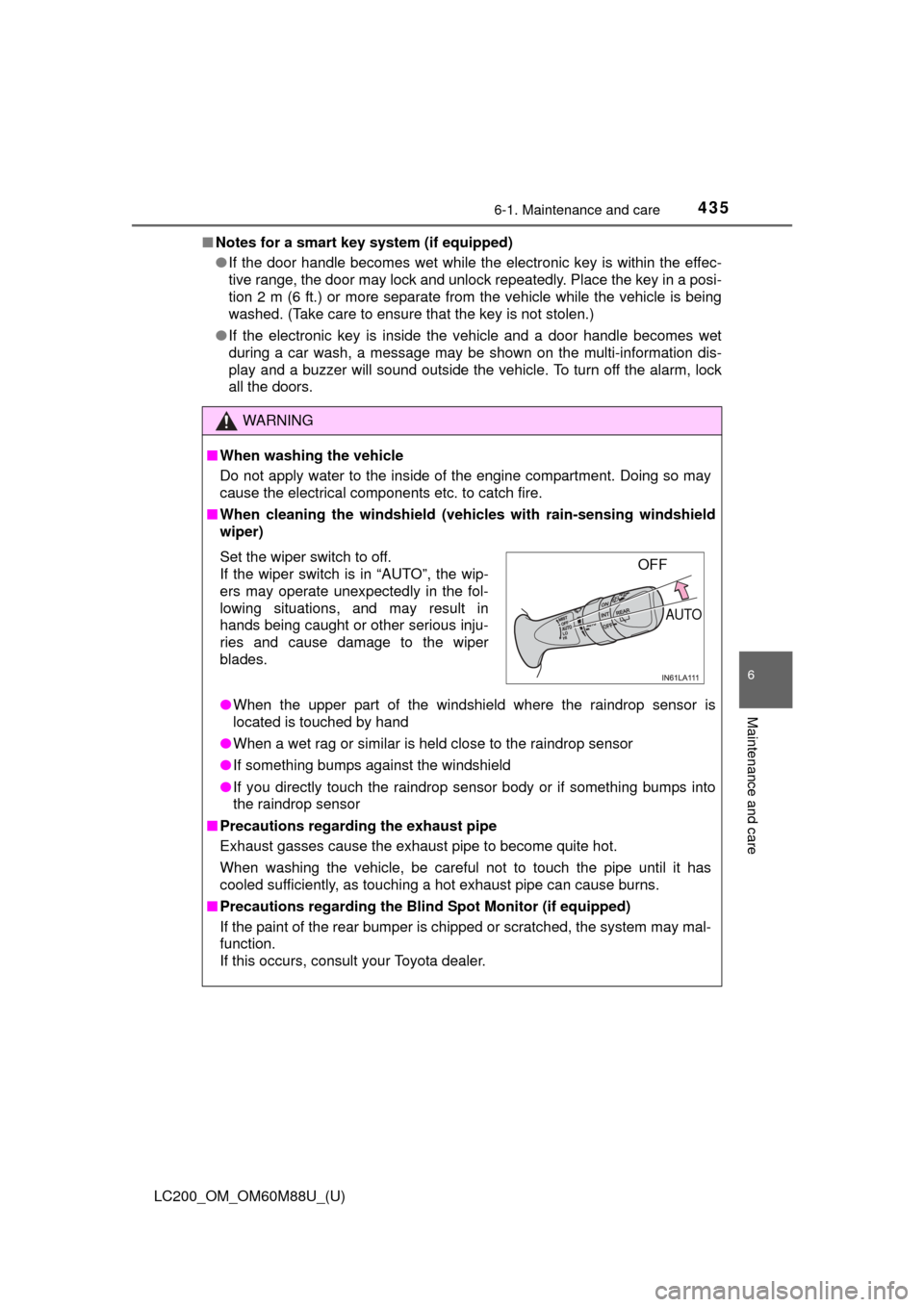
■ When cleaning the windshield (veh icles with rain-sensing windshield
wiper)
● When the upper part of the windshi eld where the raindrop sensor is
located is touched by hand
● When a wet rag or similar is held close to the raindrop sensor
● If something bumps against the windshield
● If you directly touch the raindrop sensor body or if something bumps into
the raindrop sensor
■ Precautions regarding the exhaust pipe
Exhaust gasses cause the exhaust pipe to become quite hot.
When washing the vehicle, be careful not to touch the pipe until it has
cooled sufficiently, as touching a hot exhaust pipe can cause burns.
■ Precautions regarding the Blind Spot Monitor (if equipped)
If the paint of the rear bumper is chipped or scratched, the system may mal-
function.
If this occurs, consult your Toyota dealer.
Set the wiper switch to off.
If the wiper switch is in “AUTO”, the wip-
ers may operate unexpectedly in the fol-
lowing situations, and may result in
hands being caught or other serious inju-
ries and cause damage to the wiper
blades.OFF
AUTO
Page 511 of 608
5117-2. Steps to take in an emergency
LC200_OM_OM60M88U_(U)
7
When trouble arises
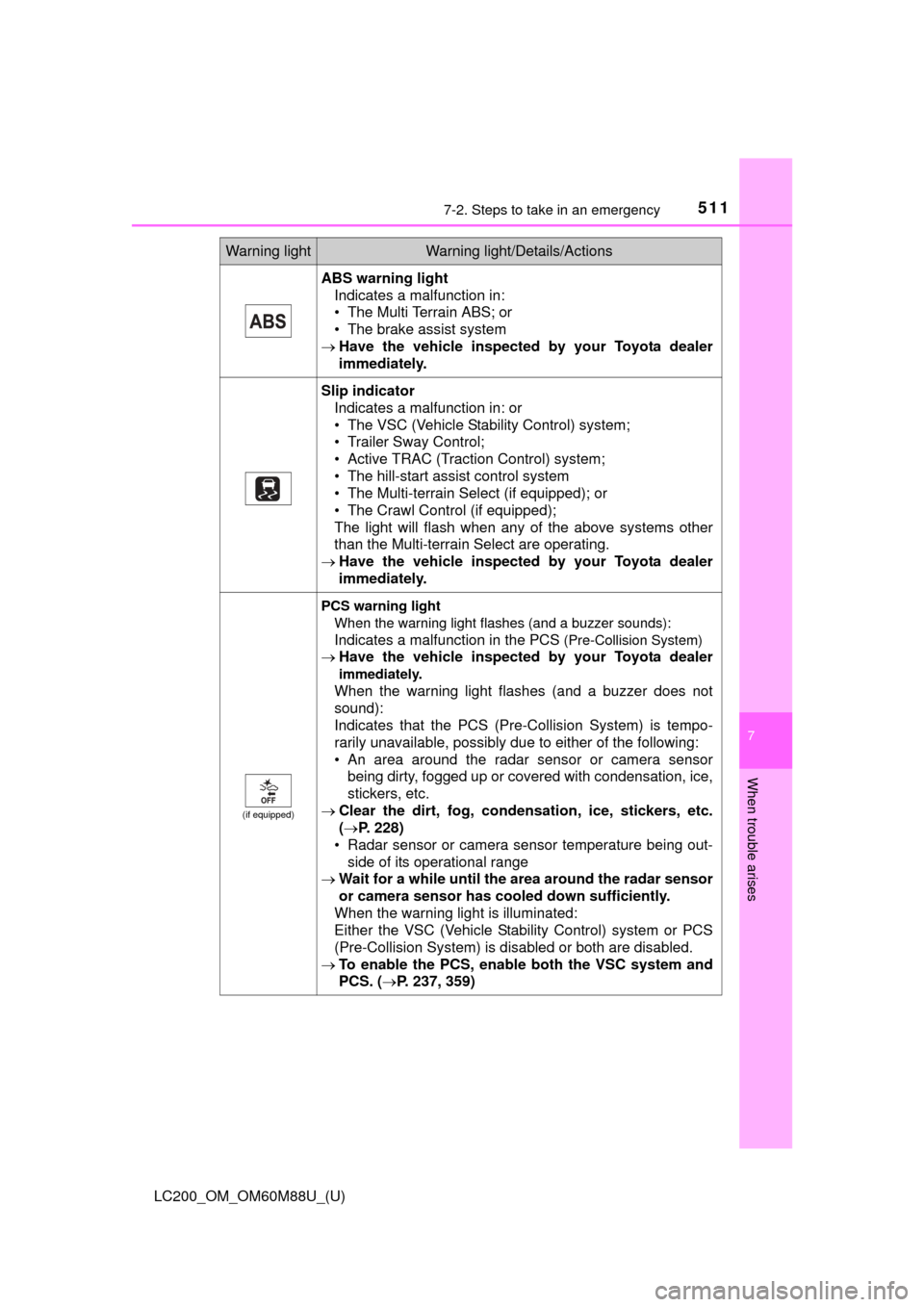
ABS warning lightIndicates a malfunction in:
• The Multi Terrain ABS; or
• The brake assist system
Have the vehicle inspected by your Toyota dealer
immediately.
Slip indicator
Indicates a malfunction in: or
• The VSC (Vehicle Stability Control) system;
• Trailer Sway Control;
• Active TRAC (Traction Control) system;
• The hill-start assist control system
• The Multi-terrain Select (if equipped); or
• The Crawl Control (if equipped);
The light will flash when any of the above systems other
than the Multi-terrain Select are operating.
Have the vehicle inspected by your Toyota dealer
immediately.
(if equipped)
PCS warning light
When the warning light flashes (and a buzzer sounds):
Indicates a malfunction in the PCS
(Pre-Collision System)
Have the vehicle inspected by your Toyota dealer
immediately.
When the warning light flashes (and a buzzer does not
sound):
Indicates that the PCS (Pre-Collision System) is tempo-
rarily unavailable, possibly due to either of the following:
• An area around the radar sensor or camera sensor
being dirty, fogged up or covered with condensation, ice,
stickers, etc.
Clear the dirt, fog, conden sation, ice, stickers, etc.
( P. 228)
• Radar sensor or camera sensor temperature being out-
side of its operational range
Wait for a while until the area around the radar sensor
or camera sensor has cool ed down sufficiently.
When the warning light is illuminated:
Either the VSC (Vehicle Stability Control) system or PCS
(Pre-Collision System) is disabled or both are disabled.
To enable the PCS, enable both the VSC system and
PCS. ( P. 237, 359)
Warning lightWarning light/Details/Actions