2016 TOYOTA COROLLA Vent
[x] Cancel search: VentPage 121 of 620

1213-2. Opening, closing and locking the doors
3
Operation of each component
COROLLA_TMMMS_TMMC_U (OM12J84U)l
Vehicles with a multi-information display: If the electronic key is inside the
vehicle and a door handle becomes wet during a car wash, a message may
be shown on the multi-information display and a buzzer will sound outside
the vehicle. To turn off the alarm, lock all the doors.
l The lock sensor may not work properly if it comes into contact with ice,
snow, mud, etc. Clean the lock sensor and attempt to operate it again.
l If there is another electronic key in the detection area, it may take slightly
longer to unlock the doors after the door handle is gripped.
l Fingernails may scrape against the door during operation of the door han-
dle. Be careful not to injure fingernails or damage the surface of the door.
l A sudden handle operation or a handle operation immediately after entering
the effective range may prevent the doors from being unlocked. Touch the
door unlock sensor and check that the doors are unlocked before pulling the
door handle again.
l Unlocking the vehicle may take more time if another electronic key is within
the effective range.
n When the vehicle is not driven for extended periods
lTo prevent theft of the vehicle, do not leave the electronic key within 6 ft. (2
m) of the vehicle.
l The smart key system can be deactivated in advance. ( P. 576)
n To operate the system properly
Make sure to carry the electronic key when operating the system. Do not get
the electronic key too close to the vehicle when operating the system from the
outside of the vehicle.
Depending on the position and holding condition of the electronic key, the key
may not be detected correctly and the system may not operate properly. (The
alarm may go off accidentally, or the door lock prevention function may not
operate.)
n If the smart key system do es not operate properly
l Locking and unlocking the doors: Use the mechanical key. ( P. 535)
l Starting the engine: P. 536
n Customization
Settings (e. g. smart key system) can be changed.
(Customizable features: P. 576)
n If the smart key system has been deactivated in a customized setting
lLocking and unlocking the doors and opening the trunk:
Use the wireless remote control or mechanical key. ( P. 111, 535)
l Starting the engine and changing engine switch modes: P. 536
l Stopping the engine: P. 1 6 9
Page 125 of 620

1253-3. Adjusting the seats
3
Operation of each component
COROLLA_TMMMS_TMMC_U (OM12J84U)
CAUTION
nSeat adjustment
lBe careful that the seat does not hit passengers or luggage.
l Do not recline the seat more than necessary when the vehicle is in motion
to reduce the risk of sliding under the lap belt.
If the seat is too reclined, the lap belt may slide past the hips and apply
restraint forces directly to the abdomen or your neck may contact the
shoulder belt, increasing the risk of death or serious injury in the event of
an accident.
l Manual seat only: After adjusting the seat, make sure that the seat is
locked in position.
n When adjusting the seat positions
Make sure to leave enough space around the feet so they do not get stuck.
Page 134 of 620

1343-4. Adjusting the steering wheel and mirrors
COROLLA_TMMMS_TMMC_U (OM12J84U)
Auto anti-glare inside rear view mirror
Responding to the level of brightness of the headlights of vehicles
behind, the reflected light is automatically reduced.
Changing automatic anti-glare
function mode
On/off
When the automatic anti-glare
function is in ON mode, the indica-
tor illuminates.
Vehicles without a smart key sys-
tem: The function will set to ON
mode each time the engine switch
is turned to the “ON” position.
Pressing the button turns the func-
tion to OFF mode. (The indicator
also turns off.)
Vehicles with a smart key system: The function will set to ON mode each
time the engine switch is turned to IGNITION ON mode.
Pressing the button turns the function to OFF mode. (The indicator also
turns off.)
n To prevent sensor error (vehicles with an auto anti-glare inside rear view
mirror)
Indicator
To ensure that the sensors operate prop-
erly, do not touch or cover them.
CAUTION
Do not adjust the position of the mirror while driving.
Doing so may lead to mishandling of the vehicle and cause an accident,
resulting in death or serious injury.
Page 137 of 620
137
3
Operation of each component
COROLLA_TMMMS_TMMC_U (OM12J84U)
3-5. Opening and closing the windows
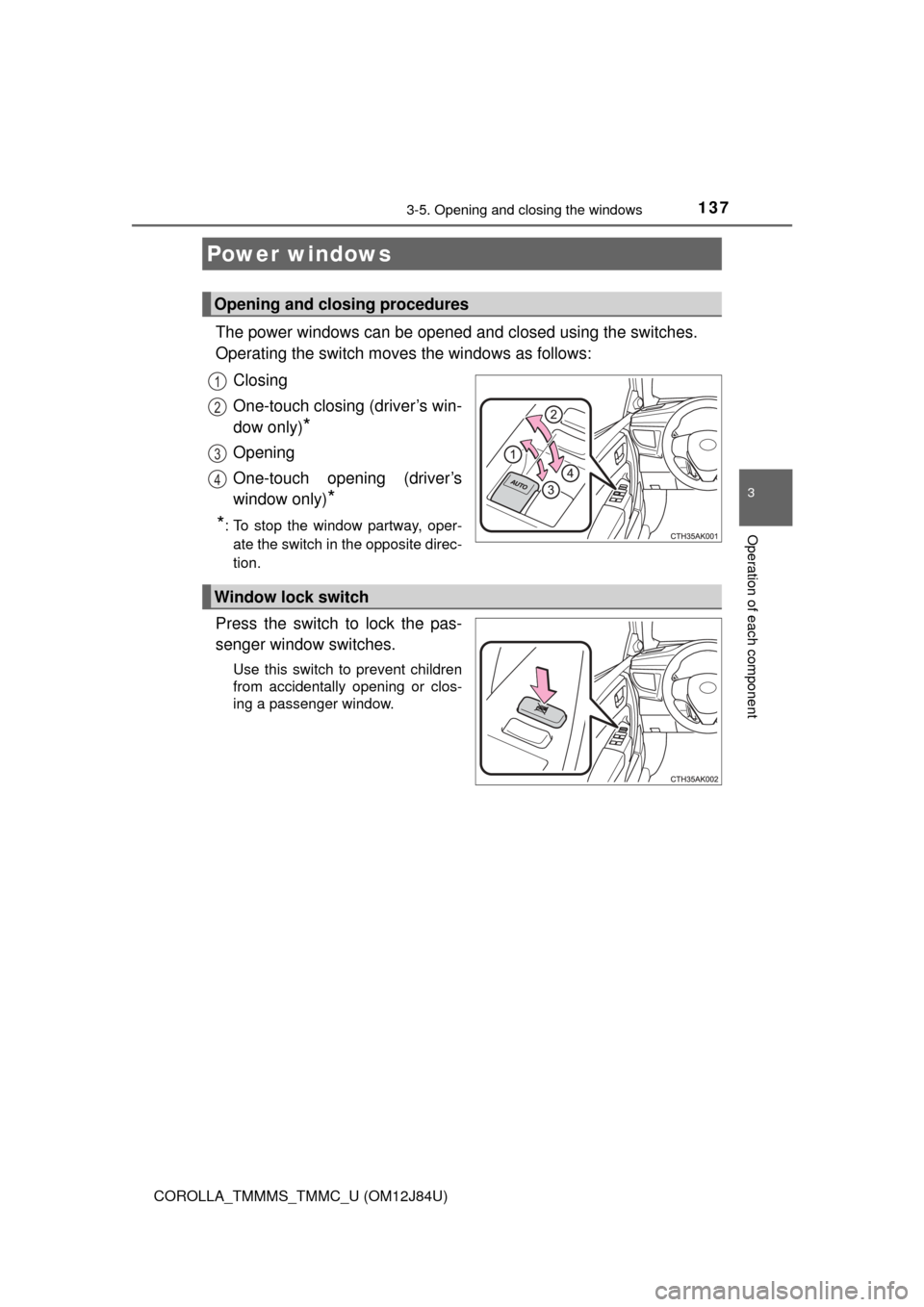
The power windows can be opened and closed using the switches.
Operating the switch moves the windows as follows:
Closing
One-touch closing (driver’s win-
dow only)
*
Opening
One-touch opening (driver’s
window only)
*
*
: To stop the window partway, oper- ate the switch in the opposite direc-
tion.
Press the switch to lock the pas-
senger window switches.
Use this switch to prevent children
from accidentally opening or clos-
ing a passenger window.
Power windows
Opening and closing procedures
1
2
3
4
Window lock switch
Page 140 of 620

1403-5. Opening and closing the windows
COROLLA_TMMMS_TMMC_U (OM12J84U)
CAUTION
Observe the following precautions.
Failure to do so may result in death or serious injury.
nClosing the windows
lThe driver is responsible for all the power window operations, including the
operation for the passengers. In order to prevent accidental operation,
especially by a child, do not let a child operate the power windows. It is
possible for children and other passengers to have body parts caught in
the power window. Also, when riding with a child, it is recommended to use
the window lock switch.( P. 137)
l Check to make sure that all passengers do not have any part of their body
in a position where it could be caught when a window is being operated.
l When exiting the vehicle, turn the engine switch off, carry the key and exit
the vehicle along with the child. There may be accidental operation, due to
mischief, etc., that may possibly lead to an accident.
n Jam protection function (driver’s window only)
lNever use any part of your body to intentionally activate the jam protection
function.
l The jam protection function may not work if something gets caught just
before the window fully closes.
Page 144 of 620

1443-5. Opening and closing the windows
COROLLA_TMMMS_TMMC_U (OM12J84U)
CAUTION
nOpening the moon roof
Observe the following precautions.
Failure to do so may cause death or serious injury.
lDo not allow any passengers to put their hands or heads outside the vehi-
cle while it is moving.
l Do not sit on top of the moon roof.
n Closing the moon roof
Observe the following precautions.
Failure to do so may result in death or serious injury.
lThe driver is responsible for moon roof opening and closing operations.
In order to prevent accidental operation, especially by a child, do not let a
child operate the moon roof. It is possible for children and other passen-
gers to have body parts caught in the moon roof.
l Check to make sure that all passengers do not have any part of their bod-
ies in a position where they could be caught when the moon roof is being
operated.
l When exiting the vehicle, turn the engine switch off, carry the key and exit
the vehicle along with the child. There may be accidental operation, due to
mischief, etc., that may possibly lead to an accident.
n Jam protection function
lNever use any part of your body to intentionally activate the jam protection
function.
l The jam protection function may not work if something gets caught just
before the moon roof fully closes.
Page 149 of 620

1494-1. Before driving
4
Driving
COROLLA_TMMMS_TMMC_U (OM12J84U)
nWhen starting off on an uphill
The hill-start assist control will activate. ( P. 215)
n Driving in the rain
lDrive carefully when it is raining, because visibility will be reduced, the win-
dows may become fogged-up, and the road will be slippery.
l Drive carefully when it starts to rain, because the road surface will be espe-
cially slippery.
l Refrain from high speeds when driving on an expressway in the rain,
because there may be a layer of water between the tires and the road sur-
face, preventing the steering and brakes from operating properly.
n Engine speed while driving (except vehicles with a manual transmis-
sion)
In the following conditions, the engine speed may become high while driving.
This is due to automatic up-shifting control or down-shifting implementation to
meet driving conditions. It does not indicate sudden acceleration.
l The vehicle is judged to be driving uphill or downhill
l When the accelerator pedal is released
l When the brake pedal is depressed while sport mode is selected (if
equipped)
l When the brake pedal is depressed suddenly and vehicle speed is reduced
sharply (continuously variable transmission)
n Breaking in your new Toyota
To extend the life of the vehicle, observing the following precautions is recom-
mended:
lFor the first 186 miles (300 km):
Avoid sudden stops.
l For the first 621 miles (1000 km):
• Do not drive at extremely high speeds.
• Avoid sudden acceleration.
• Do not drive continuously in low gears.
• Do not drive at a constant speed for extended periods.
n Operating your vehicle in a foreign country
Comply with the relevant vehicle registration laws and confirm the availability
of the correct fuel. ( P. 552)
CAUTION
Observe the following precautions.
Failure to do so may result in death or serious injury.
nWhen starting the vehicle (except veh icles with a manual transmission)
Always keep your foot on the brake pedal while stopped with the engine
running. This prevents the vehicle from creeping.
Page 150 of 620

1504-1. Before driving
COROLLA_TMMMS_TMMC_U (OM12J84U)
CAUTION
Observe the following precautions.
Failure to do so may result in death or serious injury.
nWhen driving the vehicle
lDo not drive if you are unfamiliar with the location of the brake and ac\
cel-
erator pedals to avoid depressing the wrong pedal.
• Accidentally depressing the accelerator pedal instead of the brake
pedal will result in sudden acceleration that may lead to an accident.
• When backing up, you may twist your body around, leading to a diffi- culty in operating the pedals. Make sure to operate the pedals properly.
• Make sure to keep a correct driving posture even when moving the
vehicle only slightly. This allows you to depress the brake and accelera-
tor pedals properly.
• Depress the brake pedal using your right foot. Depressing the brake
pedal using your left foot may delay response in an emergency, result-
ing in an accident.
l Do not drive the vehicle over or stop the vehicle near flammable materials.
The exhaust system and exhaust gases can be extremely hot. These hot
parts may cause a fire if there is any flammable material nearby.
l During normal driving, do not turn off the engine. Turning the engine off
while driving will not cause loss of steering or braking control, but the
power assist to these systems will be lost. This will make it more difficult to
steer and brake, so you should pull over and stop the vehicle as soon as it
is safe to do so.
However, in the event of an emergency, such as if it becomes impossible
to stop the vehicle in the normal way: P. 489
l Use engine braking (downshift) to maintain a safe speed when driving
down a steep hill.
Using the brakes continuously may cause the brakes to overheat and lose
effectiveness. ( P. 176, 178, 180, 184)
l Do not adjust the display, the positions of the steering wheel, the seat, or
the inside or outside rear view mirrors while driving.
Doing so may result in a loss of vehicle control.
l Always check that all passengers’ arms, heads or other parts of their body
are not outside the vehicle.
l Do not drive in excess of the speed limit. Even if the legal speed limit per-
mits it, do not drive over 85 mph ( 140 km/h) unless your vehicle has high-
speed capability tires. Driving over 85 mph (140 km/h) may result in tire
failure, loss of control and possible injury. Be sure to consult a tire dealer
to determine whether the tires on y our vehicle are high-speed capability
tires or not before driving at such speeds.