Page 346 of 492

3466-3. Do-it-yourself maintenance
AVALON (U)_(01999-07001)■
The initialization operation
●Make sure to carry out in
itialization after adjusting the tire inflation pres-
sure.
Also, make sure the tires are cold be fore carrying out initialization or tire
inflation pressure adjustment.
●If you have accidentally turned the engine switch to off during initializa-
tion, it is not necessary to press th e reset switch again as initialization
will restart automatically when the engine switch has been turned to
IGNITION ON mode for the next time.
●If you accidentally press the reset s witch when initialization is not neces-
sary, adjust the tire inflation pressu re to the specified level when the
tires are cold, and conduct initialization again.
●While the position of each tire is being determined and the inflation pres-
sures are not being displayed on the multi-information display, if the
inflation pressure of a tire drops, the tire pressure warning light will come
on.
■Warning performance of the ti re pressure warning system
The warning of the tire pressure warning system will change in accor-
dance with the conditions under which it was initialized. For this reason,
the system may give a warning even if the tire pressure does not reach a
low enough level, or if the pressure is higher than the pressure that was
adjusted to when the system was initialized.
■When initialization of the tire pr essure warning system has failed
Initialization may take longer to comp lete if the vehicle is driven on an
unpaved road. When performing initia lization, drive on a paved road if
possible. Depending on the driving environment and condition of the tires,
initialization will be completed in approx imately 10 minutes. If initialization
is not complete after driving approxima tely 10 minutes, continue driving
for a while.
If the inflation pressure of each tire is not displayed after driving for
approximately 1 hour, perform the following procedure.
●Park the vehicle in a safe place for approximately 20 minutes. Then
drive straight (with occasional left and right turns) at approximately 25
mph (40 km/h) or more for approximately 10 to 20 minutes.
Page 388 of 492
3887-2. Steps to take in an emergency
AVALON (U)_(01999-07001)
(Amber)
(If equipped)
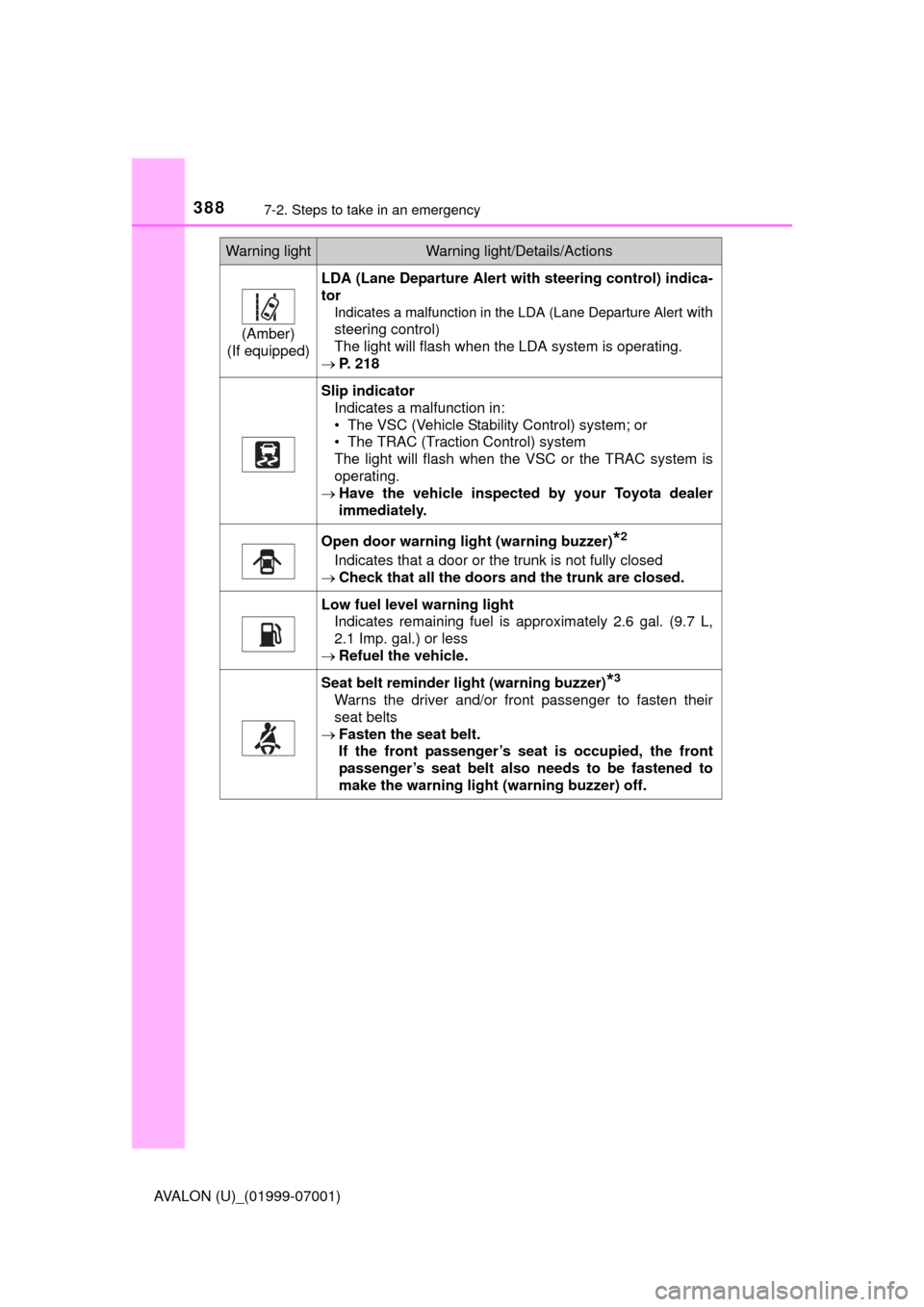
LDA (Lane Departure Alert wi th steering control) indica-
tor
Indicates a malfunction in the LDA (Lane Departure Alert with
steering control
)
The light will flash when the LDA system is operating.
P. 218
Slip indicator
Indicates a malfunction in:
• The VSC (Vehicle Stability Control) system; or
• The TRAC (Traction Control) system
The light will flash when the VSC or the TRAC system is
operating.
Have the vehicle inspected by your Toyota dealer
immediately.
Open door warning light (warning buzzer)*2
Indicates that a door or the trunk is not fully closed
Check that all the doors and the trunk are closed.
Low fuel level warning light
Indicates remaining fuel is approximately 2.6 gal. (9.7 L,
2.1 Imp. gal.) or less
Refuel the vehicle.
Seat belt reminder light (warning buzzer)*3
Warns the driver and/or front passenger to fasten their
seat belts
Fasten the seat belt.
If the front passenger’s seat is occupied, the front
passenger’s seat belt also needs to be fastened to
make the warning light (warning buzzer) off.
Warning lightWarning light/Details/Actions
Page 392 of 492

3927-2. Steps to take in an emergency
AVALON (U)_(01999-07001)
WARNING
■Maintenance of the tires
Each tire, including the spare (if provided), should be checked monthly
when cold and inflated to the inflation pressure recommended by the
vehicle manufacturer on the vehicle placard or tire inflation pressure
label (tire and load information label). (If your vehicle has tires of a dif-
ferent size than the size indicated on the vehicle placard or tire inflation
pressure label [tire and load information label], you should determine
the proper tire inflation pressure for those tires.)
As an added safety feature, your vehicle has been equipped with a tire
pressure monitoring system (TPMS-ti re pressure warning system) that
illuminates a low tire pre ssure telltale (tire pressure warning light) when
one or more of your tires is significantly under-inflated. Accordingly,
when the low tire pressure telltale (tire pressure warning light) illumi-
nates, you should stop and check your tires as soon as possible, and
inflate them to the proper pressure. Driving on a significantly under-
inflated tire causes the tire to overheat and can lead to tire failure.
Under-inflation also reduces fuel effi ciency and tire tread life, and may
affect the vehicle’s hand ling and stopping ability.
Please note that the TPMS (tire pres sure warning system) is not a sub-
stitute for proper ti re maintenance, and it is the driver’s responsibility to
maintain correct tire pressure, even if under-inflation has not reached
the level to trigger illumina tion of the TPMS low tire pressure telltale (tire
pressure warning light).
Your vehicle has also been equipped with a TPMS (tire pressure warn-
ing system) malfunction indicator to indicate when the system is not
operating properly. The TPMS (tire pressure warning system) malfunc-
tion indicator is combined with the lo w tire pressure telltale (tire pressure
warning light). When the system dete cts a malfunction, the telltale will
flash for approximately one minute and then remain continuously illumi-
nated. This sequence will continue up on subsequent vehicle start-ups
as long as the malfunction exists. When the malfunction indicator is illu-
minated, the system may not be able to detect or signal low tire pres-
sure as intended.
Page 402 of 492
4027-2. Steps to take in an emergency
AVALON (U)_(01999-07001)
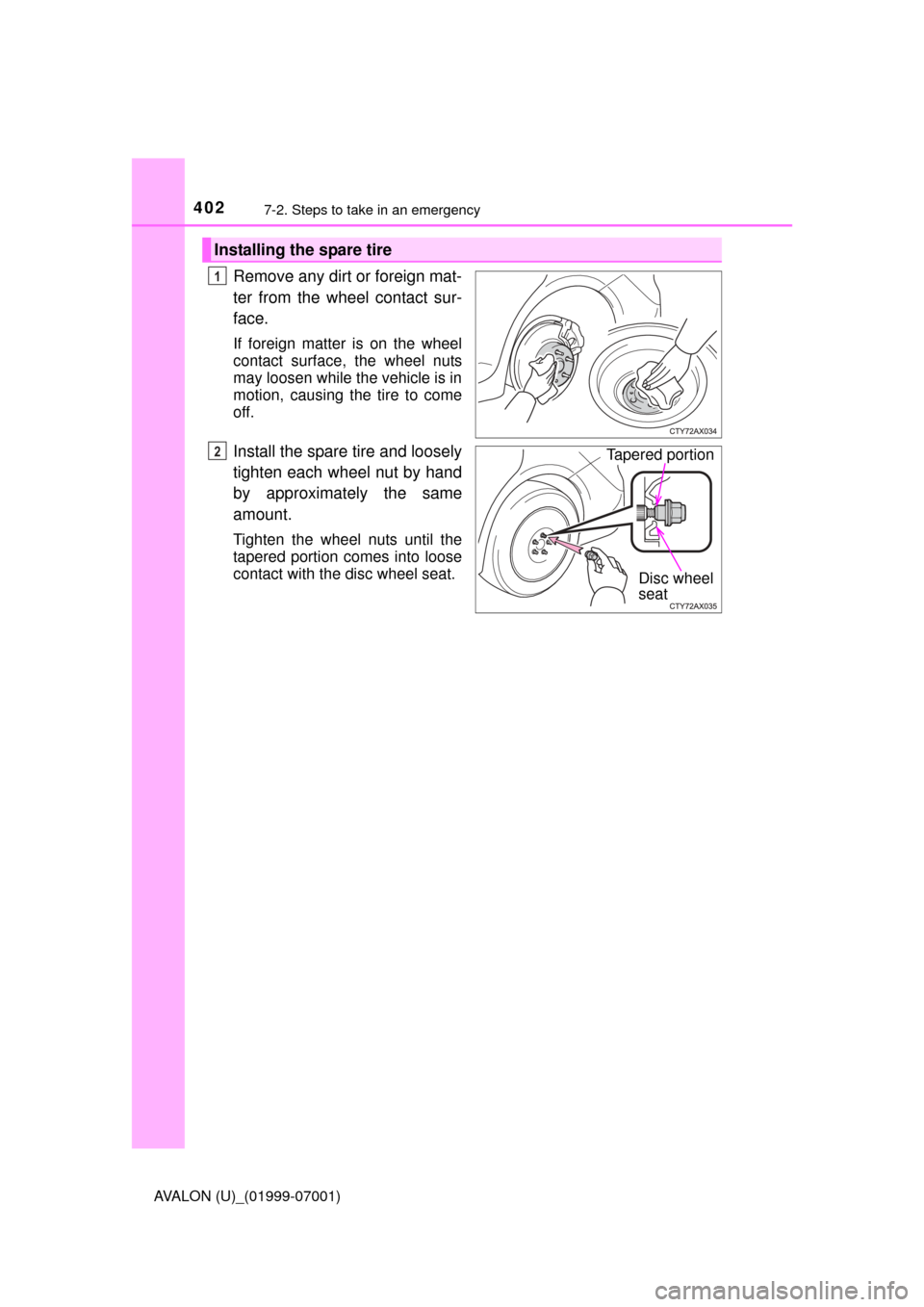
Remove any dirt or foreign mat-
ter from the wheel contact sur-
face.
If foreign matter is on the wheel
contact surface, the wheel nuts
may loosen while the vehicle is in
motion, causing the tire to come
off.
Install the spare tire and loosely
tighten each wheel nut by hand
by approximately the same
amount.
Tighten the wheel nuts until the
tapered portion comes into loose
contact with the disc wheel seat.
Installing the spare tire
1
Tapered portionDisc wheel
seat2
Page 414 of 492
4147-2. Steps to take in an emergency
AVALON (U)_(01999-07001)
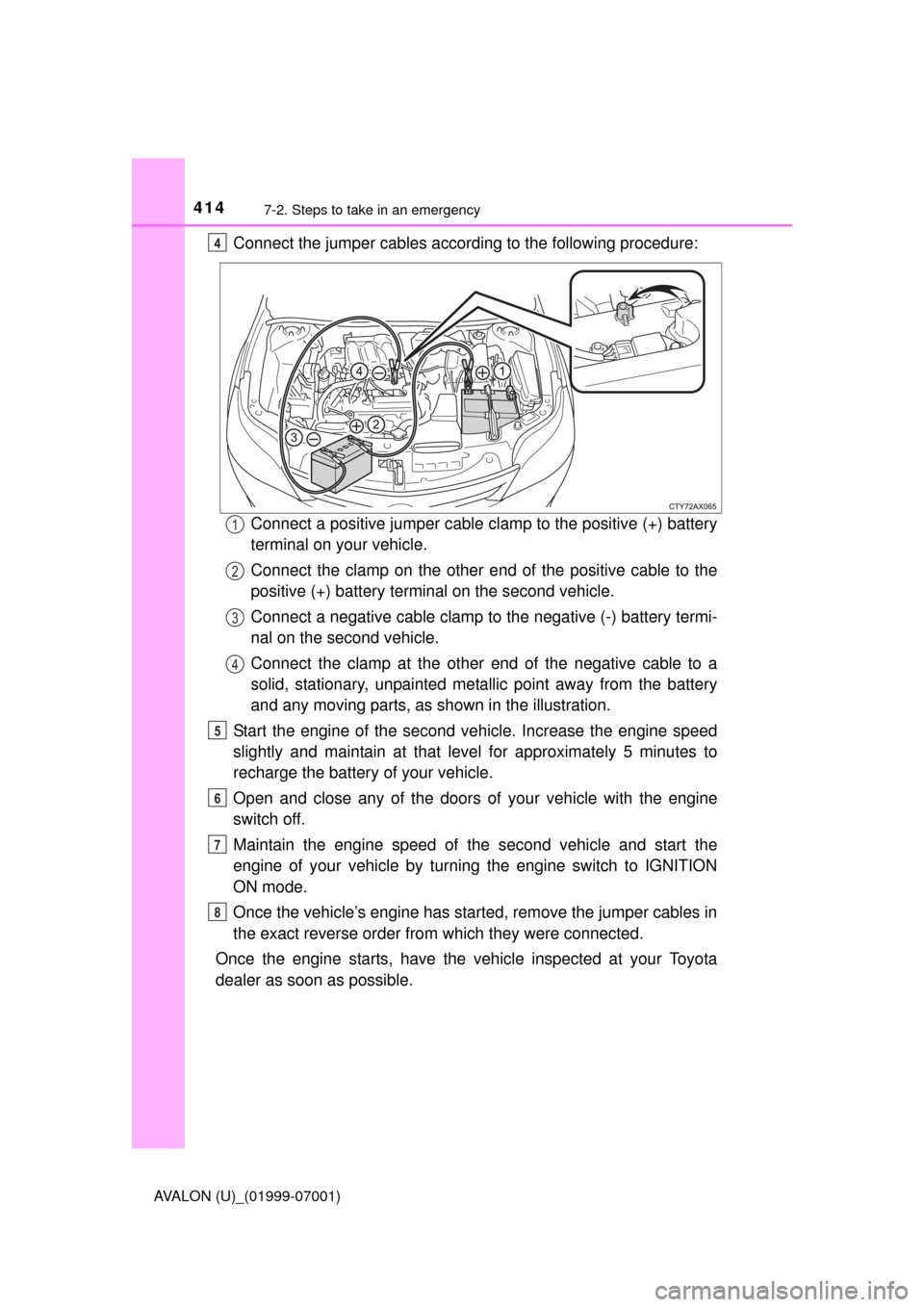
Connect the jumper cables according to the following procedure:Connect a positive jumper cable clamp to the positive (+) battery
terminal on your vehicle.
Connect the clamp on the other e nd of the positive cable to the
positive (+) battery terminal on the second vehicle.
Connect a negative cable clamp to the negative (-) battery termi-
nal on the second vehicle.
Connect the clamp at the other end of the negative cable to a
solid, stationary, unpainted metallic point away from the battery
and any moving parts, as shown in the illustration.
Start the engine of the second vehicle. Increase the engine speed
slightly and maintain at that le vel for approximately 5 minutes to
recharge the batter y of your vehicle.
Open and close any of the doors of your vehicle with the engine
switch off.
Maintain the engine speed of t he second vehicle and start the
engine of your vehicle by turning the engine switch to IGNITION
ON mode.
Once the vehicle’s engine has started, remove the jumper cables in
the exact reverse order from which they were connected.
Once the engine starts, have the vehicle inspected at your Toyota
dealer as soon as possible.4
1
2
3
4
5
6
7
8