Page 15 of 594
Illustrated index & Exterior 1) Engine hood (page 11-9)
2) Front wiper (page 3-101)
3) Headlight (page 3-95)
4) Replacing bulbs (page 11-44)
5) Moonroof (page 2-38)
6) Door locks (page 2-5)
7) Outside mirrors (page 3-111)
8) Tire pressure (page 11-33)
9) Flat tires (page 9-4)
10) Snow tires (page 8-9)
11) Fog light (page 3-99)
12) Tie-down hooks (page 9-12)
13) Towing hook (page 9-12)10
Page 16 of 594
1) Rear window defogger (page 3-112)
2) Fuel filler lid and cap (page 7-5)
3) Child safety locks (page 2-32)
4) Tie-down hole (page 9-12)
5) Trunk lid (page 2-36)
6) Towing hook (page 9-12)
– CONTINUED –11
Page 65 of 594
Seat, seatbelt and SRS airbags/*SRS airbag (Supplemental Restraint System airbag)
& Components
1) SRS frontal airbag
2) SRS side airbag
3) SRS curtain airbag
4) SRS knee airbag The SRS airbags are stowed in the
following locations.
Driver ’ s SRS frontal airbag : in the center
portion of the steering wheel
Front passenger ’ s SRS frontal airbag :
near the top of the dashboard under an
“ SRS AIRBAG ” mark
SRS side airbag : in the door side of each
front seat seatback which bears an “ SRS
AIRBAG ” label
SRS curtain airbag : in the roof side
(between the front pillar and a point
behind the rear quarter glass)
An “ SRS AIRBAG ” mark is located at the
top of each center pillar and rear pillar.
SRS knee airbag : under the steering
column1-36
Page 67 of 594

Seat, seatbelt and SRS airbags/*SRS airbag (Supplemental Restraint System airbag)
& SUBARU advanced frontal
airbag systemYour vehicle is equipped with a SUBARU
advanced frontal airbag system that com-
plies with the new advanced frontal airbag
requirements in the amended Federal
Motor Vehicle Safety Standard (FMVSS)
No. 208.
The SUBARU advanced frontal airbag
system automatically determines the de-
ployment force of the driver ’ s SRS frontal
airbag at the time of deployment as well as
whether or not to activate the front
passenger ’ s SRS frontal airbag and, if
activated, the deployment force of the
SRS frontal airbag at the time of deploy-
ment.
Your vehicle has warning labels on the
driver ’ s and front passenger ’ s sun visors
beginning with the phrase “ EVEN WITH
ADVANCED AIR BAGS ” and a tag
attached to the glove box lid beginning
with the phrase “ Even with Advanced Air
Bags ” . Make sure that you carefully read
the instructions on the warning labels and
tag.
Always wear your seatbelt. The SUBARU
advanced frontal airbag system is a
supplemental restraint system and must
be used in combination with a seatbelt. All
occupants should wear a seatbelt or be
seated in an appropriate child restraint system.
The driver ’ s SRS frontal airbag is stowed
in the center portion of the steering wheel.
The front passenger ’ s SRS frontal airbag
is stowed near the top of the dashboard
under an “ SRS AIRBAG ” mark. Also, the
driver ’ s knee airbag is stowed in the
bottom of the steering column.
In a moderate to severe frontal collision,
the following components deploy.
. SRS frontal airbag for driver
. SRS frontal airbag for front passenger
. Knee airbag for driver
. SRS curtain airbag *1
*1: When an offset frontal collision that is severe
enough to deploy the front airbag occurs.
These components supplement the seat-
belts by reducing the impact to the
occupant ’ s head, chest and knees. WARNINGNEVER INSTALL A FORWARD OR
REARWARD FACING CHILD SEAT
IN THE FRONT SEAT. DOING SO
RISKS SERIOUS INJURY OR DEATH
TO THE CHILD BY PLACING THE
CHILD ’ S HEAD TOO CLOSE TO THE
SRS AIRBAG.1-38
Page 69 of 594

Seat, seatbelt and SRS airbags/*SRS airbag (Supplemental Restraint System airbag)
seatbelt to help avoid injuries that
can result when the SRS airbag
contacts an occupant not in proper
position such as one thrown toward
the front of the vehicle during pre-
accident braking.
WARNING
. Do not put any objects over the
steering wheel pad and dash-
board. If the SRS frontal airbag
deploys, these objects could in-
terfere with its proper operation
and could be propelled inside the
vehicle, causing injury.
. Do not put any objects under the
driver ’ s side of the instrument panel. If the knee airbag deploys,
those objects could interfere with
its proper operation and could be
propelled inside the vehicle,
causing injury.
. The key must not be attached to
heavy, sharp or hard acces-
sories, or another key. If the knee
airbag deploys, those objects
could interfere with its proper
operation and could be propelled
inside the vehicle and cause
injury.
WARNING
Do not attach accessories to the
windshield, or fit an extra-wide mir- ror over the inside rear view mirror.
If the SRS airbag deploys, those
objects could become projectiles
that could seriously injure vehicle
occupants.
! Driver ’ s SRS frontal airbag
The driver ’ s SRS frontal airbag uses a
dual stage inflator. The inflator operates in
different ways depending on the severity
of impact.
Have the system inspected by your
SUBARU dealer immediately if the SRS
airbag system warning light illuminates.
NOTE The driver ’ s SRS side airbag and SRS
curtain airbag are not controlled by the
SUBARU advanced frontal airbag sys-
tem.
! Front passenger ’ s SRS frontal air-
bag
The front passenger ’ s SRS frontal airbag
uses a dual stage inflator. The inflator
operates in different ways depending on
the severity of impact.
The occupant detection system sensor is
installed under the seat upholstery and
monitors the physique and posture of the
front passenger. Using this information,1-40
Page 81 of 594
Seat, seatbelt and SRS airbags/*SRS airbag (Supplemental Restraint System airbag)
injured in the event of SRS side
airbag deployment.
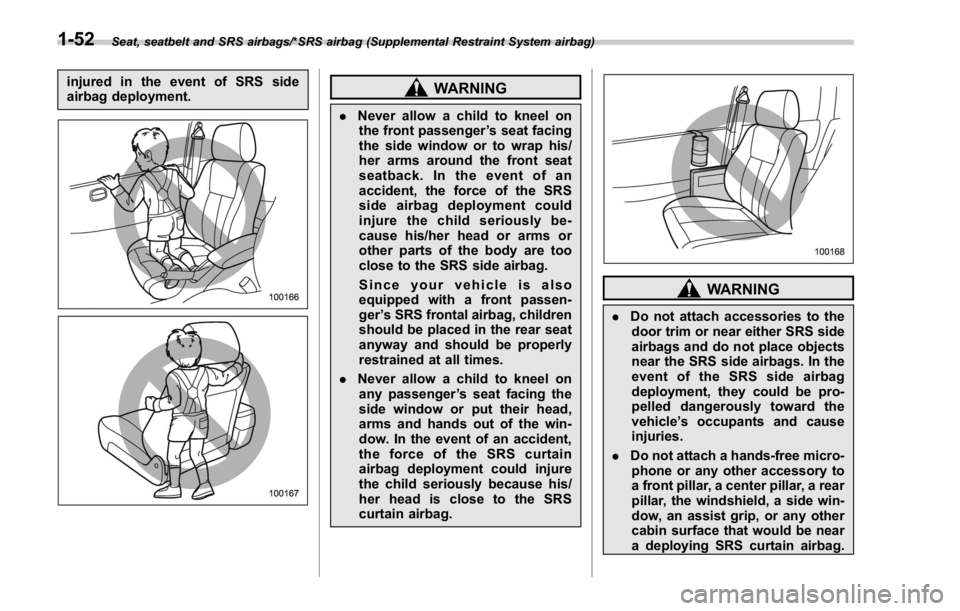
WARNING. Never allow a child to kneel on
the front passenger ’ s seat facing
the side window or to wrap his/
her arms around the front seat
seatback. In the event of an
accident, the force of the SRS
side airbag deployment could
injure the child seriously be-
cause his/her head or arms or
other parts of the body are too
close to the SRS side airbag.
Since your vehicle is also
equipped with a front passen-
ger ’ s SRS frontal airbag, children
should be placed in the rear seat
anyway and should be properly
restrained at all times.
. Never allow a child to kneel on
any passenger ’ s seat facing the
side window or put their head,
arms and hands out of the win-
dow. In the event of an accident,
the force of the SRS curtain
airbag deployment could injure
the child seriously because his/
her head is close to the SRS
curtain airbag. WARNING. Do not attach accessories to the
door trim or near either SRS side
airbags and do not place objects
near the SRS side airbags. In the
event of the SRS side airbag
deployment, they could be pro-
pelled dangerously toward the
vehicle ’ s occupants and cause
injuries.
. Do not attach a hands-free micro-
phone or any other accessory to
a front pillar, a center pillar, a rear
pillar, the windshield, a side win-
dow, an assist grip, or any other
cabin surface that would be near
a deploying SRS curtain airbag.1-52
Page 95 of 594
Keys and doors/Door locks
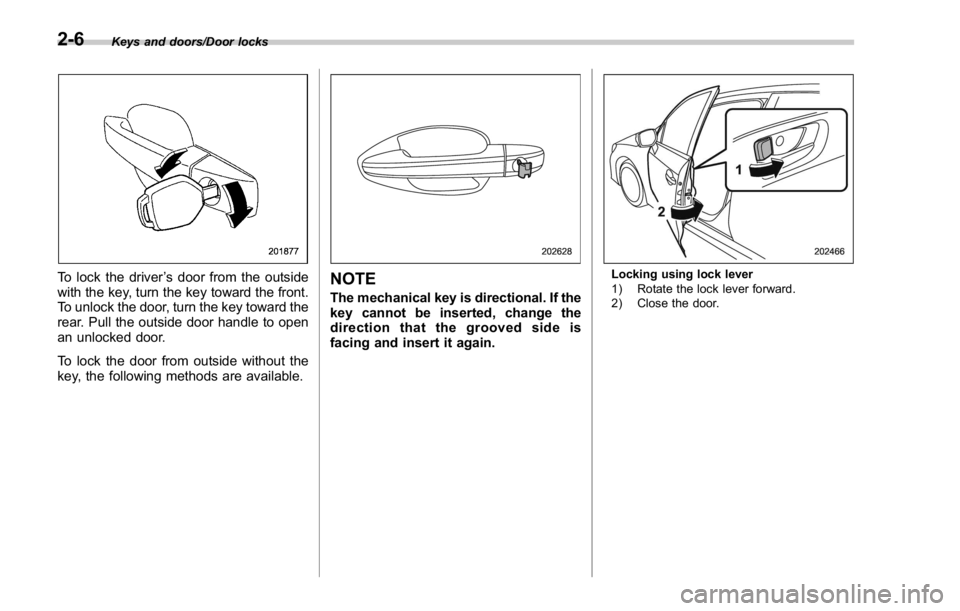
To lock the driver ’ s door from the outside
with the key, turn the key toward the front.
To unlock the door, turn the key toward the
rear. Pull the outside door handle to open
an unlocked door.
To lock the door from outside without the
key, the following methods are available. NOTE The mechanical key is directional. If the
key cannot be inserted, change the
direction that the grooved side is
facing and insert it again. Locking using lock lever
1) Rotate the lock lever forward.
2) Close the door.2-6
Page 102 of 594

& Locking and unlocking with
“ keyless access ” entry func-
tion ! Operating ranges
1) Antenna
2) Operating range
The operating ranges of the door locking/
unlocking functions and the trunk lid
unlocking function are approximately 16
to 32 in (40 to 80 cm) from the respective
door handles and the trunk ornament. 1) LED indicator
When the access key is within either of the
operating ranges of the front doors, the
LED indicator on the access key flashes.
When the keyless access functions are
disabled, the LED indicator does not flash
unless a button on the access key is
pressed.
! Operating range tips
. Locking by using the keyless access
function can be operated only by the door
lock sensor in the operating range in
which the access key is detected.
. Unlocking by using the keyless access
function can be operated only by the door
handle in the operating range in which the
access key is detected.
. If the access key is placed too close to the vehicle body, the keyless access
function may not operate properly. If they
do not operate properly, repeat the opera-
tion from further away.
. If the access key is placed near the
ground or in an elevated location from the
ground, even if it is in the indicated
operating range, the keyless access func-
tion may not operate properly.
. When the access key is within the
operating range, it is possible for anyone,
even someone who is not carrying the
access key, to operate the keyless access
function. Note that locking and unlocking
can be operated only by the door handle,
door lock sensor or trunk lid opener button
in the operating range in which the access
key is detected.
. It is not possible to lock the doors using
the keyless access function when the
access key is inside the vehicle. However,
depending on the status of the access key
and the environmental conditions, the
access key may be locked inside the
vehicle. Before locking, make sure that
you have the access key.
. When the battery of the access key is
discharged, or when operating it in a
location with strong radio waves or noise
(e.g., near a radio tower, power plant,
broadcast station or an area where wire-
less equipment is used), or while talkingKeys and doors/Keyless access with push – button start system
– CONTINUED –2-13