2016 SUBARU WRX tow
[x] Cancel search: towPage 478 of 594
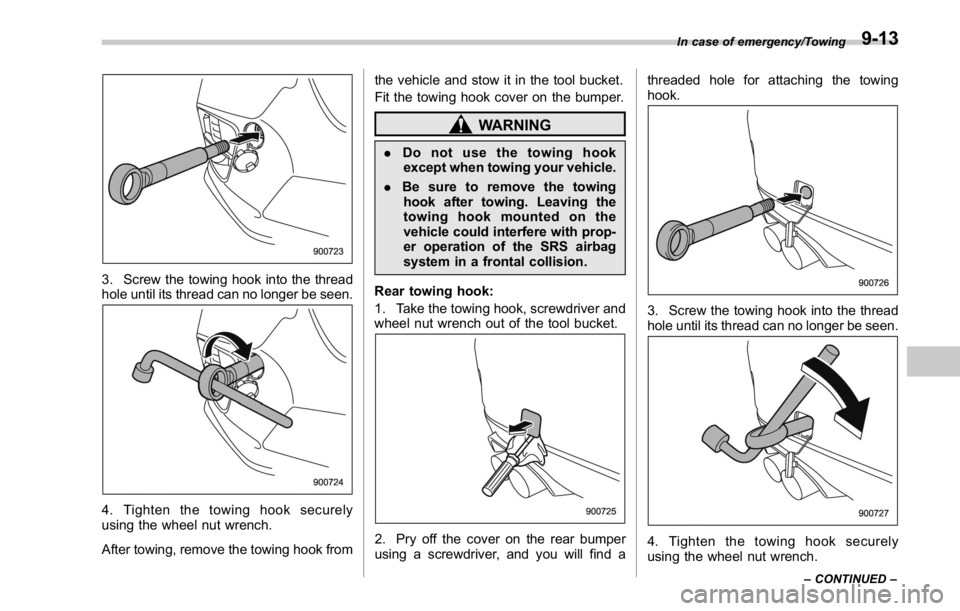
3. Screw the towing hook into the thread
hole until its thread can no longer be seen.
4. Tighten the towing hook securely
using the wheel nut wrench.
After towing, remove the towing hook from the vehicle and stow it in the tool bucket.
Fit the towing hook cover on the bumper.
WARNING. Do not use the towing hook
except when towing your vehicle.
. Be sure to remove the towing
hook after towing. Leaving the
towing hook mounted on the
vehicle could interfere with prop-
er operation of the SRS airbag
system in a frontal collision.
Rear towing hook:
1. Take the towing hook, screwdriver and
wheel nut wrench out of the tool bucket.
2. Pry off the cover on the rear bumper
using a screwdriver, and you will find a threaded hole for attaching the towing
hook.
3. Screw the towing hook into the thread
hole until its thread can no longer be seen.
4. Tighten the towing hook securely
using the wheel nut wrench. In case of emergency/Towing
– CONTINUED –9-13
Page 479 of 594
In case of emergency/Towing
After towing, remove the towing hook from
the vehicle and stow it in the tool bucket.
Fit the towing hook cover on the bumper.
WARNINGDo not use the towing hook except
when towing your vehicle.
Be sure to remove the towing hook
after towing. Leaving the towing
hook mounted on the vehicle could
interfere with proper operation of
the fuel pump shut off function
when the vehicle is struck from
behind.
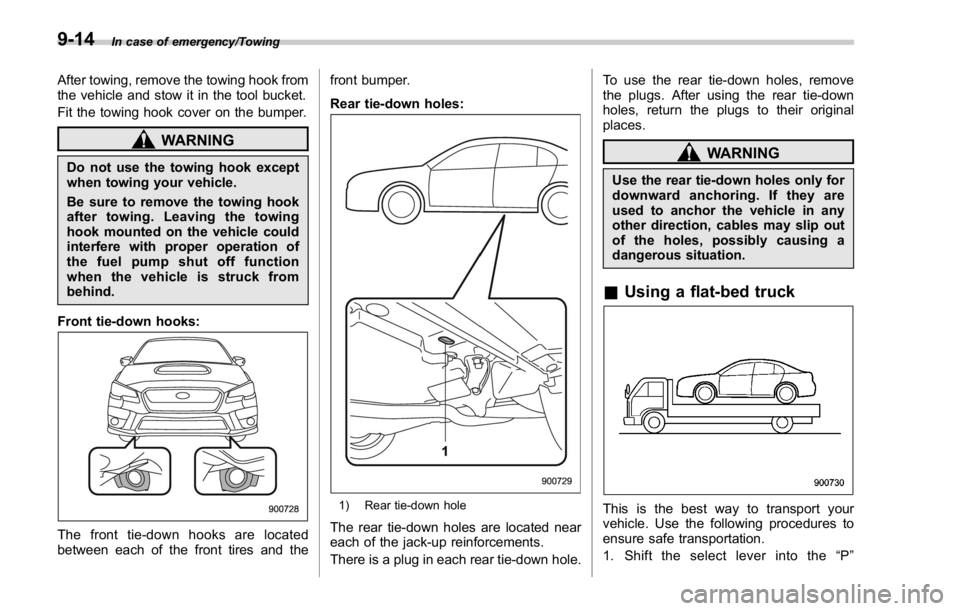
Front tie-down hooks:
The front tie-down hooks are located
between each of the front tires and the front bumper.
Rear tie-down holes:
1) Rear tie-down hole
The rear tie-down holes are located near
each of the jack-up reinforcements.
There is a plug in each rear tie-down hole. To use the rear tie-down holes, remove
the plugs. After using the rear tie-down
holes, return the plugs to their original
places.
WARNINGUse the rear tie-down holes only for
downward anchoring. If they are
used to anchor the vehicle in any
other direction, cables may slip out
of the holes, possibly causing a
dangerous situation.
& Using a flat-bed truck
This is the best way to transport your
vehicle. Use the following procedures to
ensure safe transportation.
1. Shift the select lever into the “ P ”9-14
Page 480 of 594
position for CVT models. Shift the shift
lever into the “ 1st ” position for MT models.
2. Apply the parking brake firmly.
3. Secure the vehicle onto the carrier
properly with safety chains. Each safety
chain should be equally tightened and
care must be taken not to pull the chains
so tightly that the suspension bottoms out.
CAUTIONIf your vehicle has a front under-
spoiler and rear underspoiler (both
optional), be careful not to scrape
them when placing the vehicle on
the carrier and when removing the
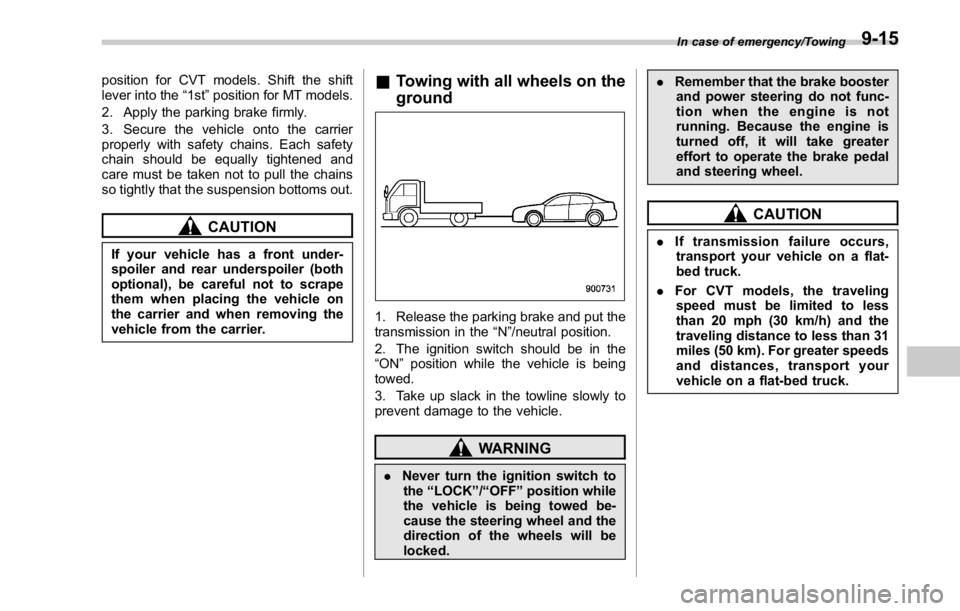
vehicle from the carrier. & Towing with all wheels on the
ground
1. Release the parking brake and put the
transmission in the “ N ” /neutral position.
2. The ignition switch should be in the
“ ON ” position while the vehicle is being
towed.
3. Take up slack in the towline slowly to
prevent damage to the vehicle.
WARNING
. Never turn the ignition switch to
the “ LOCK ” / “ OFF ” position while
the vehicle is being towed be-
cause the steering wheel and the
direction of the wheels will be
locked. . Remember that the brake booster
and power steering do not func-
tion when the engine is not
running. Because the engine is
turned off, it will take greater
effort to operate the brake pedal
and steering wheel.
CAUTION. If transmission failure occurs,
transport your vehicle on a flat-
bed truck.
. For CVT models, the traveling
speed must be limited to less
than 20 mph (30 km/h) and the
traveling distance to less than 31
miles (50 km). For greater speeds
and distances, transport your
vehicle on a flat-bed truck. In case of emergency/Towing
9-15
Page 498 of 594

Engine hood To open the hood:
1. If the wiper blades are lifted off the
windshield, return them to their original
position.
2. Pull the hood release knob under the
instrument panel. 3. Release the secondary hood release
by moving the lever between the front
grille and the hood toward the left.
4. Lift up the hood.
To close the hood:
1. Lower the hood to a height of approxi-
mately 11.8 in (30 cm) above its closed
position and then let it drop.
2. After closing the hood, be sure the
hood is securely locked.
If this does not close the hood, release it
from a slightly higher position. Do not push
the hood forcibly to close it. It could
deform the metal. WARNINGAlways check that the hood is
properly locked before you start
driving. If it is not, it might fly open
while the vehicle is moving and
block your view, which may cause
an accident and serious bodily in-
jury.
CAUTION. When you open the engine hood,
do not stand the wiper blades up.
Furthermore, while the hood is
open, do not operate the wind-
shield wipers. Doing so could
result in damage to the engine
hood and wiper blades.
. Be extremely careful not to catch
fingers or other objects when
closing the engine hood.
. Do not push the hood forcibly to
close it. It could deform the
metal.
. Be extremely careful opening the
engine hood when the wind is
strong. The engine hood could
close suddenly, possibly causing
injuries from slamming.
. Do not install accessories other Maintenance and service/Engine hood
– CONTINUED –11-9
Page 573 of 594

Consumer information and Reporting safety defects/Uniform tire quality grading standards
.
Vehicle stability will deteriorate..
Heavy and/or high-mounted
loads could increase the risk of
rollover. .
Stopping distance will increase..
Brakes could overheat and fail..
Suspension, bearings, axles and
other body parts could break or
experience accelerated wear that
will shorten vehicle life. .
Tires could fail..
Tread separation could occur..
Tire could separate from its rim.
& Steps for Determining Cor-
rect Load Limit1.
Locate the statement “ The com-
bined weight of occupants and
cargo should never exceed XXX
kg or XXX lbs. ” on your vehicle ’ s
placard.
2.
Determine the combined weight
of the driver and passengers that
will be riding in your vehicle.
3.
Subtract the combined weight of
the driver and passengers from
XXX kg or XXX lbs. 4.
The resulting figure equals the
available amount of cargo and
luggage load capacity. For exam-
ple, if the “ XXX ” amount equals
1400 lbs. and there will be five 150
lb passengers in your vehicle, the
amount of available cargo and
luggage load capacity is 650 lbs.
(1400 − 750 (5 6 150) = 650 lbs.)5.
Determine the combined weight
of luggage and cargo being loaded
on the vehicle. That weight may not
safely exceed the available cargo
and luggage load capacity calcu-
lated in Step 4.
6.
If your vehicle will be towing a
trailer, load from your trailer will be
transferred to your vehicle. Consult
this manual to determine how this
reduces the available cargo and
luggage load capacity of your ve-
hicle. Uniform tire quality grading
standards This information indicates the rela-
tive performance of passenger car
tires in the area of treadwear,
traction, and temperature resis-
tance. This is to aid the consumer
in making an informed choice in the
purchase of tires.
Quality grades can be found where
applicable on the tire sidewall be-
tween tread shoulder and maxi-
mum section width. For example:
Treadwear 200 Traction AA Tem-
perature A
The quality grades apply to new
pneumatic tires for use on passen-
ger cars. However, they do not
apply to deep tread, winter type
snow tires, space-saver or tempor-
ary use spare tires, tires with
nominal rim diameters of 12 inches
or less, or to some limited produc-
tion tires.
All passenger car tires must con-13-14
Page 581 of 594

14-6 Index
Bulb wattage ....................................................... 12-16
Control switch ........................................................ 3-94
Flasher ................................................................. 3-96
Indicator light ......................................................... 3-35
HID headlights .......................................................... 11-44
High beam indicator light ............................................ 3-35
High/low beam change (dimmer) .................................. 3-96
Hill Holder ................................................................. 7-46
Indicator light ................................................. 3-24, 7-48
Switch .................................................................. 7-47
Hill start assist .................................................. 7-49, 11-29
OFF indicator light .................................................. 3-24
To activate/deactivate ............................................. 7-51
Warning light ......................................................... 3-24
HomeLink ®
.............................................................. 3-105
Hook
Coat ..................................................................... 6-11
Towing and tie-down ............................................... 9-12
Horn ........................................................................ 3-114
Hose and connections ............................................... 11-17
I
Ignition switch .............................................................. 3-4
Light ....................................................................... 3-6
Illumination brightness control ...................................... 3-98
Immobilizer. ................................................................. 2-3
Indicator light (security indicator light) ....................... 3-33
Indicator light
BSD/RCTA OFF. .................................................... 3-37
BSD/RCTA warning ................................................ 3-37
Cruise control ........................................................ 3-35 Cruise control set ................................................... 3-35
Front fog light ......................................................... 3-35
Headlight ............................................................... 3-35
High beam ............................................................. 3-35
Hill Holder ............................................................. 3-24
Hill start assist OFF ................................................ 3-24
Immobilizer ............................................................ 3-33
REV. ..................................................................... 3-37
Security ................................................................. 3-33
Select lever/Gear position ........................................ 3-34
Shift-up ................................................................. 3-34
SI-DRIVE .............................................................. 3-34
Steering responsive fog lights OFF ... ........................ 3-37
Traction control OFF ............................................... 3-27
Turn signal ............................................................ 3-35
Vehicle Dynamics Control OFF ................................. 3-27
Vehicle Dynamics Control operation .......................... 3-26
Inside mirror ............................................................ 3-103
Interior lights ............................................................... 6-2
Internal trunk lid release handle .................................... 2-37
J
Jack-up point .............................................................. 9-4
Jump starting .............................................................. 9-9
K
Key............................................................................ 2-3
Number .................................................................. 2-3
Reminder chime ...................................................... 3-5
Replacement. .......................................................... 2-4
Keyless access entry function ...................................... 2-13
Page 586 of 594

Tires and wheels. ...................................................... 11-31
Tools .......................................................................... 9-3
Top tether anchorages ........................................ 1-29, 1-32
Towing ...................................................................... 9-12
All wheels on the ground ........................................ 9-15
Flat-bed truck ........................................................ 9-14
Hooks ................................................................... 9-12
Trailer
Towing .................................................................. 8-12
Trip meter ................................................................... 3-9
Trunk lid ................................................................... 2-36
Release handle ..................................................... 2-37
Turn signal
Indicator lights ....................................................... 3-35
Lever .................................................................... 3-97
U
Under-floor storage compartment ................................. 6-12
Useful information ...................................................... 5-28
STARLINK ............................................................ 5-30
V
Valet mode ................................................................ 2-30
Vanity mirror ................................................................ 6-4
Vehicle
Capacity weight ..................................................... 8-11
Identification ........................................................ 12-18
Symbols .................................................................... 3
Vehicle Dynamics Control
OFF indicator light .................................................. 3-27
OFF switch ........................................................... 7-40 Operation indicator light ........................................... 3-26
System .................................................................. 7-38
Warning light .......................................................... 3-26
Ventilator .................................................................... 4-2
Voice command system operation ... ........................... 5-107
Voice command system ........................................ 5-107
W
Warning and indicator lights ......................................... 3-13
Warning chimes
Keyless access with push-button start system .... ........ 3-28
Warning light
ABS...................................................................... 3-20
Access key .................................................... 3-28, 3-29
All-Wheel Drive ...................................................... 3-25
AT OIL TEMP ......................................................... 3-18
Automatic headlight beam leveler ............................. 3-35
Brake system ......................................................... 3-21
Charge .................................................................. 3-17
CHECK ENGINE .................................................... 3-16
Door open ............................................................. 3-25
Driver ’ s Control Center Differential ............................ 3-36
Engine low oil level ................................................. 3-17
Hill start assist ....................................................... 3-24
Keyless access with push-button start system .... ........ 3-28
Low fuel ................................................................ 3-24
Low tire pressure .................................................... 3-19
Oil pressure ...........................................................
3-17
Power steering ....................................................... 3-25
Rear differential oil temperature ................................ 3-18
Seatbelt. ................................................................ 3-14 Index
14-11