2016 SUBARU WRX heater
[x] Cancel search: heaterPage 244 of 594

Ventilator control ................................................. 4-2Center and side ventilators .................................. 4-2
Climate control panel .......................................... 4-3Type A ................................................................ 4-3
Type B ................................................................ 4-4
Automatic climate control operation ................. 4-5Sensors .............................................................. 4-5
Manual climate control operation ...................... 4-6Airflow mode selection ........................................ 4-6
Temperature control ............................................ 4-7
Fan speed control ............................................... 4-8
Air conditioner control ........................................ 4-8
Air inlet selection ................................................ 4-8
Defrosting ............................................................ 4-9Type A ................................................................ 4-9
Type B ................................................................ 4-9 Operating tips for heater and air
conditioner ........................................................ 4-9Cleaning ventilation grille ..................................... 4-9
Efficient cooling after parking in direct
sunlight ........................................................... 4-10
Lubrication oil circulation in the refrigerant
circuit .............................................................. 4-10
Checking air conditioning system before summer
season ............................................................ 4-10
Cooling and dehumidifying in high humidity and
low temperature weather conditions ................. 4-10
Air conditioner compressor shut-off when engine
is heavily loaded .............................................. 4-10
Refrigerant for your climate control system ... ..... 4-10
Air filtration system ........................................... 4-11Replacing an air filter ......................................... 4-11Climate control 4
Page 252 of 594
Defrosting & Type A Select the “ ” mode by pressing the
defroster button, or select the “
” mode
by turning the airflow mode selection dial
to defrost or to dehumidify the windshield
and front door windows.
& Type B Select the “ ” mode by pressing the
defroster button, or select the “
” mode
by pressing the airflow mode selection
button to defrost or to dehumidify the
windshield and front door windows. NOTE When the “ ” or “ ” mode is se-
lected, the air conditioner compressor
operates automatically regardless of
the position of the air conditioner
button to defrost the windshield more
quickly. However the indicator on the
air conditioner button will not illumi-
nate. At the same time, the air inlet
selection is automatically set to the
outside air mode. After defrosting the
windshield by pressing the defroster
button “
” , pressing the button again
returns the system to the setting that
had been selected before the defroster
was activated. Operating tips for heater and
air conditioner & Cleaning ventilation grille
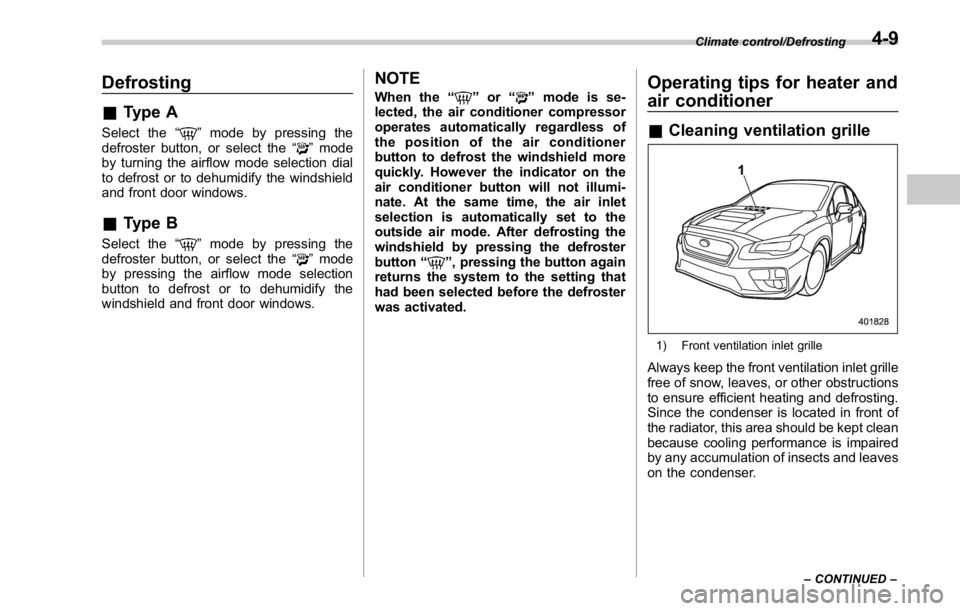
1) Front ventilation inlet grille
Always keep the front ventilation inlet grille
free of snow, leaves, or other obstructions
to ensure efficient heating and defrosting.
Since the condenser is located in front of
the radiator, this area should be kept clean
because cooling performance is impaired
by any accumulation of insects and leaves
on the condenser. Climate control/Defrosting
– CONTINUED –4-9
Page 253 of 594

Climate control/Operating tips for heater and air conditioner
& Efficient cooling after parking
in direct sunlightAfter parking in direct sunlight, drive with
the windows open for a few minutes to
allow outside air to circulate into the
heated interior. This results in quicker
cooling by the air conditioner. Keep the
windows closed during the operation of
the air conditioner for maximum cooling
efficiency.
& Lubrication oil circulation in
the refrigerant circuitOperate the air conditioner compressor at
a low engine speed (at idle or low driving
speeds) a few minutes each month during
the off-season to circulate its oil.
& Checking air conditioning
system before summer sea-
sonCheck the air conditioner unit for refriger-
ant leaks, hose conditions, and proper
operation each spring. Have the air con-
ditioning system checked by your
SUBARU dealer. & Cooling and dehumidifying in
high humidity and low tem-
perature weather conditions Under certain weather conditions (high
relative humidity, low temperatures, etc.) a
small amount of water vapor emission
from the air outlets may be noticed. This
condition is normal and does not indicate
any problem with the air conditioning
system.
& Air conditioner compressor
shut-off when engine is
heavily loaded To improve acceleration and gas mileage,
the air conditioner compressor is designed
to temporarily shut off during air condi-
tioner operation whenever the accelerator
is fully depressed such as during rapid
acceleration or when driving up a steep
incline. & Refrigerant for your climate
control system
1) Air conditioner label
Your air conditioner uses ozone friendly
refrigerant HFC134a (as shown on the air
conditioner label). Therefore, the method
of adding, changing or checking the
refrigerant is different from the method
for CFC12 (freon). Consult your SUBARU
dealer for service. Repairs needed as a
result of using the wrong refrigerant are
not covered under warranty.4-10
Page 404 of 594

you to start the engine from outside the
vehicle. In addition, the remote engine
start system can activate the heater or air
conditioner, providing you with a comfor-
table cabin upon entry.
NOTE The length of time for which it is
acceptable to allow the engine to
remain idling may be governed by local
laws and regulations. Check the local
rules when using the remote engine
start system. & Models with “ keyless access
with push-button start sys-
tem ”
NOTE For more details, refer to the Owner ’ s
Manual supplement for the remote
engine start system.
Access key
1) Lock button
An access key can be used as the remote
engine start transmitter. Operate the lock
button to start or stop the engine as
follows.
! Before starting the engine
Before using the remote engine start
system to start the engine, confirm the
following conditions. . The select lever is in the “ P ” position.
. All doors are closed.
. The engine hood is closed.
. The push-button ignition switch is in the
“ OFF ” position.
! Starting the engine
To start the engine with remote engine
start system, briefly press the lock button
twice within 2 seconds, then press and
hold the lock button for 3 seconds.
1. Press the lock button briefly. The
hazard warning flashers then flash once.
2. Within 2 seconds, press the lock
button briefly again. The hazard warning
flashers then flash once again.
3. After step 2, immediately press and
hold the lock button. The hazard warning
flashers then flash once.
4. Approximately 3 seconds after step 3,
release the lock button. The engine will
then start successfully.Starting and operating/Remote engine start system (dealer option)
– CONTINUED –7-15
Page 405 of 594

Starting and operating/Remote engine start system (dealer option)
! Stopping the engine
Press and hold the lock button to stop the
engine with remote engine start system.
! Automatic engine shutdown
The remote engine start system will
automatically shut down or will not start
the engine under the following conditions.
. The total run-time has exceeded 20
minutes.
. Any door is opened.
. The select lever is moved to any
position other than “ P ” .
. The engine hood is opened.
. Thepush-buttonignitionswitchis
pressed.
. The brake pedal is depressed.
. The engine speed is 3,000 rpm or
more.
The time setting until the engine auto-
matically stops can be changed. To
change it, please contact your SUBARU
dealer. Note that some settings may
violate state, provincial, or local laws and
regulations. Check the laws in your area to
determine which setting is permitted. & Entering the vehicle while it
is running via remote start 1. Unlock the vehicle doors using the
keyless access function. If the vehicle ’ s
doors are unlocked manually using the
key, the vehicle ’ s alarm system will trigger
(if the alarm system is armed prior to
activating the remote engine start system)
and the engine will turn off. Perform either
of the following procedures to disarm the
alarm system. Refer to “ Alarm system ”
F 2-25.
. Switch the ignition to the “ ACC ” or
“ ON ” state by pressing the push-button
ignition switch once or twice, respec-
tively.
. Press any button on the access key/
transmitter.
2. Enter the vehicle.
3. The engine will shut down when any
door is opened.
4. Press the push-button ignition switch
while depressing the brake pedal to restart
the engine.
& Entering the vehicle follow-
ing remote engine start shut-
down
An alarm trigger may occur if the vehicle is
opened by the remote keyless entry
transmitter within a few seconds immedi- ately following remote engine start shut-
down.
& Pre-heating or pre-cooling
the interior of the vehicle Before exiting the vehicle, set the tem-
perature controls to the desired setting
and operation. After the system starts the
engine, the heater or air conditioning will
activate and heat or cool the interior to
your setting.
& System maintenance For models with “ keyless access with
push-button start system ” :
Perform the procedure described in “ Re-
placing battery of access key ” F 11-50.7-16
Page 551 of 594

Specifications/Fuses and circuits
Fuses and circuits & Fuse panel located in the passenger compartment Fuse
panel Fuse
rating Circuit
1 20A
(Not available)
2 7.5A
. Combination meter
3 15A
. Door locking
4 10A
. Front wiper deicer relay
5 Empty
6 7.5A
. Remote control rear
view mirrors
. Seat heater relay
7 10A
. Combination meter
. Integrated unit
8 7.5A
. Stop light
9 7.5A
. Front wiper deicer
10 7.5A
. Power supply (battery)
11 7.5A
. Turn signal unit
12 15A
. Transmission control
unit
. Engine control unit
. Integrated unit
13 20A
. Accessory power outlet
(center console)
14 10A
. Parking light
. Tail light
. Rear combination light12-10
Page 552 of 594

Fuse
panel Fuse
rating Circuit
15 10A
. Trunk light
. Keyless unit
16 7.5A
. Illumination
17 15A
. Seat heaters
18 10A
. Backup light
19 –
. Daytime running lights
20 10A
. Accessory power outlet
(instrument panel)
21 7.5A
. Starter relay
22 10A
. Air conditioner
. Rear window defogger
relay coil
23 Empty
24 10A
. Audio unit
. Navigation system (if
equipped)
25 15A
. SRS airbag system
26 7.5A
. Power window relay
. Radiator main fan relay
27 15A
. Blower fan
28 15A
. Blower fan
29 15A
. Fog light
30 Empty Fuse
panel Fuse
rating Circuit
31 7.5A
. Auto air conditioner unit
. Integrated unit
32 7.5A
. Clutch switch
. Steering lock control
unit
33 7.5A
. Vehicle Dynamics Con-
trol unit Specifications/Fuses and circuits
– CONTINUED –12-11
Page 553 of 594

Specifications/Fuses and circuits
& Fuse panel located in the engine compartment! STI
A) Main fuse Fuse
panel Fuse
rating Circuit
1 30A
. ABS unit
. Vehicle Dynamics Con-
trol unit
2 25A
. Main fan (cooling fan)
3 25A
. Sub fan (cooling fan)
4
Empty
5
25A
. Audio
6
30A
. Headlight (low beam)
7
15A
. Headlight (high beam)
8 20A
. Back-up
9 15A
. Horn
10 25A
. Rear window defogger
. Mirror heater
11 15A
. Fuel pump
12 10A
. Transmission control
unit
13 7.5A
. Engine control unit
14 15A
. Turn and hazard warn-
ing flasher
15 15A
. Tail and illumination re-
lay
16 7.5A
. Alternator12-12