2016 SUBARU WRX door lock
[x] Cancel search: door lockPage 44 of 594
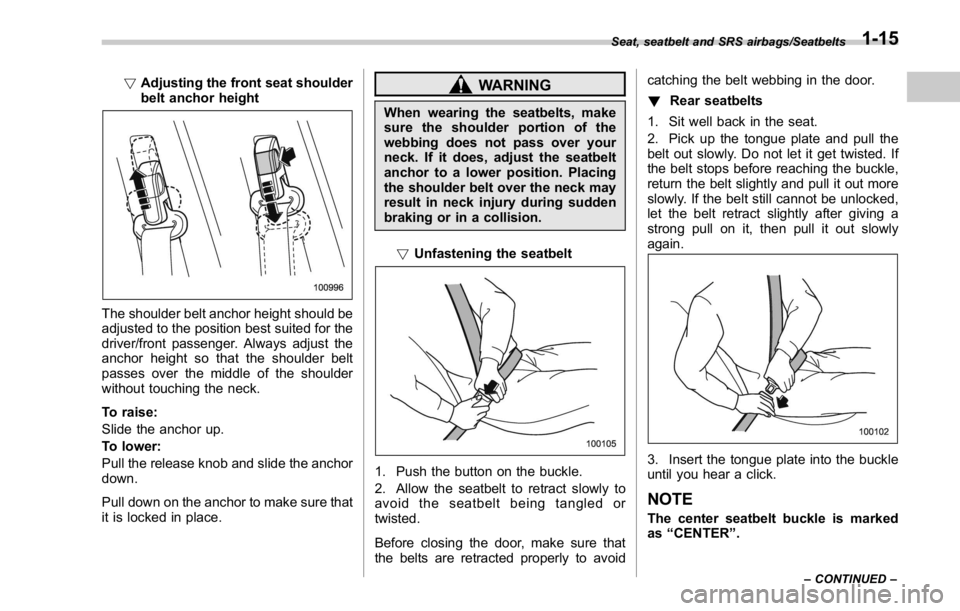
! Adjusting the front seat shoulder
belt anchor height
The shoulder belt anchor height should be
adjusted to the position best suited for the
driver/front passenger. Always adjust the
anchor height so that the shoulder belt
passes over the middle of the shoulder
without touching the neck.
To raise:
Slide the anchor up.
To lower:
Pull the release knob and slide the anchor
down.
Pull down on the anchor to make sure that
it is locked in place. WARNINGWhen wearing the seatbelts, make
sure the shoulder portion of the
webbing does not pass over your
neck. If it does, adjust the seatbelt
anchor to a lower position. Placing
the shoulder belt over the neck may
result in neck injury during sudden
braking or in a collision.
! Unfastening the seatbelt
1. Push the button on the buckle.
2. Allow the seatbelt to retract slowly to
avoid the seatbelt being tangled or
twisted.
Before closing the door, make sure that
the belts are retracted properly to avoid catching the belt webbing in the door.
! Rear seatbelts
1. Sit well back in the seat.
2. Pick up the tongue plate and pull the
belt out slowly. Do not let it get twisted. If
the belt stops before reaching the buckle,
return the belt slightly and pull it out more
slowly. If the belt still cannot be unlocked,
let the belt retract slightly after giving a
strong pull on it, then pull it out slowly
again.
3. Insert the tongue plate into the buckle
until you hear a click.
NOTE The center seatbelt buckle is marked
as “ CENTER ” .Seat, seatbelt and SRS airbags/Seatbelts
– CONTINUED –1-15
Page 46 of 594

Front seatbelt pretensioners The driver ’ s and front passenger ’ s seat-
belts have a seatbelt pretensioner. The
seatbelt pretensioners are designed to be
activated in the event of an accident
involving moderate to severe frontal and
side collisions.
The pretensioner sensor also serves as
follows.
. SRS frontal airbag sensor
. Side impact sensor (front door impact
sensor)
& Seatbelt with shoulder belt
pretensioner
NOTE This section is applicable to the dri-
ver ’ s side seatbelt. Front seatbelt pretensioner
If the sensor detects a certain predeter-
mined amount of force during frontal or
side collisions, the front seatbelt is quickly
drawn back in by the retractor to take up
the slack so that the belt more effectively
restrains the driver.
When a seatbelt pretensioner is activated,
an operating noise will be heard and a
small amount of smoke will be released.
These occurrences are normal and not
harmful. This smoke does not indicate a
fire in the vehicle.
Once the seatbelt pretensioner has been
activated, the seatbelt retractor remains
locked. Consequently, the seatbelt cannot
be pulled out and retracted and therefore
must be replaced. NOTE . Seatbelt pretensioners are not de-
signed to activate in minor impacts or
in rear impacts.
. In cases of frontal collisions, the
following components will operate si-
multaneously.
– Seatbelt pretensioner for driver
– Seatbelt pretensioner for front
passenger
– SRS frontal airbag for driver
– SRS frontal airbag for front pas-
senger*
– SRS curtain airbags (both sides)
(if an offset frontal collision occurs) *: This does not operate if the occupant
detection system deactivates airbag op-
eration. For details, refer to “ Front
passenger ’ s SRS frontal airbag ” F 1-40
.
. In cases of side collisions, the
following components will operate si-
multaneously.
– SRS curtain airbag (impacted
side)
– SRS side airbag (impacted side)
(when both the satellite safing sen-
sor and any of the center pillar
impact sensors/front door impact
sensors sense an impact force)
– Seatbelt pretensioner for driver
(when both the satellite safing sen-Seat, seatbelt and SRS airbags/Front seatbelt pretensioners
– CONTINUED –1-17
Page 48 of 594

shoulder belt pretensioner is supplemen-
ted by a lap belt pretensioner, which is
located at the base of the center pillar.
Like the shoulder belt pretensioner, the lap
belt pretensioner instantaneously pulls in
the belt to eliminate slack if a certain level
of frontal or side collision force is detected.
As a result, the seatbelt restrains the front
seat occupant more effectively.
When a seatbelt pretensioner is activated,
an operating noise will be heard and a
small amount of smoke will be released.
These occurrences are normal and not
harmful. This smoke does not indicate a
fire in the vehicle.
Once the seatbelt pretensioner has been
activated, the seatbelt pretensioner re-
mains locked. Consequently, the seatbelt
cannot be pulled out and retracted and
therefore must be replaced.
NOTE . Seatbelt pretensioners are not de-
signed to activate in minor impacts or
in rear impacts.
. In cases of frontal collisions, the
following components will operate si-
multaneously.
– Seatbelt pretensioner for driver
– Seatbelt pretensioners for front
passenger (shoulder belt preten- sioner only)
– SRS frontal airbag for driver
– SRS frontal airbag for front pas-
senger*
– SRS curtain airbags (both sides)
(if an offset frontal collision occurs) *: This does not operate if the occupant
detection system deactivates airbag op-
eration. For details, refer to “ Front
passenger ’ s SRS frontal airbag ” F 1-40
.
. In cases of side collisions, the
following components will operate si-
multaneously.
– SRS curtain airbag (impacted
side)
– SRS side airbag (impacted side)
(when both the satellite safing sen-
sor and any of the center pillar
impact sensors/front door impact
sensors sense an impact force)
– Seatbelt pretensioner for driver
(when both the satellite safing sen-
sor and the driver ’ s side front door
impact sensor sense an impact
force)
However, when a center pillar im-
pact sensor detects a signal faster
than the front door impact sensor,
or both sensors detect signals
simultaneously, the seatbelt preten-
sioner does not activate.
– Seatbelt pretensioner for front passenger (shoulder belt preten-
sioner only) (when both the satellite
safing sensor and the front passen-
ger ’ s side front door impact sensor
sense an impact force)
However, when a center pillar im-
pact sensor detects a signal faster
than the front door impact sensor,
or both sensors detect signals
simultaneously, the seatbelt preten-
sioner does not activate.
. Pretensioners are designed to func-
tion on a one-time-only basis. In the
event that a pretensioner is activated,
both the driver ’ s and front passenger ’ s
seatbelt retractor assemblies should
be replaced only by an authorized
SUBARU dealer. When replacing seat-
belt retractor assemblies, use only
genuine SUBARU parts.
. If either front seatbelt does not
retract or cannot be pulled out due to
a malfunction or activation of the
pretensioner, contact your SUBARU
dealer as soon as possible.
. If the front seatbelt retractor assem-
bly or surrounding area has been
damaged, contact your SUBARU dealer
as soon as possible.
. When you sell your vehicle, we urge
you to explain to the buyer that it has
seatbelt pretensioners by alerting theSeat, seatbelt and SRS airbags/Front seatbelt pretensioners
– CONTINUED –1-19
Page 90 of 594

Keys ..................................................................... 2-3Key number plate ................................................ 2-3
Immobilizer .......................................................... 2-3Security indicator light ........................................ 2-4
Key replacement ................................................. 2-4
Certification for immobilizer system ..................... 2-4
Door locks ........................................................... 2-5Locking and unlocking from the outside . ............. 2-5
Locking and unlocking from the inside ................ 2-7
Battery drainage prevention function ................... 2-7
Power door locking switches ............................. 2-8Key lock-in prevention function ........................... 2-9
Keyless access with push-button start
system (if equipped) ........................................ 2-9Safety precautions ............................................. 2-10
Locking and unlocking with “ keyless access ”
entry function. .................................................. 2-13
Selecting audible signal operation ...................... 2-16
Warning chimes and warning indicator ............... 2-16
Disabling keyless access function ...................... 2-16
When access key does not operate properly ....... 2-18
Replacing battery of access key ......................... 2-18
Replacing access key ......................................... 2-18
Certification for keyless access with push-button
start system ..................................................... 2-18
PIN Code Access (models with “ keyless
access with push-button start system ” )........ 2-19
Registering a PIN code ....................................... 2-20
Unlocking .......................................................... 2-21
Remote keyless entry system ........................... 2-21
Locking the doors .............................................. 2-22 Unlocking the doors .......................................... 2-22
Opening the trunk lid ......................................... 2-23
Vehicle finder function ....................................... 2-23
Sounding a panic alarm ..................................... 2-23
Selecting audible signal operation (models
without “ keyless access with push-button start
system ” ).......................................................... 2-23
Replacing the battery ......................................... 2-24
Replacing lost transmitters ................................ 2-24
Welcome lighting (if equipped) . .......................... 2-24
Certification for Remote keyless entry
system ............................................................ 2-24
Alarm system ..................................................... 2-25System operation ............................................... 2-26
Activating and deactivating the alarm system ..... 2-26
If you have accidentally triggered the alarm
system ............................................................ 2-26
Arming the system ............................................ 2-27
Disarming the system ........................................ 2-29
Valet mode ........................................................ 2-30
Passive arming (models without “ keyless access
with push-button start system ” ) ....................... 2-30
Tripped sensor identification .............................. 2-31
Shock sensors (dealer option).. .......................... 2-31
Child safety locks .............................................. 2-32
Windows ............................................................. 2-32
Power window operation by driver ..................... 2-33
Power window operation by passengers ............. 2-35
Initialization of power window .. .......................... 2-36
Trunk lid ............................................................. 2-36
To open and close the trunk lid from outside . ..... 2-36Keys and doors 2
Page 92 of 594

Keys NOTE For models with “ keyless access with
push-button start system ” , refer to
“ Keyless access with push-button start
system ” F 2-9.
1) Master key
2) Submaster key
3) Sub key
4) Key number plate
Three types of keys are provided for your
vehicle.
CAUTION
Do not attach a large key holder or
key case to either key. If it bangs against your knees while you are
driving, it could turn the ignition
switch from the “ ON ” position to the
“ ACC ” or “ LOCK ” position, thereby
stopping the engine.
& Key number plate The key number is stamped on the key
number plate attached to the key set.
Write down the key number and keep it in
another safe place, not in the vehicle. This
number is needed to make a replacement
key if you lose your key or lock it inside the
vehicle. Refer to “ Key replacement ” F 2-4.Immobilizer The immobilizer system is designed to
prevent an unauthorized person from
starting the engine. Only keys registered
with your vehicle ’ s immobilizer system can
be used to operate your vehicle. This
system, however, is not a 100% anti-theft
guaranty.
For models with “ keyless access with
push-button start system ” :
If you press the push-button ignition
switch when carrying an unregistered
access key, the switch will not turn to the
“ ON ” position and the engine will not start.
For models without “ keyless access
with push-button start system ” :
Even if an unregistered key fits into the
ignition switch and can be turned to the
“ START ” position, the engine will auto-
matically stop after several seconds.
If the engine does not start, perform either
of the following procedures.
. Perform the procedure described in
“ Starting engine ” F 9-17 (models with
“ keyless access with push-button start
system ” ).
. Pull out the key once before trying
again (models without “ keyless access
with push-button start system ” ). Refer toKeys and doors/Keys
– CONTINUED –2-3
Page 93 of 594

Keys and doors/Immobilizer
“ Ignition switch (models without push-
button start system) ” F 3-4.
CAUTION. Do not place the key under direct
sunlight or anywhere it may
become hot.
. Do not get the key wet. If the key
gets wet, wipe it dry with a cloth
immediately.
. Donotmodifyorremovethe
system. If modified or removed,
the proper operation of the sys-
tem cannot be guaranteed.
NOTE . To protect your vehicle from theft,
please pay close attention to the fol-
lowing security precautions:
– Never leave your vehicle unat-
tended with its keys inside.
– Before leaving your vehicle,
close all windows and the moon-
roof, and lock the doors.
– Do not leave spare keys or any
record of your key number in the
vehicle.
. The vehicle has a maintenance-free
type immobilizer system. & Security indicator light Refer to “ Security indicator light ” F 3-33.
& Key replacement Your key number plate will be required if
you ever need a replacement key made.
Any new key must be registered for use
with your vehicle ’ s immobilizer system
before it can be used. The maximum
number of keys that can be registered
for use with one vehicle is as follows.
. Four (models without “ keyless access
with push-button start system ” )
. Seven (models with “ keyless access
with push-button start system ” )
One key that has already been registered
is required in order to register a new key.
If you lose a key, the lost key ’ s ID code still
remains in the memory of the vehicle ’ s
immobilizer system. For security reasons,
the lost key ’ s ID code should be erased
from the memory. To erase the lost key ’ s
ID code, all keys that will be used are
required.
For details about new key registration and
erasing the lost key ’ s ID code, contact
your SUBARU dealer. & Certification for immobilizer
system For models with “ keyless access with
push-button start system ” :
Refer to “ Certification for keyless access
with push-button start system ” F 2-18.
For models without “ keyless access
with push-button start system ” :
! U.S.-spec. models
FCC ID: MOZRI-38BFH
CAUTIONFCC WARNING
Changes or modifications not ex-
pressly approved by the party re-
sponsible for compliance could void
the user ’ s authority to operate the
equipment.
This device complies with part 15 of the
FCC Rules. Operation is subject to the
following two conditions: (1) This device
may not cause harmful interference, and
(2) this device must accept any interfer-
ence received, including interference that
may cause undesired operation.2-4
Page 94 of 594

! Canada-spec. models
NOTE This device complies with Industry
Canada licence-exempt RSS standard
(s). Operation is subject to the follow-
ing two conditions: (1) this device may
not cause interference, and (2) this
device must accept any interference,
including interference that may cause
undesired operation of the device.
NOTE Le présent appareil est conforme aux
CNR d ’ Industrie Canada applicables
aux appareils radio exempts de licence.
L ’ exploitation est autorisée aux deux
conditions suivantes: (1) l ’ appareil ne
doit pas produire de brouillage, et (2)
l ’ utilisateur de l ’ appareil doit accepter
tout brouillage radioélectrique subi,
même si le brouillage est susceptible
d ’ en compromettre le fonctionnement. ! Mexico-spec. models
Door locks & Locking and unlocking from
the outside
NOTE If you unlock the driver ’ s door with a
key (including a mechanical key) and
open the door while the alarm system
is armed, the alarm system is triggered
and the vehicle ’ s horn sounds. In this
case, perform any of the following
operations:
Models with “ keyless access with
push-button start system ” :
. Press any button on the access key
(except when the access key battery is
discharged).
. Turn the push-button ignition switch
to the “ ACC ” position.
Models without “ keyless access with
push-button start system ” :
. Press any button on the remote
transmitter (except when the transmit-
ter battery is discharged).
. Insert the key into the ignition
switch and turn the ignition switch to
the “ ON ” position.
For details about the alarm system,
refer to “ Alarm system ” F 2-25.Keys and doors/Door locks
– CONTINUED –2-5
Page 95 of 594
Keys and doors/Door locks
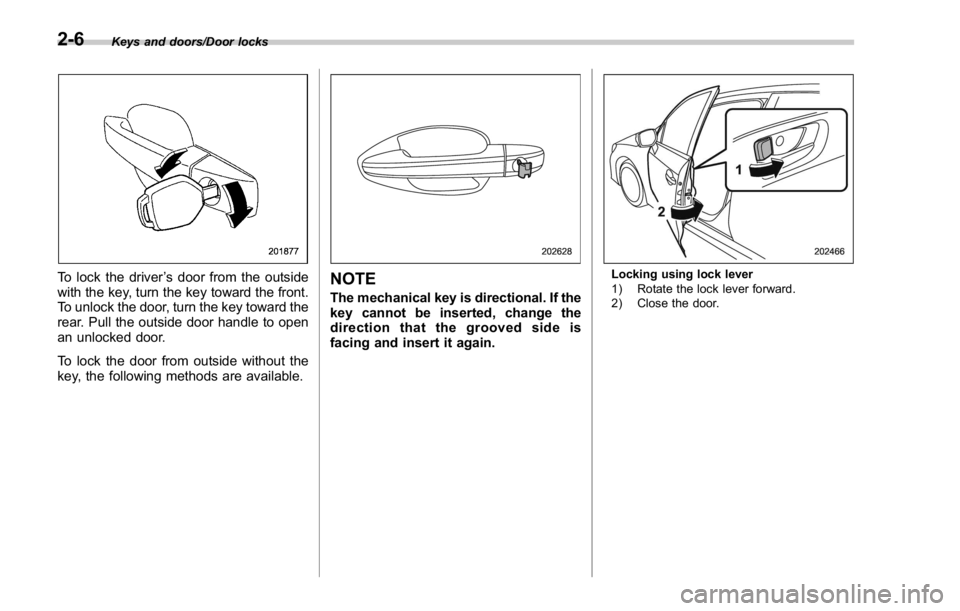
To lock the driver ’ s door from the outside
with the key, turn the key toward the front.
To unlock the door, turn the key toward the
rear. Pull the outside door handle to open
an unlocked door.
To lock the door from outside without the
key, the following methods are available. NOTE The mechanical key is directional. If the
key cannot be inserted, change the
direction that the grooved side is
facing and insert it again. Locking using lock lever
1) Rotate the lock lever forward.
2) Close the door.2-6