2016 SUBARU OUTBACK Power
[x] Cancel search: PowerPage 455 of 572
the shift lever into the“1st”position.
2. Apply the parking brake firmly.
3. Secure the vehicle onto the carrier
properly with safety chains. Each safety
chain should be equally tightened and
care must be taken not to pull the chains
so tightly that the suspension bottoms out.
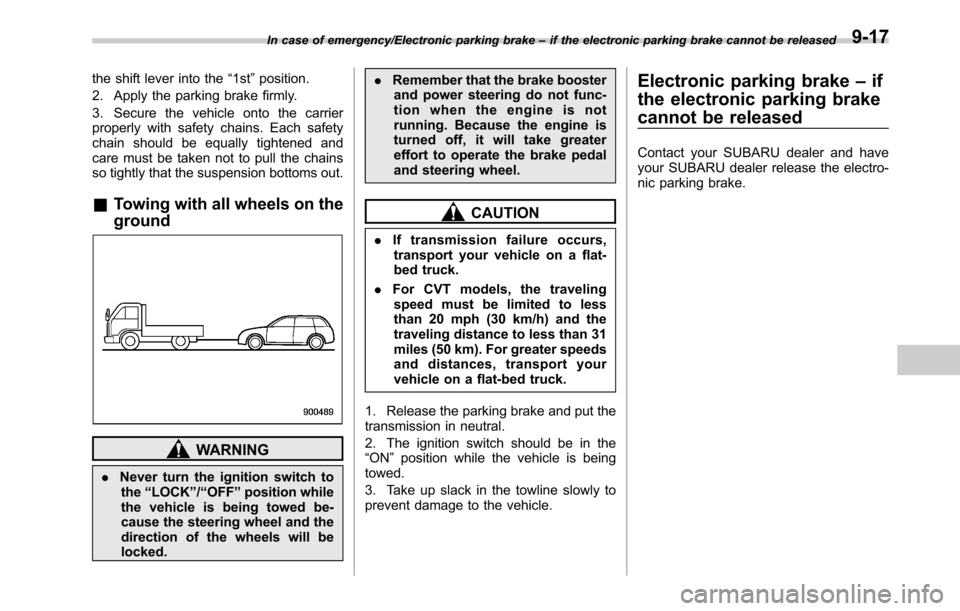
&Towing with all wheels on the
ground
WARNING
.Never turn the ignition switch to
the“LOCK”/“OFF”position while
the vehicle is being towed be-
cause the steering wheel and the
direction of the wheels will be
locked..Remember that the brake booster
and power steering do not func-
tion when the engine is not
running. Because the engine is
turned off, it will take greater
effort to operate the brake pedal
and steering wheel.
CAUTION
.If transmission failure occurs,
transport your vehicle on a flat-
bed truck.
.For CVT models, the traveling
speed must be limited to less
than 20 mph (30 km/h) and the
traveling distance to less than 31
miles (50 km). For greater speeds
and distances, transport your
vehicle on a flat-bed truck.
1. Release the parking brake and put the
transmission in neutral.
2. The ignition switch should be in the
“ON”position while the vehicle is being
towed.
3. Take up slack in the towline slowly to
prevent damage to the vehicle.
Electronic parking brake–if
the electronic parking brake
cannot be released
Contact your SUBARU dealer and have
your SUBARU dealer release the electro-
nic parking brake.
In case of emergency/Electronic parking brake–if the electronic parking brake cannot be released9-17
Page 456 of 572
In case of emergency/Access key–if access key does not operate properly
Access key–if access key
does not operate properly
CAUTION
Keep metallic objects, magnetic
sources and signal transmitters
away from the area between the
access key and the push-button
ignition switch. They may interfere
with the communication between
the access key and the push-button
ignition switch.
If the locking/unlocking procedures, power
switch procedures or engine start proce-
dures cannot be operated because of
strong radio signals in the surrounding
area or a low battery condition of the
access key, perform the following proce-
dure. When the battery of the access key
is discharged, replace it with a new one.
Refer to“Replacing battery of access key”
F11-50.
&Locking and unlocking
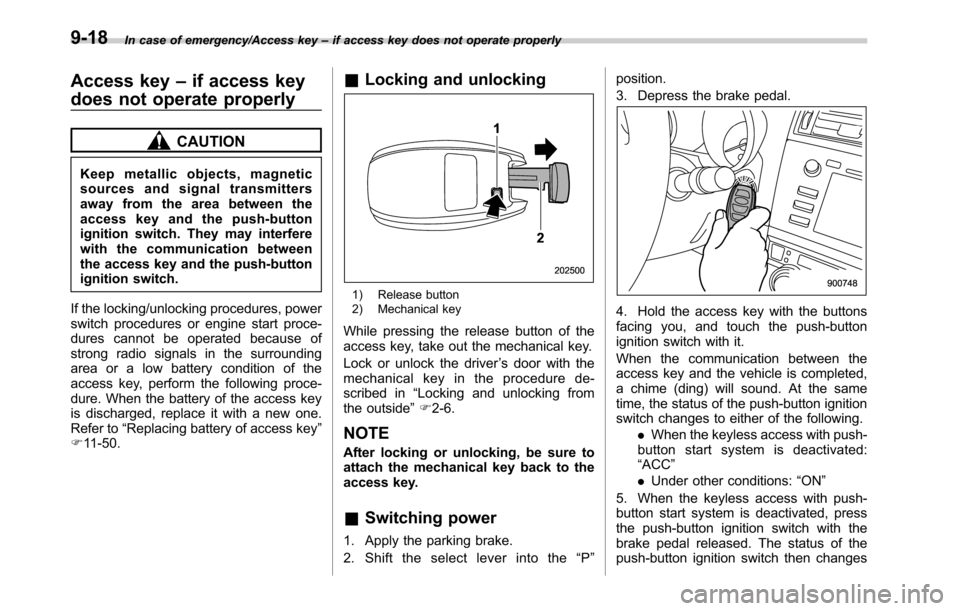
1) Release button
2) Mechanical key
While pressing the release button of the
access key, take out the mechanical key.
Lock or unlock the driver’s door with the
mechanical key in the procedure de-
scribed in“Locking and unlocking from
the outside”F2-6.
NOTE
After locking or unlocking, be sure to
attach the mechanical key back to the
access key.
&Switching power
1. Apply the parking brake.
2. Shift the select lever into the“P”position.
3. Depress the brake pedal.
4. Hold the access key with the buttons
facing you, and touch the push-button
ignition switch with it.
When the communication between the
access key and the vehicle is completed,
a chime (ding) will sound. At the same
time, the status of the push-button ignition
switch changes to either of the following.
.When the keyless access with push-
button start system is deactivated:
“ACC”
.Under other conditions:“ON”
5. When the keyless access with push-
button start system is deactivated, press
the push-button ignition switch with the
brake pedal released. The status of the
push-button ignition switch then changes
9-18
Page 457 of 572
to“ON”.
NOTE
If the power does not switch even
though the above procedure was fol-
lowed precisely, contact your SUBARU
dealer.
&Starting engine
1. Apply the parking brake.
2. Shift the select lever into the“P”
position.
3. Depress the brake pedal.
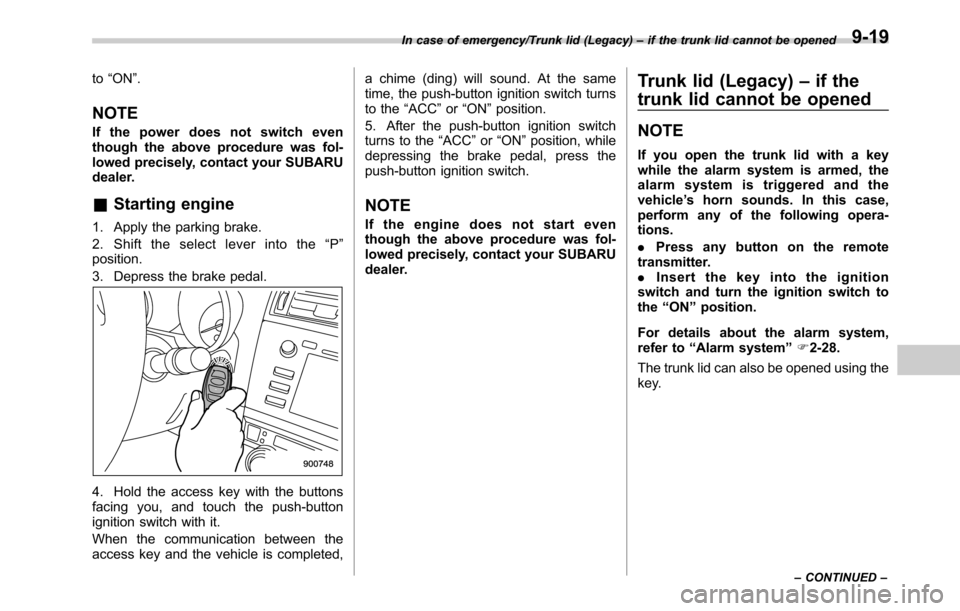
4. Hold the access key with the buttons
facing you, and touch the push-button
ignition switch with it.
When the communication between the
access key and the vehicle is completed,a chime (ding) will sound. At the same
time, the push-button ignition switch turns
to the“ACC”or“ON”position.
5. After the push-button ignition switch
turns to the“ACC”or“ON”position, while
depressing the brake pedal, press the
push-button ignition switch.
NOTE
If the engine does not start even
though the above procedure was fol-
lowed precisely, contact your SUBARU
dealer.
Trunk lid (Legacy)–if the
trunk lid cannot be opened
NOTE
If you open the trunk lid with a key
while the alarm system is armed, the
alarm system is triggered and the
vehicle’s horn sounds. In this case,
perform any of the following opera-
tions.
.Press any button on the remote
transmitter.
.Insert the key into the ignition
switch and turn the ignition switch to
the“ON”position.
For details about the alarm system,
refer to“Alarm system”F2-28.
The trunk lid can also be opened using the
key.
In case of emergency/Trunk lid (Legacy)–if the trunk lid cannot be opened
–CONTINUED–9-19
Page 458 of 572
In case of emergency/Rear gate (Outback)–if the rear gate cannot be opened
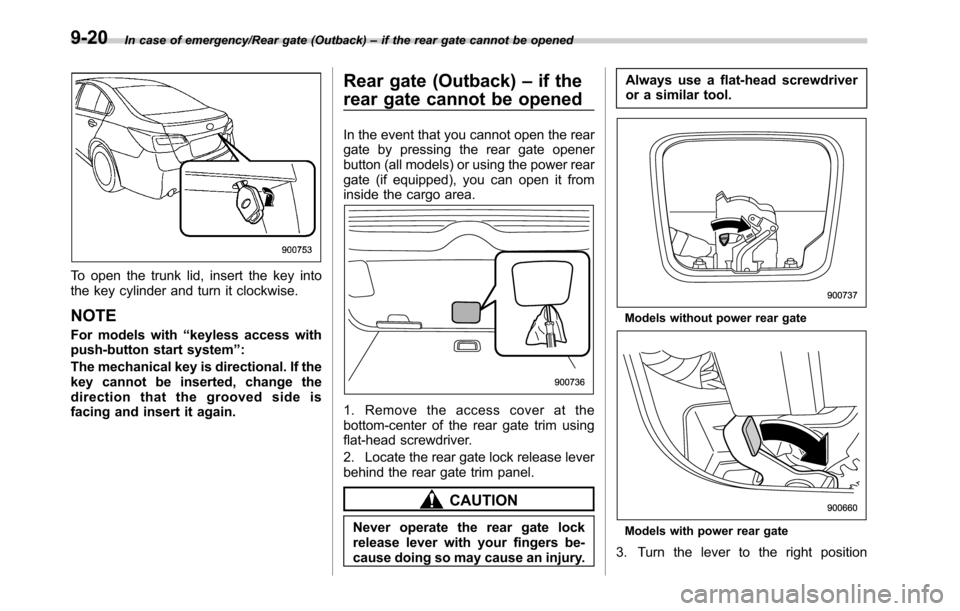
To open the trunk lid, insert the key into
the key cylinder and turn it clockwise.
NOTE
For models with“keyless access with
push-button start system”:
The mechanical key is directional. If the
key cannot be inserted, change the
direction that the grooved side is
facing and insert it again.
Rear gate (Outback)–if the
rear gate cannot be opened
In the event that you cannot open the rear
gate by pressing the rear gate opener
button (all models) or using the power rear
gate (if equipped), you can open it from
inside the cargo area.
1. Remove the access cover at the
bottom-center of the rear gate trim using
flat-head screwdriver.
2. Locate the rear gate lock release lever
behind the rear gate trim panel.
CAUTION
Never operate the rear gate lock
release lever with your fingers be-
cause doing so may cause an injury.Always use a flat-head screwdriver
or a similar tool.
Models without power rear gate
Models with power rear gate
3. Turn the lever to the right position
9-20
Page 459 of 572
using a flat-head screwdriver or a similar
tool. Then the rear gate will open.Power rear gate - if power
rear gate does not operate
properly
&When the power rear gate is
deactivated
CAUTION
When operating the power rear gate
manually, do not use excessive
force. Doing so may cause a mal-
function.
NOTE
While the power rear gate is tempora-
rily deactivated, if it is struck by body
parts or objects and sustains a strong
impact, the temporary deactivation
may be canceled. The purpose of this
is to absorb the impact of the collision
and it is not a malfunction. In this case,
the rear gate will not open or close
automatically.
If the power rear gate senses a malfunc-
tion, an electronic chirp will sound and the
rear gate will stop opening or closing.
In order for the rear gate to open and close
automatically, carry out the following
operation. If the rear gate does not openand close automatically after carrying out
this operation, we recommend that you
have the vehicle checked at a SUBARU
dealer.
!When the rear gate is closed
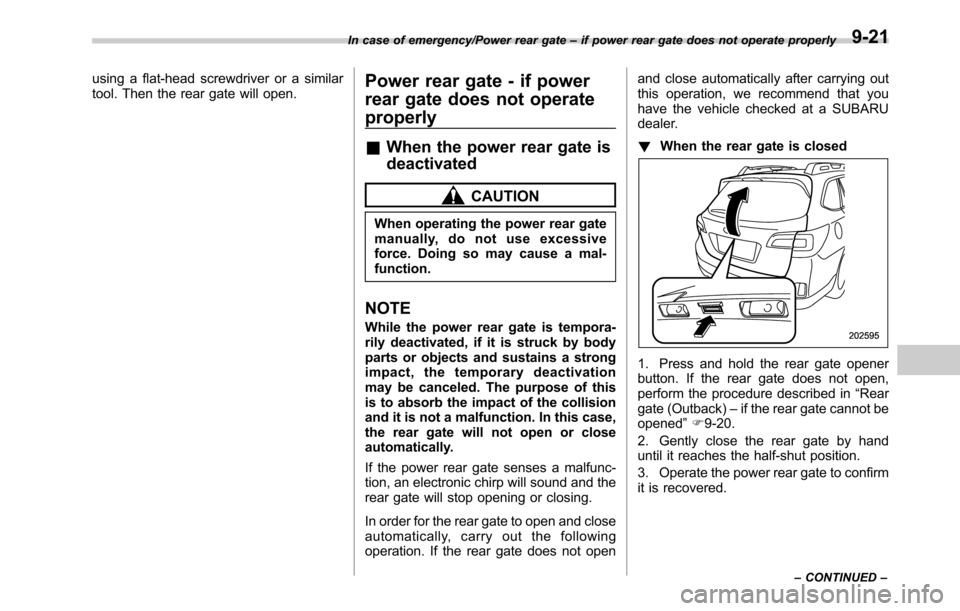
1. Press and hold the rear gate opener
button. If the rear gate does not open,
perform the procedure described in“Rear
gate (Outback)–if the rear gate cannot be
opened”F9-20.
2. Gently close the rear gate by hand
until it reaches the half-shut position.
3. Operate the power rear gate to confirm
it is recovered.
In case of emergency/Power rear gate–if power rear gate does not operate properly
–CONTINUED–9-21
Page 460 of 572

In case of emergency/If your vehicle is involved in an accident
!When the rear gate is stuck at the
fully open position or does not fully
close
If the rear gate cannot be closed due to a
dead battery, etc., while the rear gate is
stopped midway, it can be closed by hand.
1. Gently close the rear gate by hand
until it reaches the half-shut position.
2. Operate the power rear gate to confirm
it is recovered.
&When the rear gate cannot be
opened
Perform the procedure described in“Rear
gate (Outback)–if the rear gate cannot be
opened”F9-20.
&When the rear gate cannot be
closed
CAUTION
.On areas which are not flat, such
as hills, do not conduct any of
the following actions. The rear
gate may close suddenly and hit
someone’s head, face or catch
fingers and body parts in it,
resulting in injury.
.Even while conducting the fol-
lowing actions on a flat surface,be careful not to be injured by
getting caught in or hit by the
rear gate.
.When operating the power rear
gate manually, do not use exces-
sive force. Doing so may cause a
malfunction.
.After closing the rear gate by the
following methods, we recom-
mend that you have the vehicle
checked at a SUBARU dealer.
If the rear gate cannot be closed due to a
dead battery, etc., while the rear gate is
stopped midway, it can be closed by hand.
1. Gently close the rear gate by hand
until it reaches the half-shut position.
2. Operate the power rear gate to confirm
it is recovered.
If your vehicle is involved in
an accident
CAUTION
If your vehicle is involved in an
accident, be sure to inspect the
ground under the vehicle before
restarting the engine. If you find that
fuel has leaked on the ground, do
not try to restart the engine. The fuel
system has been damaged and is in
need of repair. Immediately contact
the nearest automotive service facil-
ity. We recommend that you consult
your SUBARU dealer.
Your vehicle has a fuel pump shut off
system. To minimize the risk of fire due to
fuel leakage when the engine stalls or an
airbag inflates upon collision, the system
stops supplying fuel to the engine.
Perform the following procedures to re-
start the engine after the system is
activated.
Models without“keyless access with
push-button start system”:
1. Turn the ignition switch to the“LOCK”
or“ACC”position.
2. Restart the engine.
9-22
Page 464 of 572

Appearance care/Exterior care
Exterior care
&Washing
CAUTION
.When washing the vehicle, the
brakes may get wet. As a result,
the brake stopping distance will
be longer. To dry the brakes,
drive the vehicle at a safe speed
while lightly pressing the brake
pedal to heat up the brakes.
.Do not wash the engine compart-
ment and areas adjacent to it. If
water enters the engine air in-
take, electrical parts or the power
steering fluid reservoir, it will
cause engine trouble or a mal-
function of the power steering.
.Do not use any organic solvents
when washing the surface of the
bulb assembly cover. However, if
a detergent with organic solvents
is used to wash the cover sur-
face, completely rinse off the
detergent with water. Otherwise,
the cover surface may be da-
maged.
.Outback: Since your vehicle is
equipped with a rear wiper, auto-
matic car-wash brushes couldbecome tangled around it, dama-
ging the wiper arm and other
components. Ask the automatic
car-wash operator not to let the
brushes touch the wiper arm or
to fix the wiper arm on the rear
window glass with adhesive tape
before operating the machine.
NOTE
When having your vehicle washed in
an automatic car wash, make sure
beforehand that the car wash is of
suitable type.
The best way to preserve your vehicle’s
beauty is frequent washing. Wash the
vehicle at least once a month to avoid
contamination by road grime.
Wash dirt off with a wet sponge and plenty
of lukewarm or cold water. Do not wash
the vehicle with hot water and in direct
sunlight.
Salt, chemicals, insects, tar, soot, tree
sap, and bird droppings should be washed
off by using a light detergent, as required.
If you use a light detergent, make certain
that it is a neutral detergent. Do not use
strong soap or chemical detergents. All
cleaning agents should be promptly
flushed from the surface and not allowedto dry there. Rinse the vehicle thoroughly
with plenty of lukewarm water. Wipe the
remaining water off with a chamois or soft
cloth.
!Washing the underbody
Chemicals, salts and gravel used for
deicing road surfaces are extremely cor-
rosive, accelerating the corrosion of un-
derbody components, such as the exhaust
system, fuel and brake lines, brake
cables, floor pan and fenders, and sus-
pension.
Thoroughly flush the underbody and in-
side of the fenders with lukewarm or cold
water at frequent intervals to reduce the
harmful effects of such agents.
Mud and sand adhering to the underbody
components may accelerate their corro-
sion.
After driving off-road or on muddy or
sandy roads, wash the mud and sand off
the underbody.
Carefully flush the suspension and axle
parts, as they are particularly prone to
mud and sand buildup. Do not use a
sharp-edged tool to remove caked mud.
CAUTION
.Be careful not to damage brake
hoses, sensor harnesses, and
10-2
Page 543 of 572

The vehicle placard shows original
tire size, recommended cold tire
inflation pressure on each tire at
maximum loaded vehicle weight,
seating capacity and loading infor-
mation.
!Adverse safety consequences
of under-inflation
CAUTION
Driving at high speeds with
excessively low tire pressures
can cause the tires to flex
severely and to rapidly be-
come hot. A sharp increase
in temperature could cause
tread separation, and failure
of the tire(s). Possible result-
ing loss of vehicle control
could lead to an accident.
!Measuring and adjusting air
pressure to achieve proper in-
flation
Check and, if necessary, adjust the
pressure of each tire (including the
spare) at least once a month andbefore any long journey. Check the
tire pressures when the tires are
cold. Use a pressure gauge to
adjust the tire pressures to the
specific values. Driving even a
short distance warms up the tires
and increases the tire pressures.
Also, the tire pressures are affected
by the outside temperature. It is
best to check tire pressure out-
doors before driving the vehicle.
When a tire becomes warm, the air
inside it expands, causing the tire
pressure to increase. Be careful not
to mistakenly release air from a
warm tire to reduce its pressure.
&Glossary of tire terminology
.Accessory weight
The combined weight (in excess of
those standard items which may be
replaced) of automatic transmis-
sion, power steering, power brakes,
power windows, power seats, radio,
and heater, to the extent that these
items are available as factory-in-
stalled equipment (whether in-stalled or not).
.Bead
The part of the tire that is made of
steel wires, wrapped or reinforced
by ply cords and that is shaped to fit
the rim.
.Bead separation
A breakdown of the bond between
components in the bead.
.Bias ply tire
A pneumatic tire in which the ply
cords that extend to the beads are
laid at alternate angles substantially
less than 90 degrees to the center-
line of the tread.
.Carcass
The tire structure, except tread and
sidewall rubber which, when in-
flated, bears the load.
.Chunking
The breaking away of pieces of the
tread or sidewall.
.Cold tire pressure
The pressure in a tire that has been
driven less than 1 mile or has been
standing for three hours or more.
Consumer information and Reporting safety defects/Tire information
–CONTINUED–13-5