2016 SUBARU IMPREZA remote start
[x] Cancel search: remote startPage 402 of 594

RPM
.The security alarm is triggered
. The select lever is not in the “P ”
position (CVT models)
If the system detects any door (including
the rear gate/trunk lid) open during opera-
tion, it will prevent starting or stop the
engine, and sound the horn and flash side
marker lights, tail lights, and parking lights
6 times.
In addition to the items above, if the
vehicle ’s engine management system
determines there is a safety risk due to a
vehicle-related problem, the vehicle will
power down and the horn will sound 3
times.
NOTE
. If the alarm system is armed at the
time of remote engine starter activation
(the security indicator light on the
combination meter is flashing), the
alarm system will remain armed
throughout the remote start run cycle.
. If the alarm system is disarmed at
the time of remote engine starter
activation (the security indicator light
on the combination meter is not flash-
ing), the alarm system will remain
disarmed throughout the remote start
run cycle. !
Remote start operation - fob con-
firmation
Your remote engine starter fob is a
bidirectional transceiver that can confirm
system operation with several different
visual and audible indications. The fob ’s
LED-backlit button and internal piezo
buzzer will indicate status of the system
using the following flash and beep se-
quences, provided the fob is within opera-
tional range of the system.
Starting and operating/Remote engine start system (dealer option)
–CONTINUED –7-17
Page 403 of 594

Starting and operating/Remote engine start system (dealer option)
PreconditionFob Indication
Meaning
Flash Beep
Fob start button is being pressed Continuous while button is
held down—
The fob is transmitting an RF signal
User attempts to start engine by pressing fob
button twice within 3 sec 1 flash 1 beep Engine start request received
2 flashes
2 beepsEngine started successfully
1 flash every 3 sec —Engine idling
3 flashes 3 beepsVehicle is in range but engine not started
2 long flashes —Vehicle not in range (engine not started)
Engine idling by remote engine start operation 1 flash every 3 sec
—Engine idling
3 flashes 3 beepsEngine stopped by system timeout or for safety
reasons (see sections above)
User attempts to stop engine by pressing and
holding fob button for at least 2 sec. 3 flashes
3 beepsEngine stopped by user request
1 flash every 3 sec —Stop request not received. Engine still idling.
7-18
Page 404 of 594

&Entering the vehicle while it
is running via remote start
1. Unlock the vehicle doors using the
keyless access function (if equipped) or
remote keyless entry system. If the vehi-
cle’s doors are unlocked manually using
the key, the vehicle’ s alarm system will
trigger (if the alarm system is armed prior
to activating the remote engine start
system) and the engine will turn off.
Perform either of the following procedures
to disarm the alarm system. Refer to
“Alarm system ”F 2-27.
. Insert the key into the ignition switch
and turn it to the “ON”position (models
without “keyless access with push-
button start system ”)
. Turn the push-button ignition switch
to the “ACC”or “ON ”position (models
with “keyless access with push-button
start system ”)
. Press any button on the access key/
remote keyless entry transmitter.
2. Enter the vehicle.
3. The engine will shut down when any
door or trunk/rear gate is opened.
4. Insert the key into the ignition switch
and turn to the “START”position to restart
the engine.
& Entering the vehicle follow-
ing remote engine start shut-
down
An alarm trigger may occur if the vehicle is
opened by the remote keyless entry
transmitter within a few seconds immedi-
ately following remote engine start shut-
down.
&Pre-heating or pre-cooling
the interior of the vehicle
Before exiting the vehicle, set the tem-
perature controls to the desired setting
and operation. After the system starts the
engine, the heater or air conditioning will
activate and heat or cool the interior to
your setting.
&Service mode (models with-
out “keyless access with
push-button start system ”)
In service mode, the remote engine start
function is temporarily disabled to prevent
the system from unexpectedly starting the
engine while being serviced.
To engage or disengage service mode:
1. Enter the vehicle and close all vehicle
doors and the trunk/rear gate.
2. Verify that the select lever is in the “P”
position (CVT models) 3. Depress and hold the brake pedal
4. Turn the ignition switch to the
“ON”
position
5. Press and release the remote engine
start transmitter “
”button three times.
The system will honk the vehicle ’s horn
each time the button is pressed.
6. The system will pause for 1 second
then honk the vehicle’ s horn three times to
indicate that the service mode has been
engaged or honk one time to indicate that
the service mode has been disengaged.
NOTE
When taking your vehicle in for service,
it is recommended that you inform the
service personnel that your vehicle is
equipped with a remote engine start
system.
& Remote transmitter program
(models without “keyless ac-
cess with push-button start
system ”)
New transmitters can be programmed to
the remote engine start system in the
event that a transmitter is lost, stolen,
damaged or additional transmitters are
desired (the system will accept up to eight
transmitters). New remote engine start
transmitters can be programmed accord-
Starting and operating/Remote engine start system (dealer option)
–CONTINUED –7-19
Page 405 of 594

Starting and operating/Remote engine start system (dealer option)
ing to the following procedure.
1. Open the driver’s door (the driver ’s
door must remain opened throughout the
entire process).
2. Depress and hold the brake pedal.
3. Turn the ignition switch to “ON”then
“LOCK” /“OFF ”, back to “ON”then “LOCK”/
“OFF ”, back to “ON”then “LOCK” /“OFF ”,
then back to “ON”again and leave the
ignition “ON”throughout the programming
process.
4. The system will flash the side marker
lights, tail lights and parking lights and
honk the horn three times, indicating that
the system has entered the transmitter
learn mode.
5. Press and release the “
”button on
the transmitter that you want to program.
6. The system will flash the side marker
lights, tail lights and parking lights and
honk the horn one time, indicating that the
system has learned the transmitter. Upon
successful programming, the remote start
confirmation transmitter button will flash
one time.
7. Repeat step 5 for any additional
transmitters (the system will accept up to
eight transmitters).
8. The system will exit the transmitter
learn mode if the key is turned to the
“LOCK”/ “OFF ”position, the door is closed or after 2 minutes.
&
System maintenance
NOTE
For models without “keyless access
with push-button start system”:
In the event that the vehicle ’s battery is
replaced, discharged or disconnected,
it will be necessary to start the vehicle
a minimum of one time using the key
prior to activating the remote engine
start system. This is required to allow
the vehicle electronic systems to re-
synchronize.
! Changing the batteries
CAUTION
.Do not let dust, oil or water get on
or in the remote engine start
transmitter when replacing the
battery.
. Be careful not to damage the
printed circuit board in the re-
mote engine start transmitter
when replacing the battery.
. Be careful not to allow children to
touch the battery and any re-
moved parts; children could
swallow them. .
There is a danger of explosion if
an incorrect replacement battery
is used. Replace only with the
same or equivalent type of bat-
tery.
. Batteries should not be exposed
to excessive heat such as sun-
shine, fire or the like.
For models with “keyless access with
push-button start system ”:
Perform the procedure described in “Re-
placing battery of access key ”F 11-44.
For models without “keyless access
with push-button start system”:
The two 3-volt lithium batteries (model
CR-2032) supplied in your remote engine
start transmitter should last approximately
one year, depending on usage. When the
batteries begin to weaken, you will notice
a decrease in range (distance from the
vehicle that your remote control operates).
Follow the instructions below to change
the remote engine start transmitter bat-
teries.
7-20
Page 406 of 594
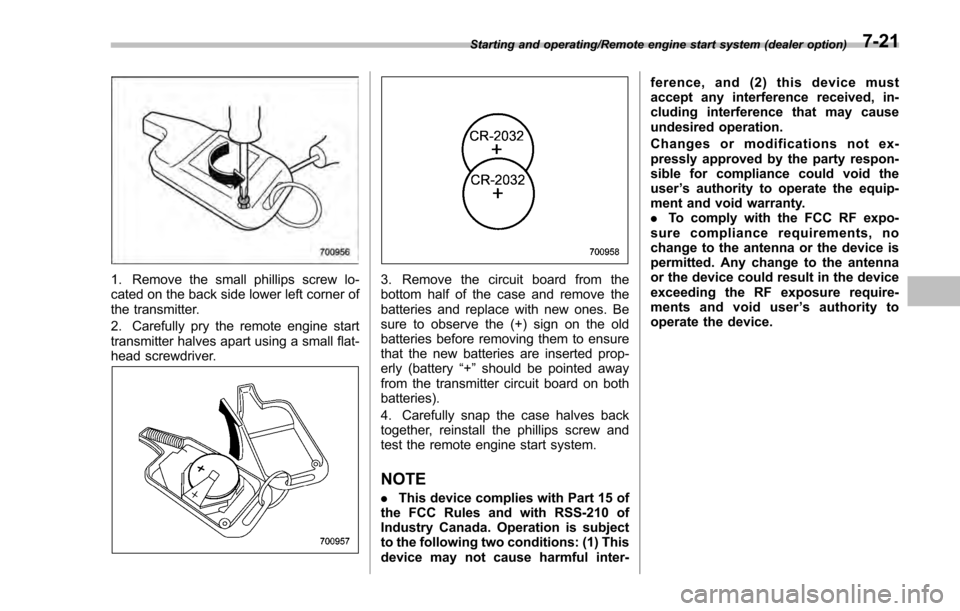
1. Remove the small phillips screw lo-
cated on the back side lower left corner of
the transmitter.
2. Carefully pry the remote engine start
transmitter halves apart using a small flat-
head screwdriver.3. Remove the circuit board from the
bottom half of the case and remove the
batteries and replace with new ones. Be
sure to observe the (+) sign on the old
batteries before removing them to ensure
that the new batteries are inserted prop-
erly (battery“+”should be pointed away
from the transmitter circuit board on both
batteries).
4. Carefully snap the case halves back
together, reinstall the phillips screw and
test the remote engine start system.
NOTE
. This device complies with Part 15 of
the FCC Rules and with RSS-210 of
Industry Canada. Operation is subject
to the following two conditions: (1) This
device may not cause harmful inter- ference, and (2) this device must
accept any interference received, in-
cluding interference that may cause
undesired operation.
Changes or modifications not ex-
pressly approved by the party respon-
sible for compliance could void the
user
’s authority to operate the equip-
ment and void warranty.
. To comply with the FCC RF expo-
sure compliance requirements, no
change to the antenna or the device is
permitted. Any change to the antenna
or the device could result in the device
exceeding the RF exposure require-
ments and void user ’s authority to
operate the device.
Starting and operating/Remote engine start system (dealer option)7-21
Page 499 of 594
Maintenance and service/Maintenance precautions
erative. NEVER use a circuit
tester for this wiring. If your
SRS airbag or seatbelt preten-
sioner needs service, consult
your nearest SUBARU dealer.
NOTE
SUBARU does not endorse the use of
non-SUBARU approved flushing sys-
tems and strongly advises against
performing these services on a
SUBARU vehicle. Non-SUBARU ap-
proved flushing systems use chemi-
cals and/or solvents which have not
been tested or approved by SUBARU.
SUBARU warranties do not cover any
part of the vehicle which is damaged by
adding or applying chemicals and/or
solvents other than those approved or
recommended by SUBARU.
&Before checking or servicing
in the engine compartment
WARNING
. Always stop the engine and apply
the parking brake firmly to pre-
vent the vehicle from moving.
. Always let the engine cool down.
Engine parts become very hot when the engine is running and
remain hot for some time after
the engine has stopped.
. Do not spill engine oil, engine
coolant, brake fluid or any other
fluid on hot engine components.
This may cause a fire.
. When the ignition switch is in the
“ON ”position, the cooling fan
may operate suddenly even
when the engine is stopped. If
your body or clothes come into
contact with a rotating fan, that
could result in serious injury. To
avoid risk of injury, perform the
following precautions.
– Models with push-button start
system:
Always turn the push-button
ignition switch to the “OFF”
position and confirm that the
operation indicator on the
switch is turned off. Then take
the access key out from the
vehicle.
– Models without push-button
start system:
Always remove the key from
the ignition switch.
. Before performing any servicing
on a vehicle equipped with a remote engine start system (a
dealer option), temporarily place
the remote engine start system in
service mode to prevent it from
unexpectedly starting the engine.
&
When checking or servicing
in the engine compartment
CAUTION
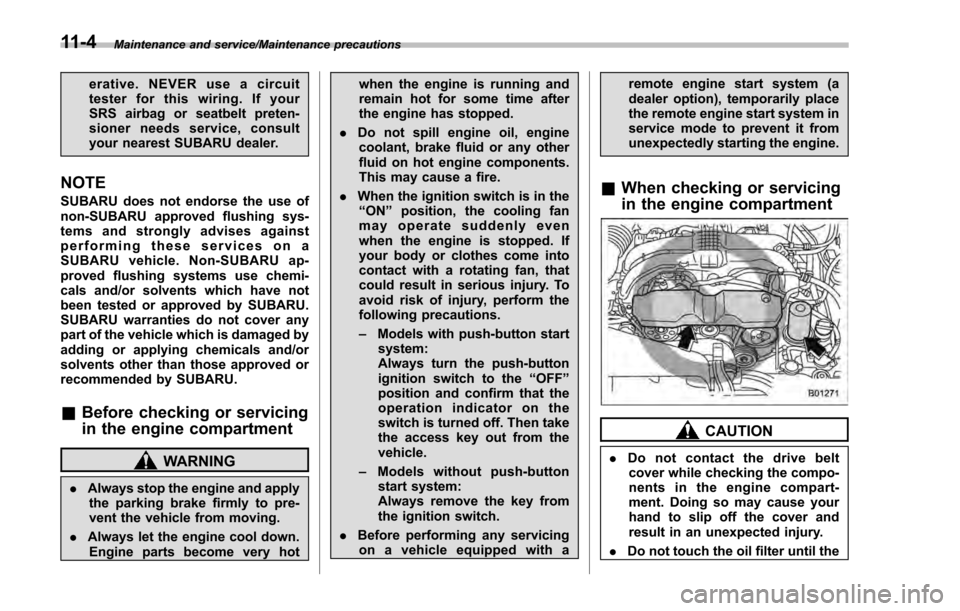
. Do not contact the drive belt
cover while checking the compo-
nents in the engine compart-
ment. Doing so may cause your
hand to slip off the cover and
result in an unexpected injury.
. Do not touch the oil filter until the
11-4
Page 579 of 594

14-2Index
A
Abbreviation................................................................... 3
ABS (Anti-lock Brake System) ..................................... 7-32
Warning light ......................................................... 3-21
Access key ................................................................. 2-9
Warning indicator ................................................... 3-25
Accessories .............................................................. 11-36
Accessory power outlet ................................................. 6-8
Air cleaner element ................................................... 11-12
Air conditioner Automatic climate control .......................................... 4-7
Manual climate control .............................................. 4-8
Air filtration system ..................................................... 4-12
Air flow mode .............................................................. 4-8
Alarm system ............................................................ 2-27
All-Wheel Drive warning light ....................................... 3-23
Aluminum wheel ....................................................... 11-28
Cleaning ............................................................... 10-3
Antenna ...................................................................... 5-2
Anti-lock Brake System (ABS) ..................................... 7-32
Arming the system ..................................................... 2-29
Armrest ....................................................................... 1-8
Ashtray ..................................................................... 6-10
AT OIL TEMP warning light ......................................... 3-19
Audio aha
TMby HARMAN ................................................ 5-44
AM/FM radio ......................................................... 5-28
AUX ..................................................................... 5-61
Base display audio set. ............................................. 5-4
Basic operation ...................................................... 5-18
Bluetooth audio ...................................................... 5-58 CD ....................................................................... 5-53
iPod
...................................................................... 5-56
Pandora
®.............................................................. 5-50
SiriusXM Satellite Radio .......................................... 5-37
STARLINK
TM7.0 Multimedia Plus audio set ................ 5-6
Steering switches for audio ...................................... 5-63
SUBARU STARLINK ............................................... 5-26
Unit setting ............................................................ 5-19
USB memory ......................................................... 5-55
Auto on/off headlights ................................................. 3-89
Auto-dimming mirror/compass .......................... 3-100, 3-102
Automatic headlight beam leveler ................................. 3-94
Warning light .......................................................... 3-31
Automatic Locking Retractor/Emergency Locking Retractor (ALR/ELR) ................................................ 1-12
B
Battery Drainage prevention function ..................................... 2-7
Jump starting ......................................................... 9-10
Replacement (access key) ..................................... 11-44
Replacement (remote engine start transmitter) ........... 7-20
Replacement (transmitter) ...................................... 11-45
Vehicle battery ..................................................... 11-34
Bluetooth
®
Audio .................................................................... 5-58
Hands-free phone system ........................................ 5-71
Settings ................................................................. 5-66
Troubleshooting ...................................................... 5-89
Bluetooth
®settings ..................................................... 5-66
Booster seat .............................................................. 1-32
Page 585 of 594

14-8Index
Overheating engine.................................................... 9-13
P
Parking Brake ................................................................... 7-40
Brake stroke ......................................................... 11-21
Light .................................................................... 11-38
Tips...................................................................... 7-40
Periodic inspections ..................................................... 8-4
Petrol fuel ................................................................... 7-3
PIN Code Access ...................................................... 2-21
Power Door locking switch .................................................. 2-8
Outlets .................................................................... 6-8
Outside mirrors .................................................... 3-108
Steering ................................................................ 7-30
Steering warning light ............................................. 3-23
Windows ............................................................... 2-35
Precautions against vehicle modification ............... 1-24, 1-70
Preparing to drive ........................................................ 7-8
Push-button Ignition switch .......................................................... 3-6
Starting and stopping engine ................................... 7-12
R
Rear Combination lights ................................................. 11-38
Differential gear oil ........................................ 11-15, 12-6
Gate ............................................................. 2-41, 9-19
Turn signal light .................................................... 11-38
Rear seat .................................................................... 1-7 Armrest
.................................................................. 1-8
Folding down ......................................................... 1-10
Head restraint adjustment ......................................... 1-8
Rear view camera ...................................................... 6-15
How to adjust the rear view image ............................ 5-25
Rear window Defogger ............................................................. 3-108
Wiper and washer switch ......................................... 3-99
Wiper blades ........................................................ 11-32
Recommended Brake fluid ............................................................. 12-7
Continuously variable transmission fluid .................... 12-7
Engine oil .............................................................. 12-4
Front differential gear oil .......................................... 12-6
Rear differential gear oil .......................................... 12-6
Spark plugs ........................................................... 12-7
Refueling .................................................................... 7-5
Remote engine start system ........................................ 7-14
Remote keyless entry system ...................................... 2-23
Replacement Access key battery ............................................... 11-44
Air cleaner element ............................................... 11-13
Brake pad and lining ............................................. 11-20
Lost transmitters (remote keyless entry system) ......... 2-26
Remote engine start transmitter battery ..................... 7-20
Remote keyless entry transmitter battery ................. 11-45
Wiper blades ........................................................ 11-30
Replacing bulbs.............................................
11-36, 12-14
Backup light ......................................................... 11-38
Cargo area light ................................................... 11-42
Dome light ........................................................... 11-42