2016 SUBARU IMPREZA clutch
[x] Cancel search: clutchPage 496 of 594

Maintenance schedule....................................... 11-3
Maintenance precautions ................................... 11-3
Before checking or servicing in the engine
compartment .................................................... 11-4
When checking or servicing in the engine compartment .................................................... 11-4
When checking or servicing in the engine compartment while the engine is running .......... 11-5
Engine hood....................................................... 11-5
Engine compartment overview .......................... 11-7
Engine oil ............................................................ 11-8
Engine oil consumption ...................................... 11-8
Locations of the oil level gauge, oil filler cap and oil filter ............................................................ 11-8
Checking the oil level ......................................... 11-8
Changing the oil and oil filter .............................. 11-9
Recommended grade and viscosity .................. 11-10
Synthetic oil ..................................................... 11-10
Cooling system ................................................ 11-10Safety precautions ........................................... 11-10
Cooling fan, hose and connections ................... 11-11
Engine coolant ................................................. 11-11
Air cleaner element .......................................... 11-12Replacing the air cleaner element ..................... 11-13
Spark plugs...................................................... 11-14Recommended spark plugs .............................. 11-14
Drive belts........................................................ 11-14
Manual transmission oil .................................. 11-14
Recommended grade and viscosity .................. 11-14
Continuously variable transmission fluid ....... 11-15Front differential gear oil (CVT models)
......... 11-15
Recommended grade and viscosity.................. 11-15
Rear differential gear oil.................................. 11-15Recommended grade and viscosity .................. 11-15
Brake fluid........................................................ 11-16Checking the fluid level .................................... 11-16
Recommended brake fluid ............................... 11-16
Clutch fluid (MT models)................................. 11-17Checking the fluid level.................................... 11-17
Recommended clutch fluid ............................... 11-17
Brake booster.................................................. 11-18
Brake pedal ...................................................... 11-18
Checking the brake pedal free play .................. 11-18
Checking the brake pedal reserve distance ....... 11-18
Clutch pedal (MT models) ............................... 11-19Checking the clutch function ............................ 11-19
Checking the clutch pedal free play .................. 11-19
Hill start assist system.................................... 11-19
Replacement of brake pad and lining ............ 11-20
Breaking-in of new brake pads and linings ....... 11-20
Parking brake stroke ....................................... 11-21
Tires and wheels .............................................. 11-21
Types of tires................................................... 11-21
Tire pressure monitoring system (TPMS) (if equipped) ...................................................... 11-21
Tire inspection ................................................. 11-23
Tire pressures and wear .................................. 11-23
Wheel balance ................................................. 11-25
Wear indicators ............................................... 11-25
Tire rotation direction mark .............................. 11-26
Maintenance and service
11
Page 502 of 594
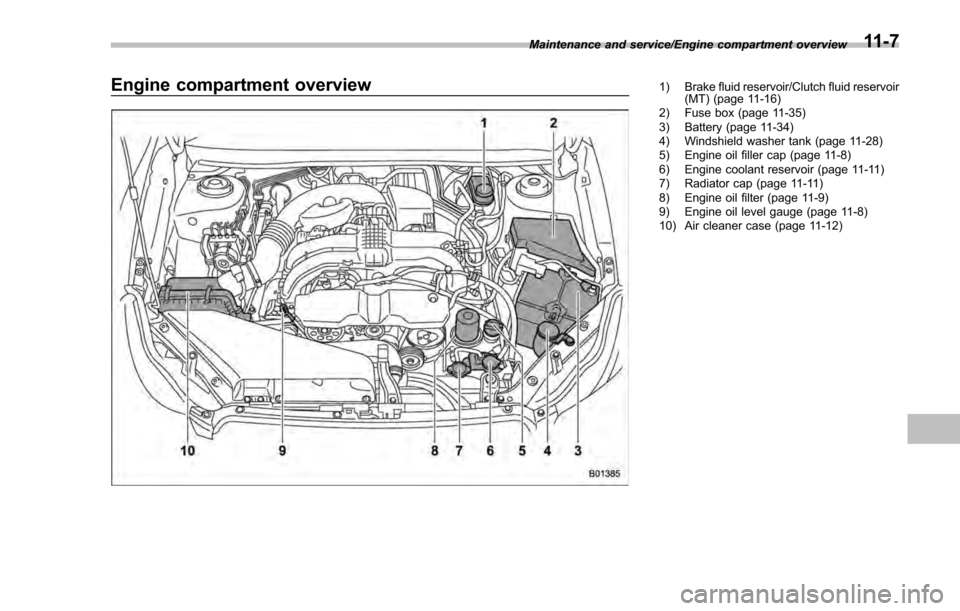
Engine compartment overview1) Brake fluid reservoir/Clutch fluid reservoir(MT) (page 11-16)
2) Fuse box (page 11-35)
3) Battery (page 11-34)
4) Windshield washer tank (page 11-28)
5) Engine oil filler cap (page 11-8)
6) Engine coolant reservoir (page 11-11)
7) Radiator cap (page 11-11)
8) Engine oil filter (page 11-9)
9) Engine oil level gauge (page 11-8)
10) Air cleaner case (page 11-12)
Maintenance and service/Engine compartment overview
11-7
Page 511 of 594
Maintenance and service/Brake fluid
Brake fluid
&Checking the fluid level
WARNING
. Never let brake fluid contact your
eyes because brake fluid can be
harmful to your eyes. If brake
fluid gets in your eyes, immedi-
ately flush them thoroughly with
clean water. For safety, when
performing this work, wearing
eye protection is advisable.
. Brake fluid absorbs moisture
from the air. Any absorbed moist-
ure can cause a dangerous loss
of braking performance.
. If the vehicle requires frequent
refilling, there may be a leak. If
you suspect a problem, have the
vehicle checked at your SUBARU
dealer.
CAUTION
. When adding brake fluid, be care-
ful not to allow any dirt into the
reservoir.
. Never splash the brake fluid over
painted surfaces or rubber parts. Alcohol contained in the brake
fluid may damage them.
. Be careful not to spill brake fluid
when adding it. If brake fluid
touches the exhaust pipe, it may
cause a bad smell, smoke, and/or
a fire. If brake fluid gets on the
exhaust pipe, be sure to wipe it
off.
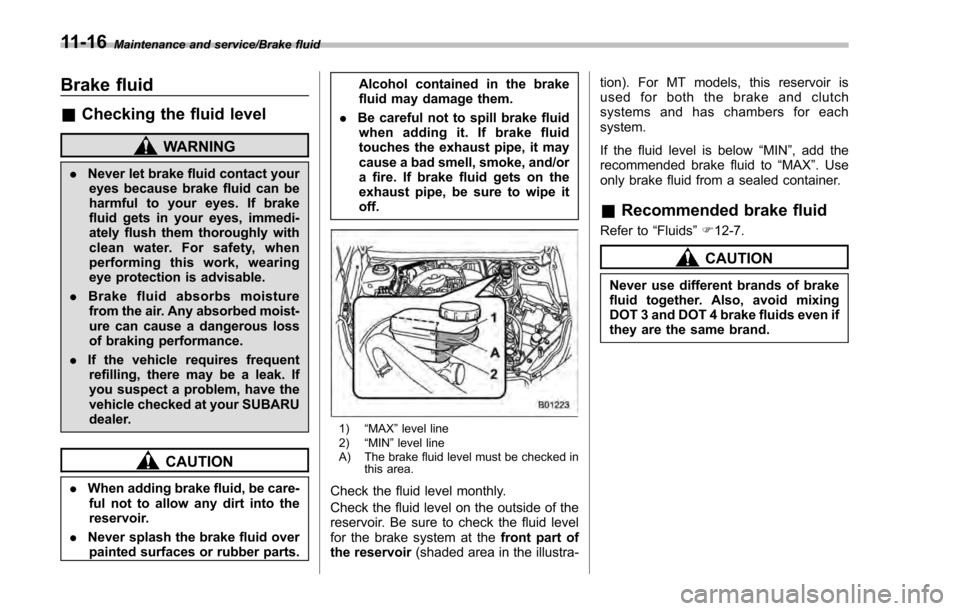
1) “MAX ”level line
2) “MIN ”level line
A) The brake fluid level must be checked in this area.
Check the fluid level monthly.
Check the fluid level on the outside of the
reservoir. Be sure to check the fluid level
for the brake system at the front part of
the reservoir (shaded area in the illustra- tion). For MT models, this reservoir is
used for both the brake and clutch
systems and has chambers for each
system.
If the fluid level is below
“MIN”, add the
recommended brake fluid to “MAX”. Use
only brake fluid from a sealed container.
& Recommended brake fluid
Refer to “Fluids ”F 12-7.
CAUTION
Never use different brands of brake
fluid together. Also, avoid mixing
DOT 3 and DOT 4 brake fluids even if
they are the same brand.
11-16
Page 512 of 594
Clutch fluid (MT models)
&Checking the fluid level
WARNING
Never let clutch fluid contact your
eyes because clutch fluid can be
harmful to your eyes. If clutch fluid
gets in your eyes, immediately flush
them thoroughly with clean water.
For safety, when performing this
work, wearing eye protection is
advisable.
CAUTION
. Clutch fluid absorbs moisture
from the air. Any absorbed moist-
ure can cause improper clutch
operation.
. If the vehicle requires frequent
refilling, there may be a leak. If
you suspect a problem, have the
vehicle checked at your SUBARU
dealer.
. When clutch fluid is added, be
careful not to allow any dirt into
the tank.
. Never splash the clutch fluid over
painted surfaces or rubber parts. Alcohol contained in the clutch
fluid may damage them.
. Be careful not to spill clutch fluid
when adding it. If clutch fluid
touches the exhaust pipe, it may
cause a bad smell, smoke, and/or
a fire. If clutch fluid gets on the
exhaust pipe, be sure to wipe it
off.
. The fluid level for the clutch
system must be checked at the
inboard side of the reservoir. It
cannot be checked at the out-
board side of the reservoir.
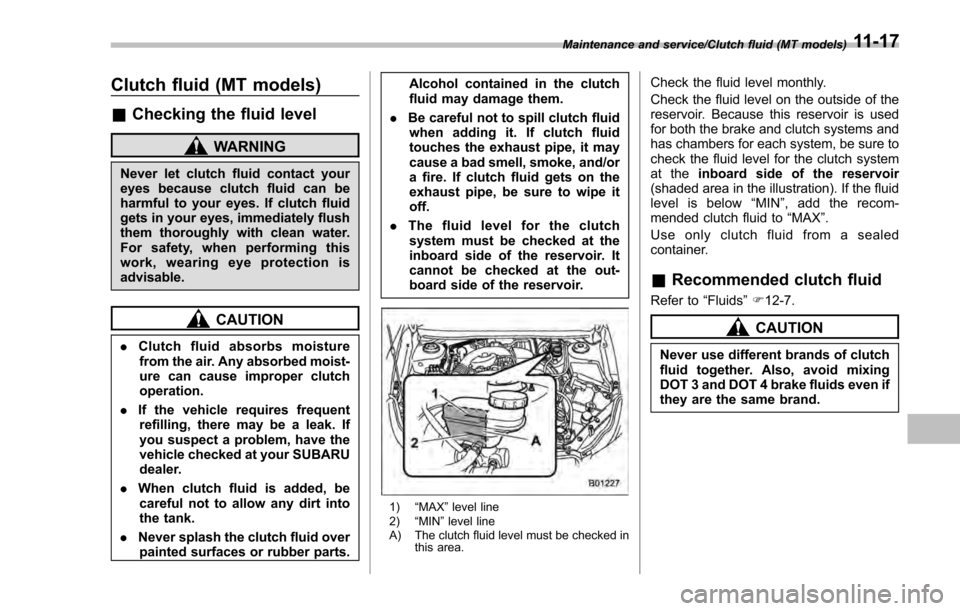
1) “MAX ”level line
2) “MIN ”level line
A) The clutch fluid level must be checked in this area.
Check the fluid level monthly.
Check the fluid level on the outside of the
reservoir. Because this reservoir is used
for both the brake and clutch systems and
has chambers for each system, be sure to
check the fluid level for the clutch system
at the inboard side of the reservoir
(shaded area in the illustration). If the fluid
level is below “MIN ”,addtherecom-
mended clutch fluid to “MAX”.
Use only clutch fluid from a sealed
container.
& Recommended clutch fluid
Refer to “Fluids ”F 12-7.
CAUTION
Never use different brands of clutch
fluid together. Also, avoid mixing
DOT 3 and DOT 4 brake fluids even if
they are the same brand.
Maintenance and service/Clutch fluid (MT models)11-17
Page 514 of 594
Clutch pedal (MT models)
Check the clutch pedal free play and
reserve distance according to the main-
tenance schedule in the“Warranty and
Maintenance Booklet ”.
&Checking the clutch function
Check the clutch engagement and disen-
gagement.
1. With the engine idling, check that there
are no abnormal noises when the clutch
pedal is depressed, and that shifting into
1st or reverse feels smooth.
2. Start the vehicle by releasing the pedal
slowly to check that the engine and
transmission smoothly couple without
any sign of slippage.
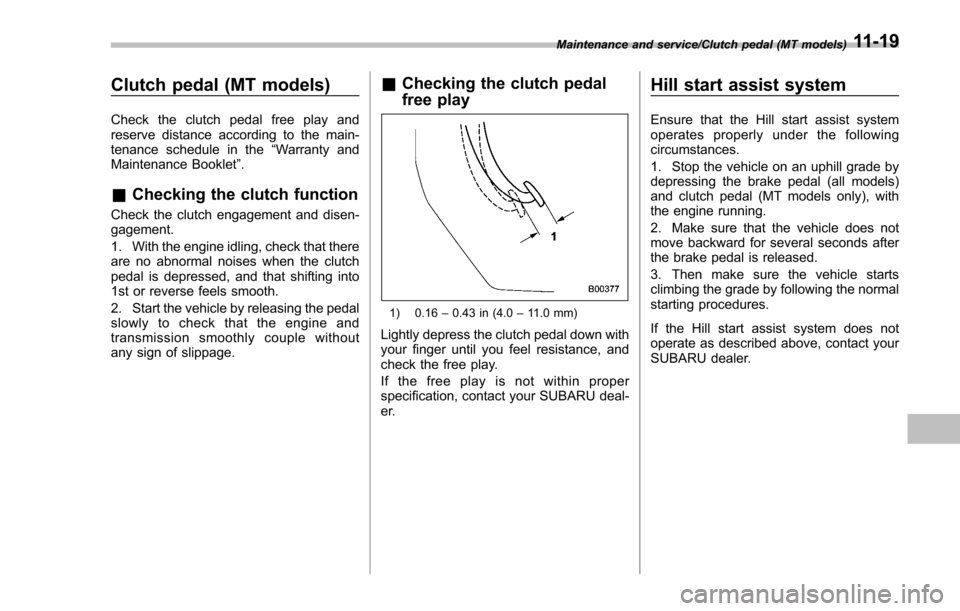
&Checking the clutch pedal
free play
1) 0.16 –0.43 in (4.0 –11.0 mm)
Lightly depress the clutch pedal down with
your finger until you feel resistance, and
check the free play.
If the free play is not within proper
specification, contact your SUBARU deal-
er.
Hill start assist system
Ensure that the Hill start assist system
operates properly under the following
circumstances.
1. Stop the vehicle on an uphill grade by
depressing the brake pedal (all models)
and clutch pedal (MT models only), with
the engine running.
2. Make sure that the vehicle does not
move backward for several seconds after
the brake pedal is released.
3. Then make sure the vehicle starts
climbing the grade by following the normal
starting procedures.
If the Hill start assist system does not
operate as described above, contact your
SUBARU dealer.
Maintenance and service/Clutch pedal (MT models)11-19
Page 548 of 594

&Fluids
Fluid
Fluid type*1Fluid capacity*2Remarks*3
Continuously variable transmission
fluid (CVT models) Consult your SUBARU dealer. 12.6 US qt (11.9 liters, 10.5 Imp qt) “
Continuously variable trans-
mission fluid ”F 11-15
Brake fluid FMVSS No. 116, fresh DOT 3 or DOT 4
brake fluid
–“
Brake fluid”F 11-16
Clutch fluid (MT models) FMVSS No. 116, fresh DOT 3 or DOT 4
brake fluid
–
“
Clutch fluid (MT models) ”F 11 -
17
*1: Use one of the indicated types of fluid.
*2: The indicated fluid quantity is only a guideline. The necessary quantity for replacement may differ slightly depending on the temperature and other
factors.
*3: For more details about maintenance and service, refer to the indicated section.
& Engine coolant
Vehicle model Coolant capacity Coolant type
MT models 8.5 US qt (8.0 liters, 7.0 Imp qt)
SUBARU Super Coolant
CVT models 8.9 US qt (8.4 liters, 7.4 Imp qt)
The indicated coolant quantity is only a guideline. The necessary quantity for replacement may differ slightly depending on the temperature and other
factors. For more details about maintenance and service, refer to “Cooling system ”F 11-10.
& Electrical system
Battery type 55D23L
Alternator 12V-130A
Spark plugs SILZKAR7B11 (NGK)Specifications/Specifications
–CONTINUED –
12-7
Page 552 of 594
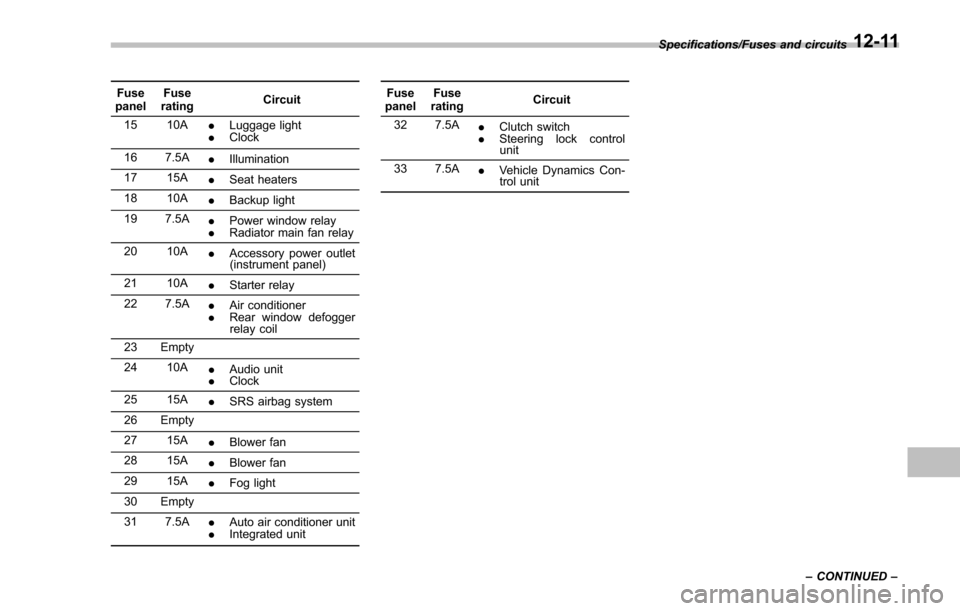
Fuse
panel Fuse
rating Circuit
15 10A .Luggage light
. Clock
16 7.5A .Illumination
17 15A .Seat heaters
18 10A .Backup light
19 7.5A .Power window relay
. Radiator main fan relay
20 10A .Accessory power outlet
(instrument panel)
21 10A .Starter relay
22 7.5A .Air conditioner
. Rear window defogger
relay coil
23 Empty
24 10A .Audio unit
. Clock
25 15A .SRS airbag system
26 Empty
27 15A .Blower fan
28 15A .Blower fan
29 15A .Fog light
30 Empty
31 7.5A .Auto air conditioner unit
. Integrated unit Fuse
panel Fuse
rating Circuit
32 7.5A .Clutch switch
. Steering lock control
unit
33 7.5A .Vehicle Dynamics Con-
trol unit Specifications/Fuses and circuits
–CONTINUED –
12-11
Page 580 of 594
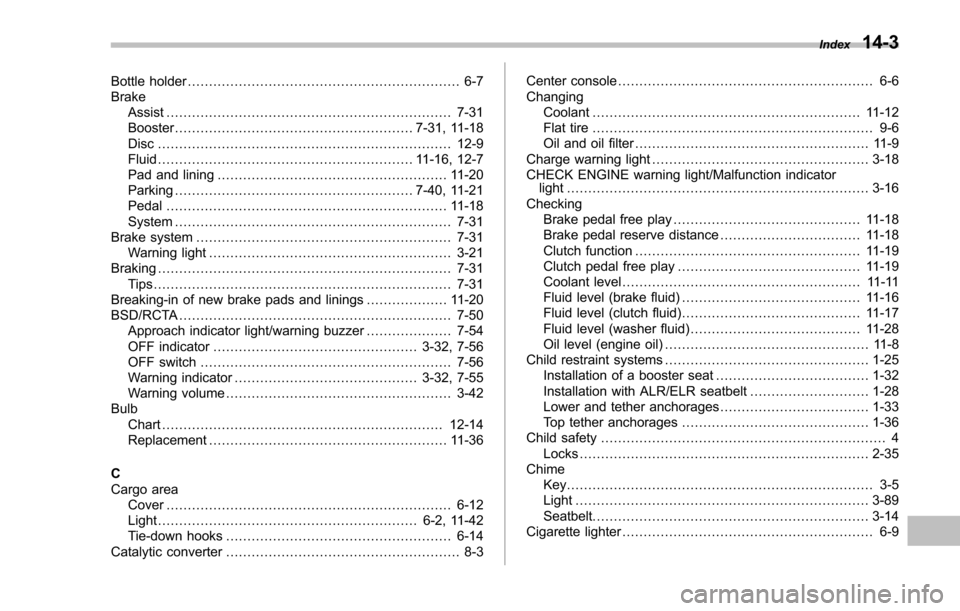
Bottle holder................................................................ 6-7
Brake Assist ................................................................... 7-31
Booster ........................................................ 7-31, 11-18
Disc ..................................................................... 12-9
Fluid ............................................................ 11-16, 12-7
Pad and lining ...................................................... 11-20
Parking ........................................................ 7-40, 11-21
Pedal .................................................................. 11-18
System ................................................................. 7-31
Brake system ............................................................ 7-31
Warning light ......................................................... 3-21
Braking ..................................................................... 7-31
Tips...................................................................... 7-31
Breaking-in of new brake pads and linings ................... 11-20
BSD/RCTA ................................................................ 7-50
Approach indicator light/warning buzzer .................... 7-54
OFF indicator ................................................ 3-32, 7-56
OFF switch ........................................................... 7-56
Warning indicator ........................................... 3-32, 7-55
Warning volume ..................................................... 3-42
Bulb
Chart .................................................................. 12-14
Replacement ........................................................ 11-36
C
Cargo area Cover ................................................................... 6-12
Light ............................................................. 6-2, 11-42
Tie-down hooks ..................................................... 6-14
Catalytic converter ....................................................... 8-3 Center console
............................................................ 6-6
Changing Coolant ............................................................... 11-12
Flat tire .................................................................. 9-6
Oil and oil filter ....................................................... 11-9
Charge warning light ................................................... 3-18
CHECK ENGINE warning light/Malfunction indicator light ....................................................................... 3-16
Checking
Brake pedal free play ............................................ 11-18
Brake pedal reserve distance ................................. 11-18
Clutch function ..................................................... 11-19
Clutch pedal free play ........................................... 11-19
Coolant level ........................................................ 11-11
Fluid level (brake fluid) .......................................... 11-16
Fluid level (clutch fluid) .......................................... 11-17
Fluid level (washer fluid) ........................................ 11-28
Oil level (engine oil) ................................................ 11-8
Child restraint systems ................................................ 1-25
Installation of a booster seat .................................... 1-32
Installation with ALR/ELR seatbelt ............................ 1-28
Lower and tether anchorages ................................... 1-33
Top tether anchorages ............................................ 1-36
Child safety ................................................................... 4
Locks .................................................................... 2-35
Chime Ke
y........................................................................\
3-5
Light ..................................................................... 3-89
Seatbelt. ................................................................ 3-14
Cigarette lighter ........................................................... 6-9
Index14-3