2016 SMART FORTWO automatic transmission
[x] Cancel search: automatic transmissionPage 130 of 214

Vehicle
Display messagesPossible causes/consequences and0050Solutions
0049
BrakeLightsInoper‐ative
The brake lights are not functioning. The actuation or the bulbs/
LEDs are faulty.
GWARNING
Bulbs and lamps are an important aspect of vehicle safety. The
brake lamps are not functioning and are no longer working when
braking.
There is a risk of an accident.
XPull over and stop the vehicle safely as soon as possible, paying
attention to road and traffic conditions.
XSecure the vehicle against rolling away (Ypage 100).
XConsult a qualified specialist workshop.
Switch Off LightsThe lights are still switched on when you leave the vehicle. A
warning tone also sounds.
XTurn the light switch to 0058or003F.
\
(Example of all doors
and tailgate open)
A door or the tailgate is open. A warning tone also sounds.
The display shows the open doors/tailgate.
XPull over paying attention to road and traffic conditions and
stop the vehicle, then close the doors and tailgate.
0052
Power Steering Mal‐function See Opera‐tor's Manual
The power steering is malfunctioning.
GWARNING
You will need to use more force to steer.
There is a risk of an accident.
XCheck whether you are able to apply the extra force required.
XIf you are able to steer safely: carefully drive on to a qualified
specialist workshop.
XIf you are unable to steer safely: do not continue driving. Con-
tact the nearest qualified specialist workshop.
0052
Electronics Mal‐function See Opera‐tor's Manual
The power steering assistance may be malfunctioning. You may
need to use more force to steer.
XDrive on carefully to a qualified specialist workshop and have
the steering checked immediately.
0044
Parking Lock Mal‐function To Park:Apply Parking Brake
Only for vehicles with automatic transmission: the letterN
flashes in the middle of the display if you try to shift to P. A
warning tone also sounds.
The parking lock is malfunctioning.
XApply the parking brake to park.
128Display messages
>> On-board computer and displays.
Page 131 of 214

Display messagesPossible causes/consequences and0050Solutions
To Start Engine:Shift to P or N
Vehicles with automatic transmission only: the currently selected
transmission position is shown in the middle of the display.
You have attempted to start the engine with the transmission in
position Dor R.
XShift to Por Nto start.
To Start Engine:Shift to N.
Vehicles with automatic transmission only: the currently selected
transmission position is shown in the middle of the display.
The engine switches off while the vehicle is in motion.
XShift to Nto start.
0044
To Start Engine:Apply Brake
Vehicles with automatic transmission only: N is shown in the
middle of the display.
You have tried to start the engine in transmission position N
without depressing the brake pedal.
XDepress the brake pedal.
TransmissionNotinP Risk of VehicleRolling Away
Vehicles with automatic transmission only: a warning tone also
sounds.
The driver's door is open/not fully closed and the gear lever is in
position R,Nor D.
GWARNING
The vehicle may roll away.
There is a risk of an accident.
XShift the selector lever to position P.
XSecure the vehicle to prevent it from rolling away.
XFully close the driver's door.
0079
Transmission Mal‐functionVisitWork‐shop
Vehicles with automatic transmission only: 0079is shown.
The automatic transmission is malfunctioning.
XNotify a qualified specialist workshop or breakdown service.
0079or0045/
003A/0046/
0044
Clutch ProtectionActive See Opera‐tor's Manual
Vehicles with automatic transmission only: 0079flashes alter-
nately with the currently selected transmission position.
The automatic transmission clutch has overheated. You will feel
the clutch pedal pulsate.
XInitially try to avoid pulling away or crawling maneuvers.
The automatic transmission is available again when the display
message goes out.
Display messages129
>> On-board computer and displays.
Z
Page 132 of 214

Display messagesPossible causes/consequences and0050Solutions
0079or0045/
003A/0046/
0044
Transmission Over‐heated See Opera‐tor's Manual
Only for vehicles with automatic transmission: 0079flashes
alternately with the currently selected transmission position. A
warning tone also sounds.
Further pulling away or crawling maneuvers have led to a critical
clutch temperature.
XPull over and stop the vehicle safely as soon as possible, paying
attention to road and traffic conditions.
XSecure the vehicle to prevent it from rolling away.
XWait until the automatic transmission has cooled down and the
display message does not reappear after acknowledging it.
Electronics Mal‐functionVisitWork‐shop
In addition the \door warning lamp and other warning lamps,
e.g. 00E5, light up.
The central vehicle electronics system is malfunctioning.
After the engine is switched off:
Rdo not lock/unlock the doors using the remote control function of
the key
Ryou can no longer start the engine.
XPull over and stop the vehicle safely as soon as possible, paying
attention to road and traffic conditions. Do not continue driv-
ing under any circumstances.
XSecure the vehicle against rolling away (Ypage 100).
XConsult a qualified specialist workshop.
Electronics Mal‐functionVisitWork‐shop
The transmission electronics are malfunctioning or the neutral
sensor is faulty.
Cruise control is automatically deactivated.
Starting the engine is only possible with the clutch pedal fully
depressed.
XVisit a qualified specialist workshop.
0039
Remove key
The key is in the ignition lock, the engine is switched off and the
driver's door is open.
XRemove the SmartKey.
Rain and Light Sen‐sor InoperativeThe rain/light sensor is malfunctioning.
Automatic headlamp mode and automatic intermittent wipe are not
available.
XSwitch on exterior lighting manually if required (Ypage 67).
XSwitch the windshield wipers on or off manually as required
(Ypage 74).
XVisit a qualified specialist workshop.
130Display messages
>> On-board computer and displays.
Page 172 of 214

XStart the engine.
XBefore disconnecting the jumper cables, let the engine run for several minutes.
XFirst disconnect the jump lead from negative terminal0085and negative terminal 0087and then
from positive terminal 0043and positive terminal 0044. Begin each time at the contacts on your
own vehicle first.
XAttach the protective cover to positive terminal 0043.
XHave the battery checked at a qualified specialist workshop.
iJump-starting is not considered to be a normal operating condition.
iJumper cables and further information regarding jump starting can be obtained at any
qualified specialist workshop.
Towing and tow-starting
Important safety notes
GWARNING
Functions relevant to safety are restricted or no longer available if:
Rthe engine is not running
Rthe brake system or the power steering is
malfunctioning
Rthere is a malfunction in the power sup-
ply or the vehicle's electrical system
When your vehicle is towed away or towed
started, you may require considerably more
effort to steer and brake. There is a risk of
an accident.
In such cases, use a tow bar. Before being
towed away or tow started, make sure the
steering moves freely.
GWARNING
You can no longer steer the vehicle if the
steering wheel lock has been engaged.
There is a risk of an accident.
Always switch off the ignition when towing the vehicle with a tow cable or a tow bar.
GWARNING
When towing or tow-starting another vehi-
cle and its weight is greater than the per-
missible gross weight of your vehicle, the:
Rthe towing eye could detach itself
Rthe vehicle/trailer combination could
rollover.
There is a risk of an accident.
When towing or tow-starting another vehi-
cle, its weight should not be greater than
the permissible gross weight of your vehi-
cle.
Information on your vehicle's gross vehicle
weight rating can be found on the vehicle
identification plate (
Ypage 205).
!Do not use the towing eyes for recovery
purposes as this could damage the vehicle.
If in doubt, recover the vehicle with a
crane.
!Drive slowly and smoothly when towing.
Excessive tractive power could otherwise
damage the vehicles.
!Do not tow with sling-type equipment.
This could damage the vehicle.
!The vehicle can be towed a maximum of
30 miles (50km). The towing speed of 30 mph (50 km/h) must not be exceeded.
If the vehicle has to be towed more than
30 miles (50km), the entire vehicle must be
raised and transported.
!Vehicles with automatic transmission
must not be started by tow-starting. This
could otherwise damage the transmission.
170Towing and tow-starting
>> Breakdown assistance.
Page 173 of 214

It is better to have the vehicle transported
than to have it towed.
Vehicles with automatic transmission:when
towing a vehicle, the transmission must be in
position N.
The battery must be connected and charged.
Otherwise, you:
Rcannot turn the SmartKey to position 2in
the ignition lock
Rcannot shift the transmission to position N
on vehicles with automatic transmission
iDeactivate the automatic locking feature
(Ypage 55). You could otherwise be locked
out when pushing or towing the vehicle.
iVehicles with the basic carrier fitted:
Do not tow away the vehicle with the basic
carrier fitted.
Do not secure the tow cable or tow bar to the
basic carrier.
Installing/removing the towing eye
Installing the towing eye
XRemove the towing eye from the stowage
space. The towing eye is located in the vehicle
tool kit stowage compartment in the front-
passenger footwell (
Ypage 161).
XCarefully prise out cover 0043using a suit-
able tool, e.g. a plastic wedge.
XScrew in the towing eye clockwise to the
stop and tighten it.
Removing the towing eye
XUnscrew and remove the towing eye.
XPosition top of cover 0043in the bumper and
press it in at the bottom until it engages.
XPlace the towing eye in the vehicle tool kit
stowage compartment in the front-
passenger footwell (
Ypage 161).
Towing the vehicle with the rear axle
raised
When towing your vehicle with the rear axle
raised, it is important that you observe the
safety instructions (
Ypage 170).
!The ignition must be switched off if you
are towing the vehicle with the rear axle
raised. Intervention by ESP
®could other-
wise damage the brake system.
XSwitch on the hazard warning lamps
(Ypage 69).
XBring the front wheels into the straight-
ahead position.
XTurn the SmartKey to position 0in the igni-
tion lock and remove the SmartKey from the
ignition lock.
XVehicles with automatic transmission:
shift the automatic transmission to posi-
tion P.
or
XVehicles with manual transmission:
depress the clutch pedal fully and select
neutral.
XTake the SmartKey with you when you leave
the vehicle.
Towing a vehicle with both axles on the
ground
i
In order to signal a change of direction
when towing with the hazard warning lamps
Towing and tow-starting171
>> Breakdown assistance.
Z
Page 174 of 214

switched on, use the combination switch as
usual. In this case, only the indicator
lamps for the direction of travel flash.
After resetting the combination switch, the
hazard warning lamp starts flashing again.
Vehicles with automatic transmission: the
automatic transmission automatically shifts
to position Pwhen you open the driver's or
front-passenger door or when you remove the
key from the ignition lock. In order to ensure
that the automatic transmission stays in
position Nwhen towing the vehicle, you must
observe the following points:
XMake sure that the vehicle is stationary.
XTurn the SmartKey to position 2in the igni-
tion lock.
XDepress and hold the brake pedal.
XShift the automatic transmission to posi-
tion N.
Vehicles with manual transmission:
XLeave the SmartKey in position 2in the
ignition lock.
XRelease the brake pedal.
XRelease the parking brake.
XSwitch on the hazard warning lamps
(Ypage 69).
It is important that you observe the safety
instructions when towing away your vehicle
(
Ypage 170).
Transporting the vehicle
!
You may only secure the vehicle by the
wheels, not by parts of the vehicle such as
axle or steering components. Otherwise,
the vehicle could be damaged.
XVehicles with automatic transmission:
turn the SmartKey to position 2in the igni-
tion lock (
Ypage 87).
XVehicles with manual transmission:
depress the clutch pedal fully and select
neutral.
XShift the transmission to position N.
As soon as the vehicle has been loaded:
XPrevent the vehicle from rolling away by
applying the parking brake.
XVehicles with automatic transmission:
shift the transmission to position P.
XVehicles with manual transmission:
depress the clutch pedal fully and engage
first or reverse gear.
XTurn the SmartKey to position0in the igni-
tion lock and remove it.
XSecure the vehicle.
The towing eye can be used to pull the vehicle
onto a trailer or transporter for transporting
purposes.
Tow-starting (emergency engine start-
ing)
!
Vehicles with automatic transmission
must not be started by tow-starting. This
could otherwise damage the transmission.
iYou can find information on "Jump-start-
ing" at (Ypage 168).
Before tow-starting:
Rthe battery must be connected
Rthe engine must be cold
Rthe exhaust system has cooled down.
XSwitch on the hazard warning lamps
(Ypage 69).
XInstall the towing eye (Ypage 171).
XSecure the rigid towing bar or the towing
rope.
XDepress and hold the brake pedal.
XTurn the SmartKey to position 2in the igni-
tion lock.
XDepress the clutch pedal fully, engage sec-
ond gear and keep the clutch pedal fully
depressed.
XRelease the brake pedal.
XTow-start the vehicle.
XRelease the clutch pedal slowly; do not
depress the accelerator pedal while doing
so.
XWhen the engine is started, immediately
depress the clutch pedal fully and select
neutral.
XPull over at a suitable place and stop the
vehicle safely, paying attention to road
and traffic conditions.
XSecure the vehicle against rolling away
with the parking brake.
XRemove the rigid towing bar or towing
rope.
172Towing and tow-starting
>> Breakdown assistance.
Page 199 of 214
Direction of rotation
Tires with a specified direction of rotation
have additional benefits, e.g. if there is a
risk of hydroplaning. These advantages can
only be gained if the tires are fitted corre-
sponding to the direction of rotation.
An arrow on the sidewall of the tire indicates
its correct direction of rotation.
Storing wheels
Store wheels that are not being used in a cool,
dry and preferably dark place. Protect the
tires from oil, grease, gasoline and diesel.
Mounting a wheel
Preparing the vehicle
XMake sure that you have the appropriate
tire-changing tools. For further informa-
tion inquire at any smart center.
XStop the vehicle on solid, non-slippery and
level ground.
XApply the parking brake (Ypage 101).
XBring the front wheels into the straight-
ahead position.
XVehicles with automatic transmission:
shift the transmission to position P.
XVehicles with manual transmission:
depress the clutch pedal fully and engage
first or reverse gear.
XSwitch off the engine.
XRemove the SmartKey from the ignition
lock.
XAlso secure the vehicle against rolling
away.
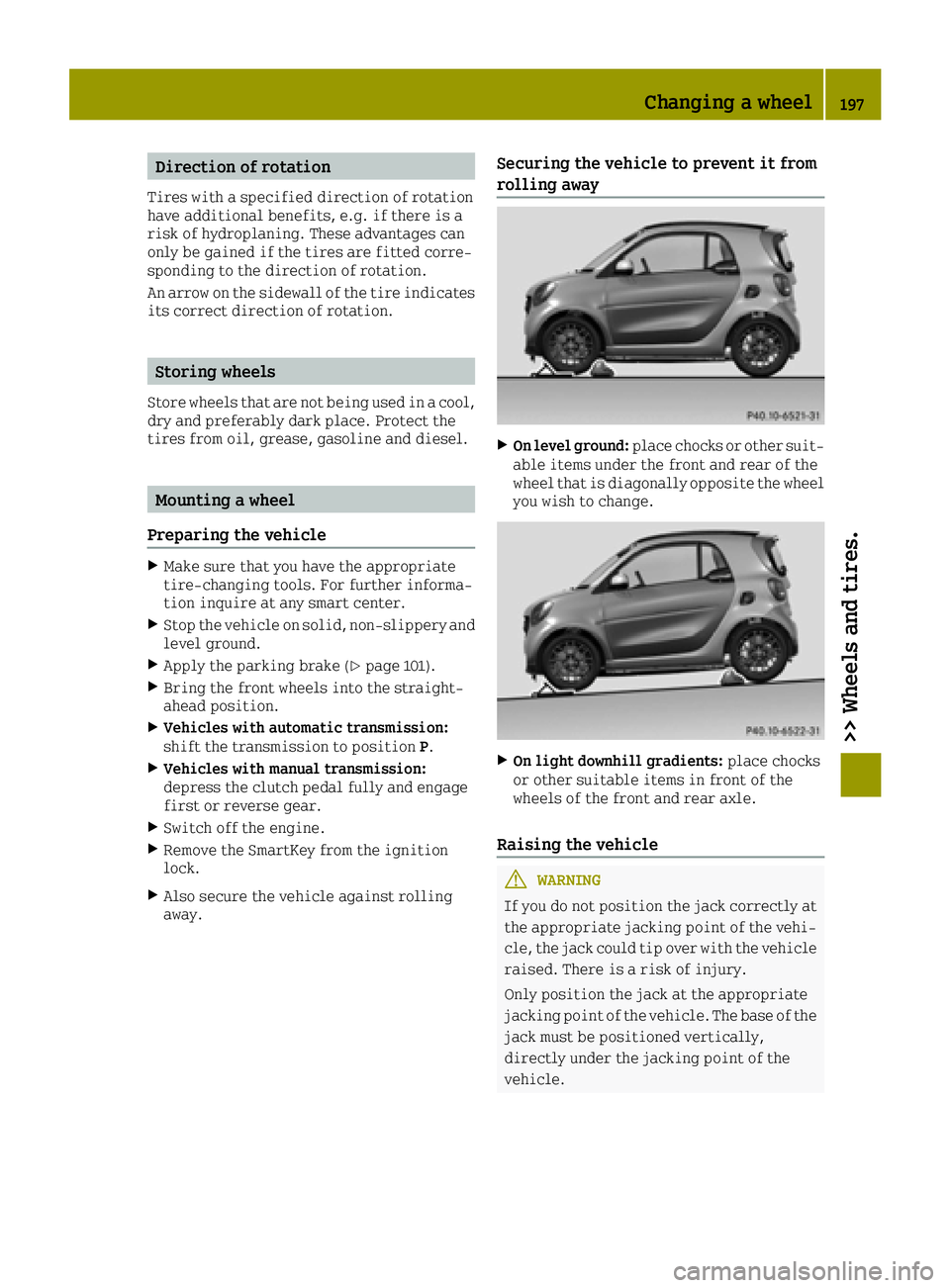
Securing the vehicle to prevent it from
rolling away
XOn level ground:place chocks or other suit-
able items under the front and rear of the
wheel that is diagonally opposite the wheel
you wish to change.
XOn light downhill gradients: place chocks
or other suitable items in front of the
wheels of the front and rear axle.
Raising the vehicle
GWARNING
If you do not position the jack correctly at
the appropriate jacking point of the vehi- cle, the jack could tip over with the vehicle
raised. There is a risk of injury.
Only position the jack at the appropriate
jacking point of the vehicle. The base of the jack must be positioned vertically,
directly under the jacking point of the
vehicle.
Changing a wheel197
>> Wheels and tires.
Z