2016 SKODA OCTAVIA lock
[x] Cancel search: lockPage 88 of 324

Fig. 83
Replacing the bags
Read and observe
and on page 82 first.
The waste container can be inserted into the slots in the doors.
Insert waste container
›
Position the waste container at the front edge of the slot.
›
Push the waste container to the back in the direction of the arrow
A
» Fig. 82 .
›
Push the waste container as required in the direction of arrow
B
.
Remove the waste container
›
Remove the waste container in the opposite direction to the arrow
A
» Fig. 82 .
Open/close waste container
›
Lift the lid in the direction of arrow
C
» Fig. 82 .
Closing takes place in reverse order.
Replace bags
›
Remove the waste container from the slot.
›
Press the two locking lugs on the frame in the direction of arrow
1
» Fig. 83 .
›
Pull the bag together with the frame down in the direction of arrow
2
.
›
Remove the bag from the frame.
›
Pull the new bag through the frame and pull it over the frame in the direction
of arrow
3
.
›
Place the bag with the frame in the direction of arrow
4
into the container
body, so that the two lugs engage audibly on the frame.
Note
We recommend that you use 20x30 cm bags.Multimedia holderFig. 84
Multimedia holder
Read and observe and on page 82 first.
The multimedia holder » Fig. 84 is provided for storing mobile phones, MP3
players etc.
Storage compartment under the front arm rest
Fig. 85
Opening the storage compart-
ment
Read and observe and on page 82 first.
›
To open Pull the arm on the handle
A
in direction of arrow » Fig. 85.
›
To close , lift the armrest in the direction of arrow until the stop and then fold
down against the direction of arrow.
86Using the system
Page 89 of 324

Glasses compartmentFig. 86
Opening the glasses storage box
Read and observe and on page 82 first.
›
To open , press on the outer edge of the glasses compartment in area
A
.
The compartment folds in the direction of the arrow » Fig. 86.
›
To close , swivel the compartment against the direction of the arrow until it
audibly clicks into place.
CAUTION
■ Do not put any heat-sensitive objects in the glasses storage box - with high
temperatures there is risk of damage.■
The box must be closed before leaving and locking the vehicle – risk of im-
pairment to the functions of the anti-theft alarm system.
Storage compartment on the front passenger side
Fig. 87
Open storage compartment / close storage compartment and
open air supply
Read and observe and on page 82 first.
The storage compartment is equipped with an interior light (this is illuminated
when the parking lights / low beam are switched on), a pen/card holder and an air outlet.
Storage compartment
›
To open , pull the handle
A
in the direction of arrow
1
and fold the cover in
the direction of arrow
2
» Fig. 87 .
›
To close , swivel the cover in the direction of arrow
3
until it audibly clicks
into place.
Air supply
›
To open , turn the rotary switch until it stops in the position
» Fig. 87
.
›
To close , turn the rotary switch until it stops in the position
.
The temperature of the storage compartment supplied with air is dependent
on the setting in the air conditioning.
Storage compartment for umbrella
Fig. 88
Opening the storage compart-
ment
Read and observe and on page 82 first.
The storage compartment under the passenger seat is used for storing an um-
brella.
›
To open , pull the handle in direction of arrow
1
pull and open the compart-
ment in the direction of arrow
2
» Fig. 88 .
›
To close , screw in the lid in the opposite direction of arrow
2
until it audibly
clicks into place.
CAUTION
Never store a wet umbrella in the storage compartment - there is a risk of
damage to the umbrella. 87Useful features
Page 91 of 324

Long cargo channelFig. 92
Open the cover: from the passenger compartment / from the lug-
gage compartment
Read and observe
and on page 82 first.
After folding-up the rear armrest and cover, an opening in the seat backrest
becomes visible through which the through-loading bag with skis can be push-
ed.
›
To open from the passenger compartment , fold down the rear armrest
slightly » page 80 .
›
Pull handle
A
in the direction of arrow
1
and fold down the cover in the
direction of arrow
2
» Fig. 92 .
›
To open from the luggage compartment , push the securing tab
B
in the di-
rection of the arrow and fold the cover with the armrest forwards.
›
To close , fold the cover and the rear armrest upwards until the stop. This
should audibly click into place.
The cover must be secured after the closing process. Ensure that the red field
above the securing tab
B
is not visible.
WARNINGThe through-loading channel is only intended for transporting skis that are
placed in a properly secured, through-loading bag.Removable through-loading bagFig. 93
Tighten ribbon / secure through-loading bag
Read and observe
and on page 82 first.
The removable through-loading bag (hereinafter referred to as through-load-
ing bag) is used exclusively for transporting skis and poles (max. 4 pairs).
Stowing the through-loading bag and skis
›
Fold the rear armrest and the cover in the seat backrest downwards » Fig. 92
on page 89 .
›
Place the empty, through-loading bag in the opening in such a way that the
end of the bag with the zip is in the boot.
›
Place the skis with the tips facing to the front and the sticks with the tips
facing to the rear. into the through-loading bag and close the bag.
Securing the through-loading bag and skis
›
Tighten the strap
A
around the skis in front of the bindings » Fig. 93. The
strap must hold the skis tight.
›
Fold the seat backrest a little forward » page 79.
›
Guide the securing strap
B
through the opening in the seat backrest around
the upper part of the seat backrest.
›
Then, fold the seat backrests back until the locking button clicks into place.
Check this by pulling on the seat backrest.
›
Insert the securing strap
B
into the lock
C
until it clicks into place.
WARNING■ The total weight of the skis which are transported must not exceed
24 kg.■
Always stow and secure the skis and the bag securely - otherwise there is
a risk of injury or accident!
89Useful features
Page 92 of 324

CAUTIONNever fold and stow the through-loading bag when it is wet - There is a risk of
damaging the through-loading bag.
Electrical sockets
Introduction
This chapter contains information on the following subjects:
12-volt power outlet
90
230-volt socket
90WARNING■ Do not place anything on the dash panel. These objects might slide or fall
down when driving and may distract you from concentrating on the traffic –
There is a risk of an accident!■
Make sure that while driving no objects can enter the driver's footwell -
There is a risk of an accident!
■
Stow all devices safely during the journey to prevent them from being
thrown around the interior in the event of a sudden braking manoeuvre or
an accident – The is a risk to life!
■
The devices may warm up during operation – The is a risk of injury or fire!
■
Improper use of the power sockets and the electrical accessories can
cause fires, burns and other serious injuries.
■
The 12-Volt sockets also work if the ignition is switched off. When leaving
the vehicle, never leave persons who are not completely independent, such
as children, unattended in the vehicle.
CAUTION
When using the 12-volt sockets, the following notes are to be observed.■The sockets can only be used for the connection of approved electrical ac-
cessories with a total power consumption of up to 120 watts - otherwise the
there is a risk of damage to the electrical system of the vehicle.■
Connecting appliances when the engine is not running will drain the battery
of the vehicle!
■
Before switching the ignition on / off or before starting the engine, switch
off the devices which are connected to the sockets - there is a risk of damage
to the equipment due to voltage fluctuations.
12-volt power outletFig. 94
Cover of the 12 volt power outlet: in the front centre console/ in
the boot
Read and observe
and on page 90 first.
›
Touse , remove the cover of the socket » Fig. 94 -
or open the cover of the
socket » Fig. 94 -
.
›
Connect the plug for the electrical appliance to the socket.
230-volt socket
Fig. 95
Open the cover of the 230 volt
power outlet
Read and observe and on page 90 first.
The 230-volt socket has a child safety lock. When inserting the plug, the fuse
is released, the socket is activated and the warning light above the socket is
illuminates green (if this flashes red, then the socket is deactivated).
›
To use , fold up the cover of the socket in the direction of arrow » Fig. 95 and
plug the electrical appliance plug into the socket.
90Using the system
Page 93 of 324

The socket may be automatically deactivated for the following reasons.
▶ Excessive current.
▶ Low battery charge state.
▶ High socket temperature.
If disabling reasons no longer exist, the socket is automatically activated.WARNING■ Make sure that no liquid or moisture enters into the socket - There is a
risk to life! If fluid does manage to get into the power socket, completely
dry out the socket before reuse.■
The child lock on the power socket is unlocked when using adapters and
extension cables which carry volts – There is a risk of injury!
■
Do no insert any objects (e.g. knitting needles) into the contacts of the
power socket – There is a risk to life!
CAUTION
■ The power socket can only be used for connecting approved electrical acces-
sories with a two-pin 230V plug, with a total power uptake of up to 150 watt.■
The plug of the electrical appliance must be plugged in up to the stop, other-
wise the child safety lock can be unlocked and the socket may be activated but
the electric appliance is still not receiving power.
■
Do not connect bulbs with neon tubes in the socket - there is a risk of dam-
aging the lamp.
■
For appliances with an independent power source (e.g. such as notebooks),
first connect the power source itself and only after that connect the appliance.
Ashtray and cigarette lighter
Introduction
This chapter contains information on the following subjects:
Ashtray
91
Cigarette lighter
91
The ashtray can be used for ash, cigarettes, cigars and the like
WARNINGNever place hot or flammable objects in the ashtray – risk of fire!AshtrayFig. 96
Removing front ashtray / Removing rear ashtray insert
Read and observe
on page 91 first.
Removable ashtray
›
Hold the ashtray
A
(not by the lid) remove in the direction of the arrow
» Fig. 96 .
Insertion takes place in reverse order.
Ashtray with removable insert
›
To remove , open the insert of the ashtray, hold the insert in the area
B
and
remove in the direction of the arrow » Fig. 96.
Insertion takes place in reverse order.
Cigarette lighter
Fig. 97
Cigarette lighter
Read and observe on page 91 first.
›
To use the lighter, push it in as far as the stop and wait until the glowing
lighter clicks out again » Fig. 97.
91Useful features
Page 99 of 324
CAUTIONThe double sided floor covering can only be used in vehicles without the varia-
ble loading floor » page 100 - There is a risk of damage to the variable loading
floor.
Net on the luggage compartment cover
Fig. 110
Net on the luggage compartment
cover
Read and observe and on page 94 first.
The net at the bottom of the luggage compartment cover » Fig. 110 is provided
for transporting light and soft items.
The maximum permissible load of the net is 1.5 kg.
Luggage compartment cover
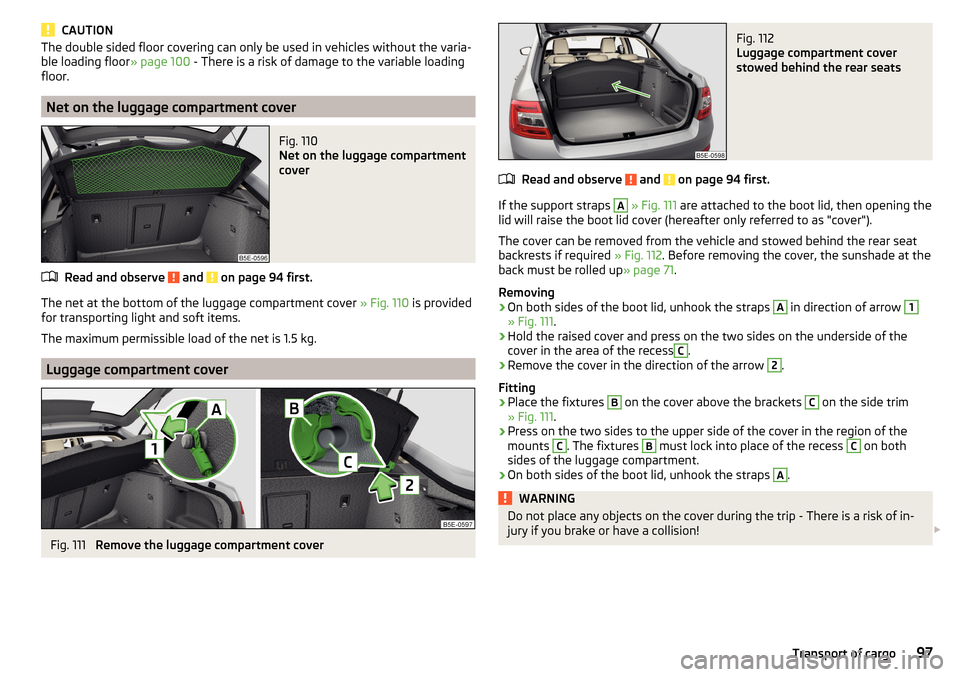
Fig. 111
Remove the luggage compartment cover
Fig. 112
Luggage compartment cover
stowed behind the rear seats
Read and observe and on page 94 first.
If the support straps
A
» Fig. 111 are attached to the boot lid, then opening the
lid will raise the boot lid cover (hereafter only referred to as "cover").
The cover can be removed from the vehicle and stowed behind the rear seat
backrests if required » Fig. 112. Before removing the cover, the sunshade at the
back must be rolled up » page 71.
Removing
›
On both sides of the boot lid, unhook the straps
A
in direction of arrow
1
» Fig. 111 .
›
Hold the raised cover and press on the two sides on the underside of the
cover in the area of the recess
C
.
›
Remove the cover in the direction of the arrow
2
.
Fitting
›
Place the fixtures
B
on the cover above the brackets
C
on the side trim
» Fig. 111 .
›
Press on the two sides to the upper side of the cover in the region of the
mounts
C
. The fixtures
B
must lock into place of the recess
C
on both
sides of the luggage compartment.
›
On both sides of the boot lid, unhook the straps
A
.
WARNINGDo not place any objects on the cover during the trip - There is a risk of in-
jury if you brake or have a collision! 97Transport of cargo
Page 105 of 324

›On the other side, press on the crossbar in the direction of the arrow and
hook it into the appropriate receptacle D.›
Make sure that the crossbar is firmly seated in the two mountings
D
.
›
Fold back part
A
of the roll-up luggage compartment cover in the opposite
direction of the arrow » Fig. 123.
Using the net partition behind the rear seats
›
Fold out part
A
of the roll-up luggage compartment cover in the direction of
arrow » Fig. 123 .
›
Press on the crossbar and remove it from the receptacles
D
» Fig. 124 , first
on one side, then on the other side.
›
The crossbar
C
Hold in such a way that the net partition can slowly roll up
without being damaged.
›
Fold back part
A
of the roll-up luggage compartment cover in the opposite
direction of the arrow » Fig. 123.
Pull out and secure the net partition behind the front seats
The process is analogous to that for behind the rear seats. Before pulling out
the net partition, the rear seat backs are to be folded forwards. After rolling up
the net partition into the housing, the rear seat backs are folded back
» page 79 .
CAUTION
If the net partition blocks when pulling it out, push the release lever B in the
direction of the arrow » Fig. 123.
Removing and installing the net partition housing
Fig. 125
Removing the net partition
housing
›
To remove , fold forwarded the rear seat backrests and open the rear right
door.
›
Push the housing
A
in the direction of the arrow
1
and remove it from the
mountings in the direction of the arrow
2
» Fig. 125 .
›To
install , insert the recesses on the housing A into the mountings on the
rear seat backrests and push the housing against the arrow 1 up to the
stop.›
Fold the rear seat backrests to their original position.
Transport on the roof rack
Fig. 126
Attachment points
Fig. 127
Remove the side panels of the luggage compartment/stow the
roof rack
The attachment points
A
and
B
are located on both sides of the vehicle
» Fig. 126 .
The mounting and dismounting of the basic carrier is carried out according to
the instructions provided.
Roof load
The maximum permitted weight of the load incl. carriers is 75 kg.
103Transport of cargo
Page 113 of 324

Display warning light AMeaning
Quickly flashes green for 2 seconds.
The auxiliary heating is blocked, e.g.
because the tank is nearly empty or
there is a fault in the auxiliary heat-
ing.Flashes red for 2 seconds.The switch off signal was not re-
ceived.Lights up orange for 2 seconds, then
green or red.The battery is weak, however the
switching on or off signal was re-
ceived.Lights up orange for 2 seconds, then
flashes green or red.The battery is weak, however the
switching on or off signal was not re-
ceived.Flashes orange for 5 seconds.The battery is discharged, however
the switching on or off signal was not
received.
Replace the battery » page 275.
CAUTION
■
The remote control must be protected against moisture, severe shocks and
direct sunlight - Otherwise, there is a risk of damage to the remote control.■
The range of the remote control with a charged battery is a few hundred me-
tres (depending on obstructions between the remote control and the vehicle,
weather conditions, the battery condition etc.).
111Heating and ventilation