Page 52 of 328
1.46
CHILD SEATS: attachment by seat belt (2/3)
The table below summarises the information already shown in the diagram \
on the previous pages, to ensure the appli-
cable regulations are respected.
Five-seater version
Type of child seat Weight of the child Front passenger
seat (1) Rear side seats Rear centre seat
Carrycot fitted
across the vehicle
Group 0 < 10 kg X U (2) X
Rear-facing shell
seat
Groups 0 or 0 + < 10 kg and < 13 kg U (5) U (3) U (3)
Shell seat/rear-facing
seat
Groups 0+ and 1 < 13 kg and 9 to 18 kg U (5) U (3) U (3)
Forward-facing seat
Group 1 9 to 18 kg X U (3) (4) U (3) (4)
Booster seat
Groups 2 and 3 15 to 25 kg and 22 to
36 kg
X U (3) (4) X
(1) RISK OF DEATH OR SERIOUS INJURY: Before installing a child seat on the front passenger seat, check that \
the airbag has been deactivated (please refer to “Child safety: fron\
t passenger airbag deactivation and activation” in
Section 1).
Page 54 of 328
1.48
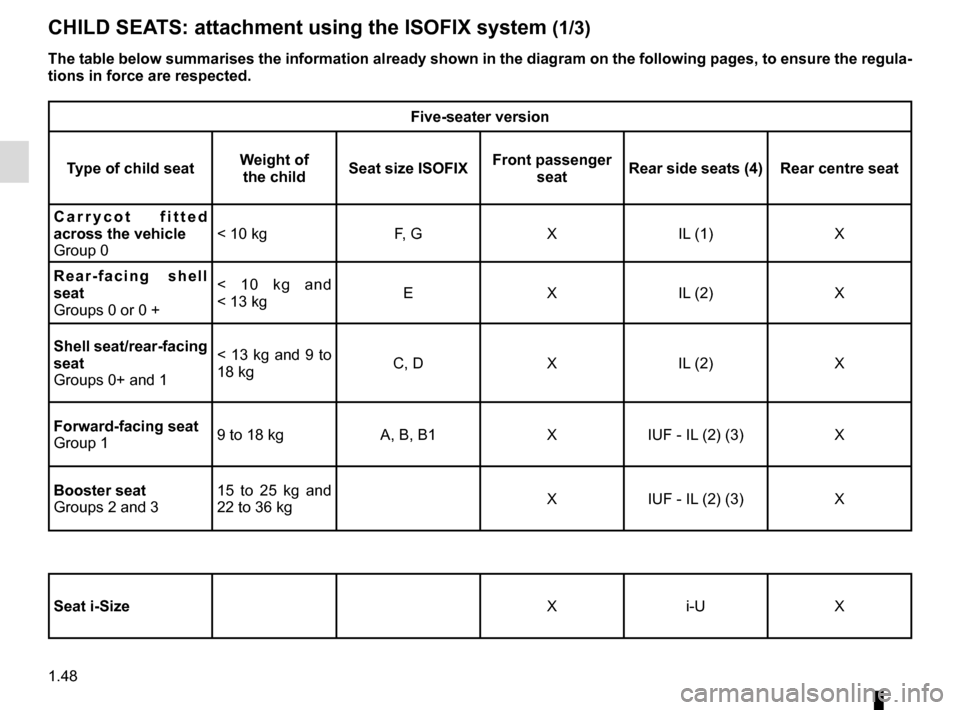
Five-seater version
Type of child seat Weight of
the child Seat size ISOFIX Front passenger
seat Rear side seats (4) Rear centre seat
Carrycot fitted
across the vehicle
Group 0 < 10 kg F, G X IL (1) X
Rear-facing shell
seat
Groups 0 or 0 + < 10 kg and
< 13 kg
E X IL (2) X
Shell seat/rear-facing
seat
Groups 0+ and 1 < 13 kg and 9 to
18 kg
C, D X IL (2) X
Forward-facing seat
Group 1 9 to 18 kg A, B, B1 X IUF - IL (2) (3) X
Booster seat
Groups 2 and 3 15 to 25 kg and
22 to 36 kg
X IUF - IL (2) (3) X
Seat i-Size X i-U X
The table below summarises the information already shown in the diagram \
on the following pages, to ensure the regula-
tions in force are respected.
CHILD SEATS: attachment using the ISOFIX system (1/3)
Page 96 of 328
1.90
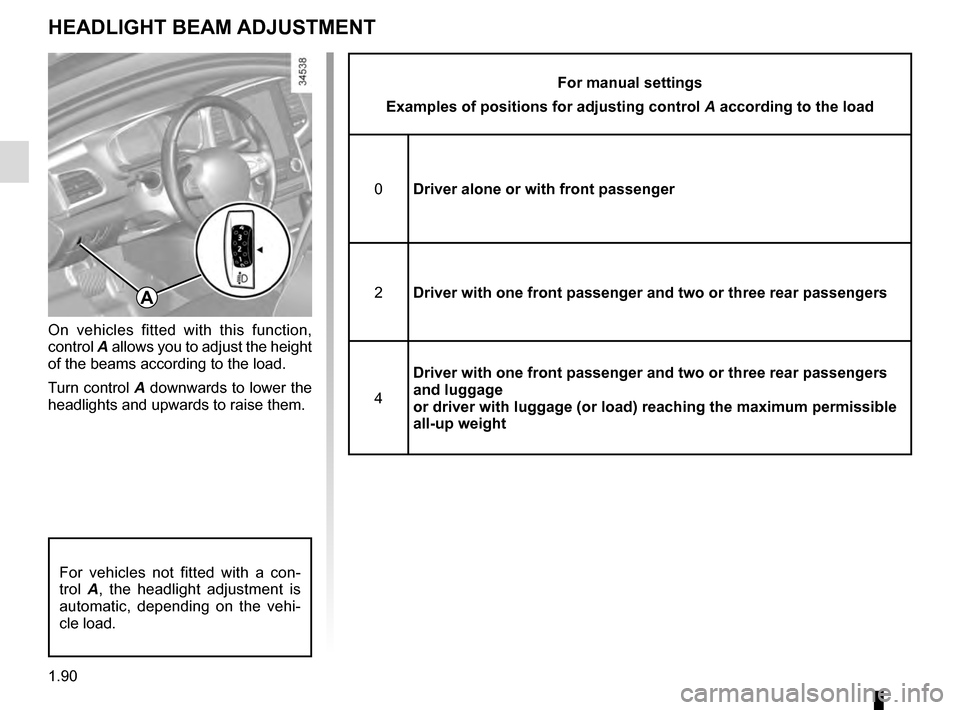
HEADLIGHT BEAM ADJUSTMENT
On vehicles fitted with this function,
control A allows you to adjust the height
of the beams according to the load.
Turn control A downwards to lower the
headlights and upwards to raise them.
For manual settings
Examples of positions for adjusting control A according to the load
0 Driver alone or with front passenger
2 Driver with one front passenger and two or three rear passengers
4 Driver with one front passenger and two or three rear passengers
and luggage
or driver with luggage (or load) reaching the maximum permissible
all-up weight
A
For vehicles not fitted with a con-
trol A, the headlight adjustment is
automatic, depending on the vehi-
cle load.
Page 233 of 328
3.43
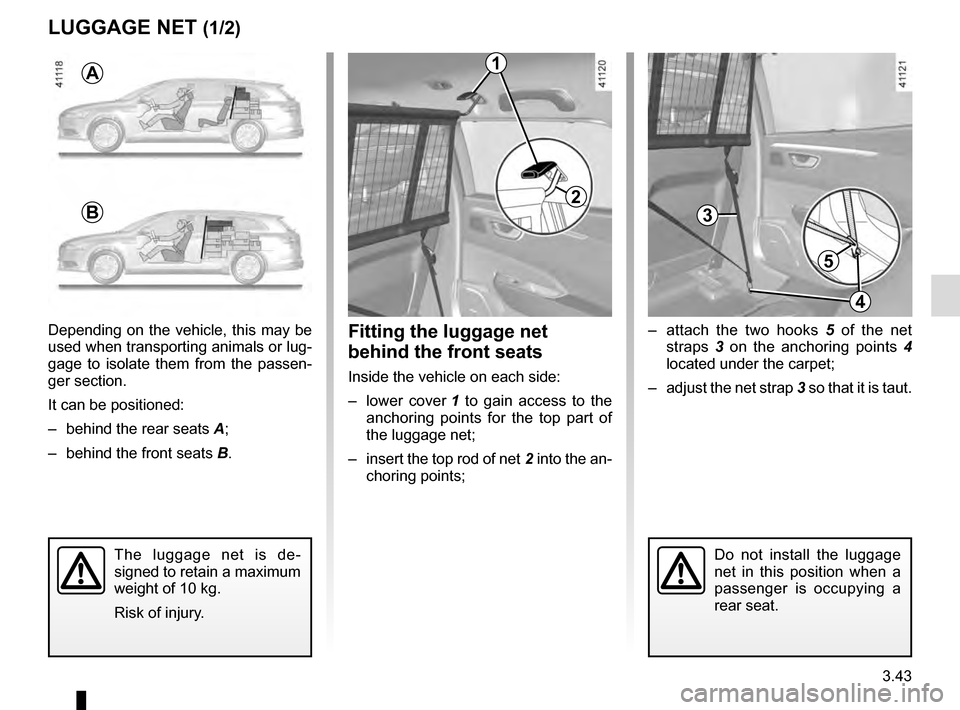
LUGGAGE NET (1/2)
– attach the two hooks 5 of the net
straps 3 on the anchoring points 4
located under the carpet;
– adjust the net strap 3 so that it is taut.Fitting the luggage net
behind the front seats
Inside the vehicle on each side:
– lower cover 1 to gain access to the
anchoring points for the top part of
the luggage net;
– insert the top rod of net 2 into the an-
choring points;
Depending on the vehicle, this may be
used when transporting animals or lug-
gage to isolate them from the passen-
ger section.
It can be positioned:
– behind the rear seats
A;
– behind the front seats B.
The luggage net is de-
signed to retain a maximum
weight of 10 kg.
Risk of injury.Do not install the luggage
net in this position when a
passenger is occupying a
rear seat.
A
B
1
2
3
5
4
Page 236 of 328
3.46
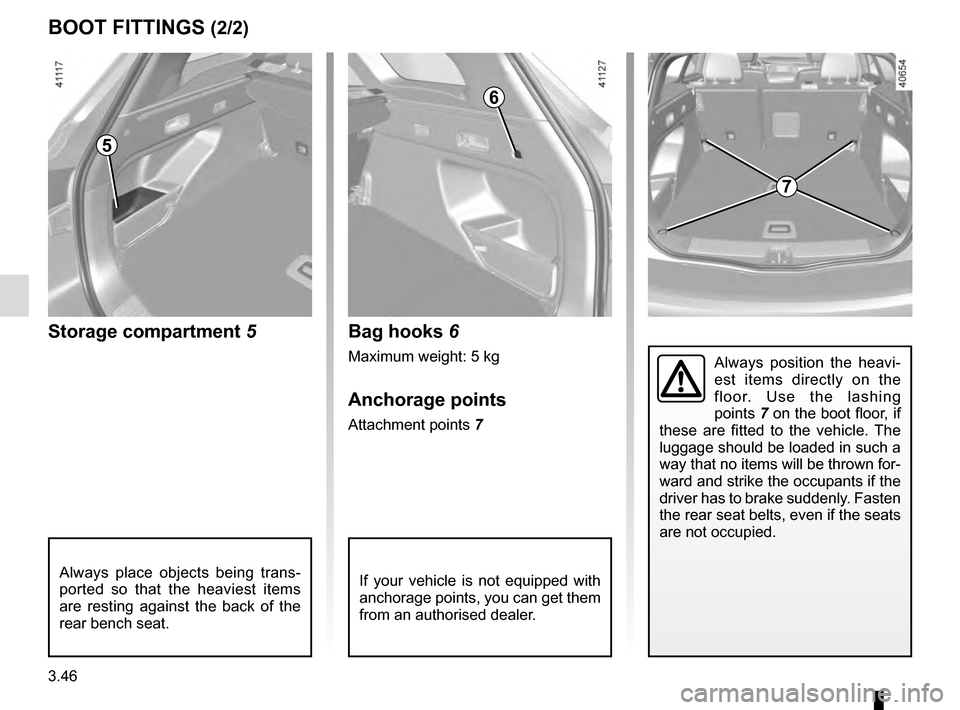
BOOT FITTINGS (2/2)
If your vehicle is not equipped with
anchorage points, you can get them
from an authorised dealer.
7
Bag hooks 6
Maximum weight: 5 kg
Anchorage points
Attachment points 7
Storage compartment 5
5
Always position the heavi-
est items directly on the
floor. Use the lashing
points 7 on the boot floor, if
these are fitted to the vehicle. The
luggage should be loaded in such a
way that no items will be thrown for-
ward and strike the occupants if the
driver has to brake suddenly. Fasten
the rear seat belts, even if the seats
are not occupied.
Always place objects being trans-
ported so that the heaviest items
are resting against the back of the
rear bench seat.
6
Page 238 of 328
3.48
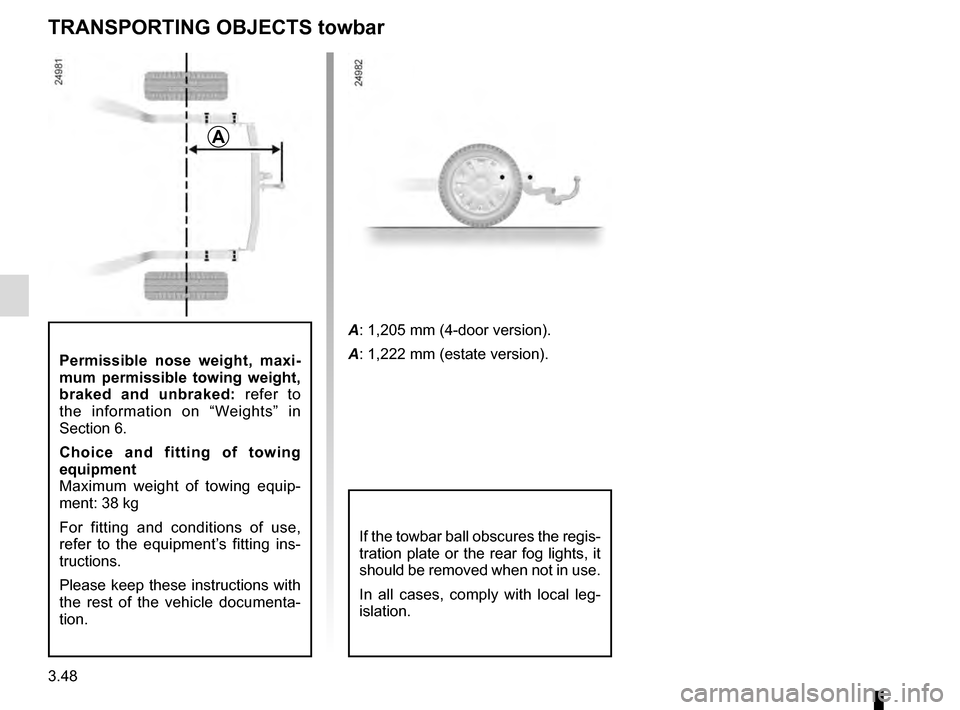
Permissible nose weight, maxi-
mum permissible towing weight,
braked and unbraked: refer to
the information on “Weights” in
Section 6.
Choice and fitting of towing
equipment
Maximum weight of towing equip-
ment: 38 kg
For fitting and conditions of use,
refer to the equipment’s fitting ins-
tructions.
Please keep these instructions with
the rest of the vehicle documenta-
tion.
TRANSPORTING OBJECTS towbar
A
A: 1,205 mm (4-door version).
A: 1,222 mm (estate version).
If the towbar ball obscures the regis-
tration plate or the rear fog lights, it
should be removed when not in use.
In all cases, comply with local leg-
islation.
Page 239 of 328
3.49
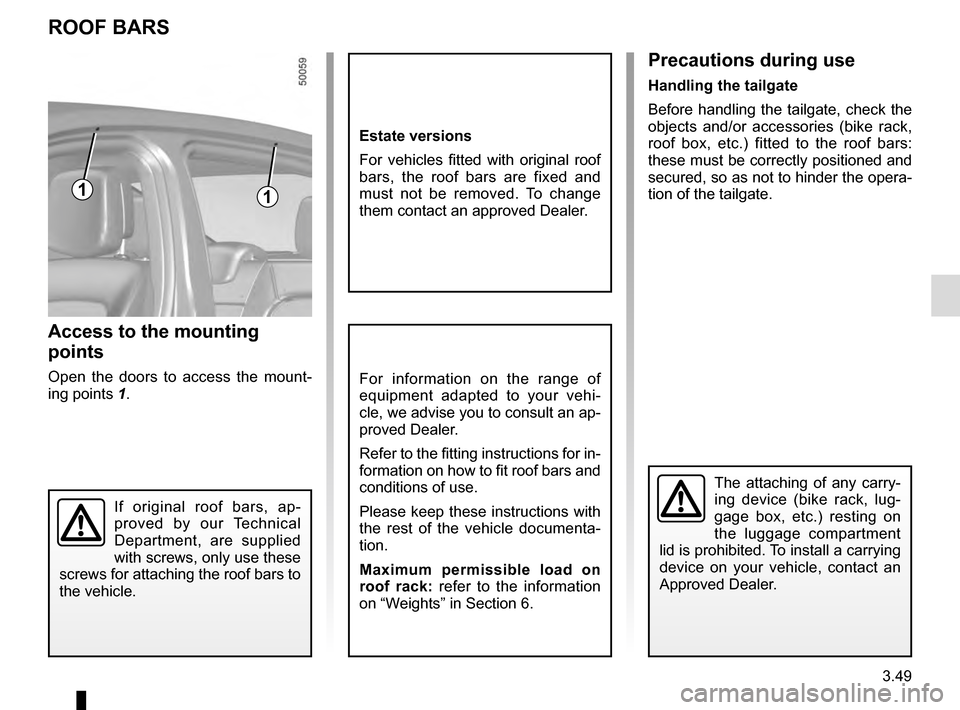
ROOF BARS
Access to the mounting
points
Open the doors to access the mount-
ing points 1.For information on the range of
equipment adapted to your vehi-
cle, we advise you to consult an ap-
proved Dealer.
Refer to the fitting instructions for in-
formation on how to fit roof bars and
conditions of use.
Please keep these instructions with
the rest of the vehicle documenta-
tion.
Maximum permissible load on
roof rack: refer to the information
on “Weights” in Section 6.
11
If original roof bars, ap-
proved by our Technical
Department, are supplied
with screws, only use these
screws for attaching the roof bars to
the vehicle.
The attaching of any carry-
ing device (bike rack, lug-
gage box, etc.) resting on
the luggage compartment
lid is prohibited. To install a carrying
device on your vehicle, contact an
Approved Dealer.
Precautions during use
Handling the tailgate
Before handling the tailgate, check the
objects and/or accessories (bike rack,
roof box, etc.) fitted to the roof bars:
these must be correctly positioned and
secured, so as not to hinder the opera-
tion of the tailgate.
Estate versions
For vehicles fitted with original roof
bars, the roof bars are fixed and
must not be removed. To change
them contact an approved Dealer.
Page 245 of 328
4.3
BONNET (2/2)
Closing the bonnet
Check that nothing has been left in the
engine compartment.
To close the bonnet again, hold the
bonnet in the middle and guide it down,
allowing a 30 cm gap before it is closed,
then release it. It will latch automatically
under its own weight.
Ensure that the bonnet is
properly locked.
Check that nothing is pre-
venting the catch from loc-
king (gravel, cloth, etc.).
After carrying out any work
in the engine compart-
ment, check that nothing
has been left behind (cloth,
tools, etc.).
These may damage the engine or
cause a fire.
In the event of even a slight
impact involving the radia-
tor grille or bonnet, have the
bonnet lock checked by an
authorised dealer as soon as pos-
sible.

The table below summarises the information already shown in the diagram \
on the previous pages, to ensure the appli-
cable regulations are respected.
F")