2016 RENAULT TALISMAN Acc
[x] Cancel search: AccPage 38 of 328
1.32
METHODS OF RESTRAINT IN ADDITION TO THE FRONT SEAT BELTS (2/4)
Load limiter
Above a certain severity of impact, this
mechanism is used to limit the force of
the belt against the body so that it is at
an acceptable level.
Air bags for driver and front
passenger
Fitted to the driver and passenger side.
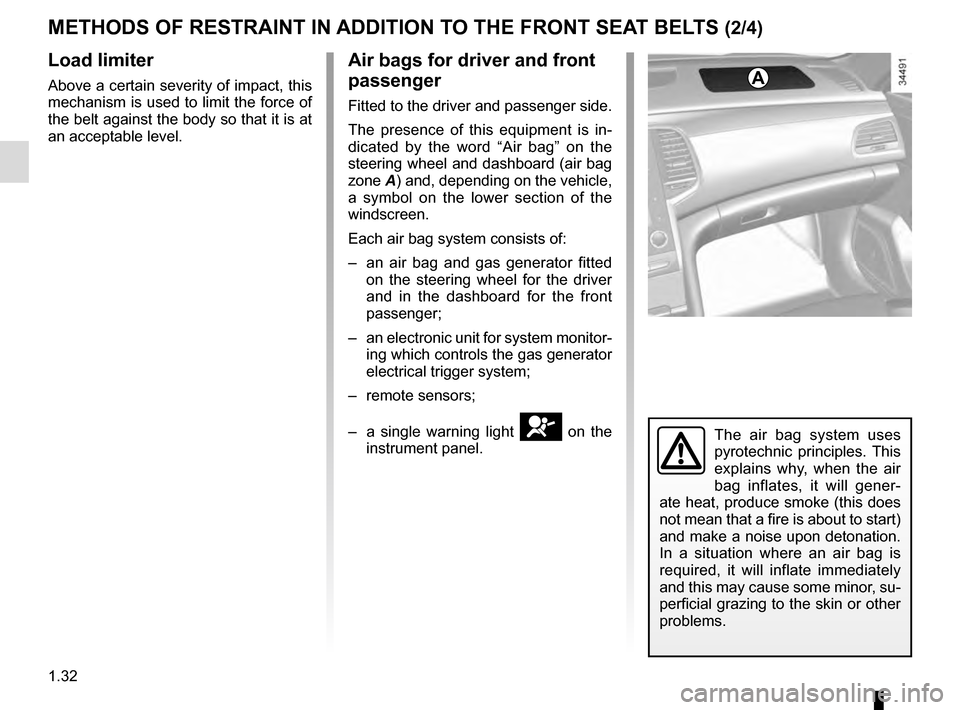
The presence of this equipment is in-
dicated by the word “Air bag” on the
steering wheel and dashboard (air bag
zone A) and, depending on the vehicle,
a symbol on the lower section of the
windscreen.
Each air bag system consists of:
– an air bag and gas generator fitted on the steering wheel for the driver
and in the dashboard for the front
passenger;
– an electronic unit for system monitor- ing which controls the gas generator
electrical trigger system;
– remote sensors;
– a single warning light
å on the
instrument panel.
A
The air bag system uses
pyrotechnic principles. This
explains why, when the air
bag inflates, it will gener-
ate heat, produce smoke (this does
not mean that a fire is about to start)
and make a noise upon detonation.
In a situation where an air bag is
required, it will inflate immediately
and this may cause some minor, su-
perficial grazing to the skin or other
problems.
Page 41 of 328
1.35
METHODS OF RESTRAINT IN ADDITION TO THE REAR SEAT BELTS
Force limiter
Above a certain severity of impact, this
mechanism is used to limit the force of
the belt against the body so that it is at
an acceptable level.
– Have the entire restraint
system checked following
an accident.
– No operation whatsoever
is permitted on any part of the
system (air bags, electronic con-
trol units, wiring) and the system
components must not be reused
on any other vehicle, even if iden-
tical.
– Only qualified personnel from our Network may work on the air
bags; otherwise the system may
trigger accidentally and cause
injury.
Page 42 of 328
1.36
SIDE PROTECTION DEVICES
Warning concerning the side air bag
– Fitting seat covers: seats equipped with an air bag require covers
specifically designed for your vehicle. Contact an approved Dealer to fi\
nd
out if these covers are available. The use of any covers other than those
designed for your vehicle (including those designed for another vehicle\
) may
affect the operation of the air bags and reduce your protection.
– Do not place any accessories, objects or even pets between the seatback,\
the door and the internal fittings. Do not cover the seatback with any items\
such as
clothes or accessories. This may prevent the air bag from operating correctly
or cause injury when the air bag is deployed.
– No work or modification whatsoever may be carried out on the seat or int\
ernal fittings, except by qualified personnel from an approved dealer.
Side air bags
These air bags are fitted to the front
seats and are activated at the sides of
the seats (door side) to protect the oc-
cupants in the event of a severe side
impact.
Curtain air bags
These are airbags fitted along the sides
of the vehicle in the ceiling which trigger
along the front and rear door side win-
dows to protect the passengers in case
of a severe side impact.
Depending on the vehicle, a mark-
ing on the windscreen informs you
of the presence of additional means
of restraint (airbags, pretensioners,
etc.) in the passenger compartment.
Page 43 of 328

1.37
ADDITIONAL METHODS OF RESTRAINT
The air bag is designed to complement the action of the seat belt. Both \
the air bags and seat belts are integral parts of
the same protection system. It is therefore essential to wear seat belts\
at all times. If seat belts are not worn, the oc-
cupants are exposed to the risk of serious injury in the event of an acc\
ident. It may also increase the risk of minor su-
perficial injuries occurring when the air bag is deployed, although such\
minor injuries are always possible with air bags.
If the vehicle should overturn or suffer a rear impact, however severe, the pretensioners and air bags are no\
t always triggered .
Shocks to the underbody of the vehicle, e.g. from pavements, potholes or\
stones, can all trigger these systems.
– No work or modification whatsoever may be carried out on any part of the air bag system (air bags, preten\
sioners, compu-
ter, wiring harness, etc.), except by qualified personnel from an approved\
dealer.
– To ensure that the system is in good working order and to avoid accidenta\
l triggering of the system which may cause injury, only qualified Network personnel may work on the air bag system.
– As a safety precaution, have the air bag system checked if your vehicle \
has been involved in an accident, or is stolen or broken into.
– When selling or lending the vehicle, inform the user of these points and\
hand over this driver’s handbook with the vehicle.
– When scrapping your vehicle, contact your approved dealer for disposal o\
f the gas generator(s).
All of the warnings below are given so that the air bag is not obstructed in any way when it is inflated and also to prevent
the risk of serious injuries caused by items which may be dislodged when\
the air bag inflates.
Page 44 of 328

1.38
CHILD SAFETY: General information (1/2)
Carrying children
Children, and adults, must be correctly
seated and strapped in for all journeys.
The children being carried in your vehi-
cle are your responsibility.
A child is not a miniature adult. Children
are at risk of specific injuries as their
muscles and bones have not yet fin-
ished growing. The seat belt alone
would not provide suitable protection.
Use an approved child seat and ensure
you use it correctly.
A collision at 50 km/h (30
mph) is the same as fall-
ing a distance of 10 metres.
Transporting a child without
a restraint is the equivalent of allow-
ing him or her to play on a fourth-
floor balcony without railings.
Never travel with a child held in your
arms. In the event of an accident,
you will not be able to keep hold of
the child, even if you yourself are
wearing a seat belt.
If your vehicle has been involved in
a road accident, replace the child
seat and have the seat belts and
ISOFIX anchorage points checked.
To prevent the doors being
opened, use the “Child
safety” device (refer to the
information on “Opening
and closing the doors” in Section 1).
Driver’s responsibility
when parking or stopping
the vehicle
Never leave an animal,
child or adult who is not self-suffi-
cient alone on your vehicle, even for
a short time.
They may pose a risk to themselves
or to others by starting the engine,
activating equipment such as the
electric windows or by locking the
doors.
Also, in hot and/or sunny weather,
please remember that the tempera-
ture inside the passenger compart-
ment increases very quickly.
RISK OF DEATH OR SERIOUS
INJURY.
Page 47 of 328
1.41
Attachment using the ISOFIX
system
Approved child seats ISOFIX are stand-
ardised in accordance with current reg-
ulations if any of the four cases below
applies:
– ISOFIX universal 3-point forward- facing seat;
– ISOFIX semi-universal 2-point seat;
– Specific;
– i-Size Which has:
– either a belt which attaches to the
third ring of the seat concerned;
– or a stay that rests on the vehi-
cle floor, compatible with the ap-
proved seat i-Size, the role of
which is to prevent the child seat
from moving in the event of a col-
lision.
In the latter three cases check that your
child seat can be installed by consulting
the list of compatible vehicles.
CHILD SAFETY: choosing a child seat mounting (1/2)
There are two ways of attaching child
seats: via the seat belt or using the
ISOFIX system.
Attachment via the seat belt
The seat belt must be adjusted to
ensure that it is effective in the event of
harsh braking or an impact.
Ensure that the strap paths indicated
by the child seat manufacturer are re-
spected.
Always check that the seat belt is cor-
rectly fastened by pulling it up, then
pulling it out fully whilst pressing on the
child seat.
Check that the seat is correctly held by
moving it from side to side and back
to front: the seat should remain firmly
fixed.
Check that the child seat has not been
installed at an angle and that it is not
resting against a window.
No modifications may be
made to the component
parts of the restraint system
(ISOFIX seat belts, seats
and their mountings) originally fitted.
The seat belt must never
be twisted or the tension
relieved. Never pass the
shoulder strap under the
arm or behind the back.
Check that the seat belt has not
been damaged by sharp edges.
If the seat belt does not operate nor-
mally, it will not protect the child.
Consult an approved dealer. Do not
use this seat until the seat belt has
been repaired.
Do not use the child seat
if it may unfasten the seat
belt restraining it: the base
of the seat must not rest on
the buckle and/or catch of the seat
belt.
Before using an ISOFIX
child seat that you pur-
chased for another vehicle,
check that its installation is
authorised. Consult the list of ve-
hicles which can be fitted with the
seat from the equipment manufac-
turer.
Page 48 of 328
1.42
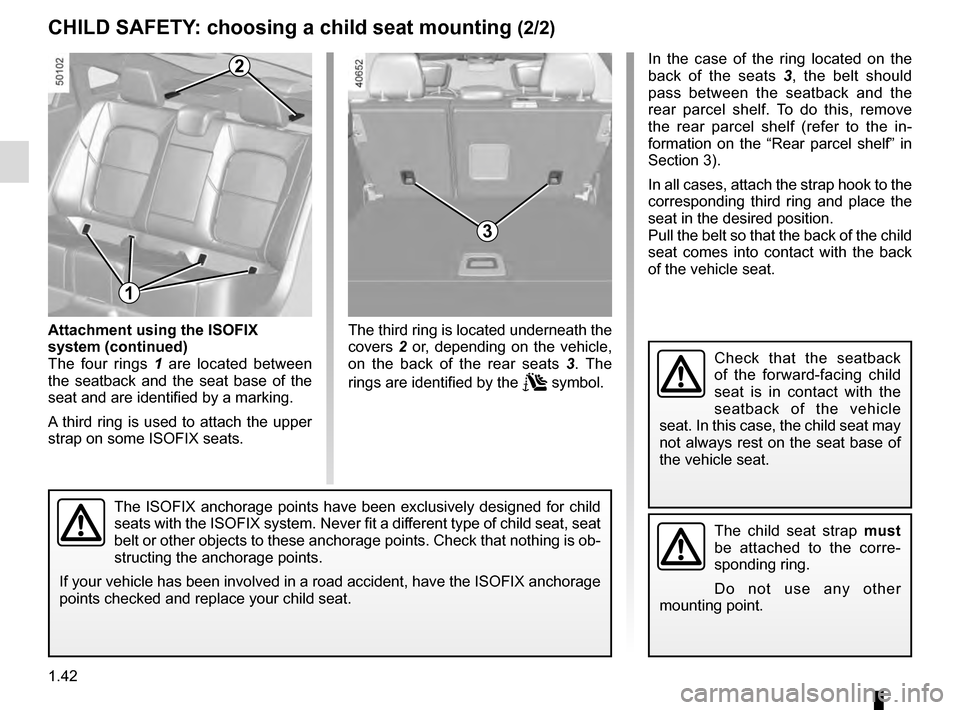
In the case of the ring located on the
back of the seats 3, the belt should
pass between the seatback and the
rear parcel shelf. To do this, remove
the rear parcel shelf (refer to the in-
formation on the “Rear parcel shelf” in
Section 3).
In all cases, attach the strap hook to the
corresponding third ring and place the
seat in the desired position.
Pull the belt so that the back of the child
seat comes into contact with the back
of the vehicle seat.
CHILD SAFETY: choosing a child seat mounting (2/2)
Attachment using the ISOFIX
system (continued)
The four rings 1 are located between
the seatback and the seat base of the
seat and are identified by a marking.
A third ring is used to attach the upper
strap on some ISOFIX seats.
The child seat strap must
be attached to the corre-
sponding ring.
Do not use any other
mounting point.
2
Check that the seatback
of the forward-facing child
seat is in contact with the
seatback of the vehicle
seat. In this case, the child seat may
not always rest on the seat base of
the vehicle seat.
The ISOFIX anchorage points have been exclusively designed for child
seats with the ISOFIX system. Never fit a different type of child seat, seat
belt or other objects to these anchorage points. Check that nothing is o\
b-
structing the anchorage points.
If your vehicle has been involved in a road accident, have the ISOFIX an\
chorage
points checked and replace your child seat.
1
The third ring is located underneath the
covers 2 or, depending on the vehicle,
on the back of the rear seats 3. The
rings are identified by the
symbol.
3
Page 57 of 328

1.51
Front passenger air bag
deactivation
You must deactivate certain devices
in addition to the front passenger seat
belt before fitting a child seat in the front
passenger seat.
CHILD SAFETY: deactivating/activating the front passenger airbag (1/3)
To deactivate the airbag: with the ve-
hicle stationary and the ignition off ,
push and turn the lock 1 to the OFF po-
sition.
With the ignition on, you must check
that the warning light
¹ is lit on the
display 2.
This light remains permanently lit to
let you know that you can fit a child
seat.
21
The front passenger air bag
must only be deactivated or
activated when the vehicle
is stationary.
If it is interfered with when the ve-
hicle is being driven, indicator lights
å and © will come on.
Switch the ignition off then on again
to reset the air bag in accordance
with the lock position.
DANGER
Since operation of the front
passenger airbag is not
compatible with the position
of a rear-facing child seat, NEVER
fit a restraint system for a rear-fac-
ing child in a seat protected by an
ACTIVATED front AIRBAG . This
can cause the CHILD’S DEATH or
SERIOUS INJURY.