2016 RENAULT TALISMAN Acc
[x] Cancel search: AccPage 289 of 328

5.29
Operating faults
If the battery is too weak to ensure cor-
rect operation, you can still start and
lock/unlock the vehicle (please refer to
the information on “Locking/unlocking
the opening elements” in Section 1).
RENAULT CARD: battery
Replacing the battery
When the message “Keycard battery
low” appears on the instrument panel,
replace the battery in the RENAULT
card:
– slide the rear casing 1 downwards
while pressing on zone A;
– remove the battery cover 2;
– remove the battery by pressing on
one side and lifting the other;
– replace it according to the direc-
tion and template shown inside the
cover.
Do not throw away your
used batteries; give them to
an organisation responsible
for collecting and recycling
batteries.
When refitting, proceed in the reverse
order, then press one of the buttons on
the card four times, close to the vehicle:
the message will disappear.
Note: it is not advisable to touch the
electronic circuit or contacts on the
RENAULT card when replacing the bat-
tery.
The batteries are available from ap-
proved Dealers, and their service
life approximately two years. Check
that there is no dye on the battery:
risk of an incorrect electrical con-
tact.
2
A
1
Page 290 of 328

5.30
ACCESSORIES
Electrical and electronic accessories
Before installing this type of accessory (particularly for transmitters\
/receivers: frequency bandwidth, power level, po-
sition of the aerial, etc.), make sure it is compatible with your vehic\
le. You can get advice from an authorised dealer.
Connect accessories with a maximum power of 120 Watts only. Fire hazard. When several accessory sockets are
used at the same time, the total power of the connected accessories must\
not exceed 180 watts.
No work may be carried out on the vehicle’s electrical or radio circuits, except by authorised dealers: an incorre\
ctly connecte d
system may result in damage being caused to the electrical equipment and\
/or the components connected to it.
If the vehicle is fitted with any aftermarket electrical equipment, make\
sure that the installation is correctly protected by a fuse.
Establish the rating and position of this fuse.
Using the diagnostic socket
The use of electronic accessories on the diagnostic socket may cause ser\
ious disturbance to the vehicle’s electronic systems.
For your safety we recommend that you use only electronic accessories ap\
proved by the manufacturer, consult an Approved
Dealer. Serious accident risk.
Use of transmitting/receiving devices (telephones, CB equipment etc.).\
Telephones and CB equipment with integrated aerials may cause interferenc\
e to the electronic systems originally fitted to the
vehicle: it is advisable only to use equipment with an external aerial. \
Furthermore, we remind you of the need to conform
to the legislation in force concerning the use of such equipment.
Fitting aftermarket accessories
If you wish to install accessories on the vehicle: please contact an aut\
horised dealer. Also, to ensure the correct operation o f
your vehicle, and to avoid any risk to your safety, we recommend that you use only accessories specifically designed for y\
our
vehicle, which are the only accessories for which the manufacturer will \
provide a warranty.
If you are using an anti-theft device, only attach it to the brake pedal\
.
Obstructions to the driver
On the driver’s side, only use mats suitable for the vehicle, attached with the pre-fi\
tted components, and check the fitting re gu-
larly. Do not lay one mat on top of another. There is a risk of wedging the pedals.
Page 293 of 328

5.33
TOWING: breakdown (1/2)
Before towing, put the gearbox in neu-
tral, unlock the steering column and re-
lease the parking brake.
For vehicles fitted with an automatic
gearbox, if it is not possible to put the
gear lever into position N, please con-
sult an authorised dealer.
Steering column unlocking
Insert the key into the ignition or, de-
pending on the vehicle, with the
RENAULT card on you, press the
engine start button for approximately 2
seconds.
Reposition the lever to neutral (posi-
tion N for vehicles fitted with an auto-
matic gearbox).
The column is unlocked, the acces-
sory functions are supplied: the vehi-
cle lights can be used (indicators, brake
lights etc.). At night the vehicle must
have its lights on.
Depending on the vehicle, once you
have finished towing, press the engine
start button twice (risk of running down
the battery). The speed specified by current legis-
lation for towing must always be ob-
served. If your vehicle is the towing
vehicle, do not exceed the maximum
towing weight for your vehicle (refer to
the information on “Weights” in
Section 6).
Towing a vehicle with an
automatic gearbox
Transport the vehicle on a trailer or tow
it with the front wheels off the ground.
In exceptional circumstances
, you
may tow it with all four wheels on the
ground, only in a forward gear, with the
gear in neutral position N over a maxi-
mum distance of 50 miles and not ex-
ceeding a speed of 15 mph (25 km/h).
3
If the lever is stuck in P , even though
you are depressing the brake pedal, the
lever can be released manually.
To do this, unclip the flap 2, then insert a
tool (with a hard rod to it) into the hole 1
and press the button 3 at the same time
in order to unlock the lever.
Contact an authorised dealer as soon
as possible.
2
1
Page 294 of 328
5.34
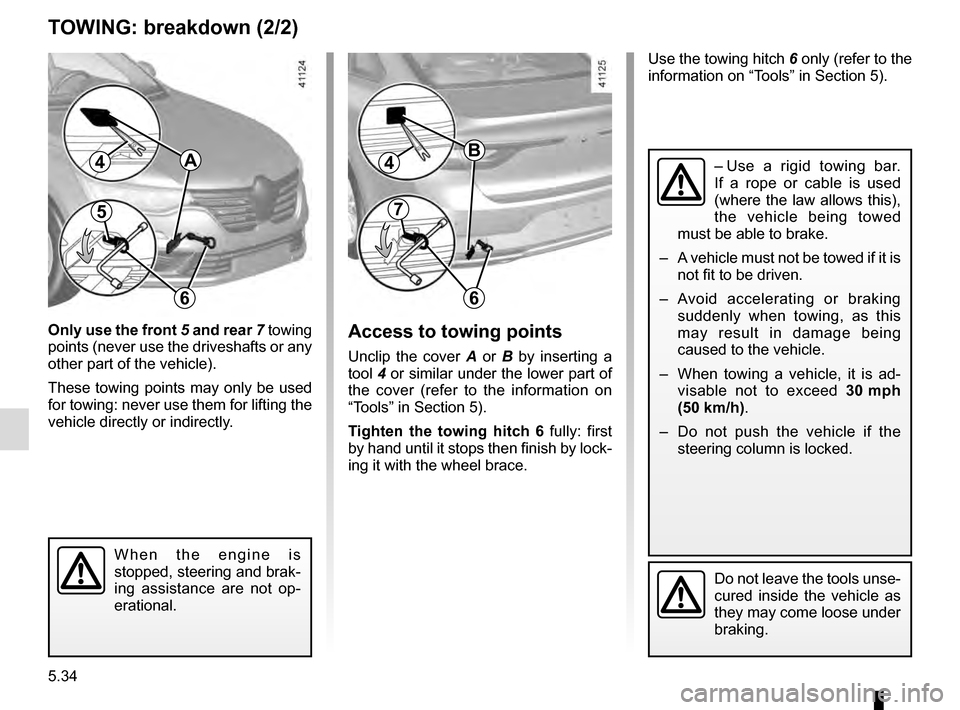
Use the towing hitch 6 only (refer to the
information on “Tools” in Section 5).
TOWING: breakdown (2/2)
Only use the front 5 and rear 7 towing
points (never use the driveshafts or any
other part of the vehicle).
These towing points may only be used
for towing: never use them for lifting the
vehicle directly or indirectly.Access to towing points
Unclip the cover A or B by inserting a
tool 4 or similar under the lower part of
the cover (refer to the information on
“Tools” in Section 5).
Tighten the towing hitch 6 fully: first
by hand until it stops then finish by lock-
ing it with the wheel brace.
When the engine is
stopped, steering and brak-
ing assistance are not op-
erational.
AB44– Use a rigid towing bar.
If a rope or cable is used
(where the law allows this),
the vehicle being towed
must be able to brake.
– A vehicle must not be towed if it is not fit to be driven.
– Avoid accelerating or braking suddenly when towing, as this
may result in damage being
caused to the vehicle.
– When towing a vehicle, it is ad- visable not to exceed 30 mph
(50 km/h).
– Do not push the vehicle if the steering column is locked.
Do not leave the tools unse-
cured inside the vehicle as
they may come loose under
braking.
57
66
Page 297 of 328

5.37
OPERATING FAULTS (3/6)
On the roadPOSSIBLE CAUSESWHAT TO DO
Vibrations. Tyres not inflated to correct pres-
sures, incorrectly balanced or dam-
aged. Check the tyre pressures: if this is not the
problem, have them checked by an ap-
proved Dealer.
White smoke from the exhaust. In the diesel version, this is not neces-
sarily a fault. Smoke may be caused
by particle filter regeneration. Please refer to the information on “Special
features of diesel versions” in Section 2.
Smoke under the bonnet. Short-circuit or cooling system leak. Stop, switch off the ignition, stand away
from the vehicle and contact an approved
dealer.
The oil pressure warning light comes
on: while cornering or braking The level is too low. Top up the engine oil level (refer to the in-
formation on “Engine oil level: topping up/
filling” in Section 4).
is slow to go out or remains lit
under acceleration Loss of oil pressure.
Stop the vehicle and contact an approved
Dealer.
Page 308 of 328

6.8
Original parts are based on strict specifications and are subject to hig\
hly-specialised tests. Therefore, they are of at least the same
level of quality as the parts fitted originally.
If you always fit genuine replacement parts to your vehicle, you will en\
sure that it performs well. Furthermore, repairs carried out
within the manufacturer’s Network using original parts are guaranteed according to the condition\
s set out on the reverse of the
repair order.
REPLACEMENT PARTS AND REPAIRS
Page 321 of 328

A
ABS ....................................................................\
...2.28 → 2.39
accessories.............................................................\
....")
7.1
ALPHABETICAL INDEX (1/5)
A
ABS ....................................................................\
...2.28 → 2.39
accessories.............................................................\
........... 5.30
accessories socket ................................................... 3.28, 3.51
adaptive cruise control...........................................2.59 → 2.65
additional methods of restraint .....................1.31 → 1.34, 1.37
side protection ............................................................. 1.36
to the rear seat belts ........................................1.31 → 1.35
adjusting your driving position ........................................... 1.27
advice on antipollution ....................................................... 2.23
air bag.................................................................\
...1.31 → 1.37
activating the front passenger air bags ........................ 1.53
deactivating the front passenger air bags .................... 1.51
air conditioning ........................................................3.6 → 3.16
air vents ...................................................................... 3.4 – 3.5
anti-corrosion check ..............................................6.15 → 6.19
anti-corrosion protection .................................................... 4.14
anti-lock braking system: ABS ...............................2.28 → 2.39
antipollution advice .................................................................\
......... 2.23
armrest: front ..................................................................\
............ 3.26
ashtray ................................................................\
............... 3.28
assisted parking............................... 2.66 → 2.70, 2.74 → 2.77
automatic gearbox (use) ........................................2.79 → 2.81
automatic gearbox selector lever...........................2.79 → 2.81
automatic trunk lid .................................................3.37 → 3.41
B
battery.................................................................\
.... 4.10 – 4.11 troubleshooting ................................................. 5.26 – 5.27
blind spot warning signal .......................................2.43 → 2.46
blind spot: warning signal ......................................2.43 → 2.46
bonnet..................................................................\
....... 4.2 – 4.3
brake fluid ........................................................................\
.... 4.8 bulbs
changing ..........................................................5.14 \
→ 5.20
C
catalytic converter................................................... 2.12 – 2.13
central door locking ......................................1.12 → 1.14, 1.18
changing a bulb .....................................................5.14 → 5.20
changing a wheel...................................................... 5.9 – 5.10
changing gear ...............................................2.14, 2.79 → 2.81
child restraint/seat .............................1.38 – 1.39, 1.41 → 1.50
child safety..................1.5, 1.8, 1.38 – 1.39, 1.41 → 1.50, 3.17
child seats..........................................1.38 – 1.39, 1.4\
1 → 1.50
children .......................................................... 1.38 – 1.39, 1.39
children (safety) ................................................... 1.5, 1.8, 3.17
cigar lighter ........................................................................\
3.28
cleaning: inside the vehicle .............................................. 4.16 – 4.17
clock ..................................................................\
................ 1.78
closing the doors ...................................................1.12 → 1.17
control instruments ................................................. 1.66 – 1.67
controls ................................................................... 1.54 – 1.55
coolant ................................................................\
................. 4.7
courtesy light .....................................3.22 – 3.23, 5.21 → 5.23
courtesy mirrors ................................................................. 3.24
cruise control ................................... 2.49 → 2.51, 2.55 → 2.58
cruise control-speed limiter.............. 2.49 → 2.51, 2.55 → 2.58
customised vehicle settings ................................... 1.76 – 1.77
customising the vehicle settings ............................ 1.76 – 1.77
D
dashboard...............................................................\
1.54 – 1.55
daytime running lights..................................................\
...... 1.87
dimensions ................................................................. 6.4 – 6.5
display ..........................................................1.56 → 1.65, 3.50
doors...................................................................\
...1.15 → 1.18
doors/tailgate .........................................................\
.............. 1.4