Page 148 of 274
3.4
MANUAL AIR CONDITIONING (1/2)
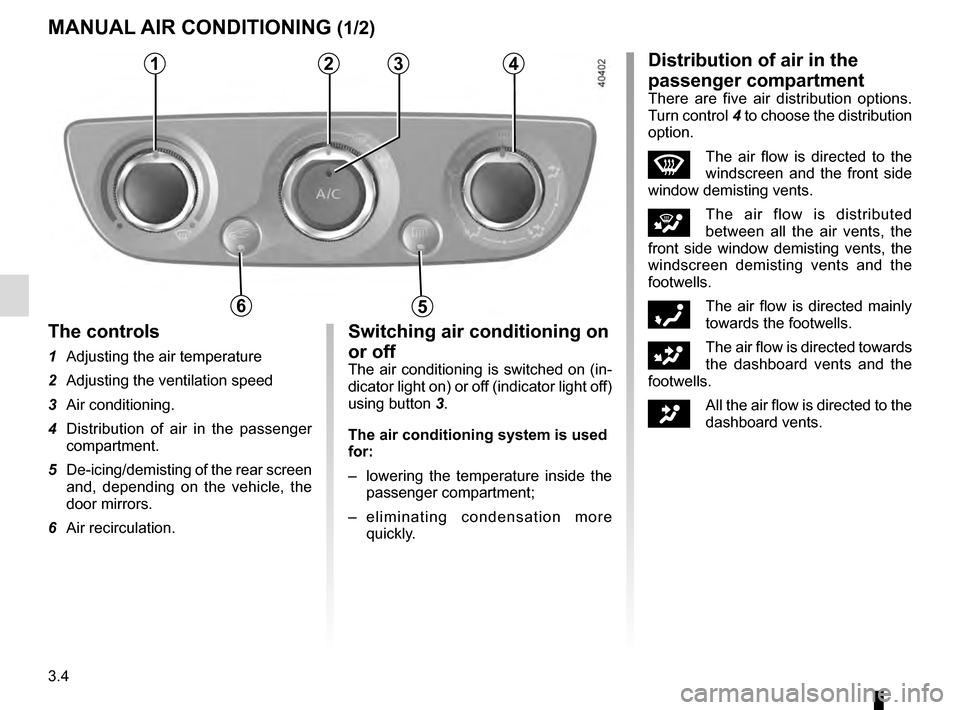
1234
56
The controls
1 Adjusting the air temperature
2 Adjusting the ventilation speed
3 Air conditioning.
4 Distribution of air in the passenger compartment.
5 De-icing/demisting of the rear screen and, depending on the vehicle, the
door mirrors.
6 Air recirculation.
Switching air conditioning on
or off
The air conditioning is switched on (in-
dicator light on) or off (indicator light off)
using button 3.
The air conditioning system is used
for:
– lowering the temperature inside the
passenger compartment;
– eliminating condensation more quickly.
Distribution of air in the
passenger compartment
There are five air distribution options.
Turn control 4 to choose the distribution
option.
WThe air flow is directed to the
windscreen and the front side
window demisting vents.
iThe air flow is distributed
between all the air vents, the
front side window demisting vents, the
windscreen demisting vents and the
footwells.
óThe air flow is directed mainly
towards the footwells.
GThe air flow is directed towards
the dashboard vents and the
footwells.
JAll the air flow is directed to the
dashboard vents.
Page 149 of 274
3.5
Adjusting the ventilation
speed
Turn control 2 clockwise to increase the
air flow in the passenger compartment.
The passenger compartment is ven-
tilated by blown air. The blower deter-
mines how much air enters but vehicle
speed has a slight effect on this.
Switching the air
recirculation on
Press button 6: the integrated indicator
light comes on.
Under these conditions, air is taken
from the passenger compartment and
is recirculated, with no air being taken
from outside the vehicle.
Air recirculation is for:
– isolating the vehicle from the exter- nal atmosphere (driving in polluted
areas, etc.);
– lowering the passenger compart- ment temperature as quickly as pos-
sible. “OFF" position:
the system is deactivated: the ventila-
tion speed for the passenger compart-
ment air is zero (vehicle stationary),
you can however still feel a slight flow
of air when the vehicle is moving.
Recommended demisting option:
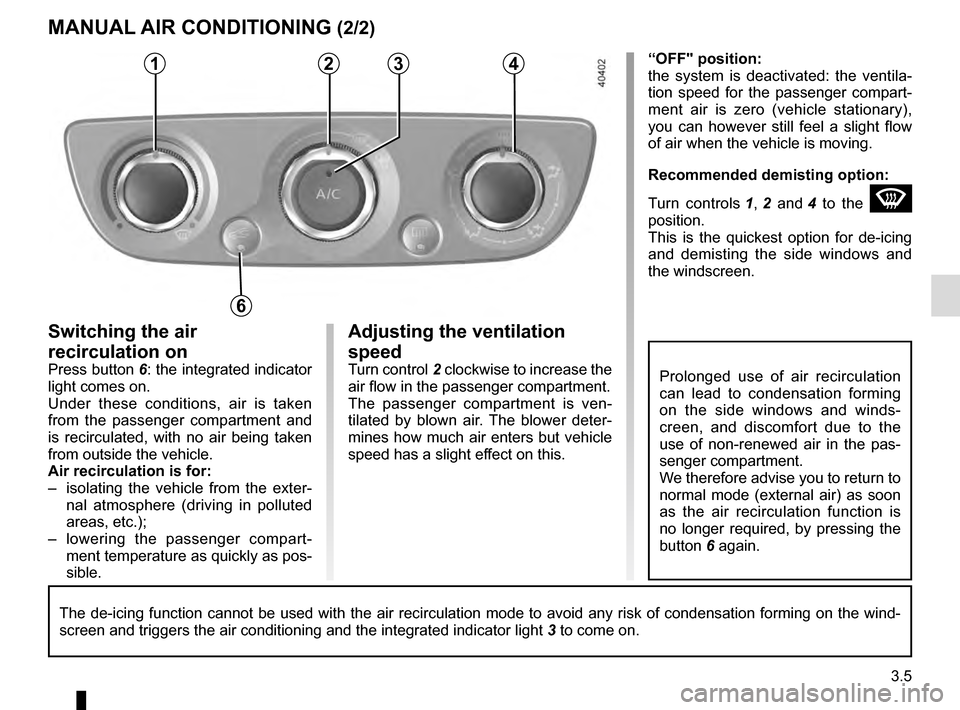
Turn controls
1, 2 and 4 to the
W
position.
This is the quickest option for de-icing
and demisting the side windows and
the windscreen.
MANUAL AIR CONDITIONING (2/2)
Prolonged use of air recirculation
can lead to condensation forming
on the side windows and winds-
creen, and discomfort due to the
use of non-renewed air in the pas-
senger compartment.
We therefore advise you to return to
normal mode (external air) as soon
as the air recirculation function is
no longer required, by pressing the
button 6 again.
The de-icing function cannot be used with the air recirculation mode to \
avoid any risk of condensation forming on the wind-
screen and triggers the air conditioning and the integrated indicator li\
ght 3 to come on.
1234
6
Page 151 of 274

3.7
AUTOMATIC CLIMATE CONTROL (2/5)
Varying the ventilation speed
In automatic mode, the system uses
the most suitable amount of air to reach
and maintain the desired comfort level.
You can still adjust the fan speed by
pressing the buttons 13 to increase or
reduce the fan speed.
In this case, the fan speed, which is
no longer controlled automatically, ap-
pears in zone A on the display 12.
Some buttons have an operating
tell-tale which indicates the opera-
ting status.
1
3
Temperature adjustment
Press button 1 or 6 to raise or lower the
left-hand 1 or right-hand 6 temperature.
Pressing button 3 for more than two se-
conds sets the passenger temperature
to the driver’s temperature.
Special note: The highest and lowest
settings allow the system to produce
maximum hot or cold temperature
levels (“LO” and “HI” indicated on the
multimedia display 12).
6
12
Clear View function
Press button 10: the integrated indica-
tor light comes on.
This function quickly demists and de-
ices the windscreen, the rear screen,
the front side windows, and the door
mirrors (depending on the vehicle). The
air conditioning and rear screen de-
icing functions must be activated.
Press button 9 to stop the heated rear
screen operating; the integrated indica-
tor goes out.
You can change the fan speed: press
the button 13.
To exit this function, press:
– the 10 button again;
– one of either button 2, 3 or 4.
109
24
A
13
Page 152 of 274

3.8
The displayed temperature values
show a comfort level.
When starting the engine, in-
creasing or decreasing the value
displayed will not allow the com-
fort level to be reached any more
quickly. The system will always op-
timise the temperature increase or
decrease (the ventilation system
does not start instantly at maximum
speed: it gradually increases). This
may take several minutes.
Generally speaking, unless there is
a particular reason not to, the dash-
board air vents should remain open.
You are recommended to use automatic mode by selecting one of the auto-
matic programmes AUTO, SOFT or FAST.
In automatic mode (indicator light for button 3 on), all heating and air conditioning
functions are controlled by the system.
You can also change the system selection. In this case, the indicator lig\
ht on the
button 3 will go out and the changed function, which is no longer controlled by \
the
system, will be shown on the display 12.
To return to automatic mode, press one of the AUTO, SOFT or FAST programmes.
AUTOMATIC CLIMATE CONTROL (3/5)
Switching air conditioning on
or off
In automatic mode, the system switches
the air conditioning system on or off,
depending on the climate conditions.
Press switch 8 to switch off the air
conditioning; the integrated indicator
comes on and “A/C OFF” is shown on
display 12.
3
812
Page 153 of 274

3.9
AUTOMATIC CLIMATE CONTROL (4/5)
Rear screen de-icing/
demisting
Press button 9: the integrated indica-
tor light comes on. This function per-
mits rapid demisting/de-icing of the rear
screen and de-icing of the door mirrors
(on equipped vehicles).
To exit this function, press button 9
again. Demisting automatically stops
by default.
ØThe air flow is directed to the
windscreen and the front side
window demisting vents.
×The air flow is distributed be-
tween front side window de-
misting vents, the windscreen demist-
ing vents and the footwells.
¿The air flow is directed mainly
towards the footwells.
¾The air flow is directed towards
the dashboard vents and the
footwells.
½All the air flow is directed to the
dashboard vents.
In this situation, the distribution of air in
the passenger compartment, which is
no longer automatically controlled, ap-
pears on the display.9
Adjusting the distribution
of air in the passenger
compartment
There are five air distribution options.
Press the switch 5 to scroll through
them. The arrows located in zone B on
the display 12 combine to show you the
distribution selected:
5
B12
13
Page 154 of 274

3.10
Manual use
Pressing button 11 allows air recircula-
tion to be forced, in which case the in-
tegrated warning light comes on as well
as warning light 14.
Prolonged use of this position may lead
to odours, caused by non-renewal of
air, and the formation of condensation
on the windows.
We therefore advise you to return to au-
tomatic mode as soon as the air recir-
culation function is no longer required,
by pressing button 11 again.Stopping the system
Press the button 7 to switch off the
system; in this case “OFF” is shown on
the display 12. To switch the system on,
press one of switches 2, 3 or 4.
Recycling
This function is managed automati-
cally (operation is confirmed by warn-
ing light 14 on display 12), but you can
also activate it manually.
Note:
– during recirculation, air is taken from the passenger compartment and
is recycled, with no air being taken
from outside the vehicle;
– air recirculation allows the external atmosphere to be cut off (when dri-
ving in polluted areas, etc.);
– lowering the passenger compart- ment temperature as quickly as pos-
sible.
AUTOMATIC CLIMATE CONTROL (5/5)
The demisting/de-icing will still take
priority over the air recirculation.
234
7111214
Page 156 of 274
3.12
ELECTRIC WINDOWS/ELECTRIC SUNROOF (1/4)
These systems operate with the igni-
tion on or off, until one of the front doors
is opened (limited to about 3 minutes).
Safety of rear occupants
The driver can disable operation of the electric windows and, depending \
on the vehicle, the rear doors, by pressing switch 4. The indicator light
integrated in the switch lights up to confirm that the locks have been a\
c-
tivated.
Driver’s responsibility
Never leave your vehicle with the RENAULT card inside and never leave a child
(or a pet) unsupervised, even for a short while. They may pose a risk to them-
selves or to others by starting the engine, activating equipment such as\
the elec-
tric windows or by locking the doors. If any part of the body becomes tr\
apped,
reverse the direction of the window immediately by pressing the relevant\
switch.
Risk of serious injury.
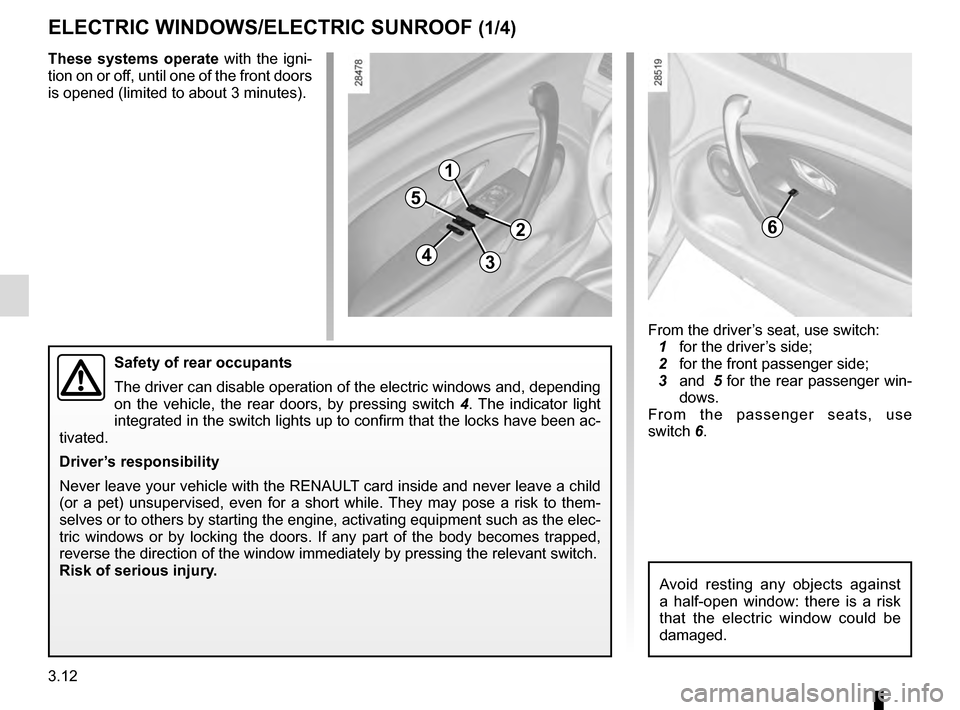
1
2
34
5
6
From the driver’s seat, use switch:
1 for the driver’s side;
2 for the front passenger side;
3 and 5 for the rear passenger win-
dows.
From the passenger seats, use
switch 6.
Avoid resting any objects against
a half-open window: there is a risk
that the electric window could be
damaged.
Page 158 of 274
3.14
ELECTRIC WINDOWS/ELECTRIC SUNROOF (3/4)
0
AB
C
D
98
Sunroof
– Open the sun blind
– To open slightly: turn button 9 to
position A;
– To open fully: turn button 9 to po-
sition B , C or D, depending on the
opening position required;
– To close: turn button 9 to position 0.
Special noteYour vehicle is equipped with an anti-
pinch facility: when the sunroof encoun-
ters resistance whilst closing, (some-
body’s fingers, etc.) it stops and then
moves back several centimetres.
Driver’s responsibility
Never leave your vehicle
with the RENAULT card
inside, and never leave a
child who is not self-sufficient or a
pet, even for a short while.
The reason for this is that the child
may endanger himself or others by
starting the engine, activating equip-
ment such as the window winders
for example, or locking the doors.
If something gets trapped, reverse
the direction of travel as soon as
possible by turning button 9 fully to
the right (position D).
Risk of serious injury.
