2016 RENAULT MASTER Egr
[x] Cancel search: EgrPage 15 of 284

1.9
Locking the doors with the
tailgate open
To lock the vehicle leaving a door open
(e.g. when transporting something in
the luggage compartment which pre-
vents it from being closed), or when
the vehicle is located in a zone of high
electromagnetic radiation, or if the key
is faulty: with the engine switched off,
press and hold switch 1 for more than
five seconds.
Locking the opening
elements without the remote
control
With the engine off, the rear doors
closed and a front door open, press
switch 1 for more than five seconds.
Make sure you have your key with you
before you leave your vehicle.
When the door is closed, all the doors
and tailgate will be locked.
Unlocking the driver’s door from out-
side the vehicle is only possible with the
key or the remote control.
Doors and tailgate status
indicator light
When the ignition is on, the indicator
light integrated in switch 1 informs you
of the status of the doors and tailgate:
– indicator light on, the doors and tail- gate are locked;
– light off, the doors and tailgate are unlocked.
When the ignition is off, the indicator
light remains lit and then goes out when
you lock the doors.
Interior locking/unlocking
door control
This enables all the doors to be locked
simultaneously.
Lock or unlock the doors by pressing
switch 1.
If a door or the tailgate is open or not
closed properly, the doors and tailgate
lock/unlock quickly.
CENTRAL DOOR LOCKING/UNLOCKING
Never leave your vehicle
with the key, remote con-
trol or transmitter/receiver
inside.
1
Driver’s responsibility
If you decide to keep the
doors locked when you are
driving, remember that it
may be more difficult for those as-
sisting you to gain access to the
passenger compartment in the
event of an emergency.
Page 25 of 284

1.19
Lumbar adjustment
(depending on the vehicle)
Turn control knob 3 to increase or de-
crease support.
To tilt the seatback
Move lever 4.
FRONT SEATS (1/3)
Adjusting seat A
To move forwards or backwards
Lift handle 1 to release. Release the
handle once the seat is in the correct
position and ensure that the seat is
locked.
To adjust the height of the seat base
Lower or pull lever 2 as many times as
is necessary to raise or lower the seat
base.
12
3
4
For safety reasons, carry
out any adjustments when
the vehicle is not being
driven.
We would advise you not to recline
the seatbacks too far to ensure that
the effectiveness of the seat belts is
not reduced.
Nothing should be placed on the
floor (area in front of driver) as such
objects may slide under the pedal
during braking manoeuvres, thus
obstructing its use.
Heated seats(depending on the vehicle)
With the ignition on , press switch 5.
The integrated indicator comes on.
The system, which has a thermostat,
decides whether or not the heating is
needed.
5
A
Page 26 of 284

1.20
FRONT SEATS (2/3)
Adjusting seat B with
suspension
To move forwards or backwards
Lift handle 11 to release. Release the
handle once the seat is in the correct
position and ensure that the seat is
locked.
To tilt the seatback
Lower or pull control 7 towards you.
To adjust the height of the seat base
Move control 9 to adjust the rear of the
seat base or control 10 to adjust the
front of the seat base.
6
7
910118
Lumbar adjustment
Activate bulb 12 to make it firmer.
Press switch 13 to make it less firm.
To adjust the seat suspension
Turn control knob 6 to the right to stiffen
the suspension and to the left to reduce
it.
1312
Heated seats(depending on the vehicle)
With the ignition on , press switch 8.
The integrated indicator comes on.
The system, which has a thermostat,
decides whether or not the heating is
needed.
B
Page 31 of 284
1.25
Check that the rear seat
belts are positioned and op-
erating correctly each time
the rear seats are moved.
REAR SEAT BELTS
Seat belts which are incor-
rectly adjusted or twisted
may cause injuries in the
event of an accident.
Use one seat belt per person,
whether child or adult.
Even pregnant women should wear
a seat belt. In this case, ensure that
the lap belt is not exerting too much
pressure on the abdomen, but do
not allow any slack.
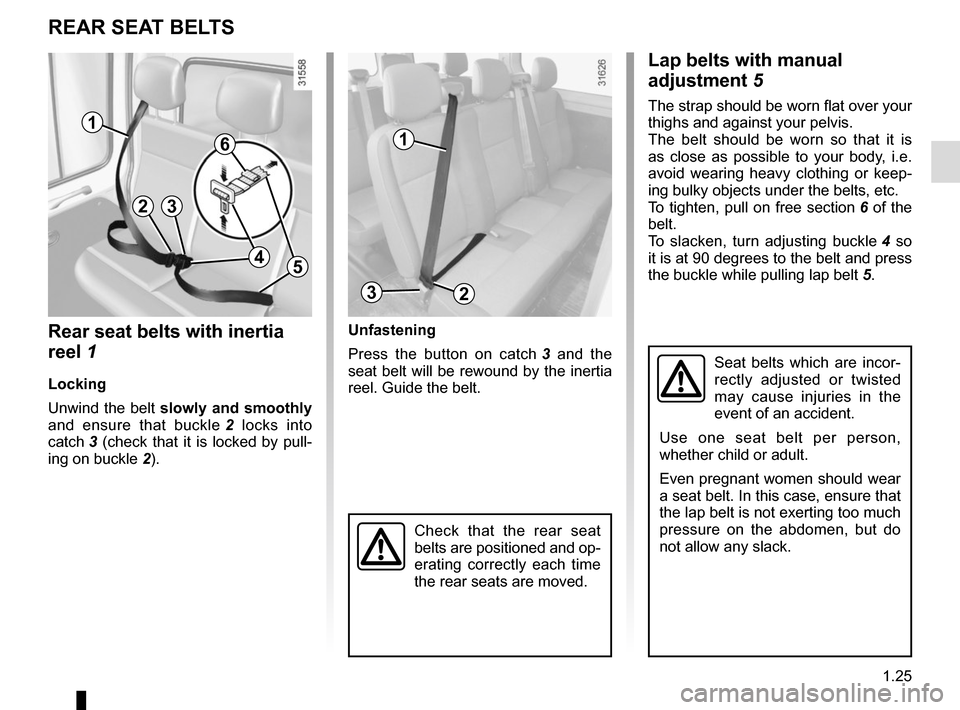
Rear seat belts with inertia
reel 1
Locking
Unwind the belt slowly and smoothly
and ensure that buckle 2 locks into
catch 3 (check that it is locked by pull- ing on buckle 2).
Lap belts with manual
adjustment 5
The strap should be worn flat over your
thighs and against your pelvis.
The belt should be worn so that it is
as close as possible to your body, i.e.
avoid wearing heavy clothing or keep-
ing bulky objects under the belts, etc.
To tighten, pull on free section 6 of the
belt.
To slacken, turn adjusting buckle 4 so
it is at 90 degrees to the belt and press
the buckle while pulling lap belt 5.
23
1
6
45
1
2
Unfastening
Press the button on catch 3 and the
seat belt will be rewound by the inertia
reel. Guide the belt.
3
Page 36 of 284

1.30
ADDITIONAL METHODS OF RESTRAINT
Operating faults
Indicator light 1, å, lights up when
the ignition is switched on and goes out
after a few seconds.
If it does not light up when the ignition
is switched on, or comes on when the
engine is running, there is a fault in the
system.
Contact your approved dealer as soon
as possible. Your protection will be re-
duced until this fault is rectified.
1
The air bag is designed to complement the action of the seat belt. Both \
the air bags and seat belts are integral parts of the same protection
system. It is therefore essential to wear seat belts at all times. If se\
at belts
are not worn, the occupants are exposed to the risk of serious injury in\
the event of an accident. It may also increase the risk of minor superfi\
cial injuries
occurring when the air bag is deployed, although such minor injuries are\
always
possible with air bags.
If the vehicle should overturn or suffer a rear impact, however severe, the pre-
tensioners and air bags are not always triggered. Shocks to the underbod\
y of the
vehicle, e.g. from pavements, potholes or stones, can all trigger these \
systems.
– No work or modification whatsoever may be carried out on any part of the air
bag system (air bags, pretensioners, computer, wiring harness, etc.), except
by qualified personnel from an approved dealer.
– To ensure that the system is in good working order and to avoid accidenta\
l trig- gering of the system which may cause injury, only qualified Network personnel
may work on the air bag system.
– As a safety precaution, have the air bag system checked if your vehicle \
has been involved in an accident, or is stolen or broken into.
– When selling or lending the vehicle, inform the user of these points and\
hand over this driver’s handbook with the vehicle.
– When scrapping your vehicle, contact your approved dealer for disposal o\
f the gas generator(s).
All of the warnings below are given so that the air bag is not obstructed in any
way when it is inflated and also to prevent the risk of serious injuries caused
by items which may be dislodged when the air bag inflates.
Page 152 of 284
2.38
POWER TAKE-OFF
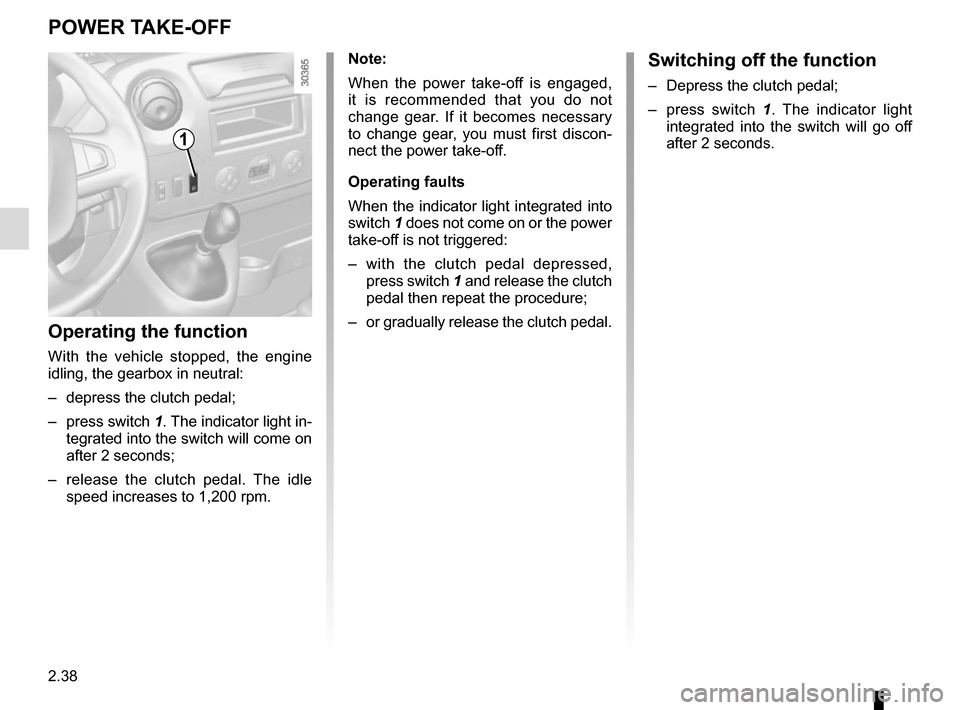
Operating the function
With the vehicle stopped, the engine
idling, the gearbox in neutral:
– depress the clutch pedal;
– press switch 1. The indicator light in-
tegrated into the switch will come on
after 2 seconds;
– release the clutch pedal. The idle speed increases to 1,200 rpm.
1
Note:
When the power take-off is engaged,
it is recommended that you do not
change gear. If it becomes necessary
to change gear, you must first discon-
nect the power take-off.
Operating faults
When the indicator light integrated into
switch 1 does not come on or the power
take-off is not triggered:
– with the clutch pedal depressed, press switch 1 and release the clutch
pedal then repeat the procedure;
– or gradually release the clutch pedal.Switching off the function
– Depress the clutch pedal;
– press switch 1. The indicator light
integrated into the switch will go off
after 2 seconds.
Page 164 of 284

3.4
MANUAL AIR CONDITIONING/HEATING SYSTEM (1/3)
Controls
A Adjusting the amount of air blown into the passenger compartment.
B Air recirculation operation (isolation of the passenger compartment)
C Adjusting the air temperature.
D Activating air conditioning (depend- ing on the vehicle).
E Rear screen and/or door mirror de- icing/demisting.
F Air distribution.
Information and advice for use
Refer to information on “Air condition-
ing: information and advice on use”.
Distribution of air in the
passenger compartment
Turn control F.
JAll the air flow is directed to the
dashboard vents.
This selection is not appropriate if all
the air vents are closed.
GThe air flow is directed to the
dashboard vents and the foot-
wells.
FThe air flow is directed mainly
towards the footwells.
iThe air flow is distributed be-
tween all the air vents, the
front side window demisting vents, the
windscreen demisting vents and the
footwells.
WThe air flow is directed to the
windscreen demisting/de-icing
outlets and the side windows. This po-
sition prevents the formation of conden-
sation. Use at the highest temperature.
VRear screen and/
or door mirror de-icing/
demisting.
Press button E: the integrated indicator
light comes on. This function demists
the rear screen and/or the heated door
mirrors quickly.
To exit this function, press the button
again; the integrated indicator goes
out. Demisting automatically stops by
default.
ABDFCE
Page 171 of 284

3.11
In automatic mode, depending on
the outside air conditions, the ven-
tilation may not start immediately at
maximum power but will increase
progressively until the engine tem-
perature is warm enough to heat the
passenger compartment air. This
may take from a few seconds to
several minutes.
Switching air conditioning on
or off
In automatic mode, the system switches
the air conditioning system on or off,
depending on the climate conditions.
Exit automatic mode by pressing
button 2: AUTO goes out on display 4
and AC OFF lights up.
Note: the “Clear View” function auto-
matically activates the air conditioning.
Press button 3 to return to automatic
mode.
Varying the ventilation speed
In automatic mode, the system uses
the most suitable amount of air to reach
and maintain the desired comfort level.
Exit automatic mode by pressing but-
tons 5 and 7.
These buttons allow you to increase or
decrease ventilation speed.
Rear screen and/or door
mirror de-icing/demisting.
Press button 11: the integrated indica-
tor light comes on.
This function allows electric demisting
of the rear screen and/or the electric
heated door mirrors, depending on the
vehicle.
To exit this function , press button 11
again. Demisting automatically stops
by default.
AUTOMATIC CLIMATE CONTROL (5/6)
23457
11