2016 RENAULT KANGOO wheel
[x] Cancel search: wheelPage 69 of 173

ENG_NU_854-2_X76LL_Renault_2
Exhaust gas monitoring
system
The exhaust gas monito")
JauneNoirNoir texte
2.7
ENG_UD14000_2
Conseils antipollution, économies de carburant, conduite (X76 - Rena\
ult)
ENG_NU_854-2_X76LL_Renault_2
Exhaust gas monitoring
system
The exhaust gas monitoring system
will detect any operating faults in the
vehicle’s antipollution system.
If this system malfunctions, toxic sub-
stances may be released into the at-
mosphere or damage may occur.
ÄThe instrument panel warning
light shows any system faults:
This comes on when the ignition is
switched on and goes out after 3 sec-
onds.
–
if it lights up continuously, consult an
approved Dealer as soon as possi-
ble;
–
if it flashes, reduce the engine speed
until the light stops flashing. Contact
your approved dealer as soon as
possible.
ADvIcE: antipollution, fuel economy and driving (2/3)
Driving
– Drive carefully for the first few miles
until the engine reaches its normal
operating temperature, rather than
let it warm up while the vehicle is sta-
tionary.
–
Speed is expensive.
– Sporty driving uses a lot of fuel: drive
with a light right foot. –
Brake as little as possible by suitably
anticipating an obstacle or bend and
then simply releasing the accelerator
pedal.
–
Avoid sudden acceleration.
– Do not overrev the engine in the in -
termediate gears. Always use the
highest gear possible without labour-
ing the engine.
–
Do not try to maintain the same
speed up a hill, accelerate no more
than you would on the level. Keep
your foot in the same position on the
accelerator pedal.
–
Double declutching and accelerating
before switching off are unnecessary
in modern vehicles.
–
Bad weather, flooded roads.
Do not drive through floods
if the depth of water is
above the lower edge of
the wheel rims.
Page 72 of 173

gear lever............................................................... (current page)
handbrake.............................................................. (current page)
power-assisted steering......................................... (current page)
2.10
ENG_UD13970_2
Levier vitesse / Frein main / Direction assistée (X76 - Renault)
ENG_NU_854-2_X76LL_Renault_2
Power-assisted steering
If you have power-assisted steering
fitted, do not leave the steering wheel
at full lock when the vehicle is parked
as this may damage the pump.1
Gear lever/Handbrake/Power-assisted steering
Gear lever
t o select reverse gear
(vehicle stationary)
Follow the grid on the gear lever
1.
GEAR lEvER/hANDBRAKE/PowER-ASSIStED StEERING
2
handbrake
t o release:
Pull the lever up slightly, press button 2
and then lower the lever to the floor.
The red warning light on the instrument
panel will come on if you are driving with
an incorrectly released handbrake.
t o apply:
Pull upwards, check that the vehicle is
properly immobilised.
Make sure that the hand-
brake is properly released
when driving (red indicator
light off), otherwise over-
heating may occur.
W h e n t h e v e h i c l e i s
stopped, depending on the
gradient and/or the vehicle
load, it may be necessary to
apply the handbrake by at least two
further notches and engage a gear
(1
st or reverse).
Never switch off the igni-
tion when travelling down-
hill, and avoid doing so in
normal driving (assistance
is not provided).An impact to the underside of the vehicle (e.g.: striking a post, raised kerb
or other street furniture) may result in damage to the vehicle (e.g.: defor-
mation of an axle).
To avoid any risk of accident, have your vehicle checked by an approved
dealer.
Page 73 of 173

ABS ...................................................... (up to the end of the DU)
anti-lock braking system: ABS .............. (up to the end of the DU) 2.11
ENG_UD7283_1
Système antiblocage des roues : ABS (X76 - Renault)
ENG_NU_854-2_X76LL_Renault_2
Anti-lock braking system
ANtI-locK BRAKING SyStEM: ABS
Depending on the vehicle, this is com-
posed of:
–
ABS (anti-lock braking system);
– emergency brake assist with, de -
pending on the vehicle, braking
anticipation;
These functions are an ad-
ditional aid in the event of
critical driving conditions,
enabling the vehicle behav-
iour to be adapted to suit the driving
conditions.
However, the functions do not take
the place of the driver. th
ey do
not increase the vehicle’s limits
and should not encourage you
to drive more quickly. Therefore,
they can under no circumstances
replace the vigilance or responsibil-
ity of the driver when manoeuvring
the vehicle (the driver must always
be ready for sudden incidents which
may occur when driving).
ABS (Anti-lock Braking
System)
Under heavy braking, the ABS prevents
the wheels from locking, allowing the
stopping distance to be managed and
keeping control of the vehicle.
Under these circumstances, the vehi-
cle can be steered to avoid an obstacle
whilst braking. In addition, this system
can increase stopping distances, par-
ticularly on roads with low surface grip
(wet ground etc.).
You will feel a pulsation through the
brake pedal each time the system is
activated. The ABS does not in any way
improve the vehicle’s physical perform-
ance relating to the road surface and
roadholding. It is still essential to follow
the rules of good driving practice (such
as driving at a safe distance from the
vehicle in front etc.).
In an emergency, apply firm and
continuous pressure to the brake
pedal. There is no need to pump
it repeatedly. The ABS will modu-
late the force applied in the braking
system.
operating faults:
– If the
x warning light on the in-
strument panel comes on while driv-
ing, braking is still operational ;
–
If the
x and D warning
lights on the instrument panel come
on when driving, this indicates a
fault with the braking system.
In such cases, the ABS and emergency
brake assist are also deactivated and,
depending on the vehicle, the mes-
sages “check ABS” and “check brak-
ing system” appear on the instrument
panel.
Consult an approved dealer.
Yo u r b r a k i n g s y s t e m s
are partially operational.
However, it is dangerous
to brake suddenly and
it is essential to stop immediately,
as soon as traffic conditions allow.
Contact an approved dealer.
Page 109 of 173

maintenance:bodywork ........................................ (up to the end of the DU)
washing ................................................ (up to the end of the DU)
paintwork maintenance ................................... (up to the end of the DU)
anti-corrosion protection ........................................ (current page) 4.11
ENG_UD7309_1
Entretien de la carrosserie (X76 - Renault)
ENG_NU_854-2_X76LL_Renault_4
Bodywork maintenance
BOdywORk MAIntenAnCe (1/2)
– Use solvents not approved by our
Technical Department to remove
stains as this could damage the
paintwork.
–
Drive frequently in snow or muddy
conditions without washing the ve-
hicle, particularly under the wheel
arches and body.
y ou should not:
– Degrease or clean mechanical com-
ponents (eg. the engine compart-
ment), underneath the body, parts
with hinges (eg. inside the fuel flap)
and painted plastic external fittings
(eg. bumpers) using high-pressure
cleaning equipment or by spraying
on products not approved by our
Technical Department. If adequate
precautions are not taken, this could
give rise to corrosion or operational
faults.
–
Wash the vehicle in bright sunlight or
freezing temperatures.
–
Scrape off mud or dirt without pre -
wetting.
–
Allow dirt to accumulate.
– Allow rust to form following minor im -
pacts.
Protection against the effects
of corrosive agents
Although your vehicle has been treated
with very effective anti-corrosion prod-
ucts, it nevertheless remains subject to
the effects of:
–
corrosives in the atmosphere
– atmospheric pollution (urban and
industrial areas);
–
saline atmosphere (near the sea,
particularly in hot weather);
–
seasonal and damp climatic con -
ditions, (e.g.: road salt in winter,
water from road cleaners, etc.).
–
abrasives
Wind-borne dust and sand, mud,
road grit thrown up by other vehi-
cles, etc.
–
minor impacts
You should take a minimum number of
precautions in order to safeguard your
vehicle against such risks and not to
lose the benefit of your vehicle’s anti-
corrosion protection.
Page 110 of 173

4.12
ENG_UD7309_1
Entretien de la carrosserie (X76 - Renault)
ENG_NU_854-2_X76LL_Renault_4
BOdywORk MAIntenAnCe (2/2)
– Before going through a roller type
car wash, return the windscreen
wiper stalk to park position (refer to
the information on the “Windscreen
wash/wipe” in Section 1). Check the
mounting of external accessories,
additional lights, door mirrors, etc.,
and be sure to hold the wiper blades
and radio aerial in place with adhe-
sive tape.
Remove the radio aerial mast if your
vehicle is fitted with this equipment.
–
Spray mechanical components,
hinges, etc. with products approved
by our Technical Department to
protect them after they have been
cleaned.
We have selected special products
to care for your vehicle and you can
obtain these from the manufactur-
er’s accessory outlets.
– Observe the vehicle stopping dis-
tances when driving on gravelled
surfaces to prevent paint damage.
–
Repair, or have repaired quickly,
areas where the paint has been dam-
aged, to prevent corrosion spread-
ing.
–
Remember to visit the body shop
periodically if your vehicle has an
anti-corrosion warranty. Refer to the
Maintenance Service Booklet.
–
Respect local regulations about
washing vehicles (e.g. do not wash
your vehicle on a public highway).
y ou should
– Wash your car frequently, with the
engine off , with cleaning products
recommended by our Technical
Department (never use abrasive
products) and be sure to jet-rinse
off:
–
spots of tree resin and industrial
grime;
–
bird droppings, which cause
a chemical reaction with the
paint that rapidly discolours
paintwork and may even cause
the paint to peel off;
Wash the vehicle immediately to
remove these marks since it is im-
possible to remove them by pol-
ishing;
–
salt, particularly in the wheel
arches and underneath the body
after driving in areas where the
roads have been gritted;
–
mud in the wheel arches and un -
derneath the body which form
damp patches.
Page 113 of 173

ENG_NU_854-2_X76LL_Renault_5
Section 5: Practical advice
Puncture . . . . . . . . . . . . . . . . . . . . . . . . . . . . . . . . . . . .\
. . . . . . .")
5.1
ENG_UD14022_2
Sommaire 5 (X76 - Renault)
ENG_NU_854-2_X76LL_Renault_5
Section 5: Practical advice
Puncture . . . . . . . . . . . . . . . . . . . . . . . . . . . . . . . . . . . .\
. . . . . . . . . . . . . . . . . . . . . . . . . . . . . . . . . . 5.2
Wheel trims . . . . . . . . . . . . . . . . . . . . . . . . . . . . . . . . . . . .\
. . . . . . . . . . . . . . . . . . . . . . . . . . . . . . . . 5.3
Changing a wheel . . . . . . . . . . . . . . . . . . . . . . . . . . . . . . . . . . . .\
. . . . . . . . . . . . . . . . . . . . . . . . . . . 5.4
Tyres . . . . . . . . . . . . . . . . . . . . . . . . . . . . . . . . . . . .\
. . . . . . . . . . . . . . . . . . . . . . . . . . . . . . . . . . . .\
. 5.5
Changing bulbs . . . . . . . . . . . . . . . . . . . . . . . . . . . . . . . . . . . .\
. . . . . . . . . . . . . . . . . . . . . . . . . . . . . 5.8
Front lights . . . . . . . . . . . . . . . . . . . . . . . . . . . . . . . . . . . . \
. . . . . . . . . . . . . . . . . . . . . . . . . . . 5.8
Fog lights . . . . . . . . . . . . . . . . . . . . . . . . . . . . . . . . . . . .\
. . . . . . . . . . . . . . . . . . . . . . . . . . . . 5.10
Rear lights: changing bulbs . . . . . . . . . . . . . . . . . . . . . . . . . . . . . . . . . . . . \
. . . . . . . . . . . . . . . . . . . . 5.1
1
Indicator lights . . . . . . . . . . . . . . . . . . . . . . . . . . . . . . . . . . . .\
. . . . . . . . . . . . . . . . . . . . . . . . 5.14
Interior lighting . . . . . . . . . . . . . . . . . . . . . . . . . . . . . . . . . . . .\
. . . . . . . . . . . . . . . . . . . . . . . . 5.15
Luggage compartment light . . . . . . . . . . . . . . . . . . . . . . . . . . . . . . . . . . . . \
. . . . . . . . . . . . . . . . . . . . 5.18
Battery: troubleshooting. . . . . . . . . . . . . . . . . . . . . . . . . . . . . . . . . . . . \
. . . . . . . . . . . . . . . . . . . . . . . 5.19
Fuses . . . . . . . . . . . . . . . . . . . . . . . . . . . . . . . . . . . . \
. . . . . . . . . . . . . . . . . . . . . . . . . . . . . . . . . . . . \
. 5.21
Wiper blades . . . . . . . . . . . . . . . . . . . . . . . . . . . . . . . . . . . .\
. . . . . . . . . . . . . . . . . . . . . . . . . . . . . . . 5.24
Towing: breakdown . . . . . . . . . . . . . . . . . . . . . . . . . . . . . . . . . . . .\
. . . . . . . . . . . . . . . . . . . . . . . . . . 5.26
Towing: towing equipment . . . . . . . . . . . . . . . . . . . . . . . . . . . . . . . . . . . . \
. . . . . . . . . . . . . . . . . . . . . 5.27
Fitting a radio . . . . . . . . . . . . . . . . . . . . . . . . . . . . . . . . . . . . \
. . . . . . . . . . . . . . . . . . . . . . . . . . . . . . . 5.28
Accessories . . . . . . . . . . . . . . . . . . . . . . . . . . . . . . . . . . . . \
. . . . . . . . . . . . . . . . . . . . . . . . . . . . . . . . 5.29
Fuel cut-off system in the event of a severe impact . . . . . . . . . . . . . . . . . . . . . . . . . . . . . . . . . . . .\
. 5.30
Radio frequency remote control: batteries. . . . . . . . . . . . . . . . . . . . . . . . . . . . . . . . . . . . \
. . . . . . . . . 5.31
Diesel filter . . . . . . . . . . . . . . . . . . . . . . . . . . . . . . . . . . . . \
. . . . . . . . . . . . . . . . . . . . . . . . . . . . . . . . . 5.32
Operating faults . . . . . . . . . . . . . . . . . . . . . . . . . . . . . . . . . . . . \
. . . . . . . . . . . . . . . . . . . . . . . . . . . . . 5.33
Page 114 of 173
practical advice ..................................... (up to the end of the DU)
puncture................................................ (up to the end of the DU)
jack ....................................................... (up to the end of the DU)
wheelbrace ............................................................ (current page)
emergency spare wheel ....................... (up to the end of the DU)
5.2
ENG_UD7312_1
Roue de secours (X76 - Renault)
ENG_NU_854-2_X76LL_Renault_5
Puncture
The jack is designed for
wheel changing purposes
only. It should never be
used for repairs or gain-
ing access to the underneath of the
vehicle.If the emergency spare
wheel has been stored
for several years, have it
checked by your Dealer to
ensure that it is safe to use.
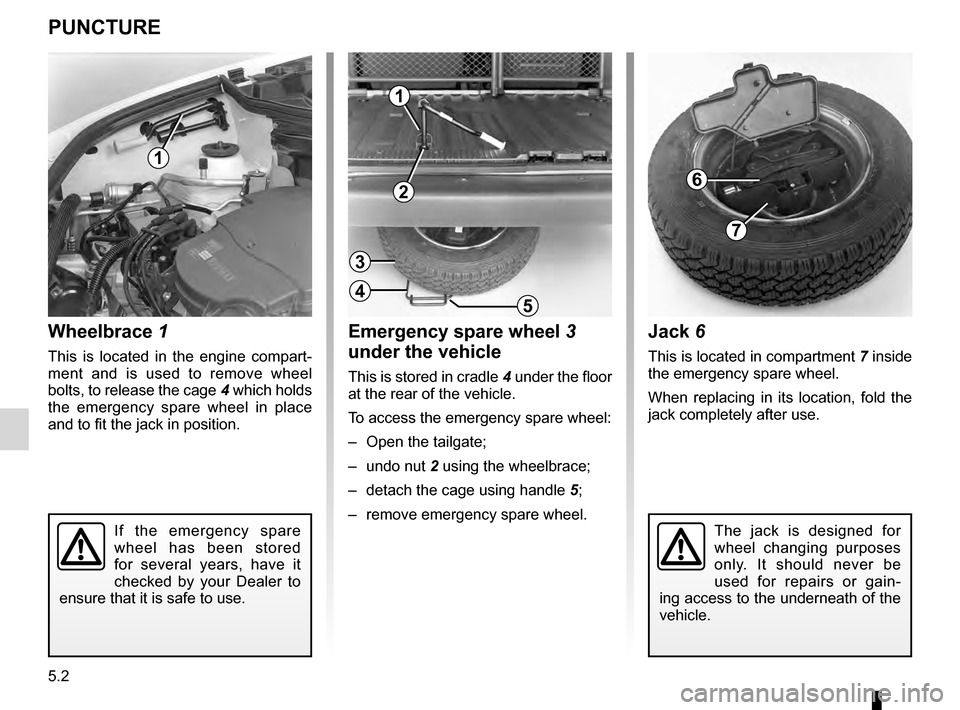
Jack 6
This is located in compartment 7 inside
the emergency spare wheel.
When replacing in its location, fold the
jack completely after use.
Emergency spare wheel 3
under
the vehicle
This is stored in cradle 4 under the floor
at the rear of the vehicle.
To access the emergency spare wheel:
–
Open the tailgate;
– undo nut 2 using the wheelbrace;
–
detach the cage using handle 5;
–
remove emergency spare wheel.
Wheelbrace 1
This is located in the engine compart-
ment and is used to remove wheel
bolts,
to release the cage 4 which holds
the emergency spare wheel in place
and to fit the jack in position.
PuncturE
1
1
2
3
45
6
7
Page 115 of 173

practical advice ..................................... (up to the end of the DU)
trims ...................................................... (up to the end of the DU) 5.3
ENG_UD7313_1
Enjoliveurs - Roue (X76 - Renault)
ENG_NU_854-2_X76LL_Renault_5
Wheel trim 3(exposed wheel bolts)
To remove it without removing the
wheel, press it at the points indicated
by the arrows.
Turn it so that the retaining brackets
holding it in place behind the wheel
bolts are released.
To refit the hubcap, proceed in reverse
order.
Wheel trims
WhEEl trims
1
Wheel trim 1(concealed wheel bolts)
Remove it using hubcap tool 2 (located
under the tool kit), by pushing the hook
into the opening located near the valve
(to reach the metal retaining wire lo-
cated behind the wheel trim).
To refit it, align it with the valve. Push the
retaining
hooks, starting with side A on
the
valve side, then B
and C and finish
with the side opposite the valve
D.
1
A
B
D
c
2
3