Page 181 of 256
5.3
PUNCTURE (1/2)
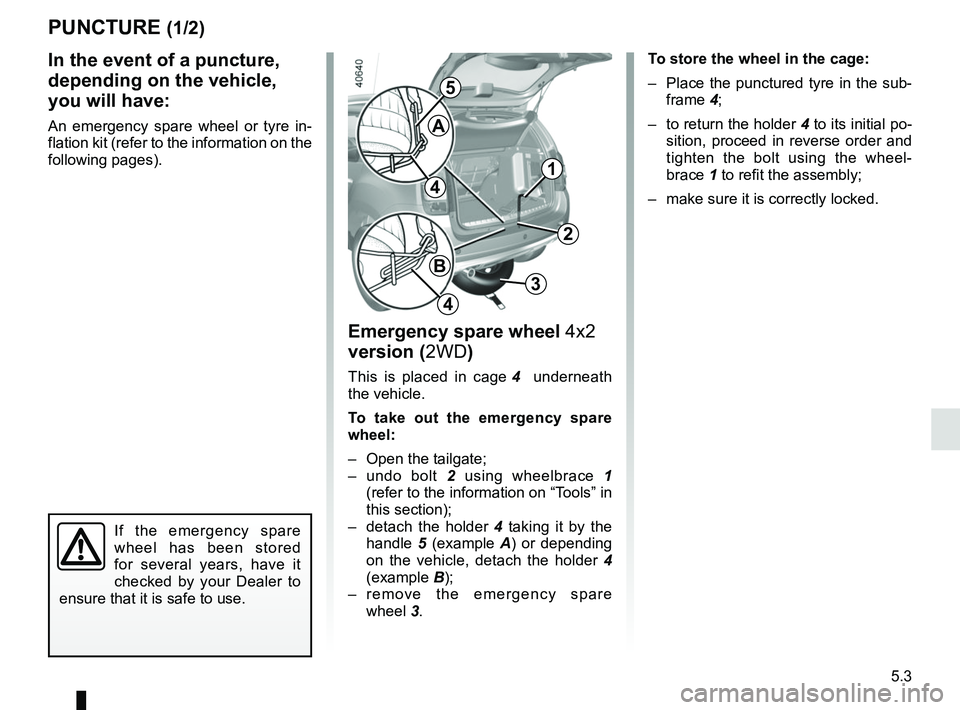
Emergency spare wheel 4x2 version (2WD)
This is placed in cage 4 underneath
the vehicle.
To take out the emergency spare
wheel:
– Open the tailgate;
– undo bolt 2 using wheelbrace 1
(refer to the information on “Tools” in
this section);
– detach the holder 4 taking it by the
handle 5 (example A ) or depending
on the vehicle, detach the holder 4
(example B);
– remove the emergency spare wheel 3.
In the event of a puncture,
depending on the vehicle,
you will have:
An emergency spare wheel or tyre in-
flation kit (refer to the information on the
following pages).
If the emergency spare
wheel has been stored
for several years, have it
checked by your Dealer to
ensure that it is safe to use.
To store the wheel in the cage:
– Place the punctured tyre in the sub- frame 4;
– to return the holder 4 to its initial po-
sition, proceed in reverse order and
tighten the bolt using the wheel-
brace 1 to refit the assembly;
– make sure it is correctly locked.
1
2
3
4
B
A
5
4
Page 196 of 256
5.18
REAR LIGHTS: replacing the bulbs(1/5)
The bulbs are under pres-
sure and can break when
replaced.
Risk of injury.
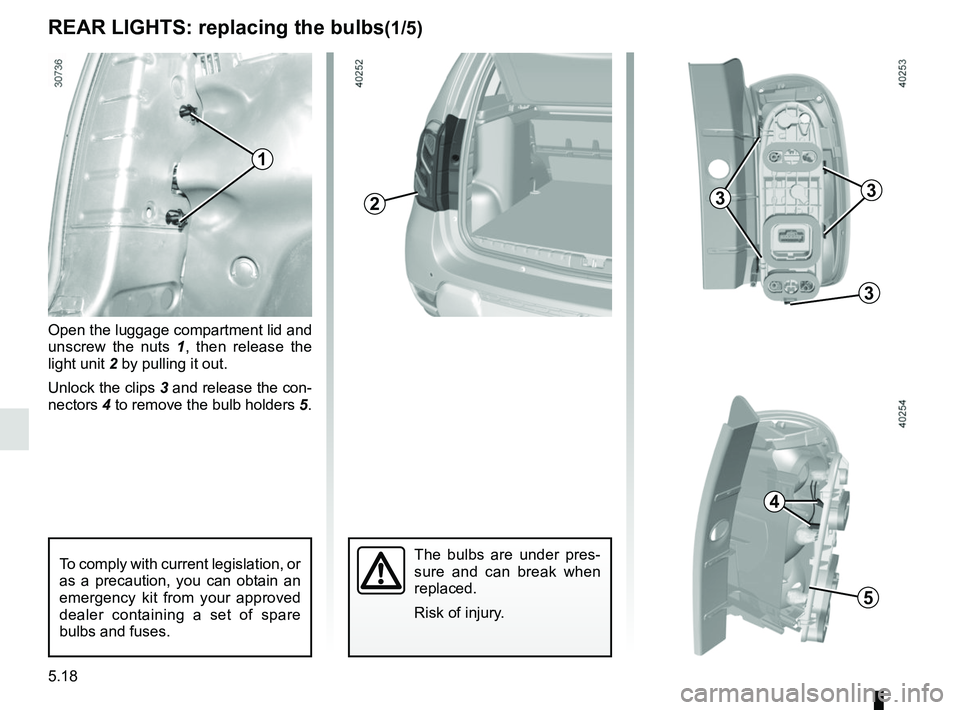
1
233
3
4
5
Open the luggage compartment lid and
unscrew the nuts 1, then release the
light unit 2 by pulling it out.
Unlock the clips 3 and release the con-
nectors 4 to remove the bulb holders 5.
To comply with current legislation, or
as a precaution, you can obtain an
emergency kit from your approved
dealer containing a set of spare
bulbs and fuses.
Page 198 of 256
5.20
REAR LIGHTS: replacing the bulbs(3/5)
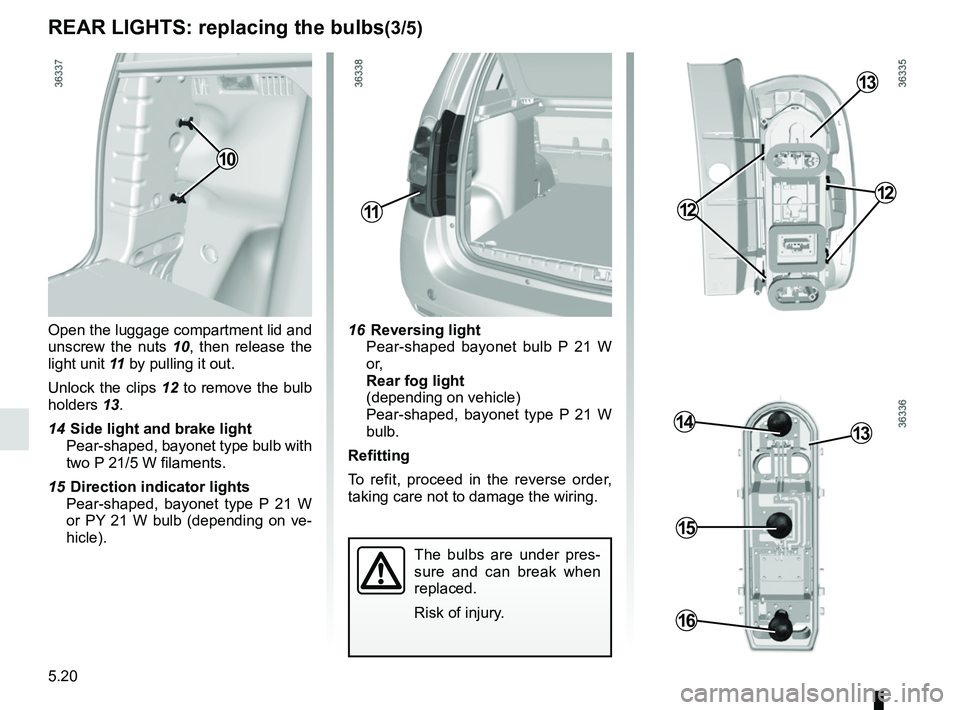
Open the luggage compartment lid and
unscrew the nuts 10, then release the
light unit 11 by pulling it out.
Unlock the clips 12 to remove the bulb
holders 13.
14 Side light and brake light
Pear-shaped, bayonet type bulb with
two P 21/5 W filaments.
15 Direction indicator lights
Pear-shaped, bayonet type P 21 W
or PY 21 W bulb (depending on ve-
hicle). 16
Reversing light
Pear-shaped bayonet bulb P 21 W
or,
Rear fog light
(depending on vehicle)
Pear-shaped, bayonet type P 21 W
bulb.
Refitting
To refit, proceed in the reverse order,
taking care not to damage the wiring.
10
111212
13
14
15
16
The bulbs are under pres-
sure and can break when
replaced.
Risk of injury.
13
Page 209 of 256

5.31
Number Allocation
A Driver’s side window
winder
B 4-wheel drive (4WD)
transmission
C LPG
D Rear accessories socket
E Passenger compartment
ECU, starter
1 Front electric window
2 Left-hand main beam
headlight
3 Right-hand main beam
headlight
4 Left-hand dipped beam
headlight
5 Right-hand dipped beam
headlight
6 Rear lights
7 Front side lights
8 Rear electric windowsNumber Allocation
9 Rear fog lights
10 Horn
11 Automatic door locking
12 ABS-ESC, brake switch,
clutch switch
13 Interior lights, boot light,
glovebox light
14 Empty location
15 Windscreen wiper
16 Cruise control/Speed
limiter, unfastened
seat belt warning,
parking distance
control, multimedia, air
conditioning, heated seats,
automatic gearbox lever,
UCHNumber Allocation
17 Daytime running lights
18 Brake lights
19 Injection, instrument panel
or dashboard, passenger
compartment, sequential
gearbox lever
20 Airbag
21 4-wheel drive transmission
(4WD), LPG, automatic
gearbox, sequential
gearbox, reverse gear
22 Power-assisted steering
23 Heated rear windscreen,
heated seats, seatbelt
alarm, parking distance
control, additional
passenger compartment
heating, cruise control/
speed limiter, heated
windscreen
FUSES (4/8)
Page 212 of 256
5.34
FUSES (7/8)
Number Allocation
A Driver’s side window
winder
B 4-wheel drive (4WD)
transmission
C Rear air conditioning
D Rear accessories socket
E Passenger compartment
ECU, starter
1 Front electric window
2 Left-hand main beam
headlight
3 Right-hand main beam
headlight
4 Left-hand dipped beam
headlight
5 Right-hand dipped beam
headlight
6 Rear lights
7 Front side lightsNumber Allocation
8 Rear electric windows
9 Rear fog lights
10 Horn
11 Automatic door locking
12 ABS-ESC, brake switch
13 Interior lights, boot light,
glovebox light
14 Not used
15 Windscreen wiper
16 Multimedia
17 Daytime running lightsNumber Allocation
18 Brake lights
19 Injection, instrument panel
or dashboard, passenger
compartment, sequential
gearbox lever
20 Airbag
21 4-wheel drive transmission
(4WD), reverse gear
22 Power-assisted steering
23 Cruise control/Speed
limiter, rear windscreen,
unfastened seatbelt
warning, parking distance
control, additional
passenger compartment
heating
Page 217 of 256

5.39
WIPER BLADES
Replacing windscreen wiper
blades 1
– With the ignition off, lift wiper arm 3.
– Turn the blade horizontally (move-ment A).
– Press tab 2 and slide the wiper blade
downwards (movement D) until
hook 4 on the wiper arm is released.
– Slide the blade (movement C) then
lift it (movement B) to release it.Replacing the rear screen wiper
blades 5
– With the ignition off, lift wiper arm 6.
– Turn blade 5 until some resistance is
met (movement E).
– Pull the blade to release it (move- ment F).
Refitting windscreen wiper blades
To refit the wiper blade, proceed in the
reverse order to removal. Make sure
that the blade is correctly locked in po-
sition.
Check the condition of the wiper
blades. You are responsible for their
service life:
– clean the blades, windscreen and rear screen regularly with soapy
water;
– do not use them when the wind- screen or rear screen are dry;
– free them from the windscreen or rear screen when they have not
been used for a long time.
– In frosty weather, make
sure that the wiper blades
are not stuck by ice (to
avoid the risk of the motor
overheating).
– Check the condition of the wiper
blades.
Replace the wiper blades as soon
as they begin to lose efficiency
(approximately once a year).
Whilst changing the blade, take care
not to drop the arm onto the window
after it has been removed as this
may break the window.
2
3
4
A
C
1
BD
56
F
E
Page 218 of 256

5.40
TOWING: breakdown (1/3)
Before any towing, put the gears into
neutral (neutral position for vehicles
equipped with a manual gearbox or N
position for vehicles equipped with an
automatic gearbox).
Unlock the steering column; the igni-
tion key must be in “M” position (ig-
nition) to enable signalling (“Stop”
lights, hazard warning lights, etc.).
Always switch on the lights when
driving at night.
Release the parking brake.
It is also essential to observe the towing
regulations imposed by current legisla-
tion in your country. Please contact an
authorised dealer.
Front and rear towing pointsOnly use the front 1 and rear 2
towing points.
Depending on the vehicle, unclip the
cover 3 by inserting a flat tool under the
cover.
When the engine is stop-
ped, steering and braking
assistance are not opera-
tional.
Do not remove the key from
the ignition when the vehi-
cle is being towed.
– Use a rigid towing bar. If a rope or cable is used (where the law allows
this), the vehicle being towed must be able to brake.
– A vehicle must not be towed if it is not fit to be driven.
– Avoid accelerating or braking suddenly when towing, as this may result
in damage being caused to the vehicle.
– When towing a vehicle, it is advisable not to exceed 30 mph (50 km/h).
– Do not push the vehicle if the steering column is locked.
These towing points may only be used
for towing: never use them for lifting the
vehicle directly or indirectly.
1
23
Page 220 of 256

5.42
TOWING: breakdown (3/3)
When storing the tools,
ensure they are securely re-
placed in the luggage com-
partment, in their original
position.
Do not leave the tools unsecured
inside the vehicle as they may come
loose under braking.
4
5
Towing a vehicle with an
automatic gearbox
When the engine is switched off, the
gearbox is no longer lubricated. It is
preferable to tow this type of vehicle
on a trailer or, for 4x2 (2WD) vehicles
only, tow it with the rear wheels off the
ground.
Under exceptional circumstances
and for 4x2 ( 2WD), vehicles only, you
may tow the vehicle with all four wheels
on the ground, only going forward, with
the gear lever in neutral position N and
for a distance not exceeding 30 miles
(50 km).
If the gear lever cannot be put into the
N position, please consult an authori-
sed dealer.
When setting off, if the lever is locked
in position P even though you are pres-
sing the brake pedal, the lever can be
released manually.
To do this, unclip the base of the lever,
simultaneously press recess 4 and the
unlocking button 5. Depending on the vehicle, unclip the
base of the lever, then insert a tool
(rigid rod) into the slot
6 and simulta-
neously press the button 7 in order to
unlock the lever.
Contact an authorised dealer as soon
as possible.
6
7