2016 RENAULT DUSTER lock
[x] Cancel search: lockPage 31 of 256
1.25
CHILD SAFETY: mounting a child seat (1/2)
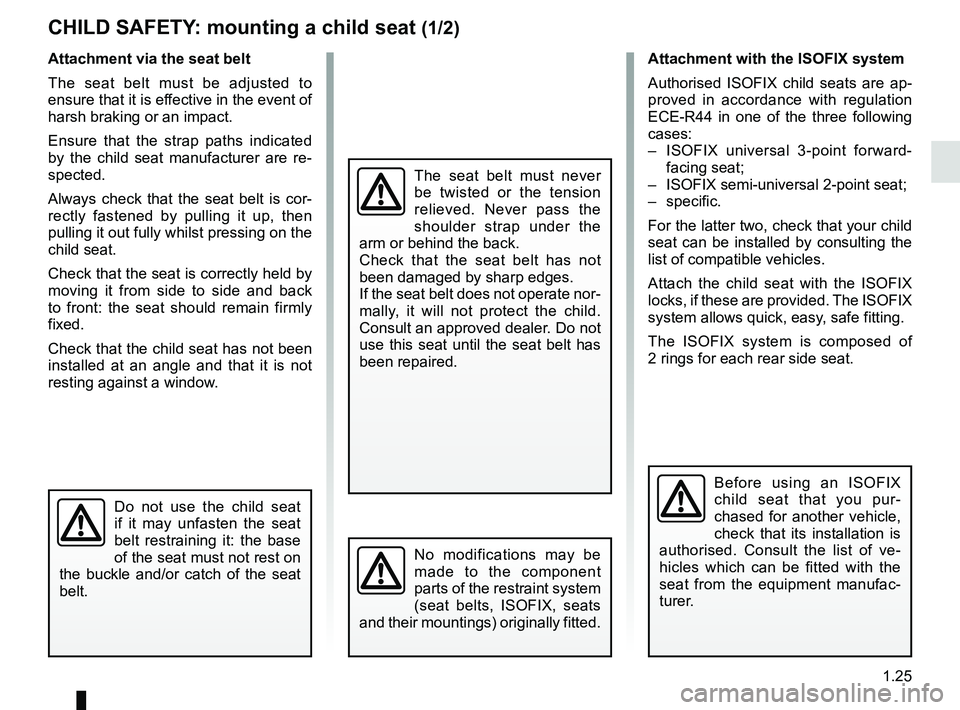
Attachment via the seat belt
The seat belt must be adjusted to
ensure that it is effective in the event of
harsh braking or an impact.
Ensure that the strap paths indicated
by the child seat manufacturer are re-
spected.
Always check that the seat belt is cor-
rectly fastened by pulling it up, then
pulling it out fully whilst pressing on the
child seat.
Check that the seat is correctly held by
moving it from side to side and back
to front: the seat should remain firmly
fixed.
Check that the child seat has not been
installed at an angle and that it is not
resting against a window.Attachment with the ISOFIX system
Authorised ISOFIX child seats are ap-
proved in accordance with regulation
ECE-R44 in one of the three following
cases:
– ISOFIX universal 3-point forward-
facing seat;
– ISOFIX semi-universal 2-point seat;
– specific.
For the latter two, check that your child
seat can be installed by consulting the
list of compatible vehicles.
Attach the child seat with the ISOFIX
locks, if these are provided. The ISOFIX
system allows quick, easy, safe fitting.
The ISOFIX system is composed of
2 rings for each rear side seat.
Before using an ISOFIX
child seat that you pur-
chased for another vehicle,
check that its installation is
authorised. Consult the list of ve-
hicles which can be fitted with the
seat from the equipment manufac-
turer.
No modifications may be
made to the component
parts of the restraint system
(seat belts, ISOFIX, seats
and their mountings) originally fitted.
The seat belt must never
be twisted or the tension
relieved. Never pass the
shoulder strap under the
arm or behind the back.
Check that the seat belt has not
been damaged by sharp edges.
If the seat belt does not operate nor-
mally, it will not protect the child.
Consult an approved dealer. Do not
use this seat until the seat belt has
been repaired.
Do not use the child seat
if it may unfasten the seat
belt restraining it: the base
of the seat must not rest on
the buckle and/or catch of the seat
belt.
Page 32 of 256

1.26
Attach the hook on the belt to one of the
rings 3 (4x2 version) or 4 (4x4 version).
Pull the belt so that the back of the child
seat comes into contact with the back
of the vehicle seat.The third ring of each side seat is used
to attach the upper strap on some child
seats.
Pass the belt between the seatback
and the rear parcel shelf (to remove the
parcel shelf: refer to Section 3 “Parcel
shelf”).
The rings ISOFIX 1
are located be-
tween the seatback and the seat base
and are clearly visible.
To ensure your child seat can be easily
fitted and locked on rings 1, use access
guides 2 on the child seat.
The ISOFIX anchorage points have been exclusively designed for child
seats with the ISOFIX system. Never fit a different type of child seat, seat
belt or other objects to these anchorage points.
Check that nothing is obstructing the anchorage points.
If your vehicle has been involved in a road accident, have the ISOFIX an\
chorage
points checked and replace your child seat.
CHILD SAFETY: mounting a child seat (2/2)
It is essential to use the
boot anchorage points 3
or 4 to attach the upper belt
of the child seat.
It is forbidden to use other mounting
points to attach this strap.
43
1
2
Page 33 of 256

1.27
CHILD SAFETY: fitting a child seat (1/6)
The types of child seats indicated may
not be available. Before using a differ-
ent child seat, check with the manufac-
turer that it can be fitted.
In the front seat
The laws concerning children travel-
ling in the front passenger seat differ in
every country. Consult the legislation in
force and follow the indications on the
diagram on the following page.
Before fitting a child seat in this seat (if
authorised):
– deactivate the front passenger air bag;
– lower the seat belt as far as possible;
– move the seat as far back as pos- sible;
– gently tilt the seatback away from vertical (approximately 25°);
– on equipped vehicles, raise the seat base as far as possible.
In all situations, reinsert the headrest to
its full extent so that it does not interfere
with the child seat (see the information
on “Front headrests” in Section 1);
RISK OF DEATH OR
SERIOUS INJURY: before
fitting a child seat in this
seat, check that the air bag
has been deactivated (refer to the in-
formation on “Deactivating the front
passenger air bag” in Section 1).
Some seats are not suitable for fitting
child seats. The diagrams on the fol-
lowing pages show you how to attach
a child seat.
Fit the child seat in a rear
seat wherever possible.
Make sure that the child
seat or the child’s feet do
not prevent the front seat from lock-
ing correctly. Refer to the informa-
tion on the “Front seat” in Section 1.
Check that when installing the child
seat in the vehicle it is not at risk of
coming loose from its base.
If you have to remove the headrest,
check that it is correctly stored so
that it does not come loose under
harsh braking or impact.
Always attach the child seat to the
vehicle even if it is not in use so that
it does not come loose under harsh
braking or impact.
After installing the child seat, if neces-
sary, the seat may be advanced (so as
to leave enough space in the rear seats
for passengers or other child seats).
For a rear-facing child seat, do not let
it touch the dashboard or move it to the
furthest forward position.
Do not change other settings after in-
stalling the child seat.
Page 39 of 256
![RENAULT DUSTER 2016 Owners Manual 1.33
To deactivate the passenger airbag,
with the ignition off, press and turn
button 1 to the OFF position.
With the ignition switched back on, it is
essential to check that warning light 2,
], i](/manual-img/7/58396/w960_58396-38.png "RENAULT DUSTER 2016 Owners Manual 1.33
To deactivate the passenger airbag,
with the ignition off, press and turn
button 1 to the OFF position.
With the ignition switched back on, it is
essential to check that warning light 2,
], i")
1.33
To deactivate the passenger airbag,
with the ignition off, press and turn
button 1 to the OFF position.
With the ignition switched back on, it is
essential to check that warning light 2,
], is lit up on the instrument panel.
This warning light remains conti-
nuously lit to let you know that you
can fit a child seat.
Deactivating the front
passenger air bag
(depending on vehicle)
To fit a rear-facing child seat on the
front passenger seat, you must deacti-
vate the front passenger air bag if your
vehicle is fitted with air bag deactiva-
tion.
CHILD SAFETY: deactivating/activating the front passenger air bag (1/3)
The passenger air bag must
be activated or deactivated
with the ignition off .
If handled when the igni-
tion is on, the warning light
å
comes on.
Switch the ignition off then on again
to reset the air bag in accordance
with the lock position.
2
1
Page 41 of 256
1.35
Operating faults
It is forbidden to fit a rear-facing child
seat to the front passenger seat if the
air bag activation/deactivation system
is faulty.
Allowing any other passenger to sit in
that seat is not recommended.
Contact your approved dealer as soon
as possible.
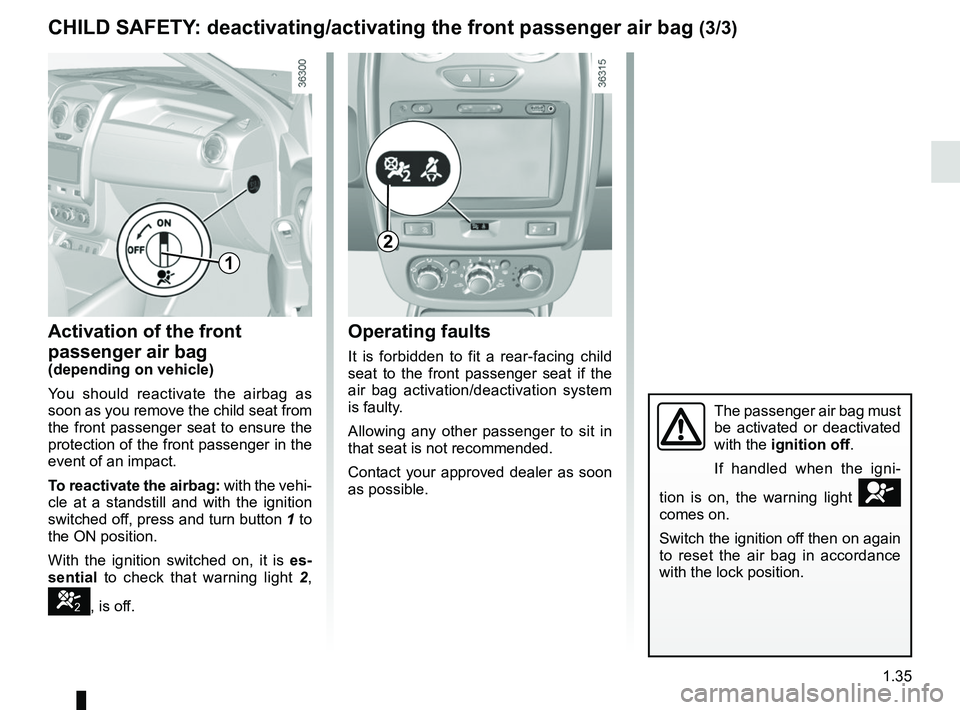
Activation of the front
passenger air bag
(depending on vehicle)
You should reactivate the airbag as
soon as you remove the child seat from
the front passenger seat to ensure the
protection of the front passenger in the
event of an impact.
To reactivate the airbag: with the vehi-
cle at a standstill and with the ignition
switched off, press and turn button 1 to
the ON position.
With the ignition switched on, it is es-
sential to check that warning light 2 ,
], is off.
CHILD SAFETY: deactivating/activating the front passenger air bag (3/3)
2
1
The passenger air bag must
be activated or deactivated
with the ignition off.
If handled when the igni-
tion is on, the warning light
å
comes on.
Switch the ignition off then on again
to reset the air bag in accordance
with the lock position.
Page 44 of 256

1.38
DRIVER’S POSITION, LEFT-HAND DRIVE (2/2)
The fittings described DEPEND ON THE VEHICLE VERSION AND COUNTRY.
1 Side air vent.
2 Side demister outlet.
3 Stalk for:
– direction indicator lights,
– exterior lights,
– front fog lights,
– rear fog light,
– horn.
4 Audible warning
5 Instrument panel.
6 Location for driver’s airbag.
7 – Steering column stalk for winds-
creen and rear screen wash/
wiper.
– On-board computer information
readout control.
8 Ignition switch.
9 Hazard warning lights switch.
10 Centre air vents.
11 Electric central locking switch. 12 Central demister outlet.
13 Location for radio, navigation system
or storage compartments.
14 Location for passenger airbag.
15 Side demister outlet.
16 Side air vent.
17 Passenger airbag activation/deacti-
vation switch.
18 Glove compartment
19 Activation/deactivation control for
the parking distance control.
20 Rear screen and door mirror de-
icing control
21 ECO mode switch.
22 ESC control (4x4 (4WD) version).
23 Activation/deactivation controls for
the Stop and Start function.
24 4x2 ( 2WD), 4x4 (4WD) mode selec-
tor or storage compartment. 25
Cigarette lighter or accessories
socket.
26 Handbrake.
27 Door mirror adjustment control.
28 Gearstick. 29 LPG control
30 Accessories socket.
31 Bottle holders.
32 Heating and ventilation controls.
33 Cruise control/speed limiter main
control.
34
Radio remote control.
35 Cruise control/speed limiter controls.
36 Beam height adjustment control.
37 Bonnet release control.
38 Fuse box.
Page 46 of 256

1.40
DRIVING POSITION, RIGHT-HAND DRIVE (2/2)
The presence of the equipment DEPENDS ON THE VEHICLE VERSION AND COUNTRY.
1 Side air vent.
2 Side demister outlet.
3 Location for passenger airbag or storage compartment.
4 Activation/deactivation control for the
parking distance control.
5 Hazard warning lights switch.
6 Electric central locking switch.
7 Central demister outlet.
8 Centre air vents.
9 Location for radio, navigation system or storage compartments.
10 Stalk for: – direction indicator lights,
– exterior lights,
– front fog lights,
– rear fog light,
– horn. 11
Instrument panel.
12 Cruise control/speed limiter controls.
13 – Steering column stalk for wind-
screen and rear screen wash/
wiper.
– On-board computer information
readout control.
14 Side demister outlet.
15 Side air vent.
16 Ignition switch.
17 Bonnet release control.
18 Beam height adjustment control.
19 Radio remote control.
20 Cruise control/speed limiter main
control.
21 ECO mode switch.
22ESC control.
23 Not used.
24 4x2 ( 2WD), 4x4 (4WD) mode selec-
tor or storage compartment.
25 Gearstick.
26 Door mirror adjustment control.
27 Handbrake.
28 Cigarette lighter or accessories
socket.
29 Heating and ventilation controls.
30 Accessories socket.
31 Bottle holder
32 Rear screen and door mirror de-icing control
33 Glove compartment
34 Fuse box.
35 Passenger airbag activation/deacti-
vation switch.
Page 49 of 256

1.43
WARNING LIGHTS (3/7)
A
ÀOil pressure warning light
This lights up when the ignition
is switched on and goes out after a few
seconds.
If it lights up on the road and, depend-
ing on the vehicle, is accompanied by
a beep, stop immediately and cut the
ignition.
Check the oil level (refer to “Engine oil
level: general information” in Section 4).
If the level is normal, the light has come
on for another reason: Consult an au-
thorised dealer straight away.
ÉPreheating warning light (on
diesel version)
This should come on when the igni-
tion is switched on. It indicates that the
heater plugs are in operation. It goes
out after preheating is sufficient and the
engine can be started.
åAirbag warning light
This lights up when the igni-
tion is switched on and goes out after
a few seconds. If it does not light up
when the ignition is switched on, if it
lights up when the engine is running,
or if it flashes, it indicates a fault in the
system.
Contact an approved Dealer as soon as
possible.
ÚBattery charge warning light
It should go out as soon as the
engine starts.
If it comes on when you are driving, it
indicates that the circuit is overcharged
or has discharged. Stop and consult an
authorised dealer as soon as possible.
xAnti-lock braking warning
light
This lights up when the ignition is
switched on and goes out after a few
seconds.
If it does not go out after the ignition is
switched on, or lights up when driving,
there is a fault with the ABS. Braking
will then be as normal, without the ABS
system.
Contact an approved Dealer as soon as
possible.
LLow fuel level warning light This comes on when the igni-
tion is switched on and goes out after
a few seconds. If it comes on when
driving and, depending on the vehicle,
is accompanied by a beep, fill up with
fuel as soon as possible. There is only
approximately 30 miles (50 km) worth
of fuel left after the warning light first
comes on.
The presence and operation of the warning lights DEPEND ON THE EQUIPMENT\
AND COUNTRY.