2016 Peugeot 308 warning
[x] Cancel search: warningPage 207 of 398
205
308_en_Chap06_conduite_ed02-2015
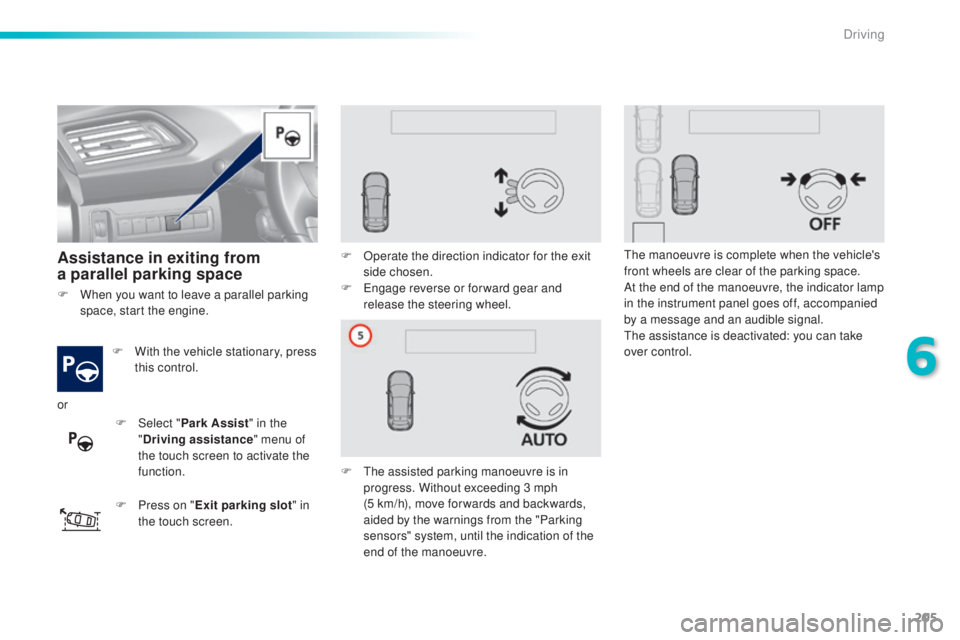
Assistance in exiting from
a parallel parking space
F With the vehicle stationary, press
t
his control.
F
Pr
ess on " Exit parking slot " in
the touch screen. F
Op
erate the direction indicator for the exit
side chosen.
F
e
ng
age reverse or for ward gear and
release the steering wheel.
F
t
he a
ssisted parking manoeuvre is in
progress. Without exceeding 3 mph
(5
k
m/h), move for wards and backwards,
aided by the warnings from the "Parking
sensors" system, until the indication of the
end of the manoeuvre.
the m
anoeuvre is complete when the vehicle's
front wheels are clear of the parking space.
At the end of the manoeuvre, the indicator lamp
in the instrument panel goes off, accompanied
by a message and an audible signal.the a ssistance is deactivated: you can take
over control.
F
Wh
en you want to leave a parallel parking
space, start the engine.
or F
Selec
t "Park Assist " in the
" Driving assistance " menu of
the touch screen to activate the
function.
6
Driving
Page 209 of 398
207
308_en_Chap06_conduite_ed02-2015
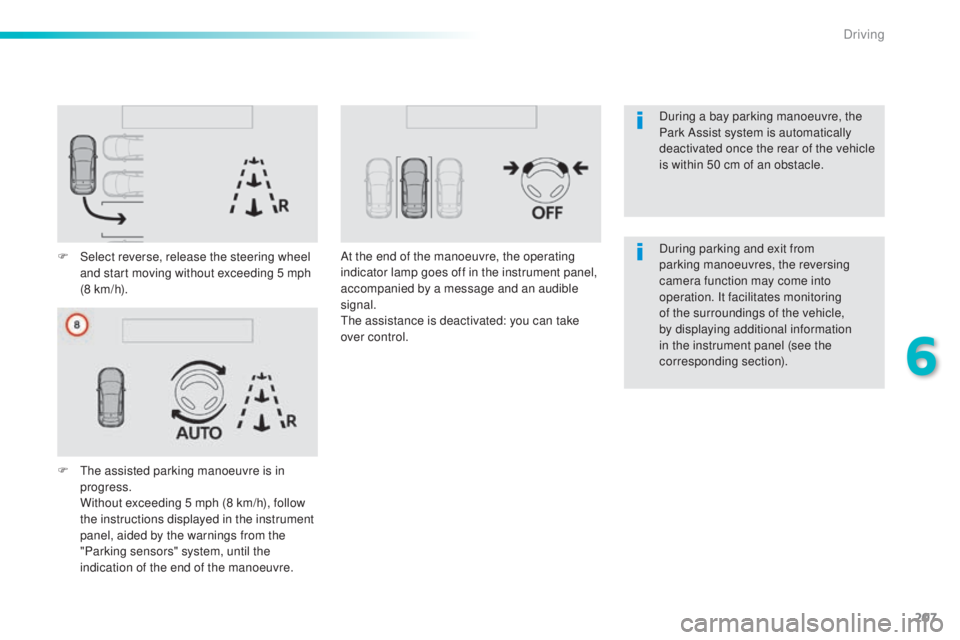
F Select reverse, release the steering wheel
and start moving without exceeding 5 mph
(8 km/h).
F
t
he a
ssisted parking manoeuvre is in
progress.
Wi
thout exceeding 5 mph (8 km/h), follow
the instructions displayed in the instrument
panel, aided by the warnings from the
"Parking sensors" system, until the
indication of the end of the manoeuvre. At the end of the manoeuvre, the operating
indicator lamp goes off in the instrument panel,
accompanied by a message and an audible
signal.
the a
ssistance is deactivated: you can take
over control. During parking and exit from
parking manoeuvres, the reversing
camera function may come into
operation. It facilitates monitoring
of the surroundings of the vehicle,
by displaying additional information
in the instrument panel (see the
corresponding section). During a bay parking manoeuvre, the
Park Assist system is automatically
deactivated once the rear of the vehicle
is within 50 cm of an obstacle.
6
Driving
Page 210 of 398
208
308_en_Chap06_conduite_ed02-2015
the system is deactivated by pressing the
c ontrol.
the s
ystem is deactivated automatically:
-
on s
witching off the ignition,
-
if t
he engine stalls,
-
if n
o manoeuvre is started within 5 minutes
of selection of the type of manoeuvre,
-
af
ter a prolonged stop of the vehicle during
a manoeuvre,
-
if t
he road wheel anti-slip regulation (ASR)
is triggered,
-
if t
he speed of the vehicle exceeds the
stated limit,
-
wh
en the driver interrupts movement of the
steering wheel,
-
af
ter 4 manoeuvre cycles,
-
on
opening the driver's door,
-
if o
ne of the front wheels encounters an
obstacle.
the o
peration indicator lamp goes off in the
instrument panel and a message is displayed
accompanied by an audible signal.
the d
river should then take back control of the
vehicle's steering.
Deactivation
If the system is deactivated during a
manoeuvre, the drive should reactivate it to
repeat the measurement.
the s
ystem is switched off automatically:
-
wh
en towing a trailer,
-
if t
he driver's door is opened,
-
if t
he speed of the vehicle is above 42 mph
(70 km/h).
to sw
itch the system of for a prolonged period,
contact a P
eu
ge
Ot d
ealer or a qualified
workshop.
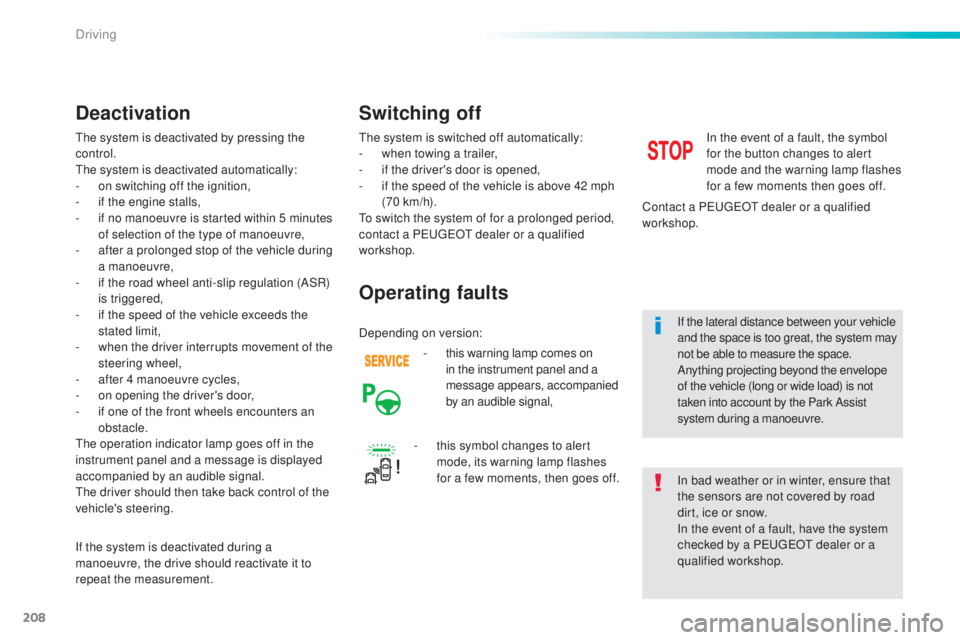
-
th
is warning lamp comes on
in the instrument panel and a
message appears, accompanied
by an audible signal,
Operating faults
In the event of a fault, the symbol
for the button changes to alert
mode and the warning lamp flashes
for a few moments then goes off.
Contact a P
eu
ge
Ot d
ealer or a qualified
workshop.
Switching off
In bad weather or in winter, ensure that
the sensors are not covered by road
dirt, ice or snow.
In the event of a fault, have the system
checked by a P
eu
ge
Ot d
ealer or a
qualified workshop.
-
th
is symbol changes to alert
mode, its warning lamp flashes
for a few moments, then goes off. If the lateral distance between your vehicle
and the space is too great, the system may
not be able to measure the space.
Anything projecting beyond the envelope
of the vehicle (long or wide load) is not
taken into account by the Park Assist
system during a manoeuvre.
Depending on version:
Driving
Page 212 of 398
210
308_en_Chap06_conduite_ed02-2015
Under-inflation alertReinitialisation
Before reinitialising the system, ensure
that the pressures of the four tyres are
correct for the use of the vehicle and in
line with the recommendations on the
tyre pressure label.
the u
nder-inflation alert can only be
relied on if the reinitialisation of the
system has done with the pressures in
the four tyres correctly adjusted.
the u
nder-inflation detection system
does not give a warning if a pressure is
incorrect at the time of reinitialisation.
thi
s is given by fixed illumination of
this warning lamp, accompanied by
an audible signal and, depending on
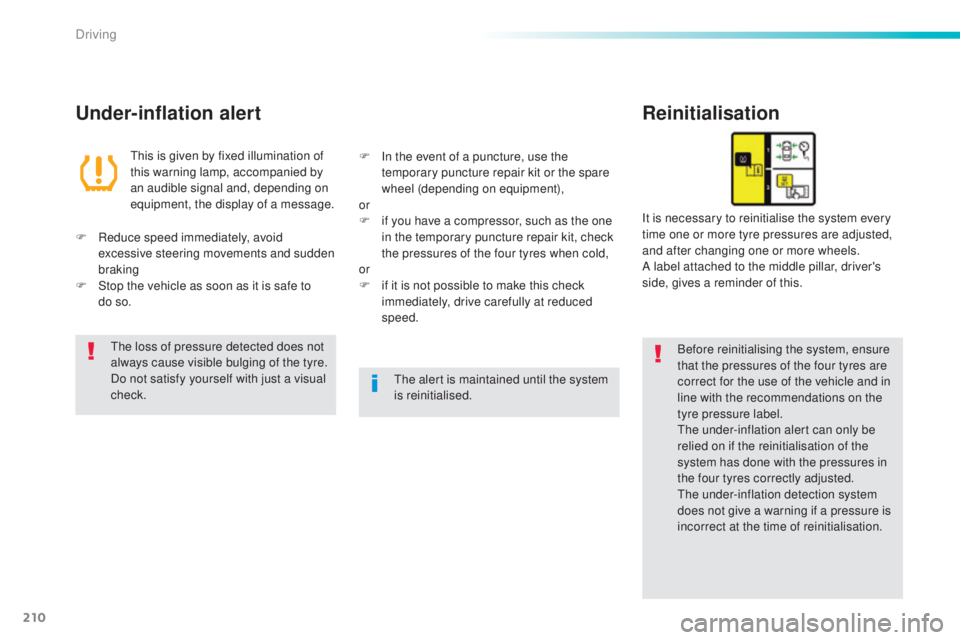
equipment, the display of a message. It is necessary to reinitialise the system every
time one or more tyre pressures are adjusted,
and after changing one or more wheels.
A label attached to the middle pillar, driver's
side, gives a reminder of this.
F
Red
uce speed immediately, avoid
excessive steering movements and sudden
braking
F
St
op the vehicle as soon as it is safe to
do
s
o. F
In t
he event of a puncture, use the
temporary puncture repair kit or the spare
wheel (depending on equipment),
or
F
if y
ou have a compressor, such as the one
in the temporary puncture repair kit, check
the pressures of the four tyres when cold,
or
F
if i
t is not possible to make this check
immediately, drive carefully at reduced
speed.the l
oss of pressure detected does not
always cause visible bulging of the tyre.
Do not satisfy yourself with just a visual
check.
the a
lert is maintained until the system
is reinitialised.
Driving
Page 214 of 398
212
308_en_Chap06_conduite_ed02-2015
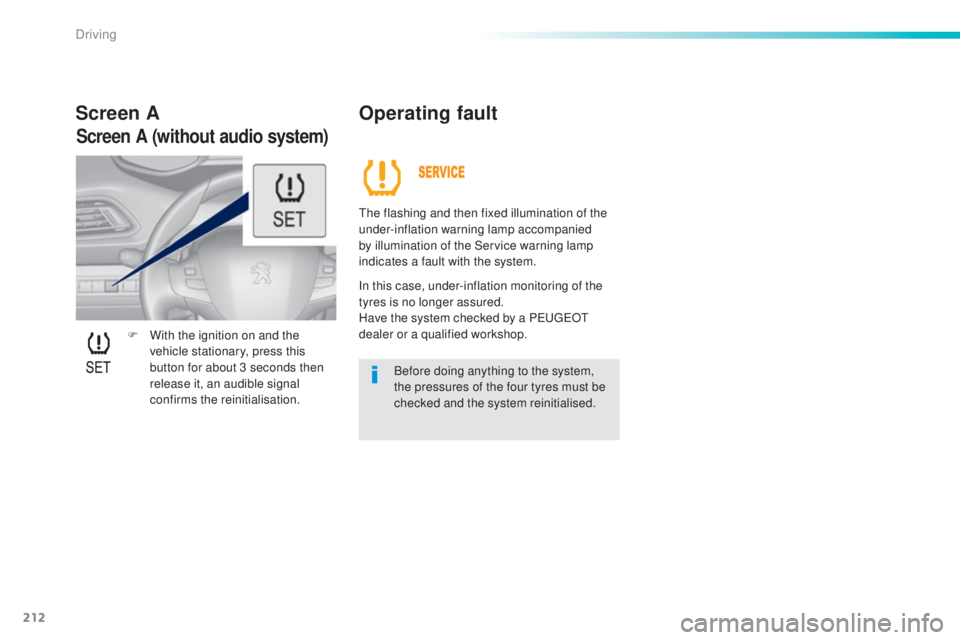
F With the ignition on and the
vehicle stationary, press this
button for about 3 seconds then
release it, an audible signal
confirms the reinitialisation.
Screen A Operating fault
the flashing and then fixed illumination of the
u nder-inflation warning lamp accompanied
by illumination of the Service warning lamp
indicates a fault with the system.
In this case, under-inflation monitoring of the
tyres is no longer assured.
Have the system checked by a P
eu
ge
Ot
d
ealer or a qualified workshop. Before doing anything to the system,
the pressures of the four tyres must be
checked and the system reinitialised.
Screen A (without audio system)
Driving
Page 216 of 398
214
308_en_Chap07_info-pratiques_ed02-2015
Low fuel level
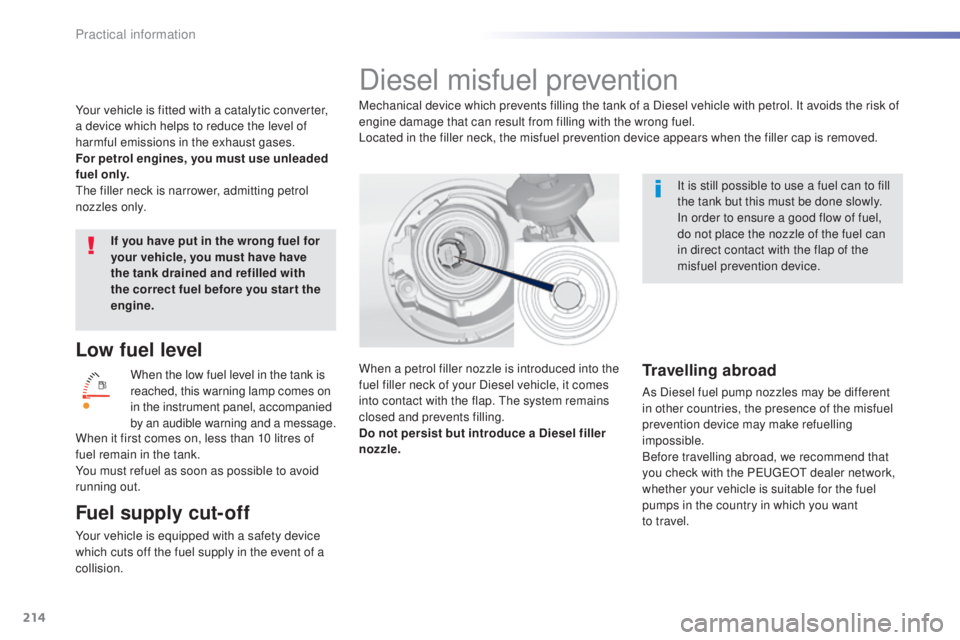
When the low fuel level in the tank is
reached, this warning lamp comes on
in the instrument panel, accompanied
by an audible warning and a message.
Fuel supply cut-off
Your vehicle is equipped with a safety device
which cuts off the fuel supply in the event of a
collision. When it first comes on, less than 10 litres of
fuel remain in the tank.
You must refuel as soon as possible to avoid
running out.If you have put in the wrong fuel for
your vehicle, you must have have
the tank drained and refilled with
the correct fuel before you star t the
engine.
Your vehicle is fitted with a catalytic converter,
a device which helps to reduce the level of
harmful emissions in the exhaust gases.
For petrol engines, you must use unleaded
fuel only.
the f
iller neck is narrower, admitting petrol
nozzles only. It is still possible to use a fuel can to fill
the tank but this must be done slowly.
In order to ensure a good flow of fuel,
do not place the nozzle of the fuel can
in direct contact with the flap of the
misfuel prevention device.
Diesel misfuel prevention
Mechanical device which prevents filling the tank of a Diesel vehicle with petrol. It avoids the risk of
engine damage that can result from filling with the wrong fuel.
Located in the filler neck, the misfuel prevention device appears when the filler cap is removed.
When a petrol filler nozzle is introduced into the
fuel filler neck of your Diesel vehicle, it comes
into contact with the flap.
the s
ystem remains
closed and prevents filling.
Do not persist but introduce a Diesel filler
nozzle.
Travelling abroad
As Diesel fuel pump nozzles may be different
in other countries, the presence of the misfuel
prevention device may make refuelling
impossible.
Before travelling abroad, we recommend that
you check with the P
eu
ge
Ot d
ealer network,
whether your vehicle is suitable for the fuel
pumps in the country in which you want
to
t
ravel.
Practical information
Page 222 of 398
220
308_en_Chap07_info-pratiques_ed02-2015
"Multimedia"
Multimedia support, hands-free kit, DVD player,
driving aids, vehicle tracking system, ...
Accessories
A wide range of accessories and genuine parts is available from the PeugeOt d ealer network.the
se accessories and parts are all suitable for your vehicle and benefit from Peu geOt's r ecommendation and warranty.
"Transport solutions"
Boot liners, roof bars, bicycle carrier on roof
bars, ski carrier, roof box, towbar harness, ...
tow b
ar, which mst be fitted by P
eu
ge
Ot
d
ealer or a qualified workshop.
Conversion kits
You can obtain an "ent erprise" kit to convert a
trade vehicle to a private car and vice-versa.
"Styling"
alloy wheels from 15 inch to 18 inch, finishers
for wheels, door sills, gear lever knobs, ...
"Ligne S": 16 and 17 inch alloy wheels, body
kit, stickers, interior and exterior mirror shells,
gear lever knob, door sills, mats*, …
"Comfort"
Door deflectors, side blinds and rear blind,
cigarette lighter, boot dividers, coat hanger
fixed to head restraint, front centre armrest,
under shelf storage, front and rear parking
sensors, styling mudflaps, window film, boot
management system, ...
*
t
o av
oid any risk of jamming of the pedals:
-
en
sure that the mat is positioned and
secured correctly,
-
ne
ver fit one mat on top of another.
"Security and safety"
Anti-theft alarm, window engraving, wheel
security bolts, child seats and booster
cushions, breathalyzer, first aid kit, warning
triangle, high visibility jacket, stolen vehicle
tracking system, temporary puncture repair kit,
snow chains, non-slip covers, front foglamps
kit, dog guard, ...
"Protection"
Mats*, seat covers compatible with lateral
airbags, mud flaps, side protection rubbing
strips, bumper protection rubbing strips,
bumper protectors, boot sill finishers, boot
mat,
...
Practical information
Page 223 of 398
221
308_en_Chap07_info-pratiques_ed02-2015
the fitting of electrical equipment
o r accessories which are not
recommended by P
eu
ge
Ot m
ay result
in a failure of your vehicle's electronic
system and excessive electrical
consumption.
Contact a P
eu
ge
Ot d
ealer
for information on the range of
recommended equipment and
accessories.
Installation of radio
communication
transmitters
Before installing any after-market radio
communication transmitter, you can
contact a P
eu
ge
Ot d
ealer for the
specification of transmitters which can
be fitted (frequency, maximum power,
aerial position, specific installation
requirements), in line with the Vehicle
ele
ctromagnetic Compatibility
Directive
(
2004/104/
eC)
. Depending on the legislation in force in
the country, certain safety equipment
may be compulsory: high visibility
safety vests, warning triangles,
breathalyzers, spare bulbs, spare fuses,
fire extinguisher, first aid kit, mud flaps
at the rear of the vehicle.
By visiting a P
eu
ge
Ot d
ealer, you can also
obtain products for cleaning and maintenance
(exterior and interior) - including ecological
products in the "
teCH
NA
tuRe" ra
nge, topping
up products (screenwash...), touch-up pens
and paint aerosols for the exact colour of your
vehicle, refills (cartridge for the temporary
puncture repair kit...), ...
7
Practical information