2016 Peugeot 308 ECU
[x] Cancel search: ECUPage 141 of 398
139
308_en_Chap05_securite_ed02-2015
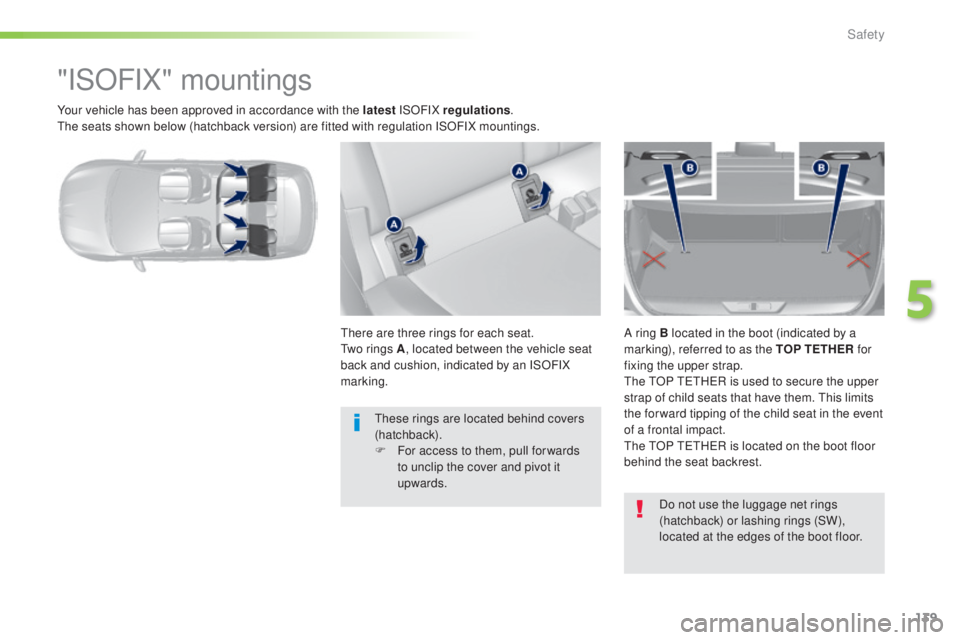
Your vehicle has been approved in accordance with the latest ISOFIX regulations.the s
eats shown below (hatchback version) are fitted with regulation ISOFIX mountings.
"ISOFIX" mountings
there are three rings for each seat.two rings A , located between the vehicle seat
back and cushion, indicated by an ISOFIX
marking. A ring B located in the boot (indicated by a
marking), referred to as the TOP TETHER for
fixing the upper strap.
the tOP t
et
HeR is u
sed to secure the upper
strap of child seats that have them.
thi
s limits
the for ward tipping of the child seat in the event
of a frontal impact.
the tOP t
et
HeR is l
ocated on the boot floor
behind the seat backrest.
Do not use the luggage net rings
(hatchback) or lashing rings (SW),
located at the edges of the boot floor.
the
se rings are located behind covers
(hatchback).
F
Fo
r access to them, pull for wards
to unclip the cover and pivot it
upwards.
5
Safety
Page 142 of 398
140
308_en_Chap05_securite_ed02-2015
the incorrect installation of a child seat
i n a vehicle compromises the child's
protection in the event of an accident.
Observe strictly the fitting instructions
provided with the child seat.
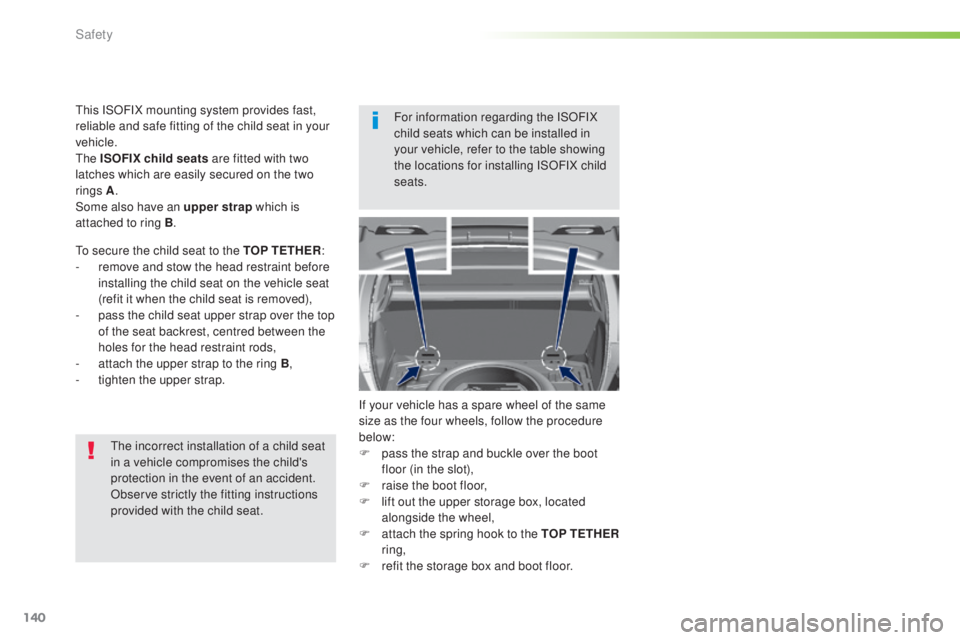
to se
cure the child seat to the TOP TETHER
:
-
re
move and stow the head restraint before
installing the child seat on the vehicle seat
(refit it when the child seat is removed),
-
pa
ss the child seat upper strap over the top
of the seat backrest, centred between the
holes for the head restraint rods,
-
at
tach the upper strap to the ring B,
-
ti
ghten the upper strap.
If your vehicle has a spare wheel of the same
size as the four wheels, follow the procedure
below:
F pa ss the strap and buckle over the boot
floor (in the slot),
F
ra
ise the boot floor,
F
li
ft out the upper storage box, located
alongside the wheel,
F
at
tach the spring hook to the TOP TETHER
ring,
F
re
fit the storage box and boot floor.
thi
s ISOFIX mounting system provides fast,
reliable and safe fitting of the child seat in your
vehicle.
the
ISOFIX child seats are fitted with two
latches which are easily secured on the two
rings A .
Some also have an upper strap which is
attached to ring B . For information regarding the ISOFIX
child seats which can be installed in
your vehicle, refer to the table showing
the locations for installing ISOFIX child
seats.
Safety
Page 143 of 398
141
308_en_Chap05_securite_ed02-2015
ISOFIX child seats recommended by PeugeOt
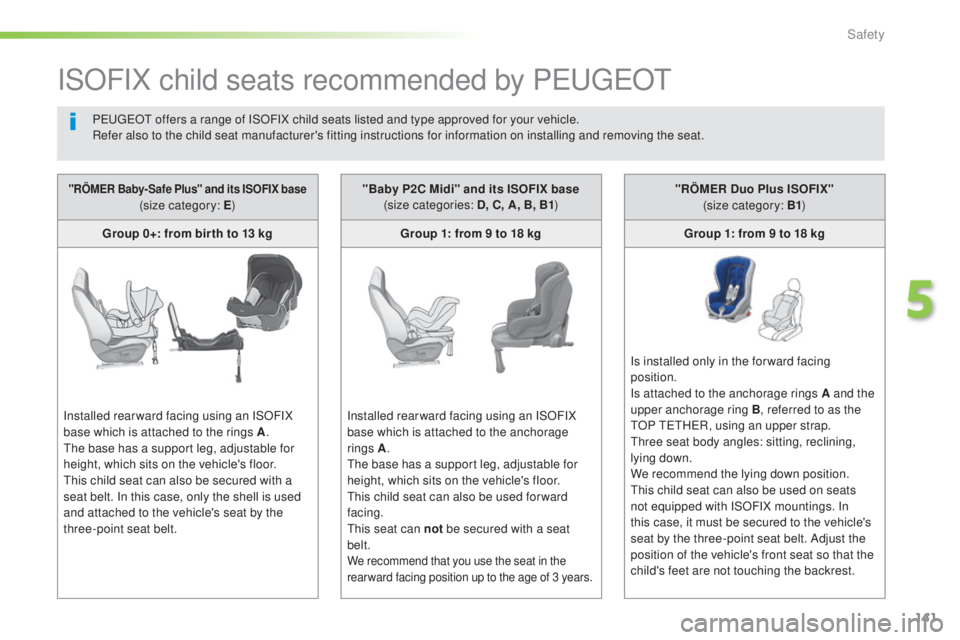
PeugeOt offers a range of ISOFIX child seats listed and type approved for your vehicle.
Refer also to the child seat manufacturer's fitting instructions for information on installing and removing the seat.
"RÖMER Baby- Safe Plus" and its ISOFIX base (size category: E)
Group 0+: from bir th to 13 kg
Installed rearward facing using an ISOFIX
base which is attached to the rings A .
the b
ase has a support leg, adjustable for
height, which sits on the vehicle's floor.
thi
s child seat can also be secured with a
seat belt. In this case, only the shell is used
and attached to the vehicle's seat by the
three-point seat belt. "Baby P2C Midi" and its ISOFIX base
(size categories: D, C, A, B, B1 )
Group 1: from 9 to 18 kg
Installed rearward facing using an ISOFIX
base which is attached to the anchorage
rings A .
the b
ase has a support leg, adjustable for
height, which sits on the vehicle's floor.
thi
s child seat can also be used for ward
facing.
thi
s seat can not be secured with a seat
belt.
We recommend that you use the seat in the
rear ward facing position up to the age of 3 years.
"RÖMER Duo Plus ISOFIX" (size category: B1 )
Group 1: from 9 to 18 kg
Is installed only in the for ward facing
position.
Is attached to the anchorage rings A and the
upper anchorage ring B , referred to as the
tOP t
et
HeR, u
sing an upper strap.
thr
ee seat body angles: sitting, reclining,
lying down.
We recommend the lying down position.
thi
s child seat can also be used on seats
not equipped with ISOFIX mountings. In
this case, it must be secured to the vehicle's
seat by the three-point seat belt. Adjust the
position of the vehicle's front seat so that the
child's feet are not touching the backrest.
5
Safety
Page 144 of 398
142
308_en_Chap05_securite_ed02-2015
Locations for ISOFIX child seats
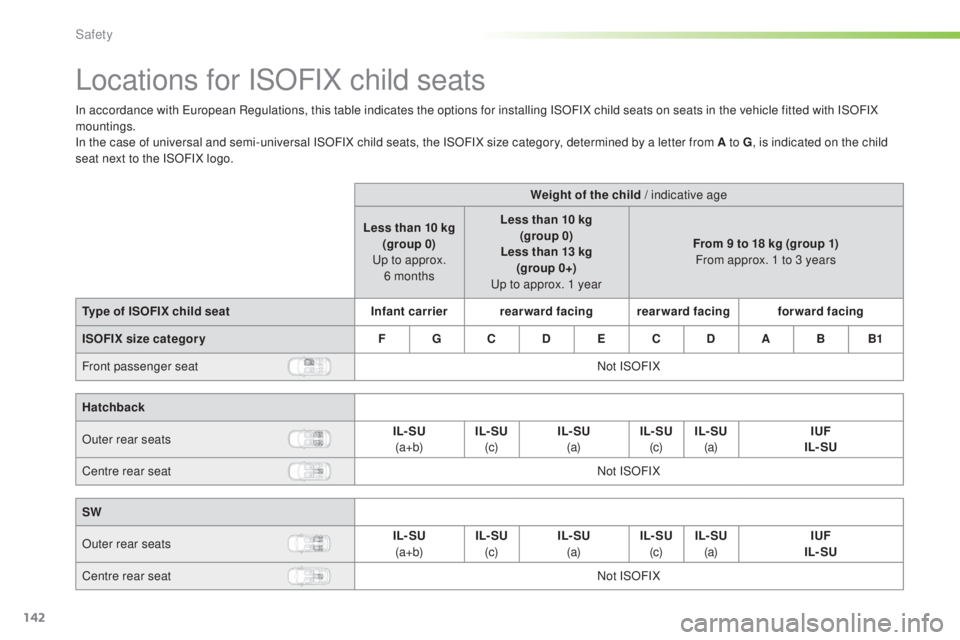
In accordance with european Regulations, this table indicates the options for installing ISOFIX child seats on seats in the vehicle fitted with ISOFIX
mountings.
In the case of universal and semi-universal ISOFIX child seats, the ISOFIX size category, determined by a letter from A to G , is indicated on the child
seat next to the ISOFIX logo.
Weight of the child / indicative age
Less than 10 kg (group 0)
up
to approx.
6
m
onthsLess than 10 kg
(group 0)
Less than 13 kg (group 0+)
up to a
pprox. 1 yearFrom 9 to 18 kg (group 1)
From approx. 1 to 3 years
Type of ISOFIX child seat Infant carrierrearward facing rearward facing forward facing
ISOFIX size categor y F G C D E C D A B B1
Front passenger seat Not ISOFIX
Hatchback
Outer rear seats IL- SU
(a+b) IL- SU
(c) IL- SU
(a) IL- SU
(c) IL- SU
(a) IUF
IL- SU
Centre rear seat Not ISOFIX
SW
Outer rear seats IL- SU
(a+b) IL- SU
(c) IL- SU
(a) IL- SU
(c) IL- SU
(a) IUF
IL- SU
Centre rear seat Not ISOFIX
Safety
Page 145 of 398
143
308_en_Chap05_securite_ed02-2015
IUF Seat suitable for the installation of an
Is
ofix Universal seat, F or ward facing
secured using the upper strap.
IL- SU
Se
at suitable for the installation of an
I sofix S emi-Universal seat either:
-
re
ar ward facing fitted with an upper
strap or a support leg,
-
fo
r ward facing fitted with a support leg,
-
an i
nfant car seat fitted with an upper
strap or a support leg. For more information on the ISOFIX
mountings and the upper strap, refer to
the corresponding section.
X
Se
at not suitable for the installation of a
child seat of the weight group indicated.
(a)
Mov
e a seat without height adjustment
for wards by 1 notch from the mid
position for wards and backwards. A
seat with height adjustment must be in
the highest position.
(b)
t
he i
nstallation of an infant carrier on
one of the outer seats makes use of the
other two seats impossible.
(c)
A se
at with height adjustment must be
placed in the highest position. Move the
seat without height adjustment forward
by 5 notches from the mid-position
forwards and backwards. Remove and stow the head restraint
before fitting a child seat with a
backrest to a passenger seat.
Refit the head restraint when the child
seat is removed.
5
Safety
Page 146 of 398
144
308_en_Chap05_securite_ed02-2015
Child seatsInstalling a booster
cushion
Recommendations
the legislation on carrying a child on the
f ront passenger seat is specific to each
country. Refer to the legislation in force in
the country in which you are driving.
Deactivate the passenger's front airbag
when a rear ward facing child seat is installed
on the front passenger seat. Otherwise, the
child would risk being seriously injured or
killed if the airbag were deployed. For optimum installation of the forward facing
child seat, ensure that the back of the child
seat is as close as possible to the backrest
of the vehicle's seat, or in contact if possible.
the h
ead restraint must be removed before
installing a child seat with a backrest on the
passenger seat.
ens
ure that the head restraint is stowed or
attached securely so that it is not thrown
around the vehicle in the event of sharp
braking.
Refit the head restraint as soon as the child
seat is removed.
the i
ncorrect installation of a child seat in a
vehicle compromises the child's protection in
the event of an accident.
Check that there is no seat belt or seat belt
buckle under the child seat as this could
destabilise it.
Remember to fasten the seat belts or the
child seat harnesses keeping the slack in
relation to the child's body to a minimum ,
even for short journeys.
For the installation of a child seat using a
seat belt, ensure that this is well tensioned
on the child seat and that it is holding the
child seat firmly against the seat of your
vehicle. If your front passenger seat is
adjustable, move it forward if necessary.
At the rear seats, always leave sufficient
space between the front seat and:
-
a re
ar ward facing child seat,
-
th
e feet of a child seated in a for ward
facing child seat.
For this, move the front seat for ward and if
necessary straighten its backrest.
Children at the front
the chest part of the seat belt must be
p ositioned on the child's shoulder without
touching the neck.
ens
ure that the lap part of the seat belt
passes correctly over the child's thighs.
P
eu
ge
Ot r
ecommends the use of a booster
seat which has a back, fitted with a seat belt
guide at shoulder level.
As a safety precaution, do not leave:
-
on
e or more children alone and
unsupervised in a vehicle,
-
a ch
ild or an animal in a vehicle which
is exposed to the sun, with the windows
closed,
-
th
e keys within reach of children inside
the vehicle.
to pr
event accidental opening of the doors,
use the child lock.
tak
e care not to open the rear windows by
more than one third.
to pr
otect young children from the rays of
the sun, fit side blinds on the rear windows.
Safety
Page 147 of 398
145
308_en_Chap05_securite_ed02-2015
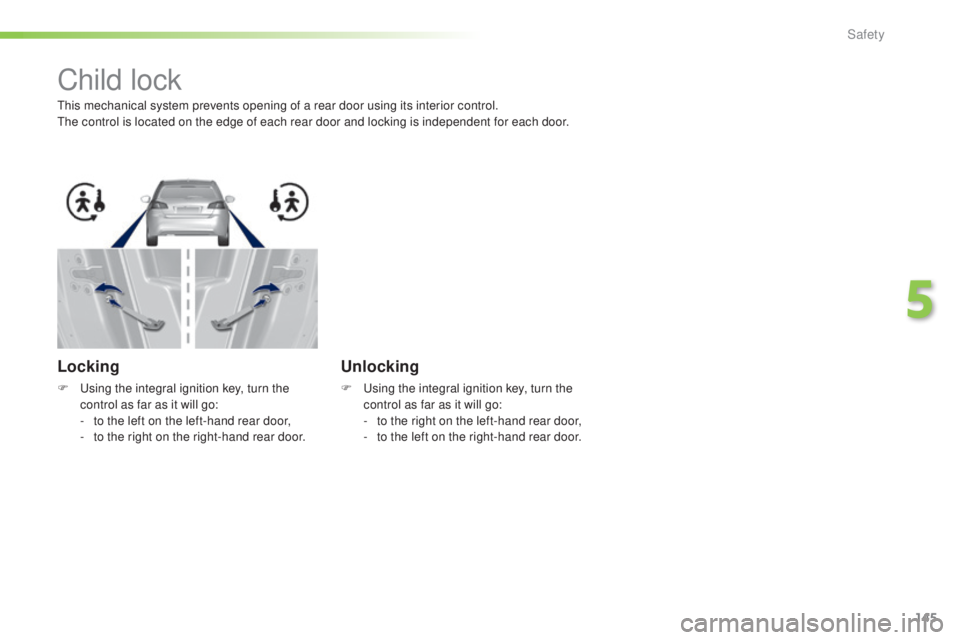
Child lock
this mechanical system prevents opening of a rear door using its interior control.the control is located on the edge of each rear door and locking is independent for each door.
Locking
F using the integral ignition key, turn the
c ontrol as far as it will go:
-
to t
he left on the left-hand rear door,
-
to t
he right on the right-hand rear door.
Unlocking
F using the integral ignition key, turn the
c ontrol as far as it will go:
-
to t
he right on the left-hand rear door,
-
to t
he left on the right-hand rear door.
5
Safety
Page 163 of 398
161
308_en_Chap06_conduite_ed02-2015
SituationConsequences
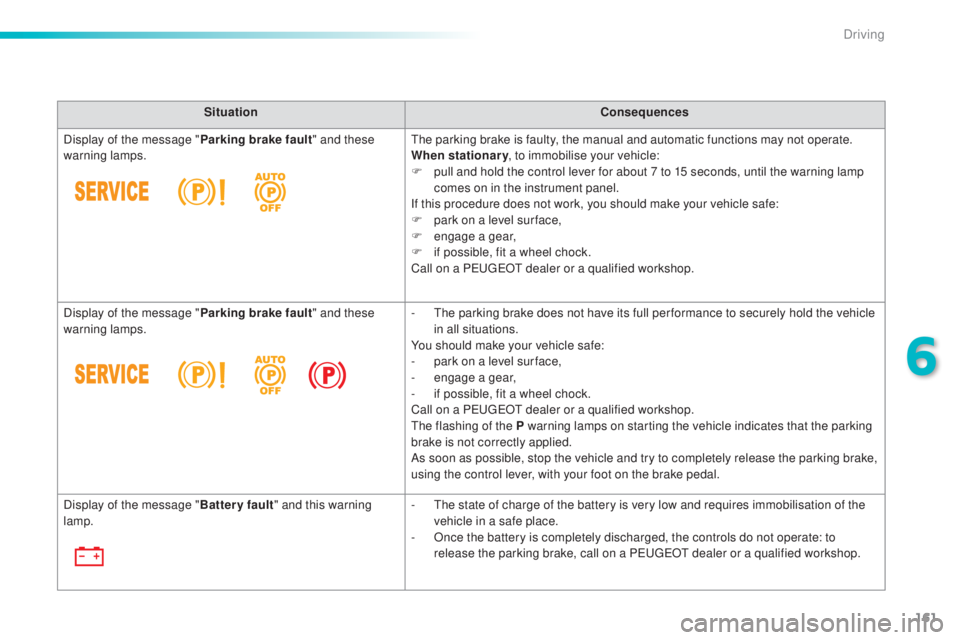
Display of the message " Parking brake fault" and these
warning lamps.
the p
arking brake is faulty, the manual and automatic functions may not operate.
When stationary , to immobilise your vehicle:
F
pu
ll and hold the control lever for about 7 to 15 seconds, until the warning lamp
comes on in the instrument panel.
If this procedure does not work, you should make your vehicle safe:
F
pa
rk on a level sur face,
F
engag
e a gear,
F
if p
ossible, fit a wheel chock.
Call on a P
eu
ge
Ot d
ealer or a qualified workshop.
Display of the message " Parking brake fault" and these
warning lamps. -
t
he p
arking brake does not have its full per formance to securely hold the vehicle
in all situations.
You should make your vehicle safe:
-
pa
rk on a level sur face,
-
engag
e a gear,
-
if p
ossible, fit a wheel chock.
Call on a P
eu
ge
Ot d
ealer or a qualified workshop.
the f
lashing of the P warning lamps on starting the vehicle indicates that the parking
brake is not correctly applied.
As soon as possible, stop the vehicle and try to completely release the parking brake,
using the control lever, with your foot on the brake pedal.
Display of the message " Battery fault" and this warning
lamp. -
t
he s
tate of charge of the battery is very low and requires immobilisation of the
vehicle in a safe place.
-
On
ce the battery is completely discharged, the controls do not operate: to
release the parking brake, call on a P
eu
ge
Ot d
ealer or a qualified workshop.
6
Driving