Page 215 of 398
213
308_en_Chap07_info-pratiques_ed02-2015
Fuel tank
Additions of fuel must be of at least 10 litres to
be registered by the fuel gauge.
Opening the filler cap may result in an inrush of
air.
thi
s vacuum is entirely normal and results
from the sealing of the fuel system.
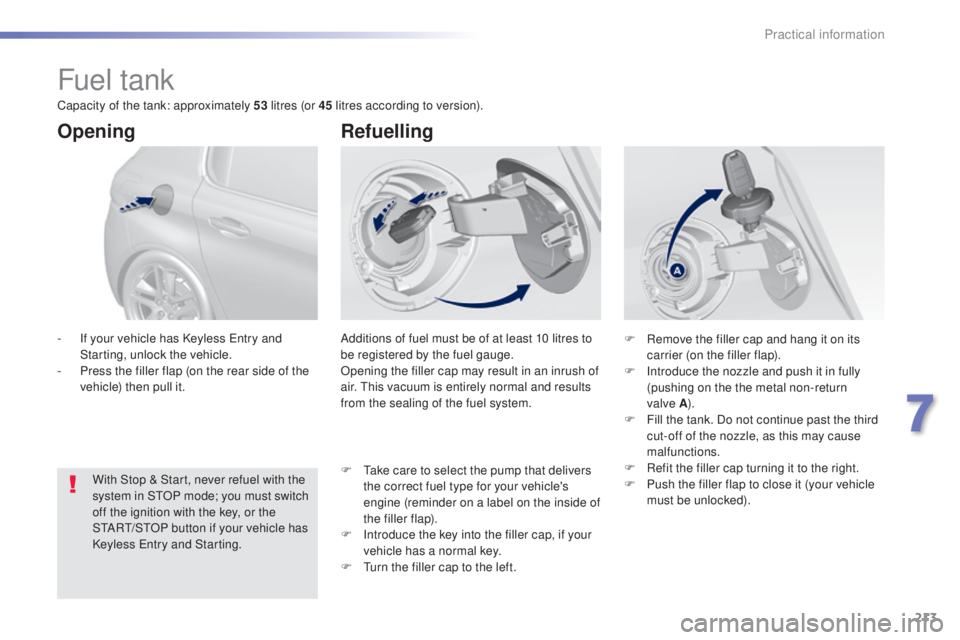
Opening
With Stop & Start, never refuel with the
system in StOP m ode; you must switch
off the ignition with the key, or the
S
tARt/StOP b
utton if your vehicle has
Keyless
ent
ry and Starting.
-
If y
our vehicle has Keyless
ent
ry and
Starting, unlock the vehicle.
-
Pr
ess the filler flap (on the rear side of the
vehicle) then pull it.
Refuelling
F Remove the filler cap and hang it on its
c arrier (on the filler flap).
F
In
troduce the nozzle and push it in fully
(pushing on the the metal non-return
valve
A ).
F Fi
ll the tank. Do not continue past the third
cut-off of the nozzle, as this may cause
malfunctions.
F
Re
fit the filler cap turning it to the right.
F
Pu
sh the filler flap to close it (your vehicle
must be unlocked).
F
t
ak
e care to select the pump that delivers
the correct fuel type for your vehicle's
engine (reminder on a label on the inside of
the filler flap).
F
In
troduce the key into the filler cap, if your
vehicle has a normal key.
F
t
ur
n the filler cap to the left.
Capacity of the tank: approximately 53
litres (or 45 litres according to version).
7
Practical information
Page 216 of 398
214
308_en_Chap07_info-pratiques_ed02-2015
Low fuel level
When the low fuel level in the tank is
reached, this warning lamp comes on
in the instrument panel, accompanied
by an audible warning and a message.
Fuel supply cut-off
Your vehicle is equipped with a safety device
which cuts off the fuel supply in the event of a
collision. When it first comes on, less than 10 litres of
fuel remain in the tank.
You must refuel as soon as possible to avoid
running out.If you have put in the wrong fuel for
your vehicle, you must have have
the tank drained and refilled with
the correct fuel before you star t the
engine.
Your vehicle is fitted with a catalytic converter,
a device which helps to reduce the level of
harmful emissions in the exhaust gases.
For petrol engines, you must use unleaded
fuel only.
the f
iller neck is narrower, admitting petrol
nozzles only. It is still possible to use a fuel can to fill
the tank but this must be done slowly.
In order to ensure a good flow of fuel,
do not place the nozzle of the fuel can
in direct contact with the flap of the
misfuel prevention device.
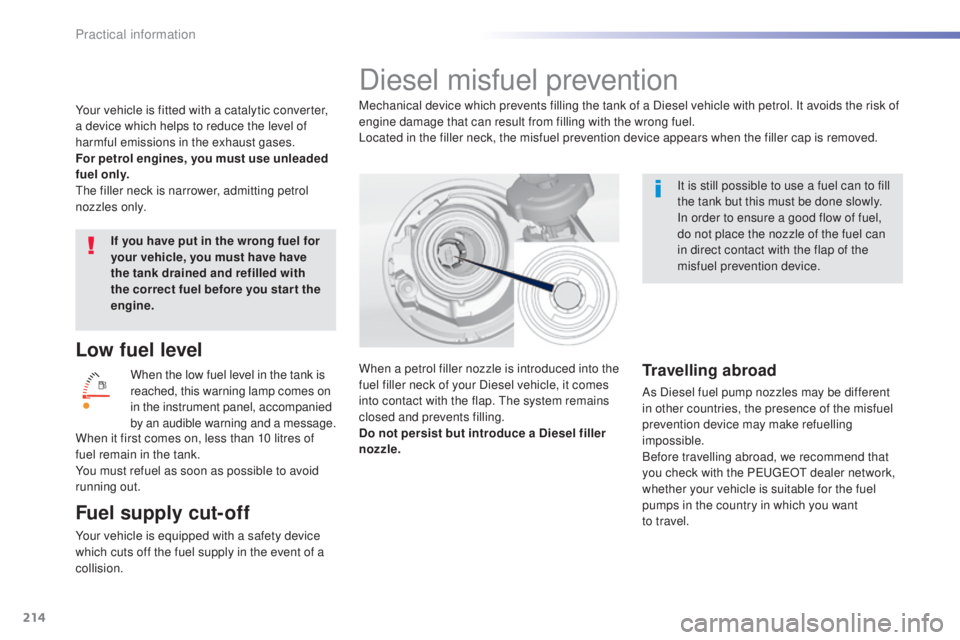
Diesel misfuel prevention
Mechanical device which prevents filling the tank of a Diesel vehicle with petrol. It avoids the risk of
engine damage that can result from filling with the wrong fuel.
Located in the filler neck, the misfuel prevention device appears when the filler cap is removed.
When a petrol filler nozzle is introduced into the
fuel filler neck of your Diesel vehicle, it comes
into contact with the flap.
the s
ystem remains
closed and prevents filling.
Do not persist but introduce a Diesel filler
nozzle.
Travelling abroad
As Diesel fuel pump nozzles may be different
in other countries, the presence of the misfuel
prevention device may make refuelling
impossible.
Before travelling abroad, we recommend that
you check with the P
eu
ge
Ot d
ealer network,
whether your vehicle is suitable for the fuel
pumps in the country in which you want
to
t
ravel.
Practical information
Page 217 of 398
215
308_en_Chap07_info-pratiques_ed02-2015
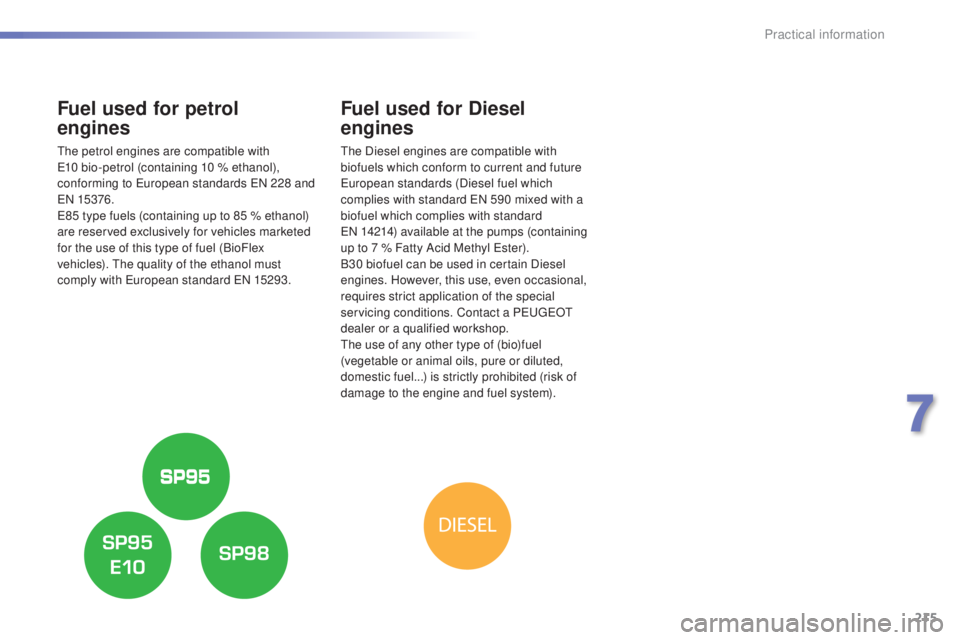
Fuel used for petrol
engines
the petrol engines are compatible with e10 bio-petrol (containing 10 % ethanol),
conforming to
eur
opean standards
eN 22
8 and
eN 1
5376.
e85 t
ype fuels (containing up to 85 % ethanol)
are reserved exclusively for vehicles marketed
for the use of this type of fuel (BioFlex
vehicles).
the q
uality of the ethanol must
comply with
eur
opean standard
eN 15
293.
Fuel used for Diesel
engines
the Diesel engines are compatible with
b iofuels which conform to current and future
eur
opean standards (Diesel fuel which
complies with standard
eN 59
0 mixed with a
biofuel which complies with standard
eN 14
214) available at the pumps (containing
up to 7 % Fatty Acid Methyl
est
er).
B30 biofuel can be used in certain Diesel
engines. However, this use, even occasional,
requires strict application of the special
servicing conditions. Contact a P
eu
ge
Ot
d
ealer or a qualified workshop.
the u
se of any other type of (bio)fuel
(vegetable or animal oils, pure or diluted,
domestic fuel...) is strictly prohibited (risk of
damage to the engine and fuel system).
7
Practical information
Page 219 of 398
217
308_en_Chap07_info-pratiques_ed02-2015
Very cold climate screen
Before fitting or removing the screen,
ensure that the engine is off and the cooling
fan has stopped. It is recommended that
the screen be fitted and removed by a
P
eu
ge
Ot d
ealer or a qualified workshop.
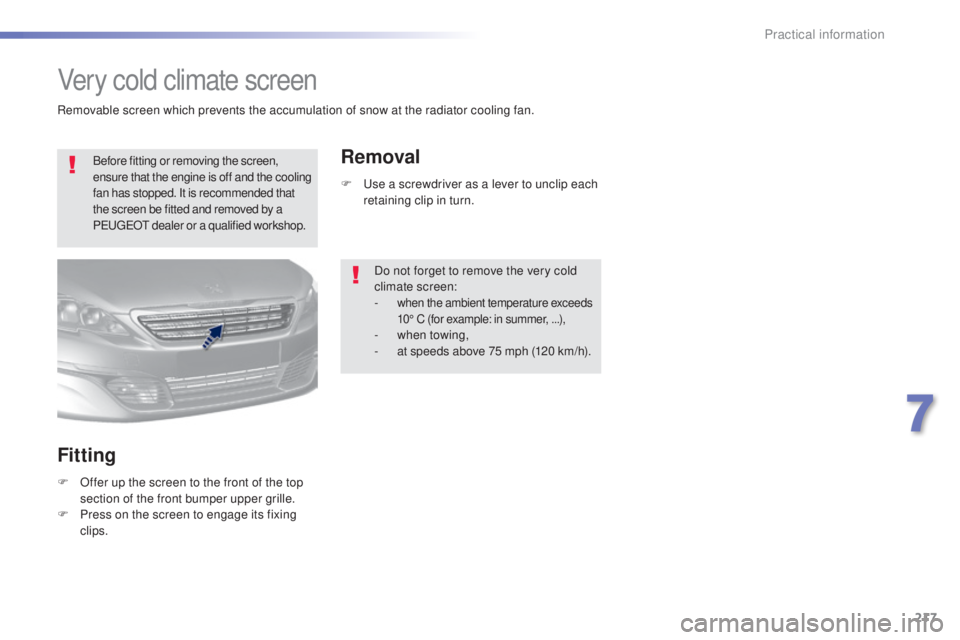
Fitting
F Offer up the screen to the front of the top
section of the front bumper upper grille.
F
Pr
ess on the screen to engage its fixing
clips.
Removal
F use a screwdriver as a lever to unclip each
r etaining clip in turn.
Do not forget to remove the very cold
climate screen:
-
when the ambient temperature exceeds
10° C (for example: in summer, . ..),
- when towing,
- at s peeds above 75 mph (120 km/h).
Removable screen which prevents the accumulation of snow at the radiator cooling fan.
7
Practical information
Page 221 of 398
219
308_en_Chap07_info-pratiques_ed02-2015
System which manages the duration of use of certain functions to conserve a sufficient level of
charge in the battery.
After the engine has stopped, you can still use functions such as the audio and telematics
system,
w
indscreen wipers, dipped beam headlamps,
c
ourtesy lamps, etc. for a maximum
combined duration of about forty minutes.
energy economy mode
Switching to economy
mode
A message then appears in the instrument
panel screen indicating that the vehicle has
switched to economy mode and the active
functions are put on standby.
If a telephone call is being made at this time, it
will be maintained for around 10 minutes with
the Bluetooth hands-free system of your audio
system.
Exiting economy mode
these functions are reactivated automatically
n ext time the vehicle is driven.
In order to restore the use of these functions
immediately, start the engine and let it run:
-
fo
r less than ten minutes, to use the
equipment for approximately five minutes,
-
fo
r more than ten minutes, to use the
equipment for up to approximately
thirty
m
inutes.
Let the engine run for the duration specified to
ensure that the battery charge is sufficient.
Do not repeatedly and continuously restart the
engine in order to charge the battery.
A flat battery prevents the engine from starting.
For more information on the battery, refer to the
corresponding section.
Load reduction mode
System which manages the use of certain
functions according to the level of charge
remaining in the battery.
When the vehicle is being driven, the load
reduction function temporarily deactivates
certain functions, such as the air conditioning,
the heated rear screen...
the d
eactivated functions are reactivated
automatically as soon as conditions permit.
7
Practical information
Page 227 of 398
225
308_en_Chap07_info-pratiques_ed02-2015
PeugeOt & tOtAL,
A PARtNeRSHIP tO DeLI VeR
Bet
te
R PeR
FORMANC
e!
Innovation, the key to success
the tOtAL Research and Development and
Peu geOt teams work together to develop high
quality lubricants that meet the requirements
of P
eu
ge
Ot v
ehicles. For you, this is the
assurance that the performance of your engine
is optimised while also ensuring its durability.
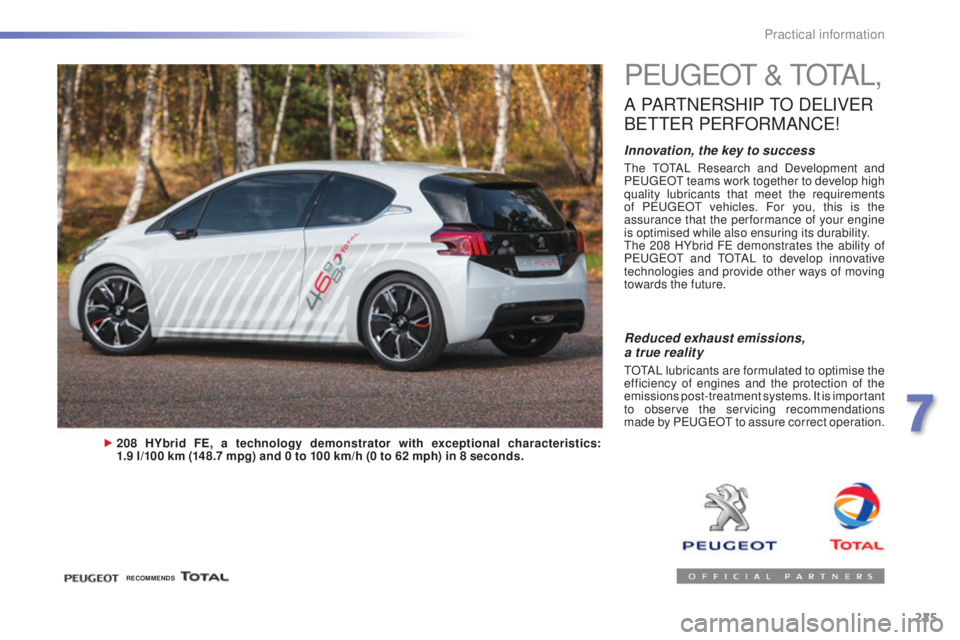
the 2
08 HYbrid F
e d
emonstrates the ability of
P
eu
ge
Ot
and
tOtAL
to develop innovative
technologies and provide other ways of moving
towards the future.
208 HYbrid FE, a technology demonstrator with exceptional characteristics:
1.9 l/100 km (148.7 mpg) and 0 to 100 km/h (0 to 62 mph) in 8 seconds.
Reduced exhaust emissions,
a true reality
tOtAL lubricants are formulated to optimise the
e fficiency of engines and the protection of the
emissions post-treatment systems. It is important
to observe the servicing recommendations
made by P
eu
ge
Ot
to assure correct operation.
RECOMMENDS
7
Practical information
Page 228 of 398
226
308_en_Chap07_info-pratiques_ed02-2015
Bonnet
Before doing anything under the
bonnet, switch off the Stop & Start
system to avoid any risk of injury
resulting from an automatic change to
S
tA
R
t m o
d e .
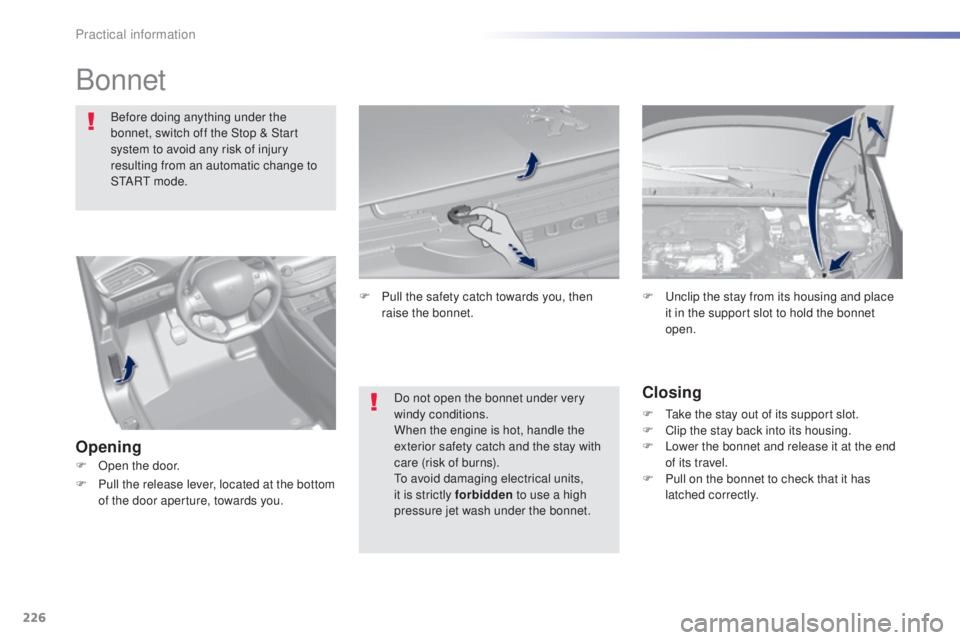
Opening Closing
F take the stay out of its support slot.
F Cl ip the stay back into its housing.
F
Lo
wer the bonnet and release it at the end
of its travel.
F
Pu
ll on the bonnet to check that it has
latched correctly.
F
u
nc
lip the stay from its housing and place
it in the support slot to hold the bonnet
open.
Do not open the bonnet under very
windy conditions.
When the engine is hot, handle the
exterior safety catch and the stay with
care (risk of burns).
to a
void damaging electrical units,
it is strictly forbidden to use a high
pressure jet wash under the bonnet.
F
Pu
ll the safety catch towards you, then
raise the bonnet.
F
Op
en the door.
F
Pu
ll the release lever, located at the bottom
of the door aperture, towards you.
Practical information
Page 229 of 398
227
308_en_Chap07_info-pratiques_ed02-2015
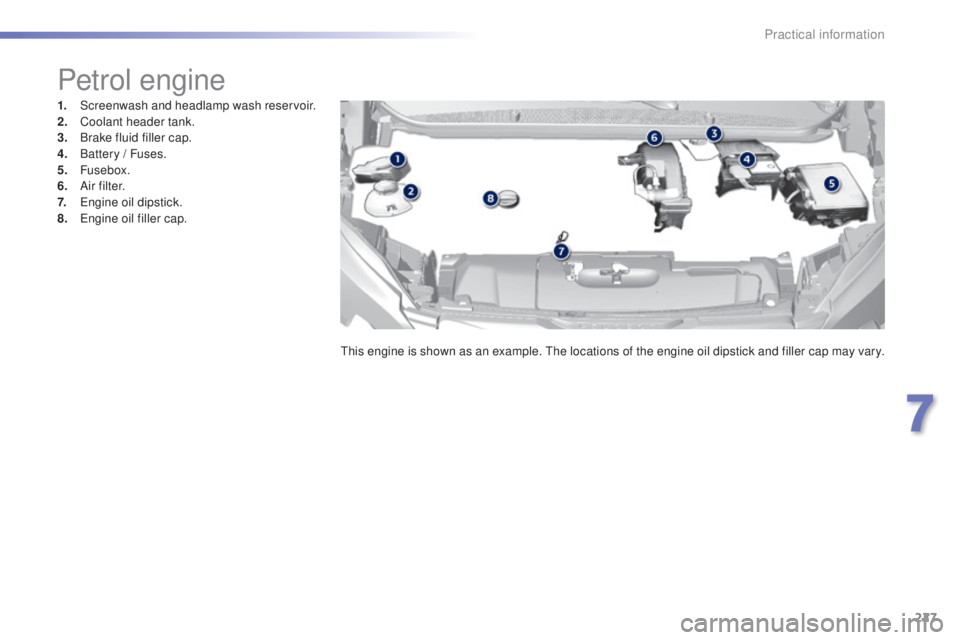
Petrol engine
1. Screenwash and headlamp wash reservoir.
2. Co olant header tank.
3.
Br
ake fluid filler cap.
4.
Ba
ttery / Fuses.
5.
F
usebox.
6.
A i
r f i l t e r.
7.
engin
e oil dipstick.
8.
eng
ine oil filler cap.
thi
s engine is shown as an example.
the l
ocations of the engine oil dipstick and filler cap may vary.
7
Practical information