Page 80 of 344
78
3008_en_Chap04_visibilite_ed01-2015
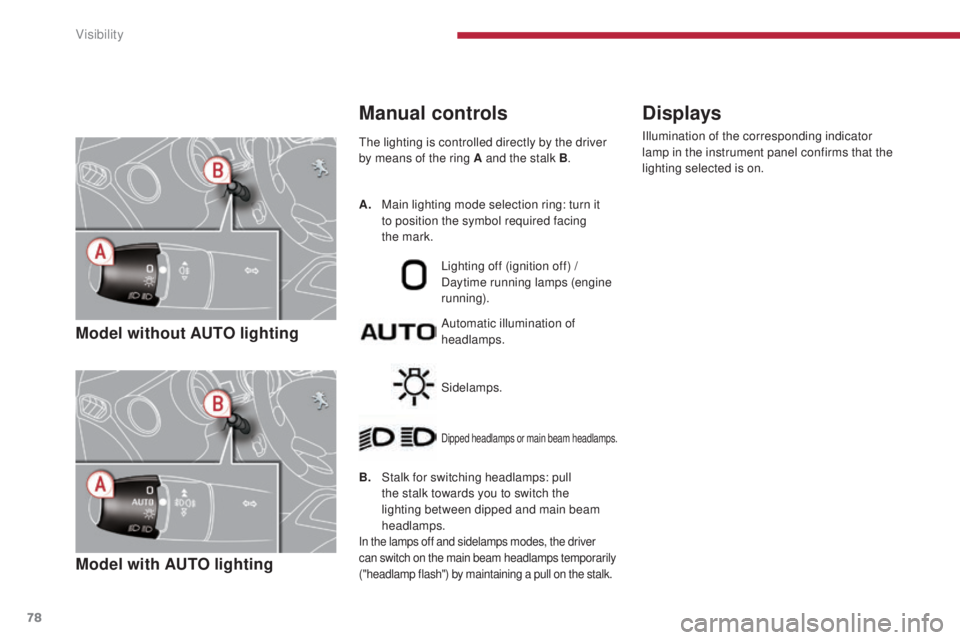
Model without AUTO lighting
Model with AUTO lighting
The lighting is controlled directly by the driver
by means of the ring A and the stalk B.
B.
S
talk for switching headlamps: pull
the stalk towards you to switch the
lighting between dipped and main beam
headlamps.
In the lamps off and sidelamps modes, the driver
can switch on the main beam headlamps temporarily
("headlamp flash") by maintaining a pull on the stalk.
Automatic illumination of
headlamps. Lighting off (ignition off) /
Daytime running lamps (engine
running).
Sidelamps.
Dipped headlamps or main beam headlamps.
Displays
Illumination of the corresponding indicator
lamp in the instrument panel confirms that the
lighting selected is on.
Manual controls
A. Main lighting mode selection ring: turn it
to position the symbol required facing
the
mark.
Visibility
Page 90 of 344
88
3008_en_Chap04_visibilite_ed01-2015
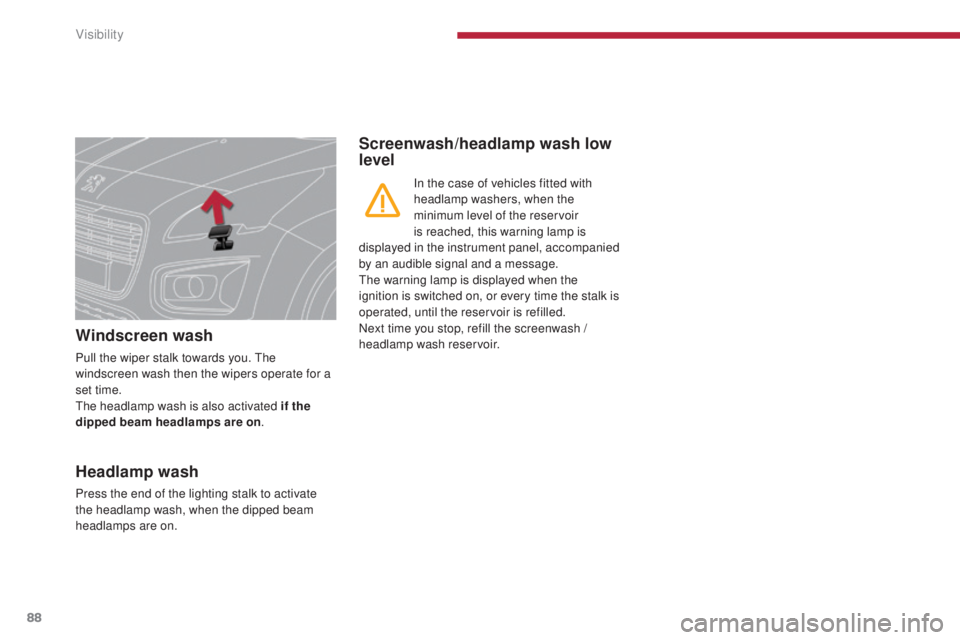
Windscreen wash
Pull the wiper stalk towards you. The
windscreen wash then the wipers operate for a
set time.
The headlamp wash is also activated if the
dipped beam headlamps are on.
Screenwash/headlamp wash low
level
In the case of vehicles fitted with
headlamp washers, when the
minimum level of the reservoir
is reached, this warning lamp is
displayed in the instrument panel, accompanied
by an audible signal and a message.
The warning lamp is displayed when the
ignition is switched on, or every time the stalk is
operated, until the reservoir is refilled.
Next time you stop, refill the screenwash
/
headlamp wash reservoir.
Headlamp wash
Press the end of the lighting stalk to activate
the headlamp wash, when the dipped beam
headlamps are on.
Visibility
Page 105 of 344
103
3008_en_Chap05_amenagements_ed01-2015
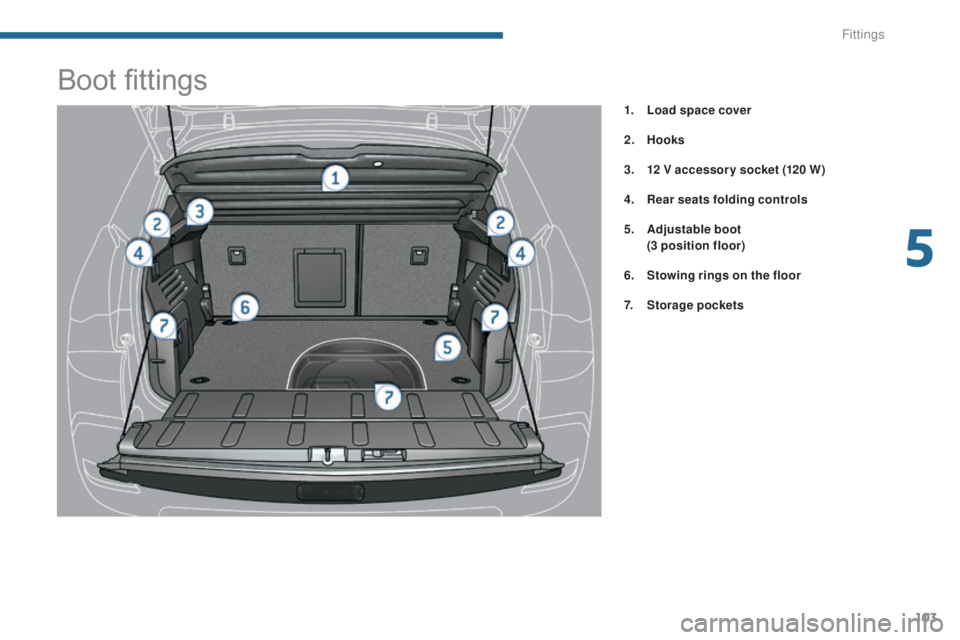
Boot fittings
1. Load space cover
2.
Hoo
ks
3.
1
2 V accessor y socket (120 W)
4.
R
ear seats folding controls
5.
A
djustable boot
(
3 position floor )
6.
S
towing rings on the floor
7.
Sto
rage pockets
5
Fittings
Page 106 of 344
104
3008_en_Chap05_amenagements_ed01-2015
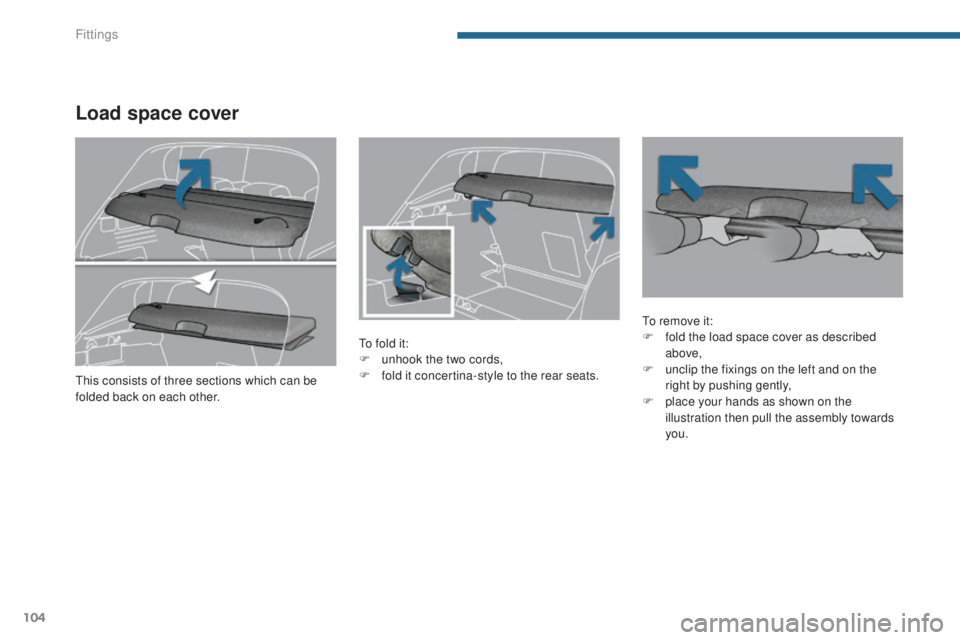
Load space cover
To fold it:
F u nhook the two cords,
F
f
old it concertina-style to the rear seats. To remove it:
F
f old the load space cover as described
above,
F
u
nclip the fixings on the left and on the
right by pushing gently,
F
p
lace your hands as shown on the
illustration then pull the assembly towards
you.
This consists of three sections which can be
folded back on each other.
Fittings
Page 108 of 344
106
3008_en_Chap05_amenagements_ed01-2015
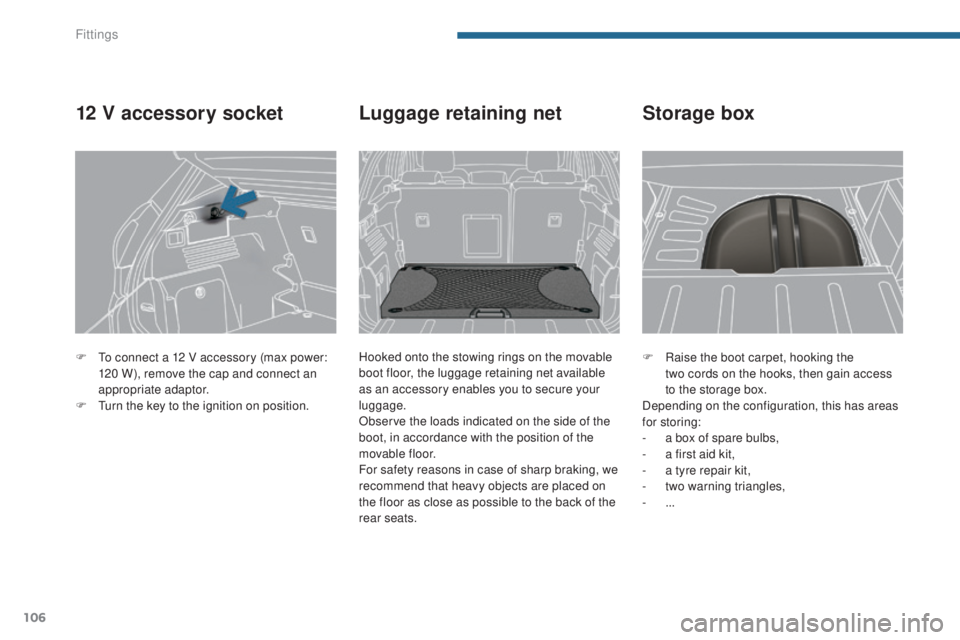
F Raise the boot carpet, hooking the two cords on the hooks, then gain access
to the storage box.
Depending on the configuration, this has areas
for storing:
-
a b
ox of spare bulbs,
-
a f
irst aid kit,
-
a t
yre repair kit,
-
t
wo warning triangles,
-
...
Storage box
F To connect a 12 V accessory (max power: 120 W), remove the cap and connect an
appropriate adaptor.
F
T
urn the key to the ignition on position.
12 V accessory socket Luggage retaining net
Hooked onto the stowing rings on the movable
boot floor, the luggage retaining net available
as an accessory enables you to secure your
luggage.
Observe the loads indicated on the side of the
boot, in accordance with the position of the
movable floor.
For safety reasons in case of sharp braking, we
recommend that heavy objects are placed on
the floor as close as possible to the back of the
rear seats.
Fittings
Page 109 of 344
107
3008_en_Chap05_amenagements_ed01-2015
Adjustable boot floor
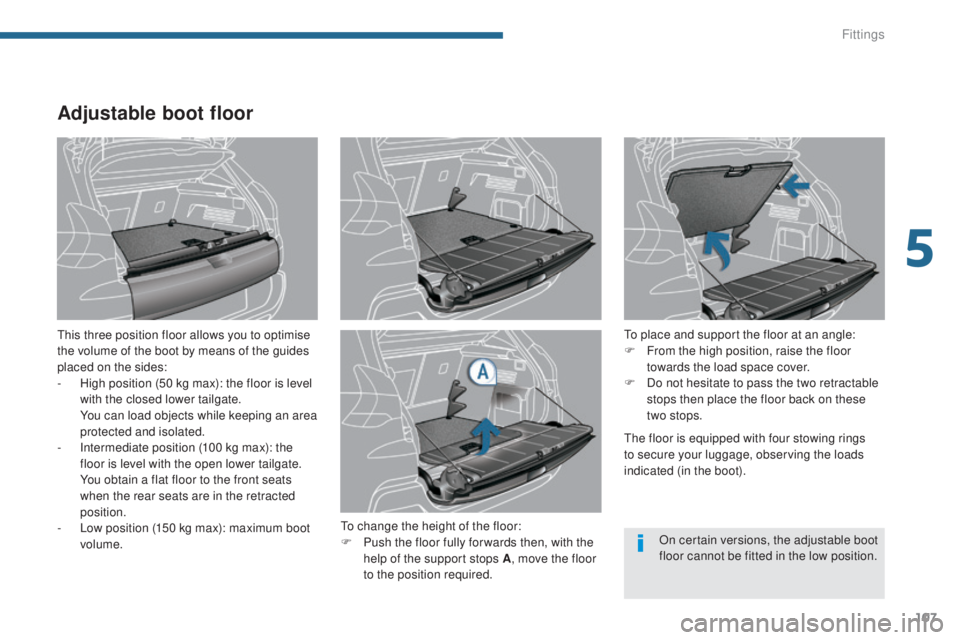
This three position floor allows you to optimise
the volume of the boot by means of the guides
placed on the sides:
-
H
igh position (50 kg max): the floor is level
with the closed lower tailgate.
Y
ou can load objects while keeping an area
protected and isolated.
-
I
ntermediate position (100 kg max): the
floor is level with the open lower tailgate.
Y
ou obtain a flat floor to the front seats
when the rear seats are in the retracted
position.
-
L
ow position (150 kg max): maximum boot
volume. To place and support the floor at an angle:
F
F rom the high position, raise the floor
towards the load space cover.
F
D
o not hesitate to pass the two retractable
stops then place the floor back on these
two stops.
To change the height of the floor:
F
P
ush the floor fully for wards then, with the
help of the support stops A , move the floor
to the position required. The floor is equipped with four stowing rings
to secure your luggage, observing the loads
indicated (in the boot).
On certain versions, the adjustable boot
floor cannot be fitted in the low position.
5
Fittings
Page 120 of 344
118
3008_en_Chap06_securite-enfants_ed01-2015
"ISOFIX" mountings
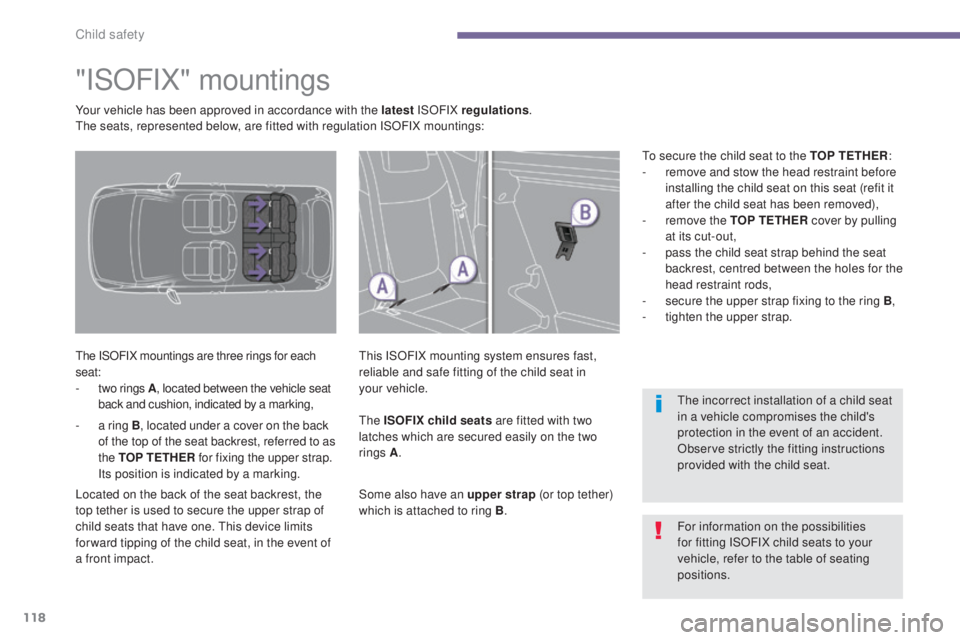
The ISOFIX mountings are three rings for each
seat:
-
t
wo rings A, located between the vehicle seat
back and cushion, indicated by a marking, This ISOFIX mounting system ensures fast,
reliable and safe fitting of the child seat in
your
vehicle.
The ISOFIX child seats are fitted with two
latches which are secured easily on the two
rings A .
Some also have an upper strap (or top tether)
which is attached to ring B .To secure the child seat to the TOP TETHER
:
-
r
emove and stow the head restraint before
installing the child seat on this seat (refit it
after the child seat has been removed),
-
r
emove the TOP TETHER cover by pulling
at its cut-out,
-
p
ass the child seat strap behind the seat
backrest, centred between the holes for the
head restraint rods,
-
s
ecure the upper strap fixing to the ring B
,
-
t
ighten the upper strap.
Your vehicle has been approved in accordance with the latest ISOFIX
regulations.
The seats, represented below, are fitted with regulation ISOFIX mountings:
-
a r
ing B, located under a cover on the back
of the top of the seat backrest, referred to as
the TOP TETHER for fixing the upper strap.
I
ts position is indicated by a marking. For information on the possibilities
for fitting ISOFIX child seats to your
vehicle, refer to the table of seating
positions. The incorrect installation of a child seat
in a vehicle compromises the child's
protection in the event of an accident.
Observe strictly the fitting instructions
provided with the child seat.
Located on the back of the seat backrest, the
top tether is used to secure the upper strap of
child seats that have one. This device limits
for ward tipping of the child seat, in the event of
a front impact.
Child safety
Page 123 of 344
121
3008_en_Chap06_securite-enfants_ed01-2015
Recommendations
The incorrect installation of a child seat in a
vehicle compromises the child's protection in
the event of an accident.
Check that there is no seat belt or seat belt
buckle under the child seat as this could
destabilise it.
Remember to fasten the seat belts or the
child seat harnesses keeping the slack in
relation to the child's body to a minimum,
even for short journeys.
For the installation of a child seat using a seat
belt, ensure that this is well tensioned on the
child seat and that it is holding the child seat
firmly against the seat of your vehicle. If your
front passenger seat is adjustable, move it
forward if necessary.
At the rear seats, always leave sufficient
space between the front seat and:
-
a r
ear ward facing child seat,
-
t
he feet of a child seated in a for ward
facing child seat.
For this, move the front seat for ward and if
necessary straighten its backrest. For optimum installation of the forward facing
child seat, ensure that the back of the child
seat is as close as possible to the backrest of
the vehicle's seat, or in contact if possible.
The head restraint must be removed before
installing a child seat with a backrest on the
passenger seat.
Ensure that the head restraint is stowed or
attached securely so that it is not thrown around
the vehicle in the event of sharp braking.
Refit the head restraint as soon as the child
seat is removed.
Children at the front
The legislation on carrying a child on the front
passenger seat is specific to each country.
Refer to the legislation in force in the country
in which you are driving.
Deactivate the passenger's front airbag when
a rear ward facing child seat is installed on
the front passenger seat. Otherwise, the child
would risk being seriously injured or killed if
the airbag were deployed.
Installing a booster
cushion
Child seats
The chest part of the seat belt must be
positioned on the child's shoulder without
touching the neck.
Ensure that the lap part of the seat belt
passes correctly over the child's thighs.
PEUGEOT recommends the use of a booster
seat which has a back, fitted with a seat belt
guide at shoulder level.
As a safety precaution, do not leave:
-
o
ne or more children alone and
unsupervised in a vehicle,
-
a c
hild or an animal in a vehicle which
is exposed to the sun, with the windows
closed,
-
t
he keys within reach of children inside
the vehicle.
To prevent accidental opening of the doors,
use the child lock.
Take care not to open the rear windows by
more than one third.
To protect young children from the rays of the
sun, fit side blinds on the rear windows.
6
Child safety