Page 209 of 344
207
3008_en_Chap10_infos-pratiques_ed01-2015
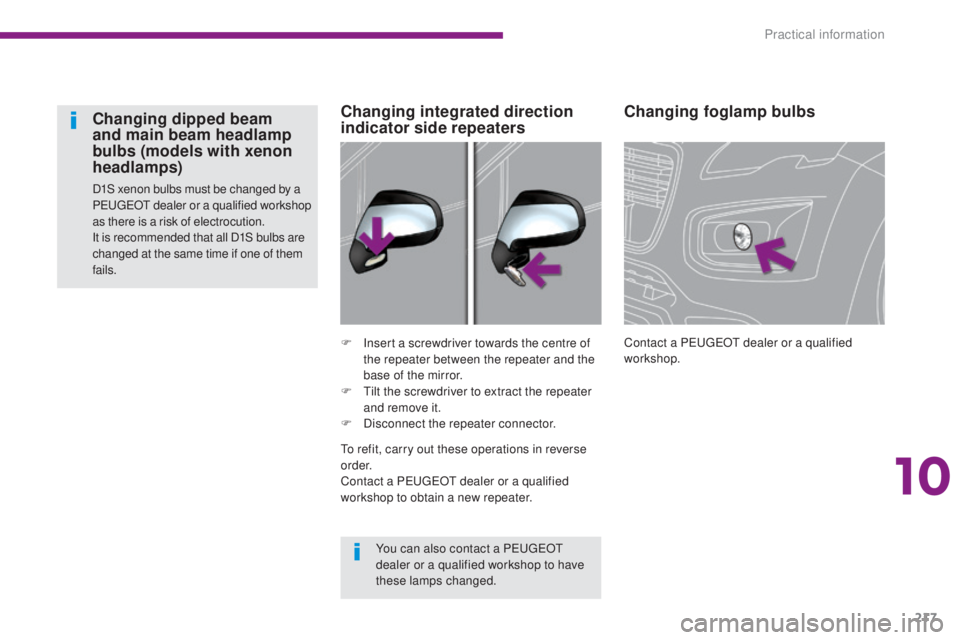
F Turn the selector A to the "air" position.
F
U
ncoil the black pipe H fully.
F
C
onnect the black pipe to the
valve of the wheel. F
C onnect the compressor's electric plug to
the vehicle's 12 V socket.
F
S
tart the vehicle again and leave the
engine running. F
A djust the pressure using the compressor
(to inflate: switch B in position "I" ; to
deflate: switch B
in position "O" and press
button C ), in accordance with the vehicle's
tyre pressure label (located on the left
hand door aperture).
A l
oss of pressure indicates that the
puncture has not been fully plugged;
contact a PEUGEOT dealer or qualified
workshop for assistance.
F
R
emove and stow the kit.
F
D
rive at reduced speed (50 mph [80 km/h]
max) limiting the distance travelled to
approximately 120 miles (200 km).
2. Inflation
As soon as possible, go to a PEUGEOT
dealer or a qualified workshop.
You must inform the technician that you
have used this kit. After inspection, the
technician will advise you on whether
the tyre can be repaired or if it must be
replaced.
10
Practical information
Page 210 of 344
208
3008_en_Chap10_infos-pratiques_ed01-2015
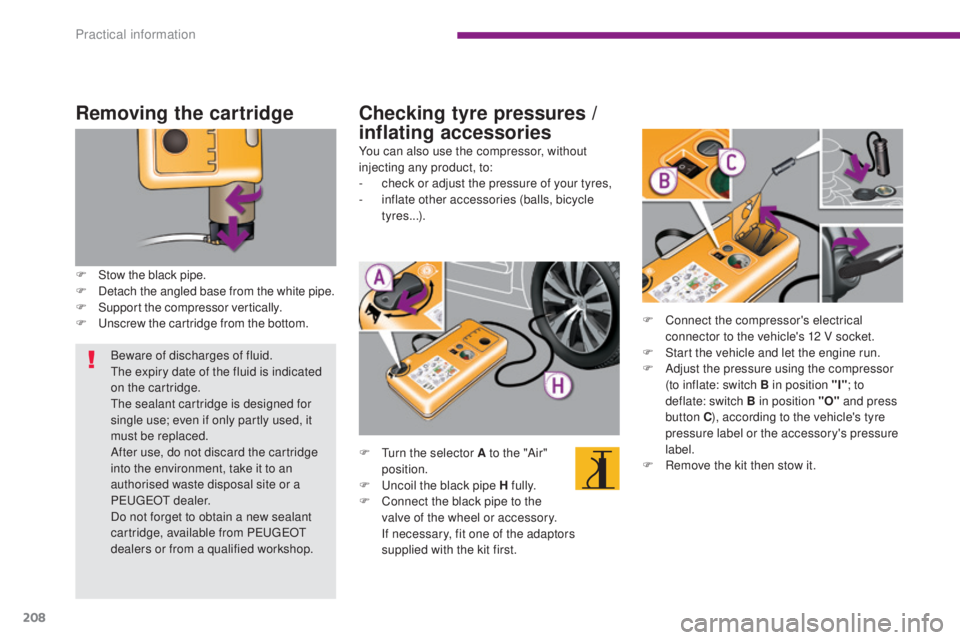
Removing the cartridge
F Stow the black pipe.
F Detach the angled base from the white pipe.
F
S
upport the compressor vertically.
F
U
nscrew the cartridge from the bottom.
Checking tyre pressures /
i nflating accessories
F Turn the selector A to the "Air"
position.
F
U
ncoil the black pipe H fully.
F
C
onnect the black pipe to the
valve of the wheel or accessory.
I
f necessary, fit one of the adaptors
supplied with the kit first.
You can also use the compressor, without
injecting any product, to:
-
c
heck or adjust the pressure of your tyres,
-
i
nflate other accessories (balls, bicycle
tyres...).
F
C
onnect the compressor's electrical
connector to the vehicle's 12 V socket.
F
S
tart the vehicle and let the engine run.
F
A
djust the pressure using the compressor
(to inflate: switch B in position "I" ; to
deflate: switch B in position "O" and press
button C ), according to the vehicle's tyre
pressure label or the accessory's pressure
label.
F R emove the kit then stow it.
Beware of discharges of fluid.
The expiry date of the fluid is indicated
on the cartridge.
The sealant cartridge is designed for
single use; even if only partly used, it
must be replaced.
After use, do not discard the cartridge
into the environment, take it to an
authorised waste disposal site or a
PEUGEOT dealer.
Do not forget to obtain a new sealant
cartridge, available from PEUGEOT
dealers or from a qualified workshop.
Practical information
Page 211 of 344
209
3008_en_Chap10_infos-pratiques_ed01-2015
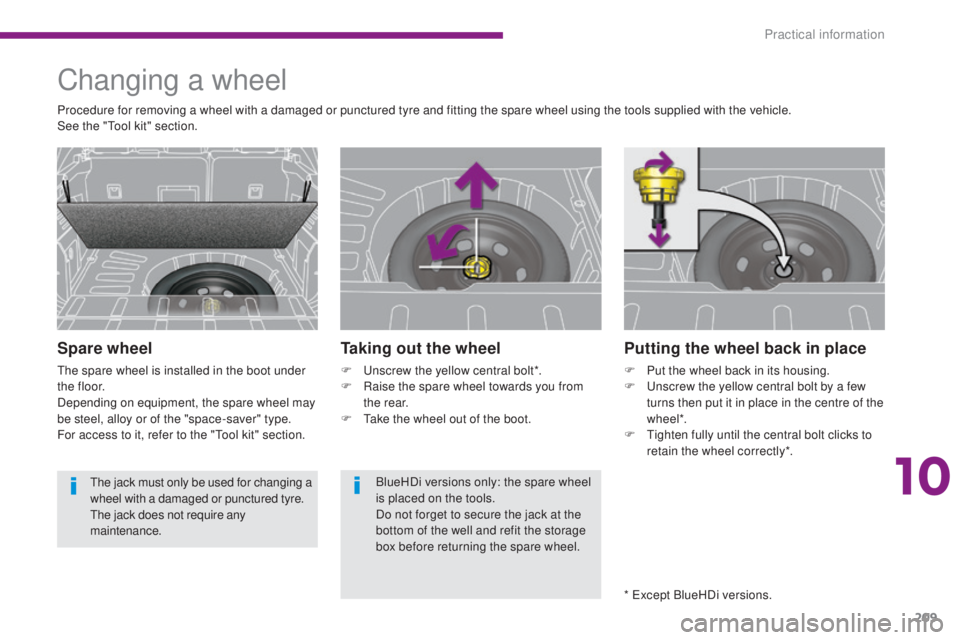
Putting the wheel back in place
F Put the wheel back in its housing.
F U nscrew the yellow central bolt by a few
turns then put it in place in the centre of the
w h e e l*.
F
T
ighten fully until the central bolt clicks to
retain the wheel correctly*.
Changing a wheel
Spare wheel
The spare wheel is installed in the boot under
t h e f l o o r.
Depending on equipment, the spare wheel may
be steel, alloy or of the "space-saver" type.
For access to it, refer to the "Tool kit" section.
Taking out the wheel
F Unscrew the yellow central bolt*.
F R aise the spare wheel towards you from
the rear.
F
T
ake the wheel out of the boot.
Procedure for removing a wheel with a damaged or punctured tyre and fitting the spare wheel using the tools supplied with the vehicle.
See the "Tool kit" section.
* Except BlueHDi versions.
BlueHDi versions only: the spare wheel
is placed on the tools.
Do not forget to secure the jack at the
bottom of the well and refit the storage
box before returning the spare wheel.
The jack must only be used for changing a
wheel with a damaged or punctured tyre.
The jack does not require any
maintenance.
10
Practical information
Page 215 of 344
213
3008_en_Chap10_infos-pratiques_ed01-2015
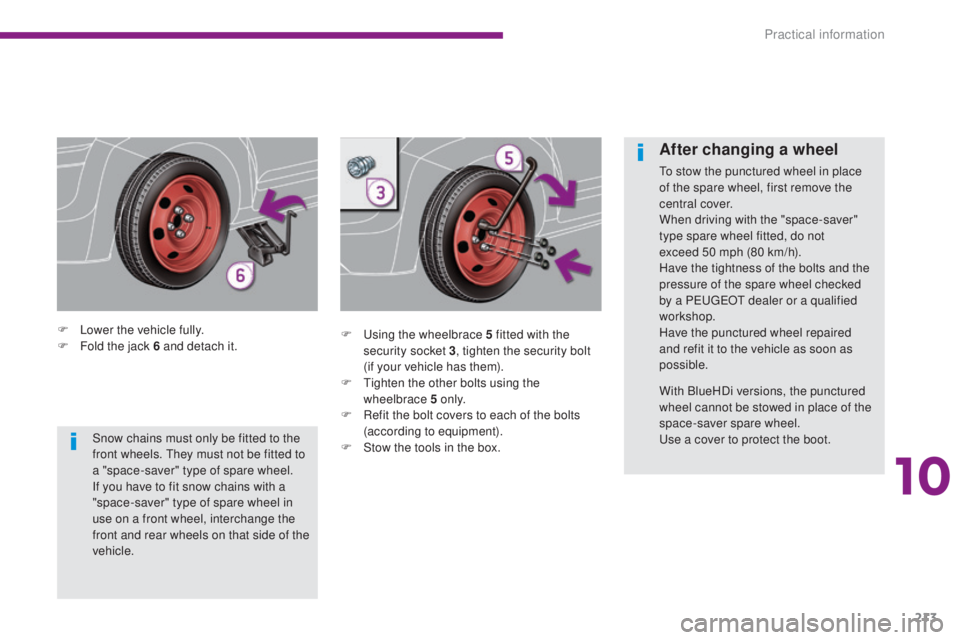
F Lower the vehicle fully.
F F old the jack 6 and detach it. F
U sing the wheelbrace 5 fitted with the
security socket 3 , tighten the security bolt
(if your vehicle has them).
F
T
ighten the other bolts using the
wheelbrace 5 o n l y.
F
R
efit the bolt covers to each of the bolts
(according to equipment).
F
S
tow the tools in the box.
After changing a wheel
To stow the punctured wheel in place
of the spare wheel, first remove the
central cover.
When driving with the "space-saver"
type spare wheel fitted, do not
exceed 50 mph (80 km/h).
Have the tightness of the bolts and the
pressure of the spare wheel checked
by a PEUGEOT dealer or a qualified
workshop.
Have the punctured wheel repaired
and refit it to the vehicle as soon as
possible.
With BlueHDi versions, the punctured
wheel cannot be stowed in place of the
space-saver spare wheel.
Use a cover to protect the boot.
Snow chains must only be fitted to the
front wheels. They must not be fitted to
a "space-saver" type of spare wheel.
If you have to fit snow chains with a
"space-saver" type of spare wheel in
use on a front wheel, interchange the
front and rear wheels on that side of the
vehicle.
10
Practical information
Page 217 of 344
215
3008_en_Chap10_infos-pratiques_ed01-2015
Changing a bulb
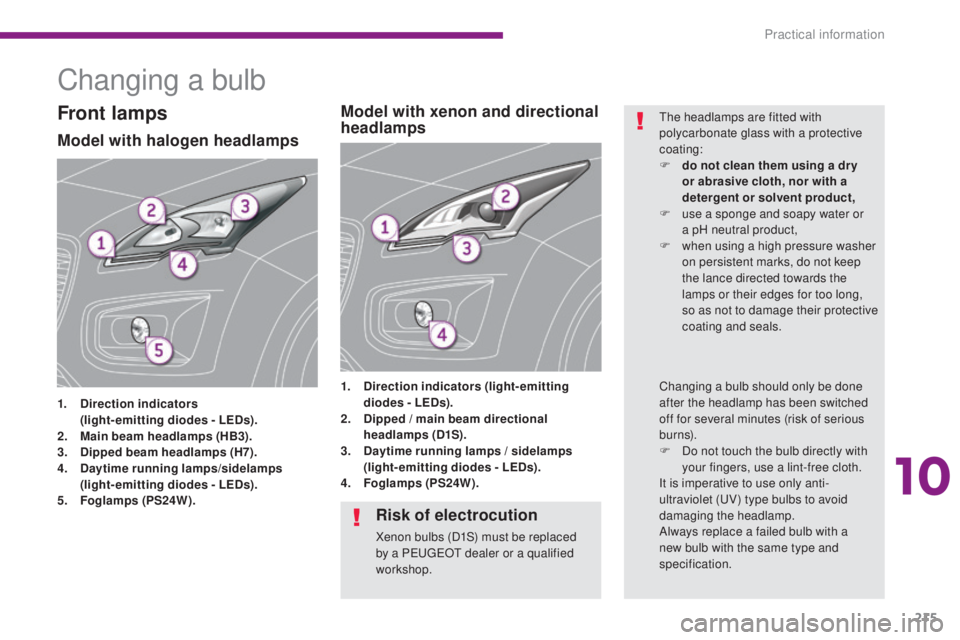
Model with halogen headlamps
1. Direction indicators (
light-emitting diodes - LEDs).
2.
M
ain beam headlamps (HB3).
3.
D
ipped beam headlamps (H7).
4.
D
aytime running lamps/sidelamps
(
light-emitting diodes - LEDs).
5.
F
oglamps (PS24W). 1.
D
irection indicators (light-emitting
diodes - LEDs).
2. D ipped / main beam directional
headlamps (D1S).
3.
D
aytime running lamps / sidelamps
(light-emitting diodes - LEDs).
4.
F
oglamps (PS24W).
Model with xenon and directional
headlampsFront lampsThe headlamps are fitted with
polycarbonate glass with a protective
coating:
F
d
o not clean them using a dr y
or abrasive cloth, nor with a
detergent or solvent product,
F
u
se a sponge and soapy water or
a
pH neutral product,
F
w
hen using a high pressure washer
on persistent marks, do not keep
the lance directed towards the
lamps or their edges for too long,
so as not to damage their protective
coating and seals.
Risk of electrocution
Xenon bulbs (D1S) must be replaced
by a PEUGEOT dealer or a qualified
workshop. Changing a bulb should only be done
after the headlamp has been switched
off for several minutes (risk of serious
burns).
F
D
o not touch the bulb directly with
your fingers, use a lint-free cloth.
It is imperative to use only anti-
ultraviolet (UV) type bulbs to avoid
damaging the headlamp.
Always replace a failed bulb with a
new bulb with the same type and
specification.
10
Practical information
Page 219 of 344
217
3008_en_Chap10_infos-pratiques_ed01-2015
Changing foglamp bulbs
Contact a PEUGEOT dealer or a qualified
workshop.
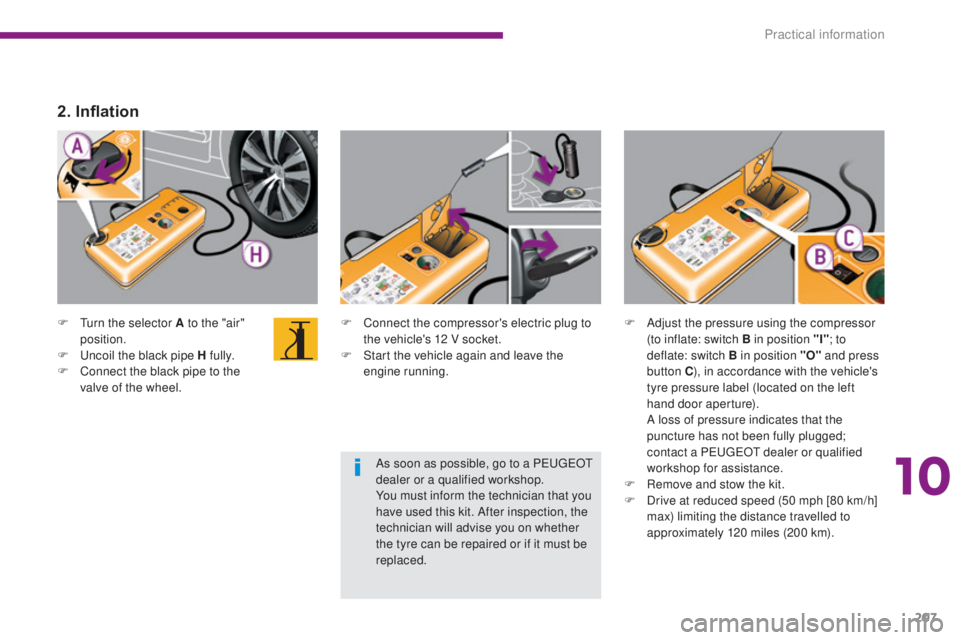
F
I
nsert a screwdriver towards the centre of
the repeater between the repeater and the
base of the mirror.
F
T
ilt the screwdriver to extract the repeater
and remove it.
F
D
isconnect the repeater connector.
Changing integrated direction
indicator side repeaters
Changing dipped beam
and main beam headlamp
bulbs (models with xenon
headlamps)
D1S xenon bulbs must be changed by a
PEUGEOT dealer or a qualified workshop
as there is a risk of electrocution.
It is recommended that all D1S bulbs are
changed at the same time if one of them
fails.
You can also contact a PEUGEOT
dealer or a qualified workshop to have
these lamps changed.
To refit, carry out these operations in reverse
o r d e r.
Contact a PEUGEOT dealer or a qualified
workshop to obtain a new repeater.
10
Practical information
Page 234 of 344
232
3008_en_Chap10_infos-pratiques_ed01-2015
Changing a wiper blade
Removing
F Raise the corresponding wiper arm.
F U nclip the wiper blade and remove it.
Fitting
F Put the corresponding new wiper blade in place and clip it.
F
F
old down the wiper arm carefully.
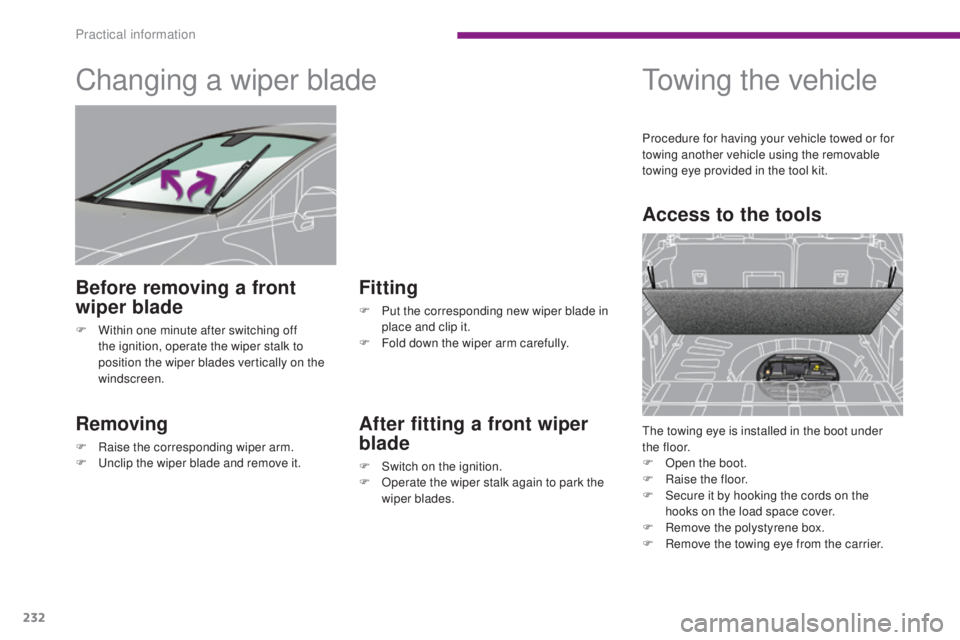
Before removing a front
wiper blade
F Within one minute after switching off the ignition, operate the wiper stalk to
position the wiper blades vertically on the
windscreen.
After fitting a front wiper
blade
F Switch on the ignition.
F O perate the wiper stalk again to park the
wiper blades.
Towing the vehicle
Access to the tools
The towing eye is installed in the boot under
t h e f l o o r.
F
O
pen the boot.
F
Ra
ise the floor.
F
S
ecure it by hooking the cords on the
hooks on the load space cover.
F
R
emove the polystyrene box.
F
R
emove the towing eye from the carrier.
Procedure for having your vehicle towed or for
towing another vehicle using the removable
towing eye provided in the tool kit.
Practical information
Page 235 of 344
233
3008_en_Chap10_infos-pratiques_ed01-2015
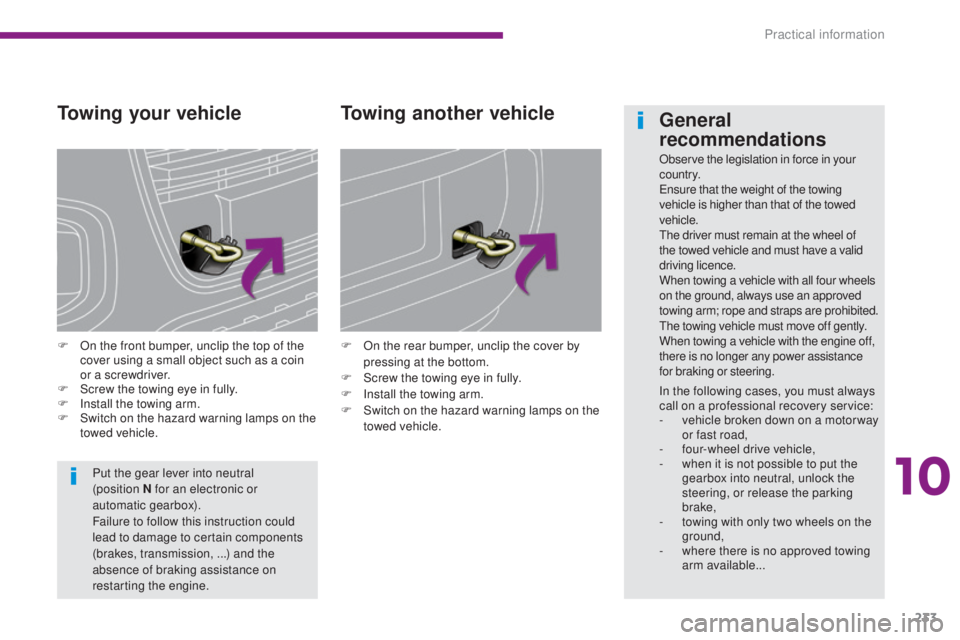
Towing your vehicle
F On the front bumper, unclip the top of the cover using a small object such as a coin
or a screwdriver.
F
S
crew the towing eye in fully.
F
I
nstall the towing arm.
F
S
witch on the hazard warning lamps on the
towed vehicle. F
O n the rear bumper, unclip the cover by
pressing at the bottom.
F
S
crew the towing eye in fully.
F
I
nstall the towing arm.
F
S
witch on the hazard warning lamps on the
towed vehicle.
Towing another vehicle
Put the gear lever into neutral
(position N for an electronic or
automatic gearbox).
Failure to follow this instruction could
lead to damage to certain components
(brakes, transmission, ...) and the
absence of braking assistance on
restarting the engine.
General
recommendations
Observe the legislation in force in your
c o unt r y.
Ensure that the weight of the towing
vehicle is higher than that of the towed
vehicle.
The driver must remain at the wheel of
the towed vehicle and must have a valid
driving licence.
When towing a vehicle with all four wheels
on the ground, always use an approved
towing arm; rope and straps are prohibited.
The towing vehicle must move off gently.
When towing a vehicle with the engine off,
there is no longer any power assistance
for braking or steering.
In the following cases, you must always
call on a professional recovery service:
-
v
ehicle broken down on a motor way
or fast road,
-
f
our-wheel drive vehicle,
-
w
hen it is not possible to put the
gearbox into neutral, unlock the
steering, or release the parking
brake,
-
t
owing with only two wheels on the
ground,
-
w
here there is no approved towing
arm available...
10
Practical information