Page 124 of 268

122
108_en_Chap06_securite_ed01-2016
Sit in a normal upright position.
Wear a correctly adjusted seat belt.
Do not leave anything between the
occupants and the airbags (a child, pet,
object...), nor fix or attach anything close to
the inflation trajectory of the airbags; this
could cause injuries during their deployment.
Never modify the original definition of your
vehicle, particularly in the area directly
around the airbags.
After an accident or if the vehicle has been
stolen or broken into, have the airbag
systems checked.
All work on the airbag system must be
carried out by a P
e
uge
Ot
dealer or a
qualified workshop.
ev
en if all of the precautions mentioned
are observed, a risk of injury or of minor
burns to the head, chest or arms when an
airbag is deployed cannot be ruled out.
t
h
e
bag inflates almost instantly (within a few
milliseconds) then deflates within the same
time discharging the hot gas via openings
provided for this purpose.Front airbags
Do not drive holding the steering wheel by its
spokes or resting your hands on the centre
part of the wheel.
Passengers must not place their feet on the
dashboard.
Do not smoke as deployment of the airbags
can cause burns or the risk of injury from a
cigarette or pipe.
Never remove or pierce the steering wheel or
hit it violently.
Do not fit or attach anything to the steering
wheel or dashboard, this could cause
injuries with deployment of the airbags.
Advice
Lateral airbags
use only approved covers on the seats,
compatible with the deployment the lateral
airbags. For information on the range of seat
covers suitable for your vehicle, you can
contact a P
e
uge
Ot
dealer.
For more information on accessories, refer
to the corresponding section.
Do not fix or attach anything to the seat
backs (clothing...).
t
h
is could cause injury
to the chest or arms if the lateral airbag is
deployed.
Do not sit with the upper part of the body any
nearer to the door than necessary.
Curtain airbags
Do not fix or attach anything to the roof. th is
could cause injury to the head if the curtain
airbag is deployed.
If fitted on your vehicle, do not remove the
grab handles installed on the roof, they play
a part in securing the curtain airbags.
For the airbags to be fully effective, observe the safety recommendations below:
Safety
Page 142 of 268
140
108_en_Chap07_info-pratiques_ed01-2016
Snow chains
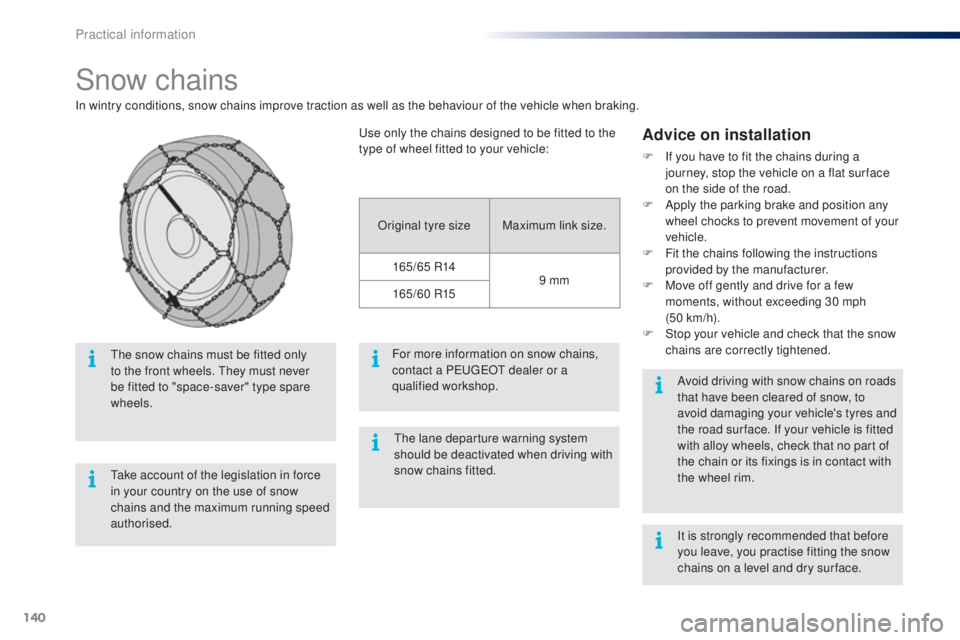
In wintry conditions, snow chains improve traction as well as the behaviour of the vehicle when braking.
Advice on installation
F If you have to fit the chains during a journey, stop the vehicle on a flat sur face
on the side of the road.
F
A
pply the parking brake and position any
wheel chocks to prevent movement of your
vehicle.
F
F
it the chains following the instructions
provided by the manufacturer.
F
M
ove off gently and drive for a few
moments, without exceeding 30 mph
(50
km/h).
F
S
top your vehicle and check that the snow
chains are correctly tightened.
ta
ke account of the legislation in force
in your country on the use of snow
chains and the maximum running speed
authorised.
th
e snow chains must be fitted only
to the front wheels.
t
h
ey must never
be fitted to "space-saver" type spare
wheels. Avoid driving with snow chains on roads
that have been cleared of snow, to
avoid damaging your vehicle's tyres and
the road sur face. If your vehicle is fitted
with alloy wheels, check that no part of
the chain or its fixings is in contact with
the wheel rim.
us
e only the chains designed to be fitted to the
type of wheel fitted to your vehicle:
Original tyre size Maximum link size.
165/65 R14 9 mm
165/60 R15
For more information on snow chains,
contact a P
e
uge
Ot
dealer or a
qualified workshop.
It is strongly recommended that before
you leave, you practise fitting the snow
chains on a level and dry sur face.
th
e lane departure warning system
should be deactivated when driving with
snow chains fitted.
Practical information
Page 144 of 268
142
108_en_Chap07_info-pratiques_ed01-2016
Accessories
A wide range of accessories and genuine parts is available from the PeugeOt dealer network.th
ese accessories and parts are all suitable for your vehicle and benefit from Pe ugeOt' s recommendation and warranty.
"
tr
ansport solutions":
boot carpet, boot liner,
transverse roof bars, bicycle carrier, ski carrier,
roof boxes, boot dividers, ...
"Style":
ligne S body kit, ligne S personalised
mats, aluminium gear lever knob, alloy wheels,
exterior and interior personalisation stickers,
chrome side mouldings, chrome mirror shells,
door sill finishers, personalised remote control
shells, ... "Comfort":
air deflectors, insulated module,
sun blinds, scented air freshener, portable
ashtray, reading lamp, front and rear parking
sensors, centre armrest, cigarette lighter... "Security and safety":
anti-theft alarm,
vehicle tracking system, snow chains, wheel
non-slip covers, wheel security bolts, child
seats, first aid kit, warning triangle, high
visibility vest, breathalyzer, fire extinguisher,
pet seat belt, foglamp kit, seat belt cutter/glass
hammer, ...
"Protection": mats, mud flaps, vehicle cover,
seat covers, bumper protectors, black grained
side mouldings, ...
to p
revent the mat from becoming caught
under the pedals:
-
e
nsure that the mat is secured correctly,
-
n
ever fit one mat on top of another."Multimedia":
audio system, speaker, semi-
integral navigation systems, hands-free kit,
driving assistance systems, 230 V socket,
portable satellite navigation system, telephone/
smartphone support, digital radio, ...
Practical information
Page 155 of 268
153
108_en_Chap08_en-cas-pannes_ed01-2016
Comprising a compressor and a sealant
cartridge, it allows the temporary repair of
a tyre so that you can drive to the nearest
garage.
It is designed to repair most punctures which
could affect the tyre, located on the tyre tread
or shoulder.
temporary puncture repair kit
Composition of the kit
1. 12 V compressor, with integral pressure gauge.
2.
S
ealant cartridge, with integral hose.
3.
Spe
ed limit sticker.
th
e speed limit sticker must be secured
to the interior of the vehicle in the
driver's field of vision, to remind you
that a wheel is in temporary use.th
is kit is installed in the storage box, under the
boot floor.
th
e vehicle's electric system allows the
connection of the compressor for long
enough to inflate a tyre after a puncture
repair.
Do not exceed a speed of 50 mph
(80
km/h) when driving with a tyre
repaired using this type of kit.
Access to the kit
8
In the event of a breakdown
Page 160 of 268
158
108_en_Chap08_en-cas-pannes_ed01-2016
Spare wheel
F As far as possible, immobilise the vehicle on level, stable, non-slippery ground.
F
A
pply the parking brake.
F
S
witch off the ignition ("
oFF" m
ode for
vehicles fitted with "Keyless
e
n
try and
Starting").
F
e
n
gage first gear or reverse for a manual
gearbox.
F
P
lace the gear selector at position N for an
e
tg
el
ectronic gearbox.
Parking the vehicle
Procedure for replacing a wheel with a damaged tyre by the spare wheel using the tools supplied with the vehicle.
F
I
f necessary, chock the wheel diagonally
opposite the wheel to be changed.
F
Y
ou must ensure that the occupants leave
the vehicle and wait in a safe location.
In the event of a breakdown
Page 161 of 268

159
108_en_Chap08_en-cas-pannes_ed01-2016
Access to the spare wheel
and tools
tools provided
the following tools are installed in a carrier,
located in the centre of the spare wheel:
1.
Wheelbrace
2.
J
ack with handle
3.
R
emovable towing eye.
Refer to the "
to
wing the vehicle" section.
tyre pressures
these are indicated on the label affixed to the
middle pillar of the left door, driver's side.
Refer to the "Identification markings" section.All of these tools are specific to your
vehicle and can vary according to
equipment. Do not use them for any
other purposes.
Never go underneath a vehicle
supported only by a jack (use an axle
stand).
Never use a jack other than the one
listed by the manufacturer. If your
vehicle does not have one, contact
a P
e
uge
Ot
dealer or a qualified
workshop to obtain the correct jack for
your vehicle.
Depending on version, the spare wheel and
tools are stowed in the boot under the floor.
F
R
emove the boot carpet.
F
R
emove the tool carrier.
F
S
lacken the central wheel retaining bolt.
F
R
emove the wheel.
8
In the event of a breakdown
Page 162 of 268

160
108_en_Chap08_en-cas-pannes_ed01-2016
Removing a wheel
F Remove the label from the middle of the spare wheel (indicating that a wheel needs
repair), and fix it inside the vehicle, where
the driver can see it.
F
R
emove the wheel trim using the end of the
wheelbrace.
F
S
lacken the wheel bolts using the
wheelbrace 1 . F
P osition the foot of the jack 2 on the ground
and ensure that it is directly below one
of the jacking points A or B located on
the underbody, closest to the wheel to be
changed.
en
sure that the jack is stable. If the ground is slippery or loose, the jack may slip or drop -
Risk of injury!
en
sure that the jack is positioned only at one of the jacking points A or B under the vehicle,
making sure that the vehicle's contact area is centred on the head of the jack. Other wise
there is a risk of damage to the vehicle and/or of the jack dropping - Risk of injury! F
ex tend the jack 2 until its head is in contact
with the jacking point A or B used.
t
h
e
contact area A or B on the vehicle used
must engage correctly with the middle of
the head of the jack.
In the event of a breakdown
Page 163 of 268
161
108_en_Chap08_en-cas-pannes_ed01-2016
Fitting the "space-saver"
type spare wheel
If your vehicle is fitted with alloy wheels,
it is normal to notice when tightening
the wheel bolts that the washers do not
come into contact with the "space-
saver" type spare wheel.
t
h
e wheel is
secured by the conical contact sur face
on each bolt.
Fitting a wheel
F Remove the bolts and put then in a clean place.
F
R
emove the wheel.
F
Ra
ise the vehicle until there is sufficient
space between the wheel and the ground,
so that the (not punctured) spare wheel can
be easily fitted.
8
In the event of a breakdown


