2016 PEUGEOT 108 wheel
[x] Cancel search: wheelPage 97 of 268

95
108_en_Chap04_conduite_ed01-2016
Under-inflation detection
the system monitors the pressures in the four
tyres, once the vehicle is moving.
It compares the information given by the four
wheel speed sensors with reference values,
which must be reinitialised ever y time the
tyre pressures are adjusted or a wheel
changed.
th
e system triggers an alert as soon as it
detects a drop in the inflation pressure of one
or more tyres.
th
e under-inflation detection system
does not replace the need for vigilance
on the part of the driver.
th
is system does not avoid the need to
check the tyre pressures (including the
spare wheel) every month as well as
before a long journey.
Driving with under-inflated tyres impairs
road holding, extends braking distances
and causes premature tyre wear,
particularly under arduous condition
(high loading, high speed, long journey).
System which automatically checks the pressures of the tyres while driving.
th
e inflation pressures defined for
your vehicle can be found on the tyre
pressure label.
For more information on the
identification markings, refer to the
corresponding section.ty re pressures should be checked
when the tyres are "cold" (vehicle
stopped for 1 hour or after a journey of
less than 6 miles (10 km) at moderate
speeds).
Other wise (when hot), add 0.3 bar to
the pressures shown on the label. Driving with under-inflated tyres
increases fuel consumption.
4
Driving
Page 98 of 268
96
108_en_Chap04_conduite_ed01-2016
under-inflation alert
this is given by fixed illumination of
this warning lamp, accompanied by
an audible signal.
F
R
educe speed immediately, avoid
excessive steering movements and sudden
braking.
F
S
top the vehicle as soon as it is safe to
do
so.
th
e loss of pressure detected does not
always cause visible bulging of the tyre.
Do not satisfy yourself with just a visual
check.
F
I
f you have a compressor (such as the one
in the temporary puncture repair kit) check
the pressures of the four tyres when cold.
I
f it is not possible to carry out this check
straight away, drive carefully at reduced
speed.
or
F
I
n the event of a puncture, use the
temporary puncture repair kit or the spare
wheel (depending on equipment).
th
e alert is maintained until the system
is reinitialised.
Reinitialisation
Before reinitialising the system, ensure
that the pressures of the four tyres are
correct for the use of the vehicle and in
line with the recommendations on the
tyre pressure label.
th
e under-inflation alert can only be
relied on if the reinitialisation of the
system has done with the pressures in
the four tyres correctly adjusted.
th
e under-inflation detection system
does not give a warning if a pressure is
incorrect at the time of reinitialisation.
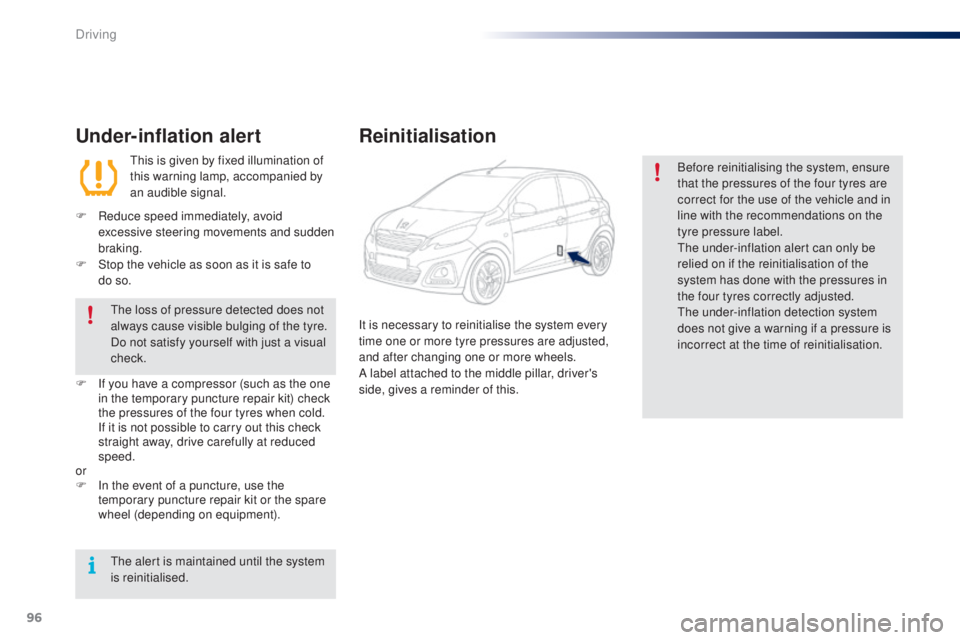
It is necessary to reinitialise the system every
time one or more tyre pressures are adjusted,
and after changing one or more wheels.
A label attached to the middle pillar, driver's
side, gives a reminder of this.
Driving
Page 108 of 268
106
108_en_Chap06_securite_ed01-2016
Horn
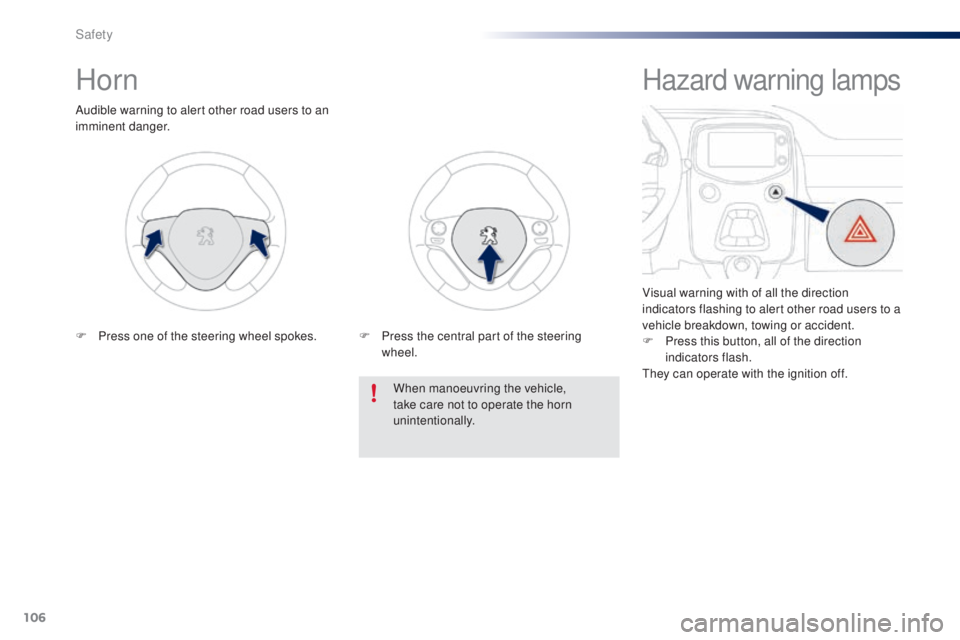
Audible warning to alert other road users to an
imminent danger.When manoeuvring the vehicle,
take care not to operate the horn
unintentionally.
F
P
ress one of the steering wheel spokes. F
P
ress the central part of the steering
wheel.
Hazard warning lamps
Visual warning with of all the direction
indicators flashing to alert other road users to a
vehicle breakdown, towing or accident.
F
P
ress this button, all of the direction
indicators flash.
th
ey can operate with the ignition off.
Safety
Page 109 of 268

107
108_en_Chap06_securite_ed01-2016
electronic Stability Control (eSC) incorporating
the following systems:
-
a
nti-lock braking system (ABS) and the
electronic brake force distribution (
eB
FD),
-
em
ergency braking assistance,
-
t
raction control (
tR
C),
-
d
ynamic stability control (DSC).
electronic stability control (eS C)
Definitions
Anti-lock braking system (ABS)
and electronic brake force
distribution (
e
BFD)
these systems improve the stability and
manoeuvrability of your vehicle when braking
and contribute towards better control in
corners, in particular on poor or slippery road
surfaces.
th
e ABS prevents wheel lock in the event of
emergency braking.
th
e electronic brake force distribution system
manages the braking pressure wheel by wheel.
emergency braking assistance
In an emergency, this system enables you to
reach the optimum braking pressure more
quickly and therefore reduce the stopping
distance.
It is triggered according to the speed at which
the brake pedal is pressed.
t
h
is is felt by a
reduction in the resistance of the pedal and an
increase in the effectiveness of the braking.
traction control (tR C)
this system optimises traction in order to limit
wheel slip by acting on the brakes of the driving
wheels and on the engine. It also improves
the directional stability of the vehicle on
acceleration.
Dynamic stability control (DSC)
If there is a difference between the path
followed by the vehicle and that required by the
driver, this system monitors each wheel and
automatically acts on the brake of one or more
wheels and on the engine to return the vehicle
to the required path, within the limits of the laws
of physics.
6
Safety
Page 110 of 268
108
108_en_Chap06_securite_ed01-2016
Illumination of this warning lamp,
accompanied by an audible signal,
indicates that there is a fault with the
electronic brake force distribution
(
eB
FD), which could cause loss of
control of the vehicle when braking.
operation
Illimination of this warning lamp,
accompanied by an audible signal,
indicates that there is a fault with
the ABS system, which could cause
loss of control of the vehicle when
braking.
Anti-lock braking system (ABS)
and electronic brake force
distribution (
e
BFD)When changing wheels (tyres and rims),
make sure that these are approved for
your vehicle.
Normal operation of the ABS may make
itself felt by slight vibration of the brake
pedal.
In emergency braking, press
very firmly without releasing the
pressure.
Yo u must stop as soon as it is safe to do so .
Contact a P
e
uge
Ot
dealer or a qualified
workshop as soon as possible.
Dynamic stability control (DSC)
and traction control (tR C)
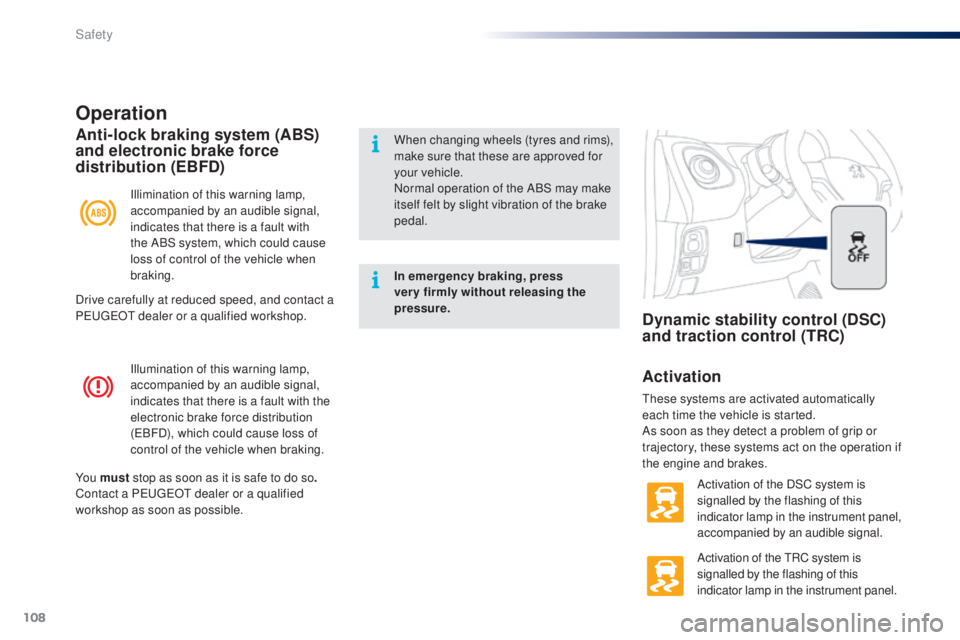
Activation
these systems are activated automatically
each time the vehicle is started.
As soon as they detect a problem of grip or
trajectory, these systems act on the operation if
the engine and brakes. Activation of the DSC system is
signalled by the flashing of this
indicator lamp in the instrument panel,
accompanied by an audible signal.
Activation of the
t
R
C system is
signalled by the flashing of this
indicator lamp in the instrument panel.
Drive carefully at reduced speed, and contact a
P
e
uge
Ot
dealer or a qualified workshop.
Safety
Page 111 of 268
109
108_en_Chap06_securite_ed01-2016
the tRC and DSC systems offer
increased safety in normal driving, but
should not encourage the driver to take
extra risks or drive at high speed.
th
e correct operation of these
systems depends on observation of
the manufacturer's recommendations
regarding the wheels (tyres and rims),
the braking components, the electronic
components and the assembly and
repair procedures used by P
e
uge
Ot
dealers.
After an impact, have the system
checked by a P
e
uge
Ot
dealer or a
qualified workshop.
Deactivation
In exceptional conditions (starting a vehicle
which is bogged down, stuck in snow, on soft
ground...), it may be advisable to deactivate the
DSC and
t
R
C systems, so that the wheels can
spin freely and regain grip.
operating fault
However, it is recommended that these
systems be reactivated as soon as possible.
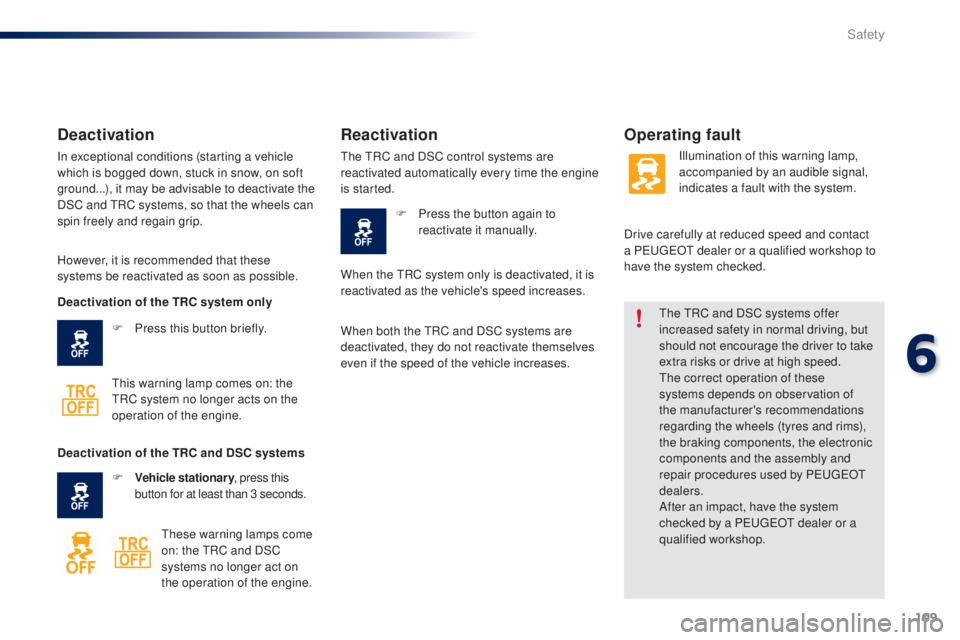
F
P
ress this button briefly.
th
is warning lamp comes on: the
tR
C system no longer acts on the
operation of the engine.
Reactivation
the tRC and DSC control systems are
reactivated automatically every time the engine
is started.
F
P
ress the button again to
reactivate it manually. Illumination of this warning lamp,
accompanied by an audible signal,
indicates a fault with the system.
Drive carefully at reduced speed and contact
a P
e
uge
Ot
dealer or a qualified workshop to
have the system checked.
Deactivation of the
t
R
C system only
Deactivation of the
t
R
C and DSC systems
F
V
ehicle stationary , press this
button for at least than 3 seconds.
th
ese warning lamps come
on: the
t
R
C and DSC
systems no longer act on
the operation of the engine. When the
t
R
C system only is deactivated, it is
reactivated as the vehicle's speed increases.
When both the
t
R
C and DSC systems are
deactivated, they do not reactivate themselves
even if the speed of the vehicle increases.
6
Safety
Page 115 of 268
113
108_en_Chap06_securite_ed01-2016
Never leave accumulations of snow or
any object projecting above the bonnet
or in front of the roof: this might fall into
the field of vision of the sensor and
generate a detection.
operating limits
the system only detects vehicles (cars, lorries)
that are stationary or moving in the same
direction as your vehicle. In difficult weather conditions (very
heavy rain, snow, fog, hail...), braking
distances increase, which can reduce
the ability of the system to avoid a
collision.
the
driver must therefore remain
particularly vigilant.
th
e system is not triggered or is interrupted if
the driver:
-
a
ccelerates strongly (even if the speed
limiter is on),
-
o
r turns the steering wheel suddenly
(avoiding manoeuvre).
Detection capability is less effective if:
-
y
ou are driving on roads with pronounced
bends and/or on roads in poor condition,
-
y
our vehicle is excessively loaded, as
this changes the horizontal attitude of the
vehicle.
-
y
our vehicle skids.It does not detect small vehicles
(bicycles, motorcycles), pedestrians or
animals, nor non-reflective stationary
objects.unwanted triggering of the system
It is possible for the system to detect a risk of
imminent collision and start working, in the
following conditions in particular:
-
d
etection of an object located close to the
edge of the road entering a corner (safety
barrier, lamp post or road sign),
-
d
etection of a structure located at the top
or bottom of a steep slope (advertising
hoarding, steet lighting),
-
d
etection of reflective objects (central
reservation...) in the road,
-
d
etection of the upper bar of a bridge or a
traffic light gantry,
-
p
assing a vehicle travelling in the other
direction in a corner,
-
p
assing a vehicle traveling in the other
direction, at a crossroads, when your
vehicle is turning left or right,
-
i
f the vehicle ahead of you sends up water
or snow,
-
i
f your vehicle stops very close to an
overhanging wall or other vehicles,
-
w
hen your vehicle closes rapidly on the
vehicle ahead,
-
i
f the vehicle is raised or lowered,
-
i
f the vehicle passes through a plastic curtain,
-
i
f driving through mist or smoke,
-
i
f the sensor is misaligned (following
replacement after a collision).
6
Safety
Page 120 of 268

118
108_en_Chap06_securite_ed01-2016
Airbags
Designed to contribute towards the safety of
the occupants in the event of violent collisions.
th
e airbags supplement the action of the force-
limiting seat belts.
If a collision occurs, the electronic detectors
record and analyse the front and side impacts
sustained in the impact detection zones:
-
i
n the case of a serious impact, the airbags
are deployed instantly and contribute
towards better protection of the occupants
of the vehicle; immediately after the impact,
the airbags deflate rapidly so that they
do not hinder visibility or the exit of the
occupants,
-
i
n the case of a minor or rear impact or in
certain roll-over conditions, the airbags
may not be deployed; the seat belt alone
contributes towards providing your
protection in these situations.
th
e airbags do not operate when the
ignition is switched off.
th
e deployment of an airbag is
accompanied by a slight emission
of smoke and a noise, due to the
detonation of the pyrotechnic charge
incorporated in the system.
th
is smoke is not harmful, but sensitive
individuals may experience slight
irritation.
th
e detonation noise associated with
the deployment of an airbag may result
in a slight loss of hearing for a short
time.
th
is equipment will only deploy once.
If a second impact occurs (during the
same or a subsequent accident), the
airbag will not be deployed again.
Impact detection zones
A. Front impact zone.
B. S ide impact zone.
Front airbags
Deployment
the airbags are deployed, except the
passenger's front airbag if it is deactivated, in the
event of a serious front impact to all or part of the
front impact zone A , in the longitudinal centreline
of the vehicle on a horizontal plane and directed
from the front to the rear of the vehicle.
th
e front airbag inflates between the thorax and
head of the front occupant of the vehicle and the
steering wheel, driver's side, and the dashboard,
passenger's side to cushion their forward
movement. System which protects the driver and front
passenger in the event of a serious front impact
in order to limit the risk of injury to the head and
thorax.
th
e driver's airbag is fitted in the centre of the
steering wheel; the front passenger's airbag is
fitted in the dashboard above the glove box.
Safety