Page 45 of 268

43
108_en_Chap02_ouvertures_ed01-2016
opening
F Briefly press the control in the opening direction to open the the roof in stages.
or
F
P
ress and hold the control in the opening
direction, until the manoeuvre is complete,
to open the roof completely.
P
ressing again stops the movement of
the
roof.
Closing
F Briefly press the control in the closing direction to open the the roof in stages.
or
F
P
ress and hold the control in the closing
direction, until the manoeuvre is complete,
to close the roof to position 1 .
P
ressing again stops the movement of the
roof.
F
t
o c
lose the roof completely, press and
hold the control (between positions 1
and
0) until the roof locks closed.
th
e closing manoeuvre of the roof
could cause serious injuries: take
particular care with children.
If the roof does not close correctly:
-
c
heck that nothing is blocking the roof
(ignition off),
-
r
epeat the closing command (with the
engine running).
If the problem persists, contact a P
e
uge
Ot
dealer or a qualified workshop.
operating fault
In the event of an electrical fault,
contact a Pe ugeOt dealer or a
qualified workshop.
Protection of the electric motors
used for opening and closing the
roof
Following repeated opening and closing of the
roof, the electric motors may become too warm
and no longer allow the roof to be opened or
closed. Allow the motors to cool down with no
operation of the roof for 10 minutes.
2
Access
Page 49 of 268

47
108_en_Chap03_ergonomie-confort_ed01-2016
ensure that no person or object
prevents the seat slide from returning to
its initial position.
Check that the seat belt has reeled in
correctly so as to not impede access for
passengers to the rear seats.
Heated seat controlAccess to the rear seats
(3-door)
F Pull this control toward you to fold the seat
back and move the seat for ward.
When returning the seat to its initial position,
guide it back until the seat and backrest lock
into place.
With the engine running, the front seats can be
heated separately.
F
P
ress the control switch.
t
h
e indicator lamp comes on.
F
P
ressing the switch again stops the
heating.
the
temperature is controlled automatically.
the
seat heating function is deactivated about
two minutes after switching off the ignition.
t
o
r
eactivate it, switch the ignition on and press
the control switch again. Switch the seat heating off as soon
as it is no longer needed, as reducing
the vehicle's electrical current demand
reduces fuel consumption.
3
ease of use and comfort
Page 56 of 268
54
108_en_Chap03_ergonomie-confort_ed01-2016
Heating
the heating system only operates with the engine running.F t
u
rn the control from blue
(cold) to red (hot) to adjust the
temperature to your wishes.
temperature adjustment
Air flow adjustment
F turn the knob from position 1 to 4 to obtain the desired flow
o f a i r.
Avoid driving for too long without
ventilation (risk of misting and
deterioration of air quality).
Air distribution adjustment
Centre vent and side air vents.
Centre vent, side vents and footwells.
Footwells.
Windscreen and footwells.
Windscreen.
th
e air distribution can be varied by
placing the control in an intermediate
position.
ease of use and comfort
Page 57 of 268
55
108_en_Chap03_ergonomie-confort_ed01-2016
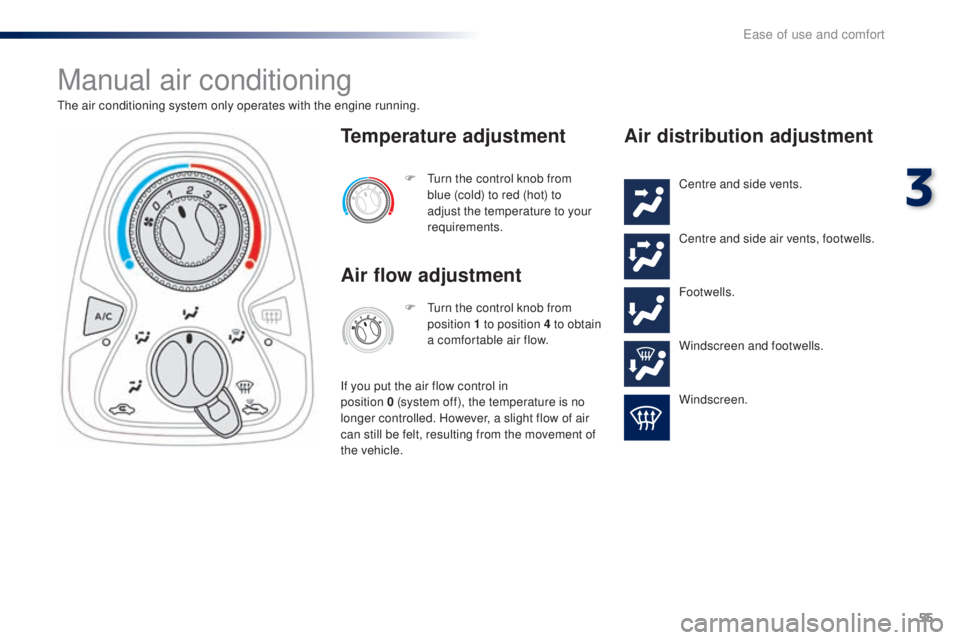
Manual air conditioning
the air conditioning system only operates with the engine running.F t
u
rn the control knob from
blue (cold) to red (hot) to
adjust the temperature to your
requirements.
temperature adjustment
Air flow adjustment
F turn the control knob from position 1 to position 4 to obtain
a comfortable air flow.
If you put the air flow control in
position
0
(system off), the temperature is no
longer controlled. However, a slight flow of air
can still be felt, resulting from the movement of
the vehicle.
Air distribution adjustment
Centre and side vents.
Centre and side air vents, footwells.
Footwells.
Windscreen and footwells.
Windscreen.
3
ease of use and comfort
Page 59 of 268

57
108_en_Chap03_ergonomie-confort_ed01-2016
Manual override
It is possible to adjust one or more functions
manually while leaving the other functions in
automatic mode.
th
e "A
u
to
" s
ymbol switches off.
to r
eturn to automatic mode, press the "A
u
to
"
b
utton.
Switching to manual mode may not be suitable
(temperature, humidity, odour, condensation)
and does not provide optimum comfort.
Automatic air conditioning
F Press the "Au to" b utton. th
e "Au
to" s
ymbol comes on.
th
e air conditioning system only operates with the engine running.
By pressing the "A
u
to
" b
utton again, you can
choose from one of the following settings in
turn:Automatic programme
Allows optimum operation of the
system.
Offers temperature control while
restricting air flow.
Dynamic air distribution mainly
towards the side air vents.
We recommend that you use this mode.
It provides optimised automatic control of
all of the following functions: passenger
compartment temperature, air flow, air
distribution and air intake, in accordance with
the comfort value that you have chosen.th
is system is designed to operate effectively
in all seasons, with the windows and fabric roof
closed.
For your comfort, when the engine is switched
off, the settings are retained until the engine is
switched on again.
to p
revent too great a distribution of cold air
when the engine is cold, the air flow will only
reach its optimum level gradually.
3
ease of use and comfort
Page 63 of 268
61
108_en_Chap03_ergonomie-confort_ed01-2016
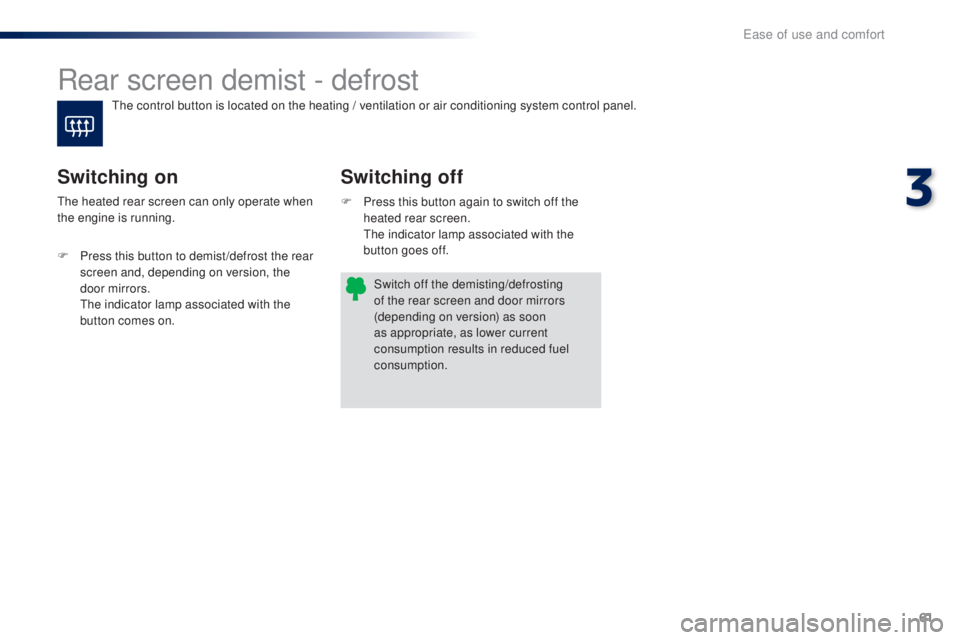
Rear screen demist - defrost
Switching off
Switching on
F Press this button again to switch off the
heated rear screen.
t
h
e indicator lamp associated with the
button goes off.th
e heated rear screen can only operate when
the engine is running.
Switch off the demisting/defrosting
of the rear screen and door mirrors
(depending on version) as soon
as appropriate, as lower current
consumption results in reduced fuel
consumption.
F
P
ress this button to demist /defrost the rear
screen and, depending on version, the
door mirrors.
t
h
e indicator lamp associated with the
button comes on.
th
e control button is located on the heating / ventilation or air conditioning system control panel.
3
ease of use and comfort
Page 72 of 268

70
108_en_Chap04_conduite_ed01-2016
A few driving recommendations
Observe the driving regulations at all times and
remain vigilant whatever the traffic conditions.
Pay close attention to the traffic and keep your
hands on the wheel so that you are ready to
react at any time to any eventuality.
On a long journey, a break every two hours is
strongly recommended.
In difficult weather, drive smoothly, anticipate
the need to brake and increase the distance
from other vehicles.Never drive with the parking brake
applied - Risk of overheating and
damage to the braking system!
Do not park or run the engine when
stationary in areas where inflammable
substances and materials (dry grass,
dead leaves...) might come into contact
with the hot exhaust system - Risk of
fire!
Never leave a vehicle unsupervised
with the engine running. If you have
to leave your vehicle with the engine
running, apply the parking brake
and put the gearbox into neutral or
position
N, depending on the type of
gearbox.
Driving on flooded
roads
We strongly advise against driving on flooded
roads, as this could cause serious damage
to the engine or gearbox, as well as to the
electrical systems of your vehicle.
Important!If you are obliged to drive through water:
-
c
heck that the depth of water does not
exceed 15 cm, taking account of waves
that might be generated by other users,
-
d
eactivate the Stop & Start system,
-
d
rive as slowly as possible without
stalling. In all cases, do not exceed 6 mph
(10
km/h),
-
d
o not stop and do not switch off the
engine.
On leaving the flooded road, as soon as
circumstances allow, make several light brake
applications to dry the brake discs and pads.
If in doubt on the state of your vehicle, contact
a P
e
uge
Ot
dealer or a qualified workshop.
Driving
Page 73 of 268
71
108_en_Chap04_conduite_ed01-2016
Starting - switching off the engine with the key
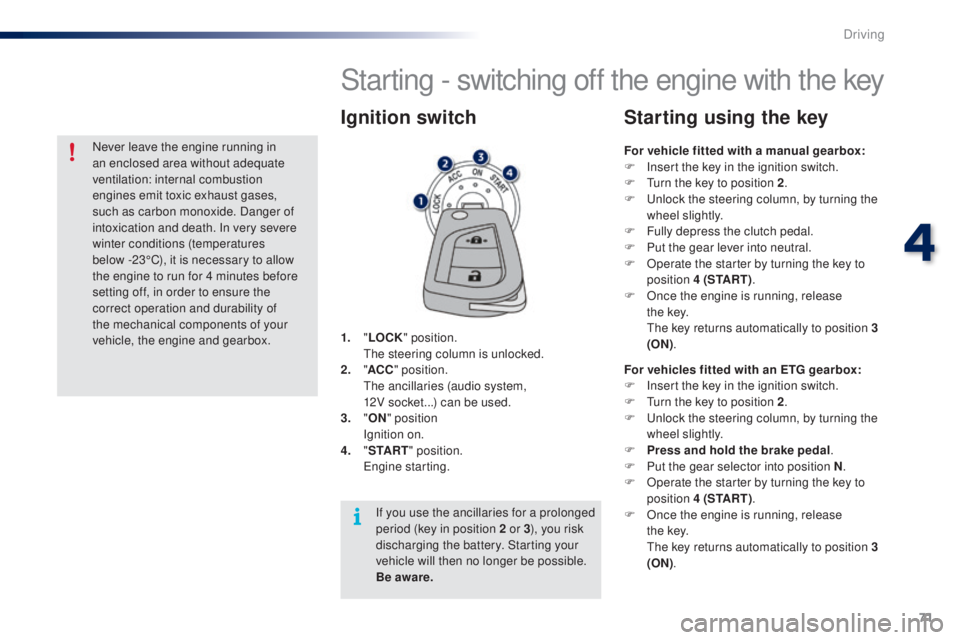
1. "L oCK " position.
th e steering column is unlocked.
2.
" AC
C" position.
t
h
e ancillaries (audio system,
12V
socket...) can be used.
3.
"
oN"
position
I
gnition on.
4.
" St
A R
t"
position.
e
n
gine starting.
Ignition switch
For vehicle fitted with a manual gearbox:
F I nsert the key in the ignition switch.
F
t
u
rn the key to position 2 .
F
u
n
lock the steering column, by turning the
wheel slightly.
F
F
ully depress the clutch pedal.
F
P
ut the gear lever into neutral.
F
O
perate the starter by turning the key to
position 4 (S
t
A R
t).
F
O
nce the engine is running, release
t h e
key.
t
h
e key returns automatically to position 3
(
o
N
).
Starting using the key
For vehicles fitted with an etg gearbox:
F I nsert the key in the ignition switch.
F
t
u
rn the key to position 2 .
F
u
n
lock the steering column, by turning the
wheel slightly.
F
P
ress and hold the brake pedal .
F
P
ut the gear selector into position N .
F
O
perate the starter by turning the key to
position 4 (S
t
A R
t).
F
O
nce the engine is running, release
t h e
key.
t
h
e key returns automatically to position 3
(
o
N
)
.
If you use the ancillaries for a prolonged
period (key in position 2 or 3 ), you risk
discharging the battery. Starting your
vehicle will then no longer be possible.
Be aware.
Never leave the engine running in
an enclosed area without adequate
ventilation: internal combustion
engines emit toxic exhaust gases,
such as carbon monoxide. Danger of
intoxication and death. In very severe
winter conditions (temperatures
below
-23°C), it is necessary to allow
the engine to run for 4 minutes before
setting off, in order to ensure the
correct operation and durability of
the mechanical components of your
vehicle, the engine and gearbox.
4
Driving