2016 NISSAN TITAN engine coolant
[x] Cancel search: engine coolantPage 489 of 636
Steering wheelCheck for changes in the steer-
ing system, such as excessive freeplay, hard
steering or strange noises.
Warning lights and chimes Make sure all
warning lights and chimes are operating properly.
Windshield wiper and washer* Check that
the wipers and washer operate properly and that
the wipers do not streak.
Windshield defroster Check that the air
comes out of the defroster outlets properly and in
sufficient quantity when operating the heater or
air conditioner.
Under the hood and vehicle
The maintenance items listed here should be
checked periodically (for example, each time you
check the engine oil or refuel) .
Battery* (for seviceable batteries) Check the
fluid level in each cell. It should be between the
MAX and MIN lines. Vehicles operated in high
temperatures or under severe conditions require
frequent checks of the battery fluid level. NOTE:
Care should be taken to avoid situations
that can lead to potential battery discharge
and potential no-start conditions such as:
1. Installation or extended use of electronic accessories that consume battery power
when the engine is not running (Phone char-
gers, GPS, DVD players, etc.) .
2. Vehicle is not driven regularly and/or only driven short distances. In these cases, the
battery may need to be charged to maintain
battery health.
Brake fluid level* Make sure that the brake fluid
level is between the MIN and MAX lines on the
reservoir.
Engine coolant level* Check the coolant level
when the engine is cold.
Engine drive belts* Make sure the drive belts
are not frayed, worn, cracked or oily.
Engine oil level* Check the level after parking
the vehicle on a level surface with the engine off.
Wait more than 10 minutes for the oil to drain
back into the oil pan. Exhaust system
Visually inspect the exhaust
pipes, muffler and hangers for leaks, cracks, de-
terioration and damage. Tighten connections or
replace parts as necessary. For additional infor-
mation, refer to “Exhaust gas (carbon monoxide)”
in the “Starting and driving” section of this
manual.
Fluid leaks Check under the vehicle for fuel, oil,
water or other fluid leaks after the vehicle has
been parked for a while. Water dripping from the
air conditioner after use is normal. If you should
notice any leaks or if fuel fumes are evident,
check for the cause and have it corrected imme-
diately.
Power steering fluid level* and lines Check
the level when the fluid is cold, with the engine
off. Check the lines for proper attachment, leaks,
cracks, etc.
Radiator and hoses Check the front of the
radiator and clean off any dirt, insects, leaves,
etc., that may have accumulated. Make sure the
hoses have no cracks, deformation, rot or loose
connections.
9-4Maintenance and schedules
Page 490 of 636
UnderbodyThe underbody is frequently ex-
posed to corrosive substances such as those
used on icy roads or to control dust. It is very
important to remove these substances from the
underbody, otherwise rust may form on the floor
pan, frame, fuel lines and exhaust system. At the
end of winter, the underbody should be thor-
oughly flushed with plain water, in those areas
where mud and dirt may have accumulated. For
additional information, refer to the “Appearance
and care” section of this manual.
Windshield-washer fluid* Check that there is
adequate fluid in the reservoir. The following descriptions are provided to give
you a better understanding of the scheduled
maintenance items that should be regularly
checked or replaced. The maintenance schedule
indicates at which mileage/time intervals each
item requires service.
Items marked with
“*”are recommended by
NISSAN for reliable vehicle operation. You are
not required to perform maintenance on these
items in order to maintain the warranties which
come with your NISSAN. Other maintenance
items and intervals are required.
When applicable, additional information can be
found in the “Do-it-yourself” section of this
manual.
NOTE: NISSAN does not advocate the use of
non-OEM approved aftermarket flushing sys-tems and strongly advises against performingthese services on a NISSAN product. Many of theaftermarket flushing systems use non-OEM ap-proved chemicals or solvents, the use of whichhas not been validated by NISSAN.
For recommended fuel, lubricants, fluids, grease,
and refrigerant, refer to “Recommended
fluids/lubricants and capacities” in the “Technical
and consumer information section of this
manual.
EMISSION CONTROL SYSTEM
MAINTENANCE:
Drive Belts*
Check engine drive belts for wear, fraying or
cracking and for proper tension. Replace any
damaged drive belts.
Engine Air Filter
Replace at specified intervals. When driving for
prolonged periods in dusty conditions,
check/replace the filter more frequently.
Engine Coolant*
Replace coolant at the specified interval. When
adding or replacing coolant, be sure to use only
Genuine NISSAN Long Life Antifreeze/Coolant
(blue) or equivalent with the proper mixture. (For
additional information on the proper mixture for
your area, refer to Engine cooling system” in the
“Do-it-yourself” section of this manual or the “Ti-
tan Diesel Owner’s Manual”.)
NOTE: Mixing any other type of coolant or the use
of non-distilled water may reduce the recom-
mended service interval of the coolant.
EXPLANATION OF SCHEDULED
MAINTENANCE ITEMS
Maintenance and schedules9-5
Page 493 of 636
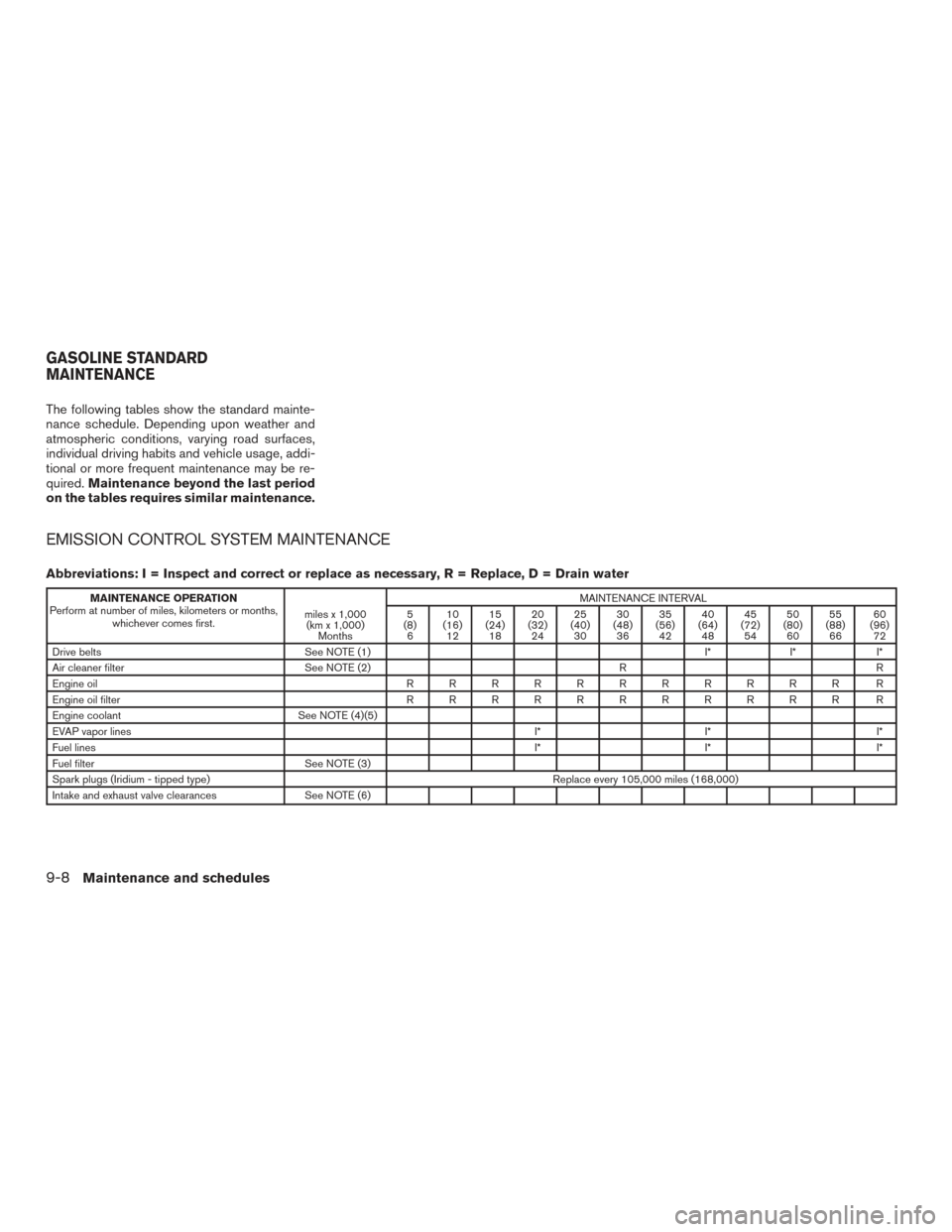
The following tables show the standard mainte-
nance schedule. Depending upon weather and
atmospheric conditions, varying road surfaces,
individual driving habits and vehicle usage, addi-
tional or more frequent maintenance may be re-
quired.Maintenance beyond the last period
on the tables requires similar maintenance.
EMISSION CONTROL SYSTEM MAINTENANCE
Abbreviations: I = Inspect and correct or replace as necessary, R = Replace, D = Drain water
MAINTENANCE OPERATION
Perform at number of miles, kilometers or months, whichever comes first. miles x 1,000
(km x 1,000) Months MAINTENANCE INTERVAL
5
(8) 6 10
(16) 12 15
(24) 18 20
(32) 24 25
(40) 30 30
(48) 36 35
(56) 42 40
(64) 48 45
(72) 54 50
(80) 60 55
(88) 66 60
(96) 72
Drive belts See NOTE (1) I*I* I*
Air cleaner filter See NOTE (2) RR
Engine oil RRRRRRRRRRR R
Engine oil filter RRRRRRRRRRR R
Engine coolant See NOTE (4)(5)
EVAP vapor lines I*I* I*
Fuel lines I*I* I*
Fuel filter See NOTE (3)
Spark plugs (Iridium - tipped type) Replace every 105,000 miles (168,000)
Intake and exhaust valve clearances See NOTE (6)
GASOLINE STANDARD
MAINTENANCE
9-8Maintenance and schedules
Page 494 of 636
MAINTENANCE OPERATION
Perform at number of miles, kilometers or months, whichever comes first. miles x 1,000
(km x 1,000) Months MAINTENANCE INTERVAL
65
(104) 78 70
(112) 84 75
(120) 90 80
(128) 96 85
(136) 102 90
(144) 108 95
(152) 114 100
(160) 120 105
(168) 126 110
(176) 132 115
(184) 138 120
(192) 144
Drive belts See NOTE (1)I*I*I*I*I* I*
Air cleaner filter See NOTE (2) RR
Engine oil RRRRRRRRRRR R
Engine oil filter RRRRRRRRRRR R
Engine coolant See NOTE (4)(5)
EVAP vapor lines I*I* I*
Fuel lines I*I* I*
Fuel filter See NOTE (3)
Spark plugs (Iridium - tipped type) Replace every 105,000 miles (168,000)
Intake and exhaust valve clearances See NOTE (6)
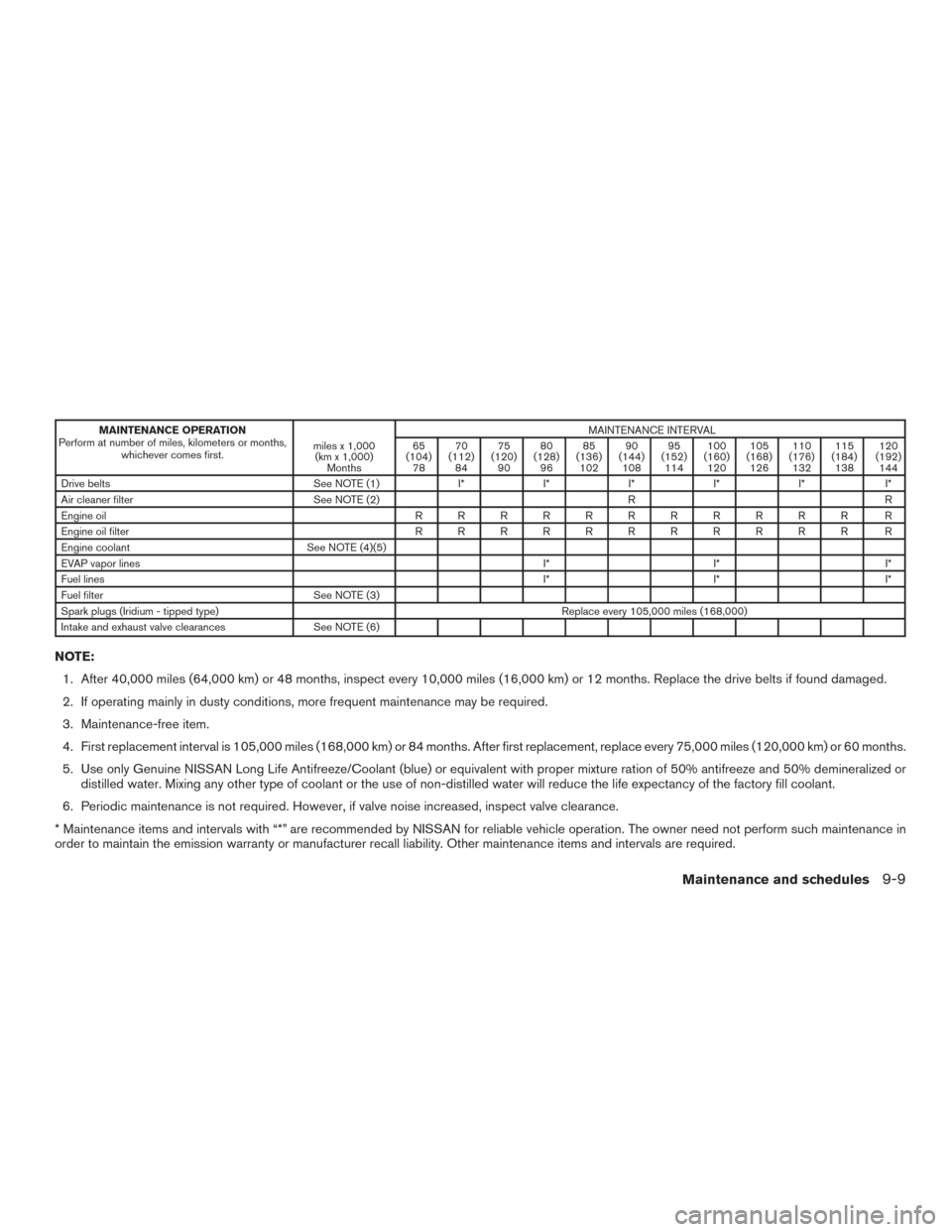
NOTE:
1. After 40,000 miles (64,000 km) or 48 months, inspect every 10,000 miles (16,000 km) or 12 months. Replace the drive belts if found damaged.
2. If operating mainly in dusty conditions, more frequent maintenance may be required.
3. Maintenance-free item.
4. First replacement interval is 105,000 miles (168,000 km) or 84 months. After first replacement, replace every 75,000 miles (120,000 km) or 60 months.
5. Use only Genuine NISSAN Long Life Antifreeze/Coolant (blue) or equivalent with proper mixture ration of 50% antifreeze and 50% demineralized or distilled water. Mixing any other type of coolant or the use of non-distilled water will reduce the life expectancy of the factory fill coolant.
6. Periodic maintenance is not required. However, if valve noise increased, inspect valve clearance.
* Maintenance items and intervals with “*” are recommended by NISSAN for reliable vehicle operation. The owner need not perform such maintenance in
order to maintain the emission warranty or manufacturer recall liability. Other maintenance items and intervals are required.
Maintenance and schedules9-9
Page 498 of 636
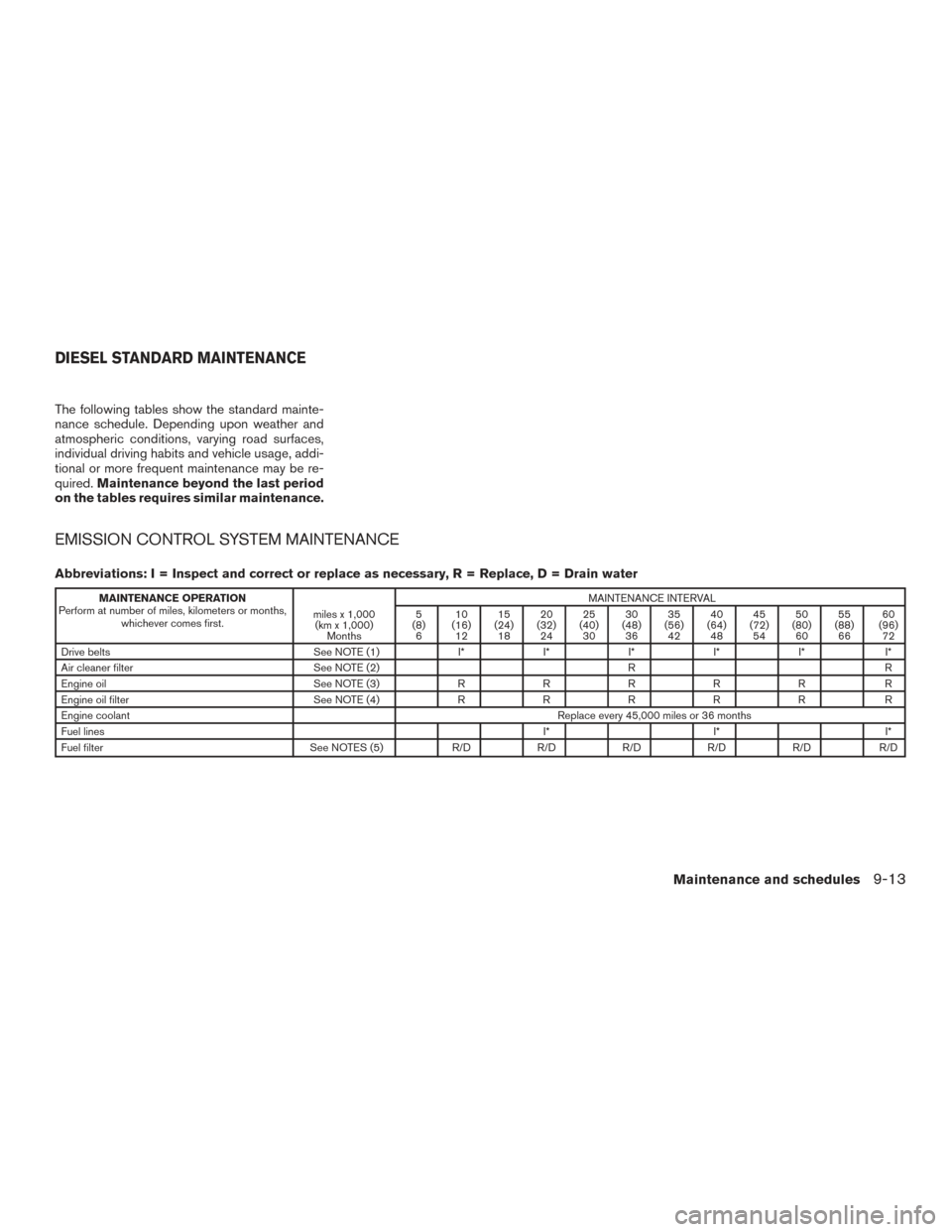
The following tables show the standard mainte-
nance schedule. Depending upon weather and
atmospheric conditions, varying road surfaces,
individual driving habits and vehicle usage, addi-
tional or more frequent maintenance may be re-
quired.Maintenance beyond the last period
on the tables requires similar maintenance.
EMISSION CONTROL SYSTEM MAINTENANCE
Abbreviations: I = Inspect and correct or replace as necessary, R = Replace, D = Drain water
MAINTENANCE OPERATION
Perform at number of miles, kilometers or months, whichever comes first. miles x 1,000
(km x 1,000) Months MAINTENANCE INTERVAL
5
(8) 6 10
(16) 12 15
(24) 18 20
(32) 24 25
(40) 30 30
(48) 36 35
(56) 42 40
(64) 48 45
(72) 54 50
(80) 60 55
(88) 66 60
(96) 72
Drive belts See NOTE (1)I*I*I*I*I* I*
Air cleaner filter See NOTE (2) RR
Engine oil See NOTE (3)RRRRR R
Engine oil filter See NOTE (4)RRRRR R
Engine coolant Replace every 45,000 miles or 36 months
Fuel lines I*I* I*
Fuel filter See NOTES (5)R/DR/DR/DR/DR/D R/D
DIESEL STANDARD MAINTENANCE
Maintenance and schedules9-13
Page 499 of 636
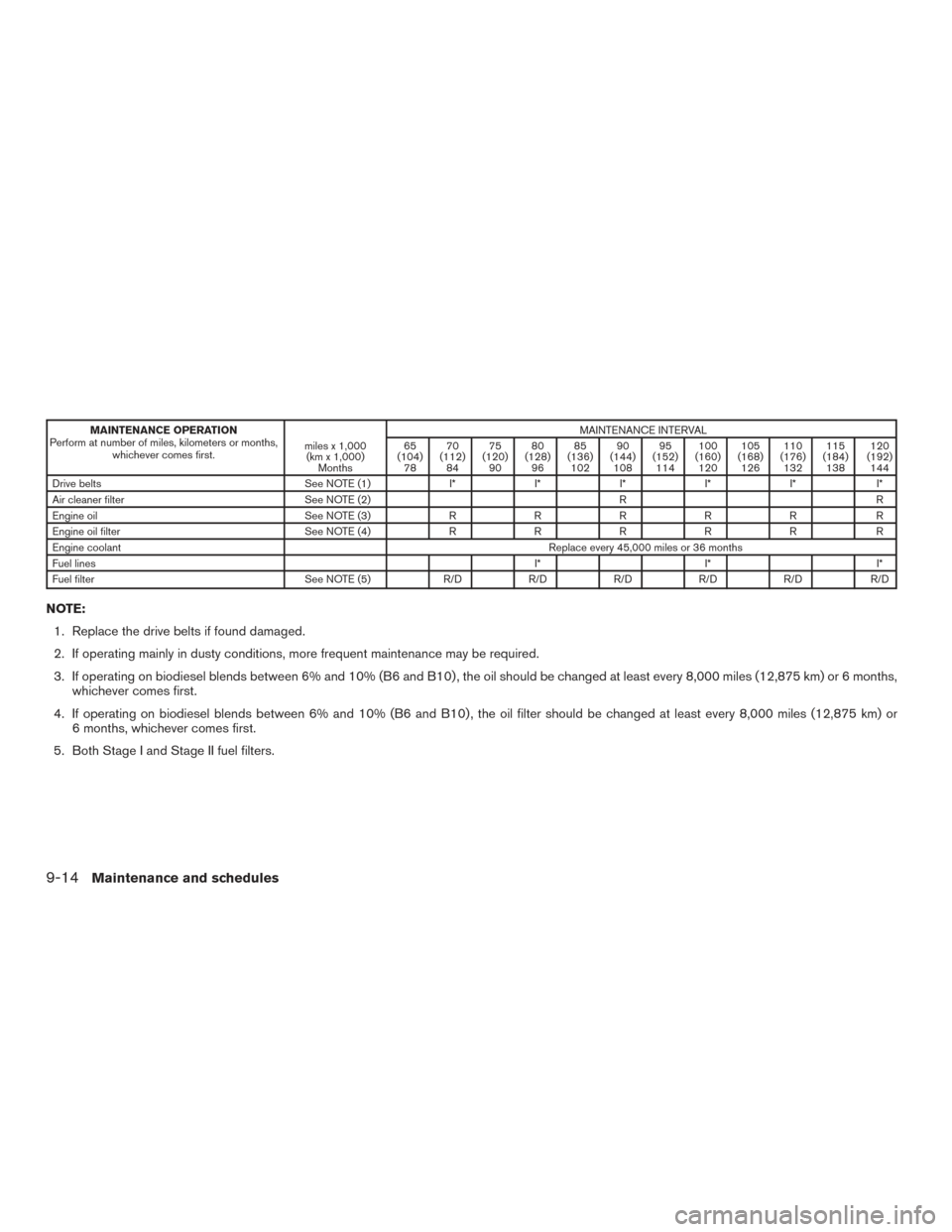
MAINTENANCE OPERATION
Perform at number of miles, kilometers or months, whichever comes first. miles x 1,000
(km x 1,000) Months MAINTENANCE INTERVAL
65
(104) 78 70
(112) 84 75
(120) 90 80
(128) 96 85
(136) 102 90
(144) 108 95
(152) 114 100
(160) 120 105
(168) 126 110
(176) 132 115
(184) 138 120
(192) 144
Drive belts See NOTE (1)I*I*I*I*I* I*
Air cleaner filter See NOTE (2) RR
Engine oil See NOTE (3)RRRRR R
Engine oil filter See NOTE (4)RRRRR R
Engine coolant Replace every 45,000 miles or 36 months
Fuel lines I*I* I*
Fuel filter See NOTE (5)R/DR/DR/DR/DR/D R/D
NOTE:
1. Replace the drive belts if found damaged.
2. If operating mainly in dusty conditions, more frequent maintenance may be required.
3. If operating on biodiesel blends between 6% and 10% (B6 and B10) , the oil should be changed at least every 8,000 miles (12,875 km) or 6 months, whichever comes first.
4. If operating on biodiesel blends between 6% and 10% (B6 and B10) , the oil filter should be changed at least every 8,000 miles (12,875 km) or 6 months, whichever comes first.
5. Both Stage I and Stage II fuel filters.
9-14Maintenance and schedules
Page 507 of 636
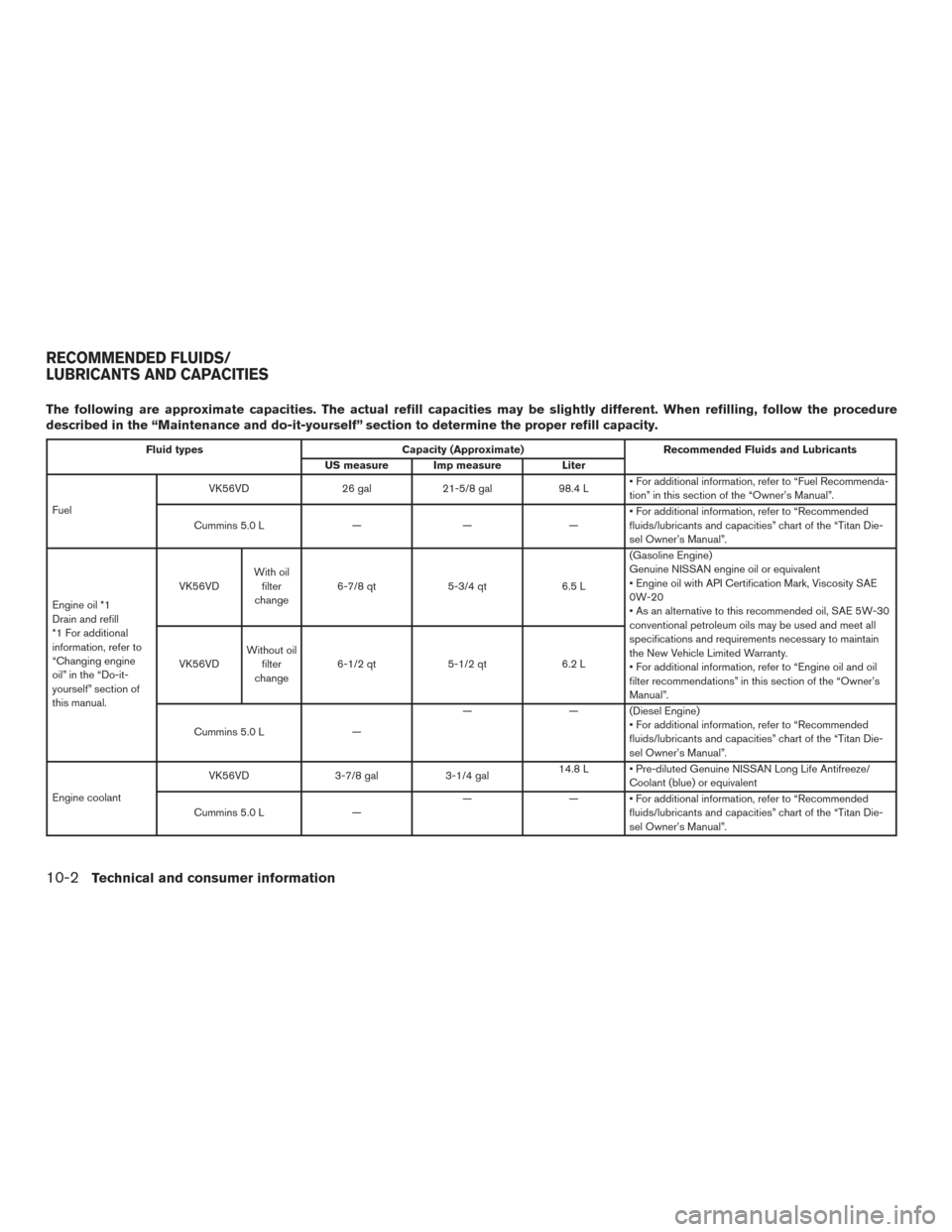
The following are approximate capacities. The actual refill capacities may be slightly different. When refilling, follow the procedure
described in the “Maintenance and do-it-yourself” section to determine the proper refill capacity.
Fluid typesCapacity (Approximate) Recommended Fluids and Lubricants
US measure Imp measure Liter
Fuel VK56VD
26 gal21-5/8 gal 98.4 L• For additional information, refer to “Fuel Recommenda-
tion” in this section of the “Owner’s Manual”.
Cummins 5.0 L ———• For additional information, refer to “Recommended
fluids/lubricants and capacities” chart of the “Titan Die-
sel Owner’s Manual”.
Engine oil *1
Drain and refill
*1 For additional
information, refer to
“Changing engine
oil” in the “Do-it-
yourself” section of
this manual. VK56VD
With oil
filter
change 6-7/8 qt
5-3/4 qt 6.5 L(Gasoline Engine)
Genuine NISSAN engine oil or equivalent
• Engine oil with API Certification Mark, Viscosity SAE
0W-20
• As an alternative to this recommended oil, SAE 5W-30
conventional petroleum oils may be used and meet all
specifications and requirements necessary to maintain
the New Vehicle Limited Warranty.
• For additional information, refer to “Engine oil and oil
filter recommendations” in this section of the “Owner’s
Manual”.
VK56VD
Without oil
filter
change 6-1/2 qt
5-1/2 qt 6.2 L
Cummins 5.0 L ——
— (Diesel Engine)
• For additional information, refer to “Recommended
fluids/lubricants and capacities” chart of the “Titan Die-
sel Owner’s Manual”.
Engine coolant VK56VD
3-7/8 gal3-1/4 gal 14.8 L • Pre-diluted Genuine NISSAN Long Life Antifreeze/
Coolant (blue) or equivalent
Cummins 5.0 L ——
— • For additional information, refer to “Recommended
fluids/lubricants and capacities” chart of the “Titan Die-
sel Owner’s Manual”.
RECOMMENDED FLUIDS/
LUBRICANTS AND CAPACITIES
10-2Technical and consumer information
Page 555 of 636
●While going downhill, the weight of the
trailer pushing on the tow vehicle may de-
crease overall stability. Therefore, to main-
tain adequate control, reduce your speed
and shift to a lower gear. Avoid long or
repeated use of the brakes when descend-
ing a hill, as this reduces their effectiveness
and could cause overheating. Shifting to a
lower gear instead provides “engine brak-
ing” and reduces the need to brake as fre-
quently.
● If the engine coolant temperature rises to a
high temperature, refer to “If your vehicle
overheats” in the “In case of emergency”
section of this owner’s manual.
● Trailer towing requires more fuel than normal
circumstances.
● Avoid towing a trailer for your vehicle’s first
500 miles (805 km) .
● For the first 500 miles (805 km) that you do
tow, do not drive over 50 mph (80 km/h).
● Have your vehicle serviced more often than
at intervals specified in the recommended
Maintenance Schedule in the “NISSAN Ser-
vice and Maintenance Guide”. ●
When making a turn, your trailer wheels will
be closer to the inside of the turn than your
vehicle wheels. To compensate for this,
make a larger than normal turning radius
during the turn.
● Crosswinds and rough roads will adversely
affect vehicle/trailer handling, possibly caus-
ing vehicle sway. When being passed by
larger vehicles, be prepared for possible
changes in crosswinds that could affect ve-
hicle handling.
Trailer Sway Assist:
To minimize trailer sway, your vehicle may apply
braking to individual wheels based on input from
your vehicle sensors and vehicle speed. Trailer
sway control is a function of the Vehicle Dynamic
Control (VDC) system and is active when the
VDC function is enabled.
CAUTION
If the VDC-OFF switch is on (meaning VDC
system OFF) , the Trailer Sway Assist is
also disabled
When Trailer Sway Assist is in operation, the
VDC warning light blinks. When vehicle control is
regained, VDC warning light will turn OFF. For additional information about the VDC system,
refer to “VEHICLE DYNAMIC CONTROL (VDC)
OFF SWITCH” and Vehicle Dynamic Control
(VDC) system” sections of this manual.
If Trailer Sway Assist activates, do the fol-
lowing:
1. Take your foot off the accelerator pedal to allow the vehicle to coast and steer as
straight ahead as the road conditions allow.
This combination will help stabilize the ve-
hicle
CAUTION
Do not try to correct trailer sway by steer-
ing or applying the brakes.
2. When the trailer sway stops, gently apply the brakes and pull to the side of the road in a
safe area.
3. Try to rearrange the trailer load so it is bal- anced as described earlier in this section.
10-50Technical and consumer information