2016 NISSAN NV200 maintenance
[x] Cancel search: maintenancePage 283 of 312
MEMO
8-44Maintenance and do-it-yourself
Page 284 of 312
9 Technical and consumer information
Recommended fluids/lubricants and capacities.......9-2
Recommended fuel .............................9-3
Engine oil and oil filter recommendations ..........9-5
Air conditioner system refrigerant and oil
recommendations ..............................9-6
Specifications .....................................9-7
Engine ........................................9-7
Wheels and tires ...............................9-8
Dimensions and weights ........................9-8
When traveling or registering your vehicle in
another country ...................................9-9
Vehicle identification ...............................9-9
Vehicle identification number (VIN) plate ..........9-9
Vehicle identification number
(chassis number) ...............................9-9
Engine serial number ........................... 9-10
F.M.V.S.S. certification label ....................9-10Emission control information label
...............9-11
Tire and loading information label ................9-11
Air conditioner specification label ................9-11
Installing front license plate ........................9-12
Vehicle loading information ........................9-12
Terms ........................................ 9-12
Vehicle load capacity .......................... 9-13
Loading tips .................................. 9-15
Measurement of weights .......................9-15
Towing a trailer ................................... 9-16
Flat towing .................................... 9-16
Uniform tire quality grading ........................9-16
Emission control system warranty ..................9-17
Reporting safety defects .......................... 9-18
Readiness for inspection/maintenance (I/M) test .....9-18
Event Data Recorders (EDR) .......................9-18
Owner’s Manual/Service Manual order information . . . 9-19
Page 285 of 312
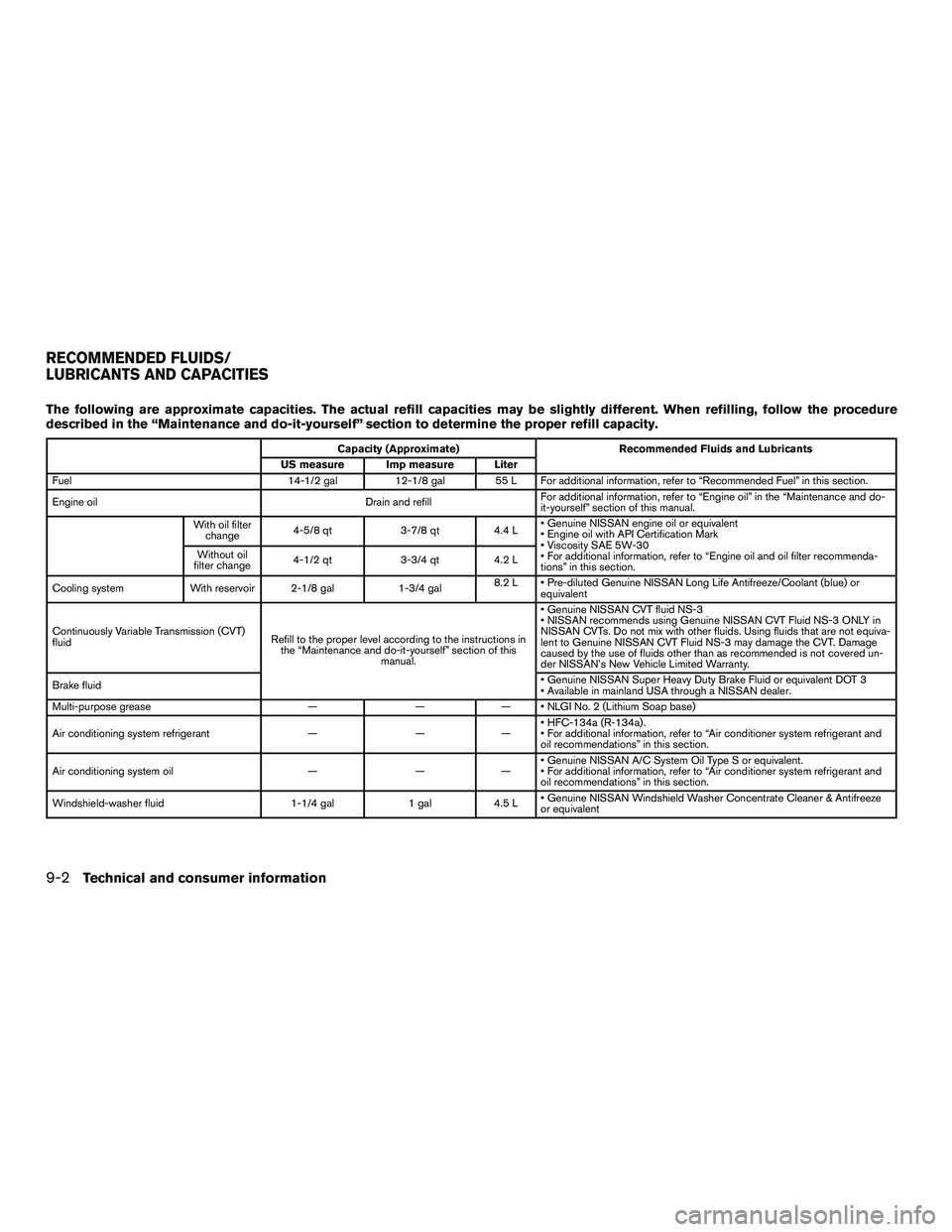
The following are approximate capacities. The actual refill capacities may be slightly different. When refilling, follow the procedure
described in the “Maintenance and do-it-yourself” section to determine the proper refill capacity.
Capacity (Approximate)Recommended Fluids and Lubricants
US measure Imp measure Liter
Fuel 14-1/2 gal12-1/8 gal 55 L For additional information, refer to “Recommended Fuel” in this section.
Engine oil Drain and refillFor additional information, refer to “Engine oil” in the “Maintenance and do-
it-yourself” section of this manual.
With oil filter change 4-5/8 qt
3-7/8 qt4.4 L• Genuine NISSAN engine oil or equivalent
• Engine oil with API Certification Mark
• Viscosity SAE 5W-30
• For additional information, refer to “Engine oil and oil filter recommenda-
tions” in this section.
Without oil
filter change 4-1/2 qt
3-3/4 qt4.2 L
Cooling system With reservoir 2-1/8 gal 1-3/4 gal8.2 L • Pre-diluted Genuine NISSAN Long Life Antifreeze/Coolant (blue) or
equivalent
Continuously Variable Transmission (CVT)
fluid Refill to the proper level according to the instructions in
the “Maintenance and do-it-yourself” section of this manual. • Genuine NISSAN CVT fluid NS-3
• NISSAN recommends using Genuine NISSAN CVT Fluid NS-3 ONLY in
NISSAN CVTs. Do not mix with other fluids. Using fluids that are not equiva-
lent to Genuine NISSAN CVT Fluid NS-3 may damage the CVT. Damage
caused by the use of fluids other than as recommended is not covered un-
der NISSAN’s New Vehicle Limited Warranty.
Brake fluid • Genuine NISSAN Super Heavy Duty Brake Fluid or equivalent DOT 3
• Available in mainland USA through a NISSAN dealer.
Multi-purpose grease ——— • NLGI No. 2 (Lithium Soap base)
Air conditioning system refrigerant ———• HFC-134a (R-134a) .
• For additional information, refer to “Air conditioner system refrigerant and
oil recommendations” in this section.
Air conditioning system oil ———• Genuine NISSAN A/C System Oil Type S or equivalent.
• For additional information, refer to “Air conditioner system refrigerant and
oil recommendations” in this section.
Windshield-washer fluid 1-1/4 gal1 gal4.5 L• Genuine NISSAN Windshield Washer Concentrate Cleaner & Antifreeze
or equivalent
RECOMMENDED FLUIDS/
LUBRICANTS AND CAPACITIES
9-2Technical and consumer information
Page 288 of 312
ENGINE OIL AND OIL FILTER
RECOMMENDATIONS
Selecting the correct oil
It is essential to choose the correct grade, quality
and viscosity engine oil to ensure satisfactory
engine life and performance. For additional infor-
mation, refer to “Recommended fluids/lubricants
and capacities” in this section. NISSAN recom-
mends the use of an energy conserving oil in
order to improve fuel economy.
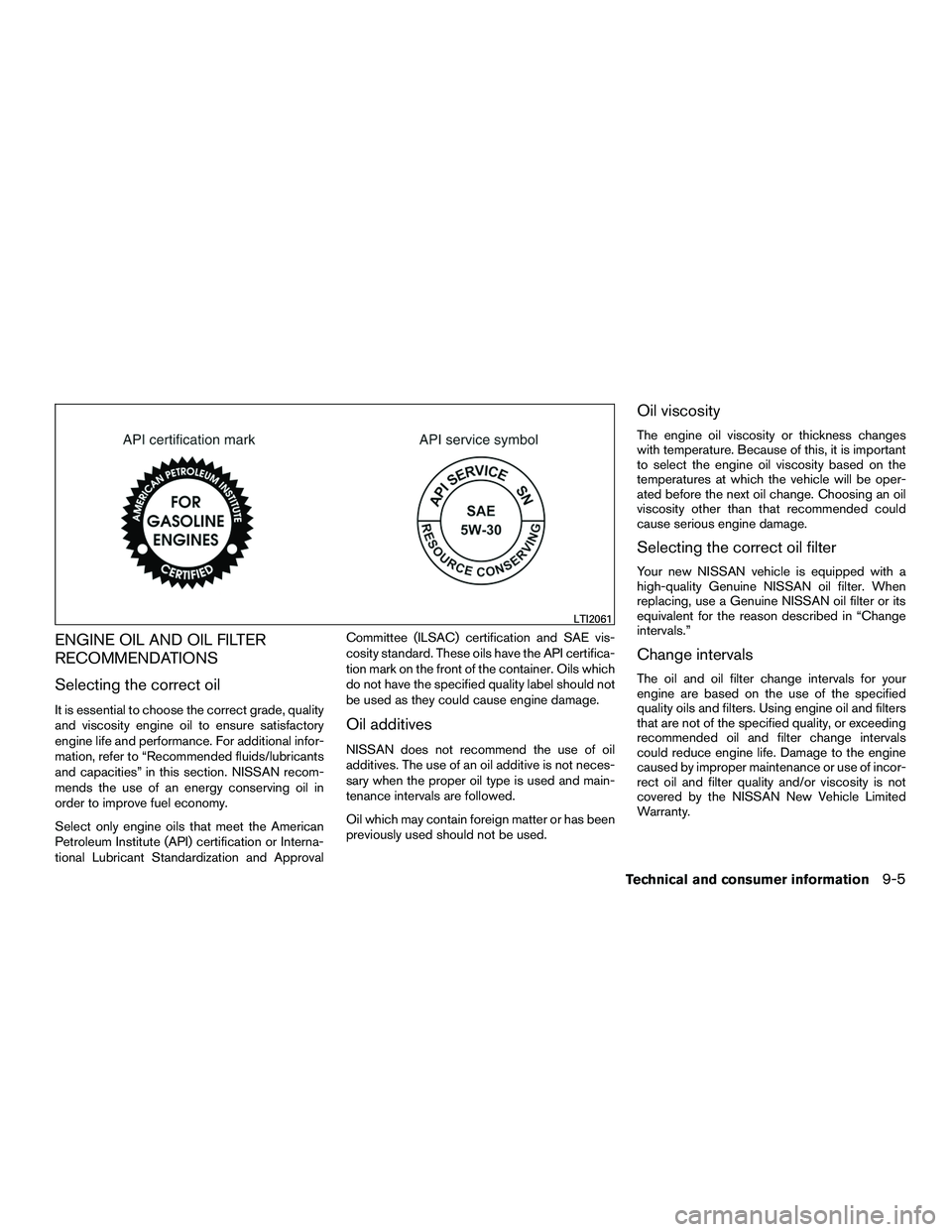
Select only engine oils that meet the American
Petroleum Institute (API) certification or Interna-
tional Lubricant Standardization and ApprovalCommittee (ILSAC) certification and SAE vis-
cosity standard. These oils have the API certifica-
tion mark on the front of the container. Oils which
do not have the specified quality label should not
be used as they could cause engine damage.Oil additives
NISSAN does not recommend the use of oil
additives. The use of an oil additive is not neces-
sary when the proper oil type is used and main-
tenance intervals are followed.
Oil which may contain foreign matter or has been
previously used should not be used.
Oil viscosity
The engine oil viscosity or thickness changes
with temperature. Because of this, it is important
to select the engine oil viscosity based on the
temperatures at which the vehicle will be oper-
ated before the next oil change. Choosing an oil
viscosity other than that recommended could
cause serious engine damage.
Selecting the correct oil filter
Your new NISSAN vehicle is equipped with a
high-quality Genuine NISSAN oil filter. When
replacing, use a Genuine NISSAN oil filter or its
equivalent for the reason described in “Change
intervals.”
Change intervals
The oil and oil filter change intervals for your
engine are based on the use of the specified
quality oils and filters. Using engine oil and filters
that are not of the specified quality, or exceeding
recommended oil and filter change intervals
could reduce engine life. Damage to the engine
caused by improper maintenance or use of incor-
rect oil and filter quality and/or viscosity is not
covered by the NISSAN New Vehicle Limited
Warranty.
LTI2061
Technical and consumer information9-5
Page 289 of 312
Your engine was filled with a high-quality engine
oil when it was built. You do not have to change
the oil before the first recommended change
interval. Oil and filter change intervals depend
upon how you use your vehicle.
Operation under the following conditions may
require more frequent oil and filter changes:● repeated short distance driving at cold out-
side temperatures
● driving in dusty conditions
● extensive idling
● towing a trailer
● stop and go commuting
For additional information, refer to “NISSAN Ser-
vice and Maintenance Guide” for the mainte-
nance schedule.
AIR CONDITIONER SYSTEM
REFRIGERANT AND OIL
RECOMMENDATIONS
The air conditioner system in your NISSAN
vehicle must be charged with the refriger-
ant HFC-134a (R-134a) and NISSAN A/C
system oil Type S or the exact equivalents.
CAUTION
The use of any other refrigerant or oil will
cause severe damage to the air condition-
ing system and will require the replace-
ment of all air conditioner system
components.
The refrigerant HFC-134a (R-134a) in your
NISSAN vehicle does not harm the earth’s ozone
layer. Although this refrigerant does not affect the
earth’s atmosphere, certain government regula-
tions require the recovery and recycling of any
refrigerant during automotive air conditioner sys-
tem service. A NISSAN dealer has the trained
technicians and equipment needed to recover
and recycle your air conditioner system refriger-
ant.
Contact a NISSAN dealer when servicing your air
conditioner system.
9-6Technical and consumer information
Page 298 of 312
5. Determine the combined weight ofluggage and cargo being loaded on
the vehicle. That weight may not
safely exceed the available cargo and
luggage load capacity calculated in
step 4.
6. If your vehicle will be towing a trailer, load from your trailer will be trans-
ferred to your vehicle. Consult this
manual to determine how this re-
duces the available cargo and lug-
gage load capacity of your vehicle.
Before driving a loaded vehicle, confirm
that you do not exceed the GVWR or the
GAWR for your vehicle. For additional
information, refer to “Measurement of
weights” in this section.
Also check tires for proper inflation pres-
sures. For additional information, refer to
the “Tire and Loading Information label” in
the Maintenance and do-it-yourself” sec-
tion of this manual.LOADING TIPS
● The GVW must not exceed GVWR
or GAWR as specified on the F.M-
.V.S.S. certification label.
● Do not load the front and rear axle to
the GAWR. Doing so will exceed the
GVWR.
WARNING
● Properly secure all cargo with
ropes or straps to help prevent it
from sliding or shifting. Do not
place cargo higher than the seat-
backs. In a sudden stop or colli-
sion, unsecured cargo could
cause personal injury.
● Do not load your vehicle any
heavier than the GVWR or the
maximum front and rear GAWRs.
If you do, parts of your vehicle can
break, tire damage could occur,
or it can change the way your
vehicle handles. This could result
in loss of control and cause per-
sonal injury. ●
Overloading and improper load-
ing not only can shorten the life
of your vehicle and the tire, but
can also cause unsafe vehicle
handling and longer braking dis-
tances. This may cause a prema-
ture tire failure which could result
in a serious accident and per-
sonal injury. Failures caused by
overloading are not covered by
the vehicle’s warranty.
MEASUREMENT OF WEIGHTS
Secure loose items to prevent weight
shifts that could affect the balance of your
vehicle. When the vehicle is loaded, drive
to a scale and weigh the front and the rear
wheels separately to determine axle
loads. Individual axle loads should not ex-
ceed either of the gross axle weight rat-
ings (GAWR) . The total of the axle loads
should not exceed the gross vehicle
weight rating (GVWR) . These ratings are
given on the vehicle certification label. If
weight ratings are exceeded, move or re-
move items to bring all weights below the
ratings.
Technical and consumer information9-15
Page 301 of 312
If you believe that your vehicle has a de-
fect which could cause a crash or could
cause injury or death, you should immedi-
ately inform the National Highway Traffic
Safety Administration (NHTSA) in addi-
tion to notifying NISSAN.
If NHTSA receives similar complaints, it
may open an investigation, and if it finds
that a safety defect exists in a group of
vehicles, it may order a recall and remedy
campaign. However, NHTSA cannot be-
come involved in individual problems be-
tween you, your dealer, or NISSAN.
To contact NHTSA, you may call the Ve-
hicle Safety Hotline toll-free at 1-888-
327-4236 (TTY: 1-800-424-9153); go
to http://www.safercar.gov; or write to:
Administrator, NHTSA, 400 Seventh
Street, SW., Washington, D.C. 20590.
You can also obtain other information
about motor vehicle safety from
http://www.safercar.gov.
You may notify NISSAN by contacting our
Consumer Affairs Department, toll-free, at
1-877-NIS-NCV1 (1-877-647-6281) .Due to legal requirements in some states, your
vehicle may be required to be in what is called the
“ready condition” for an Inspection/Maintenance
(I/M) test of the emission control system.
The vehicle is set to the “ready condition” when it
is driven through certain driving patterns. Usually,
the ready condition can be obtained by ordinary
usage of the vehicle.
If a powertrain system component is repaired or
the battery is disconnected, the vehicle may be
reset to a “not ready” condition. Before taking the
I/M test, check the vehicle’s
inspection/maintenance test readiness condi-
tion. Place the ignition switch in the ON position
without starting the engine. If the Malfunction
Indicator Light (MIL) comes on steady for 20 sec-
onds and then blinks for 10 seconds , the I/M test
condition is “not ready”. If the MIL does not blink
after 20 seconds, the I/M test condition is
“ready”. Contact a NISSAN dealer to set the
“ready condition” or to prepare the vehicle for
testing.This vehicle is equipped with an Event Data Re-
corder (EDR) . The main purpose of an EDR is to
record, in certain crash or near crash-like situa-
tions, such as an air bag deployment or hitting a
road obstacle, data that will assist in understand-
ing how a vehicle’s systems performed. The EDR
is designed to record data related to vehicle
dynamics and safety systems for a short period of
time, typically 30 seconds or less. The EDR in this
vehicle is designed to record such data as:
● How various systems in your vehicle were
operating;
● Whether or not the driver and passenger
safety belts were buckled/fastened;
● How far (if at all) the driver was depressing
the accelerator and/or brake pedal; and,
● How fast the vehicle was traveling.
● Sounds are not recorded.
REPORTING SAFETY DEFECTS READINESS FOR INSPECTION/
MAINTENANCE (I/M) TESTEVENT DATA RECORDERS (EDR)
9-18Technical and consumer information
Page 305 of 312

Clock setting
(models with Navigation System).....4-5,4-32
Cold weather driving ...............5-25
Compact disc (CD) player ...........4-35
Connect phone .................4-45
Continuously Variable Transmission (CVT) . . .5-10 Continuously Variable Transmission (CVT)
fluid ......................8-12
Driving with Continuously Variable
Transmission (CVT) .............5-10
Control panel buttons ...............4-2
Brightness/contrast button ..........4-7
Enterbutton..................4-2
Setting button .................4-5
Controls Audiocontrols(steeringwheel).......4-44
Rear seat air conditioner ..........4-21
Coolant Capacities and recommended
fuel/lubricants .................9-2
Changing engine coolant ...........8-8
Checking engine coolant level ........8-8
Corrosionprotection ...............7-5
Cruisecontrol..................5-15
Cupholders...................2-24
D
Defroster switch Rear window and outside mirror defroster
switch.....................2-19
Dimensionsandweights.............9-8
Dimmer switch for instrument panel ......2-20
Display controls (see control panel buttons) . .4-2
Door locks .....................3-3 Door open warning light
.............2-11
Doors ........................3-3
Drive belt .....................8-16
Driving Cold weather driving .............5-25
Driving with Continuously Variable
Transmission (CVT) .............5-10
Precautions when starting and driving ....5-2
Driving the vehicle ................5-10
E
Economy - fuel ..................5-18
Emission control information label .......9-11
Emission control system warranty .......9-17
Engine Before starting the engine ..........5-9
Capacities and recommended
fuel/lubricants .................9-2
Changingenginecoolant...........8-8
Changingengineoil.............8-10
Changing engine oil filter ..........8-11
Checking engine coolant level ........8-8
Checking engine oil level ...........8-9
Engine compartment check locations ....8-6
Engine cooling system ............8-7
Engineoil ...................8-9
Engine oil and oil filter recommendation . . .9-5
Engine oil pressure warning light ......2-11
Engine oil viscosity ..............9-5
Engine serial number ............9-10
Engine specifications .............9-7
Starting the engine ..............5-9
Enterbutton....................4-2
EventDatarecorders..............9-18 Exhaust gas (Carbon monoxide)
.........5-2
Explanation of maintenance items ........8-2
Extended storage switch ............8-22
F
Flashers (See hazard warning flasher switch) . .6-2
Flat tire .......................6-2
Floor mat positioning aid .............7-5
Fluid Brake fluid ..................8-12
Capacities
and recommended
fuel/lubricants.................9-2
Continuously Variable Transmission (CVT)
fluid......................8-12
Enginecoolant.................8-7
Engineoil ...................8-9
Windshield-washer fluid ...........8-13
F.M.V.S.S. certification label ...........9-10
Front air bag system
(See supplemental restraint system) ......1-48
Frontseats.....................1-2
Fuel Capacities and recommended
fuel/lubricants.................9-2
Fuel economy ................5-18
Fuel-filler cap .................3-14
Fuel-filler door lock opener lever ......3-14
Fuel-filler lid .................3-14
Fuelgauge...................2-6
Fuel octane rating ...............9-4
Loose fuel cap warning ............2-5
Fuel Cell Vehicle (FCV) System Tire pressure .................8-33
Fuel-filler door ..................3-14
10-2