Page 259 of 312
Under some driving or climate conditions, occa-
sional brake squeak, squeal or other noise may
be heard. Occasional brake noise during light to
moderate stops is normal and does not affect the
function or performance of the brake system.
Proper brake inspection intervals should
be followed.For additional information regard-
ing brake inspections, refer to the appropriate
maintenance schedule information in the
“NISSAN Service and Maintenance Guide”.
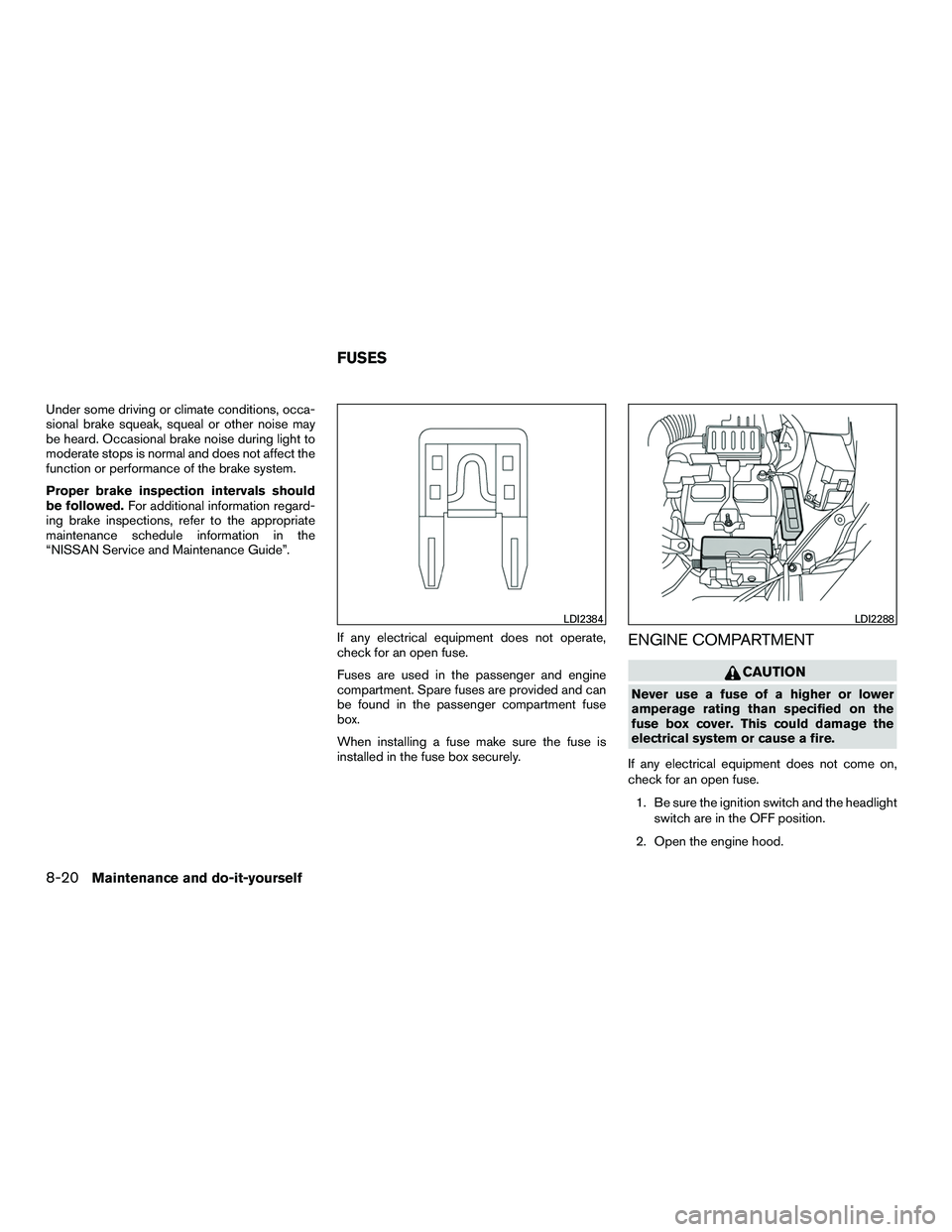
If any electrical equipment does not operate,
check for an open fuse.
Fuses are used in the passenger and engine
compartment. Spare fuses are provided and can
be found in the passenger compartment fuse
box.
When installing a fuse make sure the fuse is
installed in the fuse box securely.
ENGINE COMPARTMENT
CAUTION
Never use a fuse of a higher or lower
amperage rating than specified on the
fuse box cover. This could damage the
electrical system or cause a fire.
If any electrical equipment does not come on,
check for an open fuse. 1. Be sure the ignition switch and the headlight switch are in the OFF position.
2. Open the engine hood.
LDI2384LDI2288
FUSES
8-20Maintenance and do-it-yourself
Page 260 of 312
3. Remove the fuse box cover by pushing thetab and lifting the cover up.
4. Remove the fuse with the fuse puller. The fuse puller is located in the center of the fuse
block in the passenger compartment.
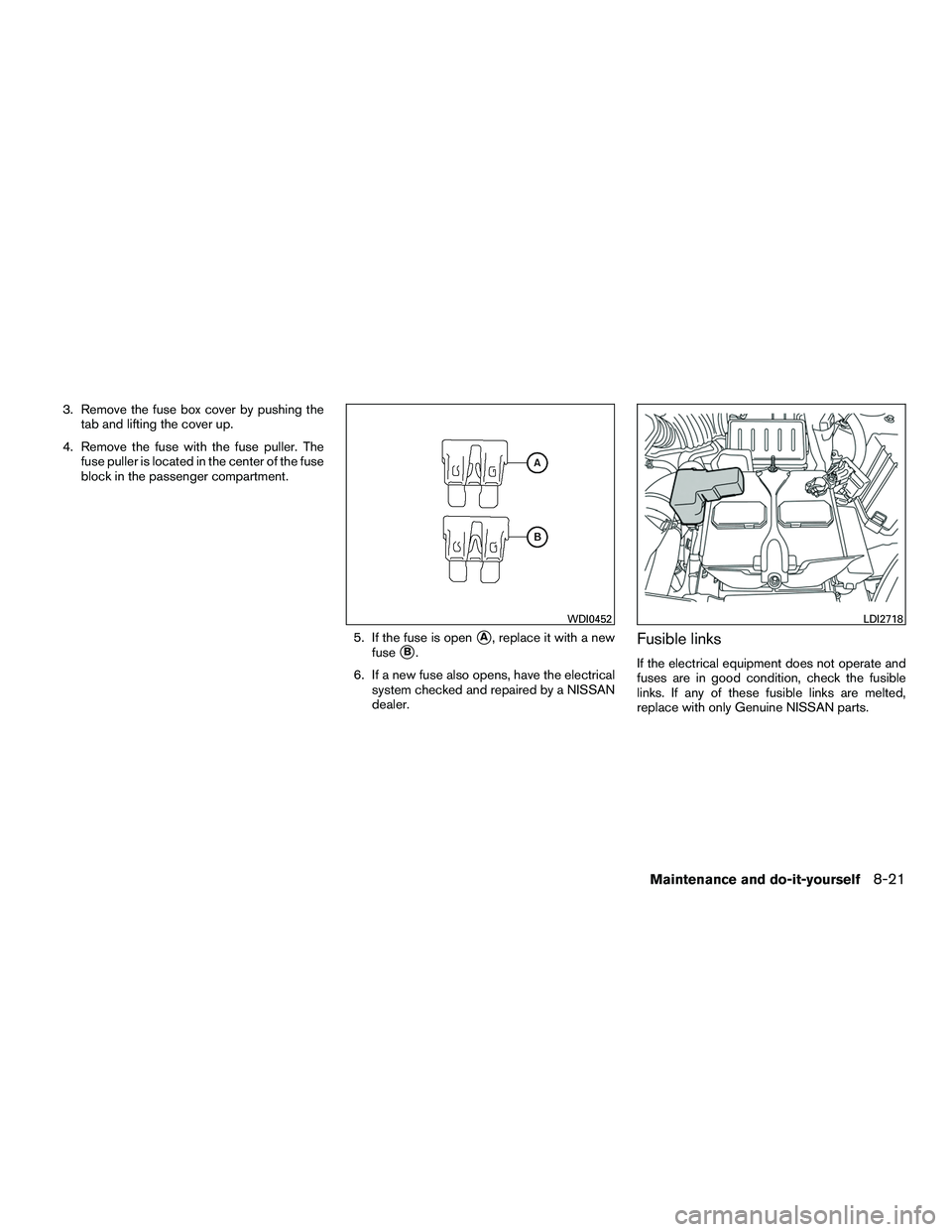
5. If the fuse is open
�A, replace it with a new
fuse
�B.
6. If a new fuse also opens, have the electrical system checked and repaired by a NISSAN
dealer.Fusible links
If the electrical equipment does not operate and
fuses are in good condition, check the fusible
links. If any of these fusible links are melted,
replace with only Genuine NISSAN parts.
WDI0452LDI2718
Maintenance and do-it-yourself8-21
Page 261 of 312
PASSENGER COMPARTMENT
CAUTION
Never use a fuse of a higher or lower
amperage rating than specified on the
fuse box cover. This could damage the
electrical system or cause a fire.
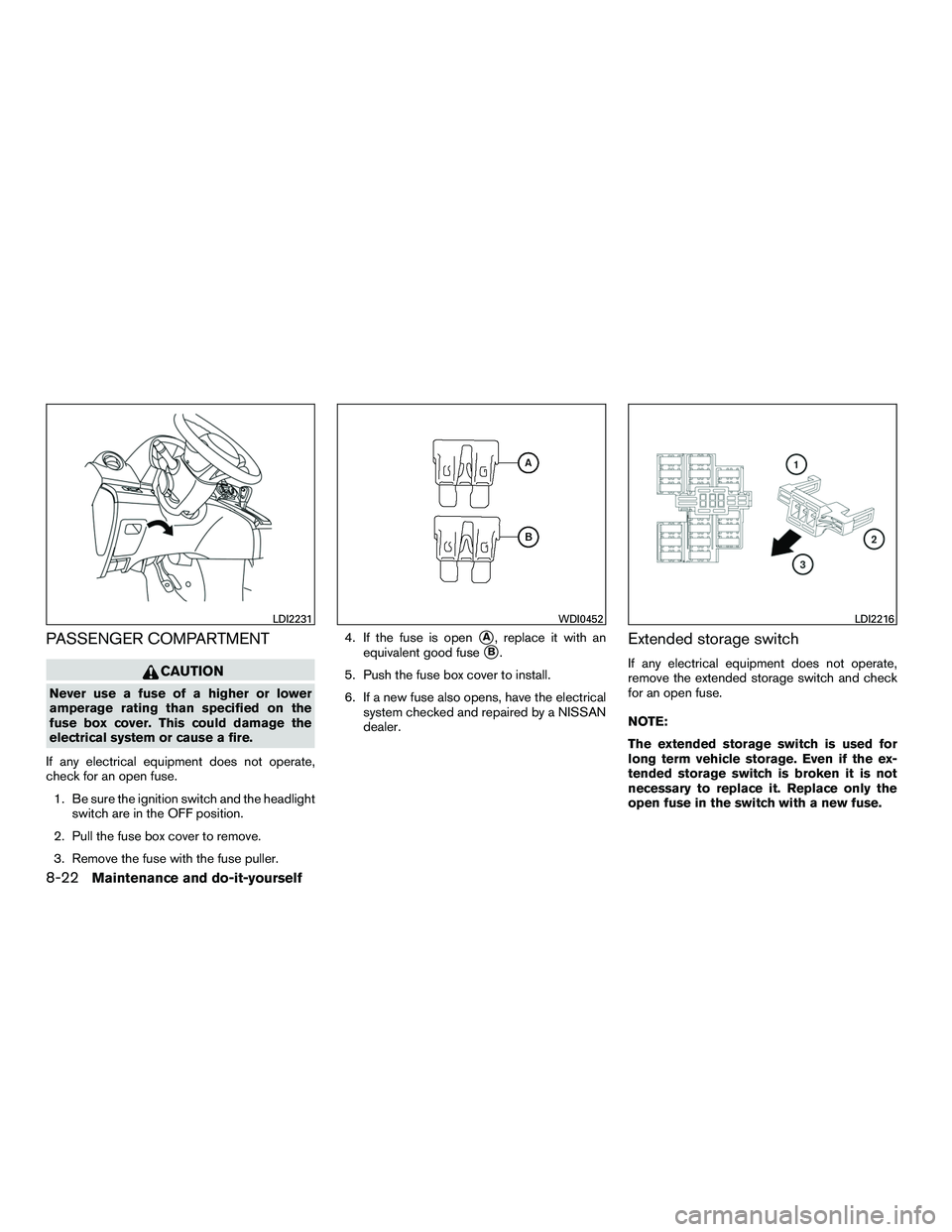
If any electrical equipment does not operate,
check for an open fuse. 1. Be sure the ignition switch and the headlight switch are in the OFF position.
2. Pull the fuse box cover to remove.
3. Remove the fuse with the fuse puller. 4. If the fuse is open
�A, replace it with an
equivalent good fuse
�B.
5. Push the fuse box cover to install.
6. If a new fuse also opens, have the electrical system checked and repaired by a NISSAN
dealer.Extended storage switch
If any electrical equipment does not operate,
remove the extended storage switch and check
for an open fuse.
NOTE:
The extended storage switch is used for
long term vehicle storage. Even if the ex-
tended storage switch is broken it is not
necessary to replace it. Replace only the
open fuse in the switch with a new fuse.
LDI2231WDI0452LDI2216
8-22Maintenance and do-it-yourself
Page 262 of 312
How to replace the extended storage switch:1. To remove the extended storage switch, be sure the ignition switch is in the OFF or
LOCK position.
2. Be sure the headlight switch is in the OFF position.
3. Remove the fuse box cover.
4. Pinch the locking tabs
�1and�2found on
each side of the storage switch.
5. Pull the storage switch straight out from the fuse box
�3.
CAUTION
Be careful not to allow children to swallow
the battery or removed parts.
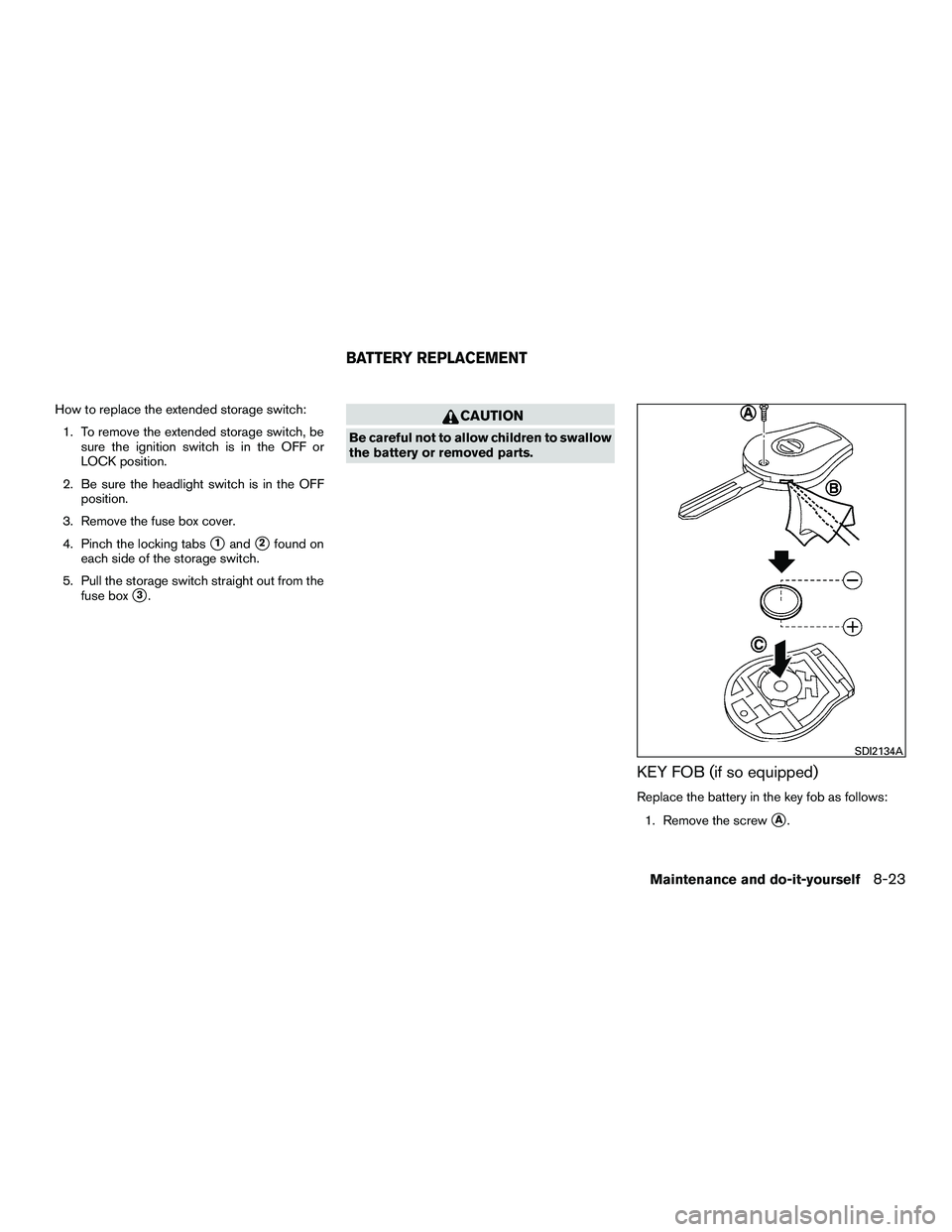
KEY FOB (if so equipped)
Replace the battery in the key fob as follows:
1. Remove the screw
�A.
SDI2134A
BATTERY REPLACEMENT
Maintenance and do-it-yourself8-23
Page 263 of 312
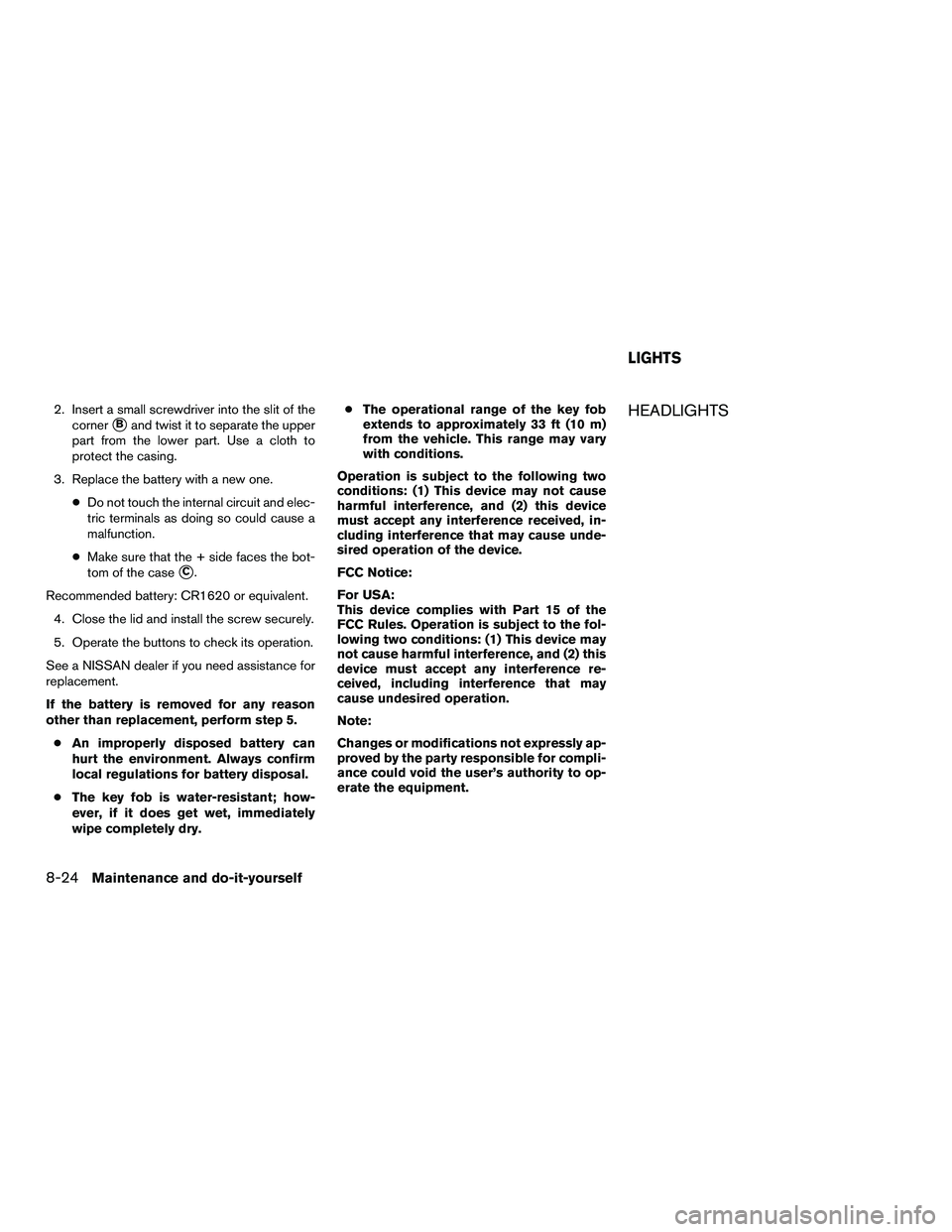
2. Insert a small screwdriver into the slit of thecorner
�Band twist it to separate the upper
part from the lower part. Use a cloth to
protect the casing.
3. Replace the battery with a new one. ●Do not touch the internal circuit and elec-
tric terminals as doing so could cause a
malfunction.
● Make sure that the + side faces the bot-
tom of the case
�C.
Recommended battery: CR1620 or equivalent. 4. Close the lid and install the screw securely.
5. Operate the buttons to check its operation.
See a NISSAN dealer if you need assistance for
replacement.
If the battery is removed for any reason
other than replacement, perform step 5. ● An improperly disposed battery can
hurt the environment. Always confirm
local regulations for battery disposal.
● The key fob is water-resistant; how-
ever, if it does get wet, immediately
wipe completely dry. ●
The operational range of the key fob
extends to approximately 33 ft (10 m)
from the vehicle. This range may vary
with conditions.
Operation is subject to the following two
conditions: (1) This device may not cause
harmful interference, and (2) this device
must accept any interference received, in-
cluding interference that may cause unde-
sired operation of the device.
FCC Notice:
For USA:
This device complies with Part 15 of the
FCC Rules. Operation is subject to the fol-
lowing two conditions: (1) This device may
not cause harmful interference, and (2) this
device must accept any interference re-
ceived, including interference that may
cause undesired operation.
Note:
Changes or modifications not expressly ap-
proved by the party responsible for compli-
ance could void the user’s authority to op-
erate the equipment.
HEADLIGHTS
LIGHTS
8-24Maintenance and do-it-yourself
Page 264 of 312
Replacing the halogen headlight bulb
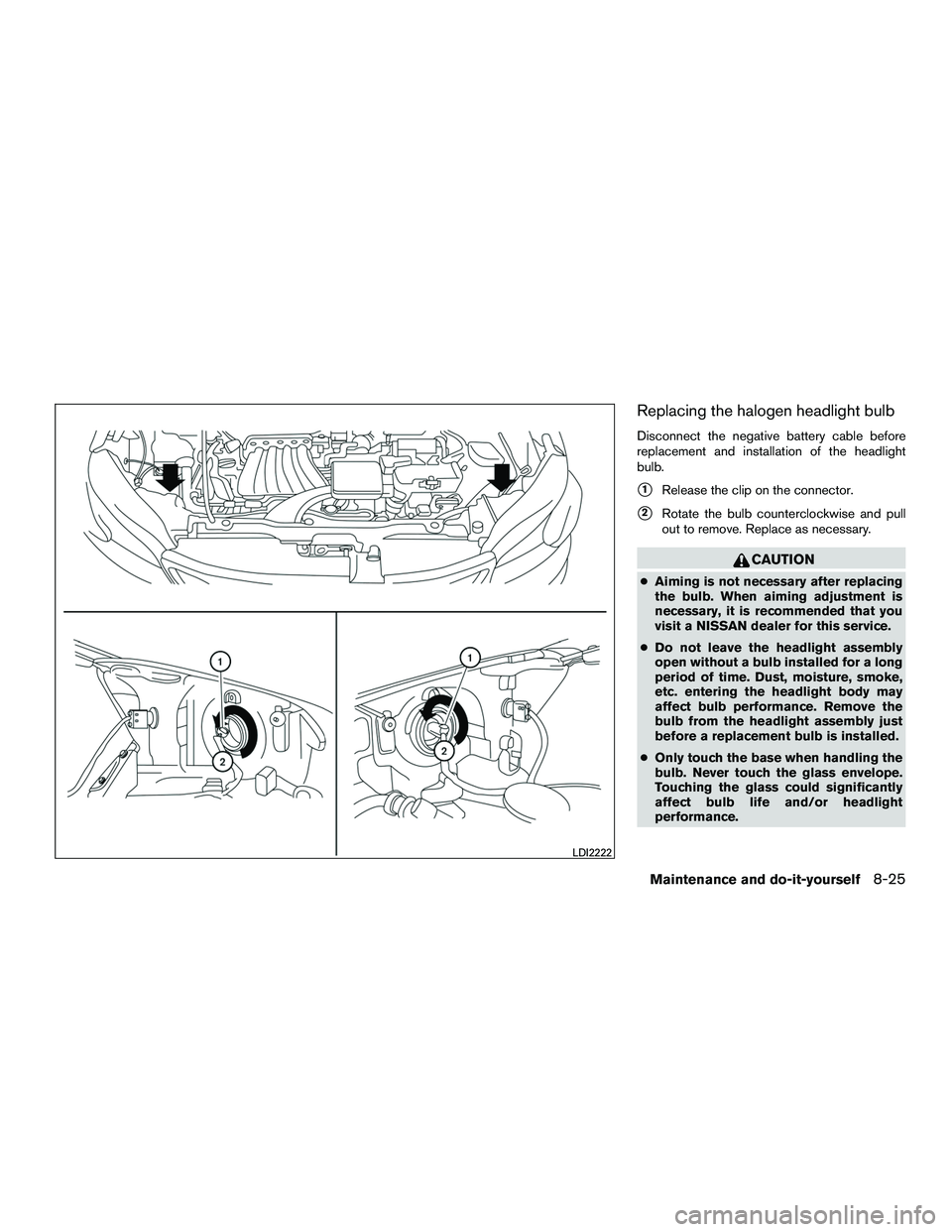
Disconnect the negative battery cable before
replacement and installation of the headlight
bulb.
�1Release the clip on the connector.
�2Rotate the bulb counterclockwise and pull
out to remove. Replace as necessary.
CAUTION
● Aiming is not necessary after replacing
the bulb. When aiming adjustment is
necessary, it is recommended that you
visit a NISSAN dealer for this service.
● Do not leave the headlight assembly
open without a bulb installed for a long
period of time. Dust, moisture, smoke,
etc. entering the headlight body may
affect bulb performance. Remove the
bulb from the headlight assembly just
before a replacement bulb is installed.
● Only touch the base when handling the
bulb. Never touch the glass envelope.
Touching the glass could significantly
affect bulb life and/or headlight
performance.
LDI2222
Maintenance and do-it-yourself8-25
Page 265 of 312
●High pressure halogen gas is sealed
inside the halogen bulb. The bulb may
break if the glass envelope is scratched
or the bulb is dropped.
● Use the same number and wattage as
shown in the chart.
Fog may temporarily form inside the lens of the
exterior lights in the rain or in a car wash. A
temperature difference between the inside and
the outside of the lens causes the fog. This is not
a malfunction. If large drops of water collect
inside the lens, it is recommended that you visit a
NISSAN dealer for this service.
Aiming the headlights
The headlights on your vehicle are properly aimed
at the assembly plant. If your vehicle has been in
a collision, the alignment of your headlights
should be checked by a NISSAN dealer. Vertical aim adjustment
NOTE:
Due to a maximum load condition of the
vehicle, headlight aiming adjustment may
be necessary. Please perform the following
procedure:
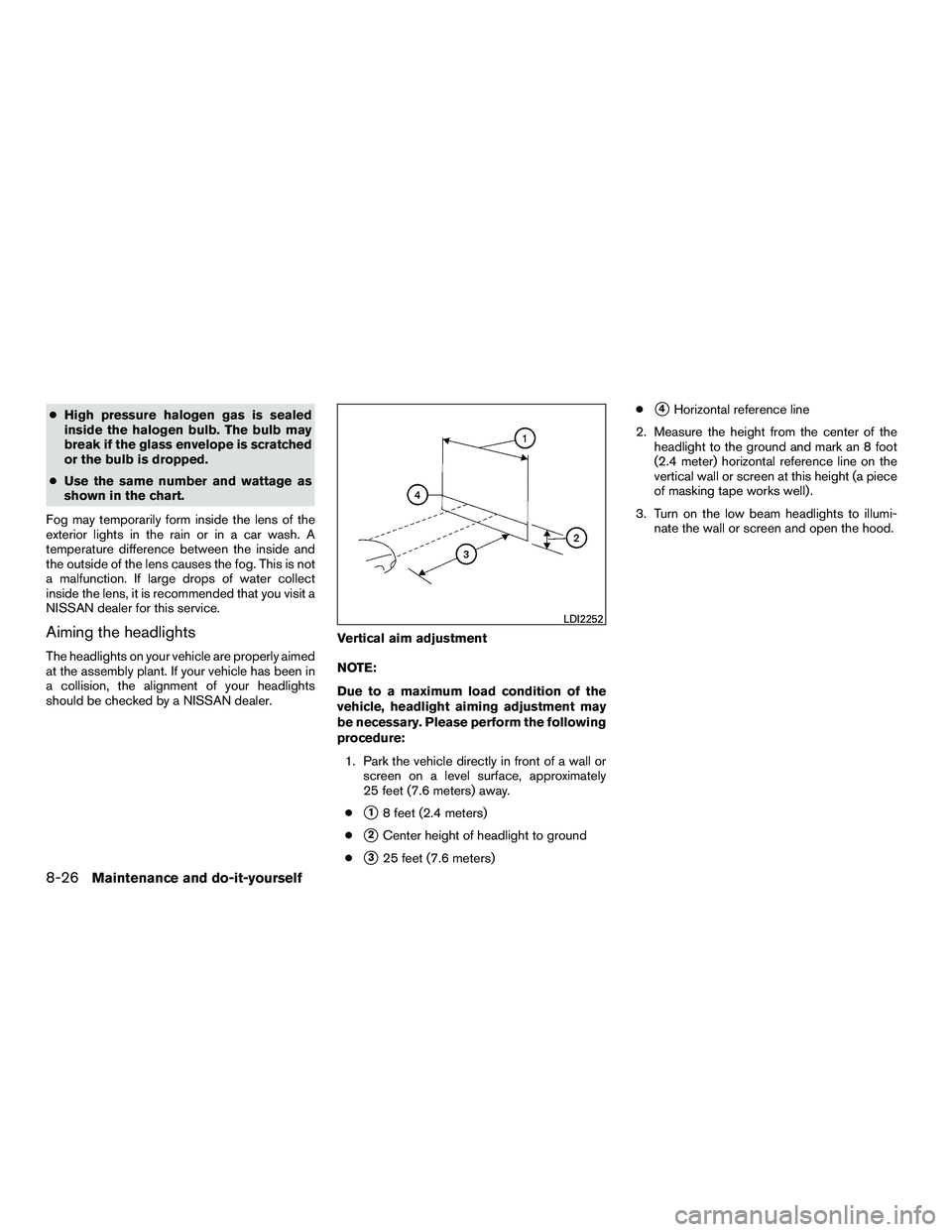
1. Park the vehicle directly in front of a wall or screen on a level surface, approximately
25 feet (7.6 meters) away.
●
�18 feet (2.4 meters)
●
�2Center height of headlight to ground
●
�325 feet (7.6 meters) ●
�4Horizontal reference line
2. Measure the height from the center of the headlight to the ground and mark an 8 foot
(2.4 meter) horizontal reference line on the
vertical wall or screen at this height (a piece
of masking tape works well) .
3. Turn on the low beam headlights to illumi- nate the wall or screen and open the hood.
LDI2252
8-26Maintenance and do-it-yourself
Page 266 of 312
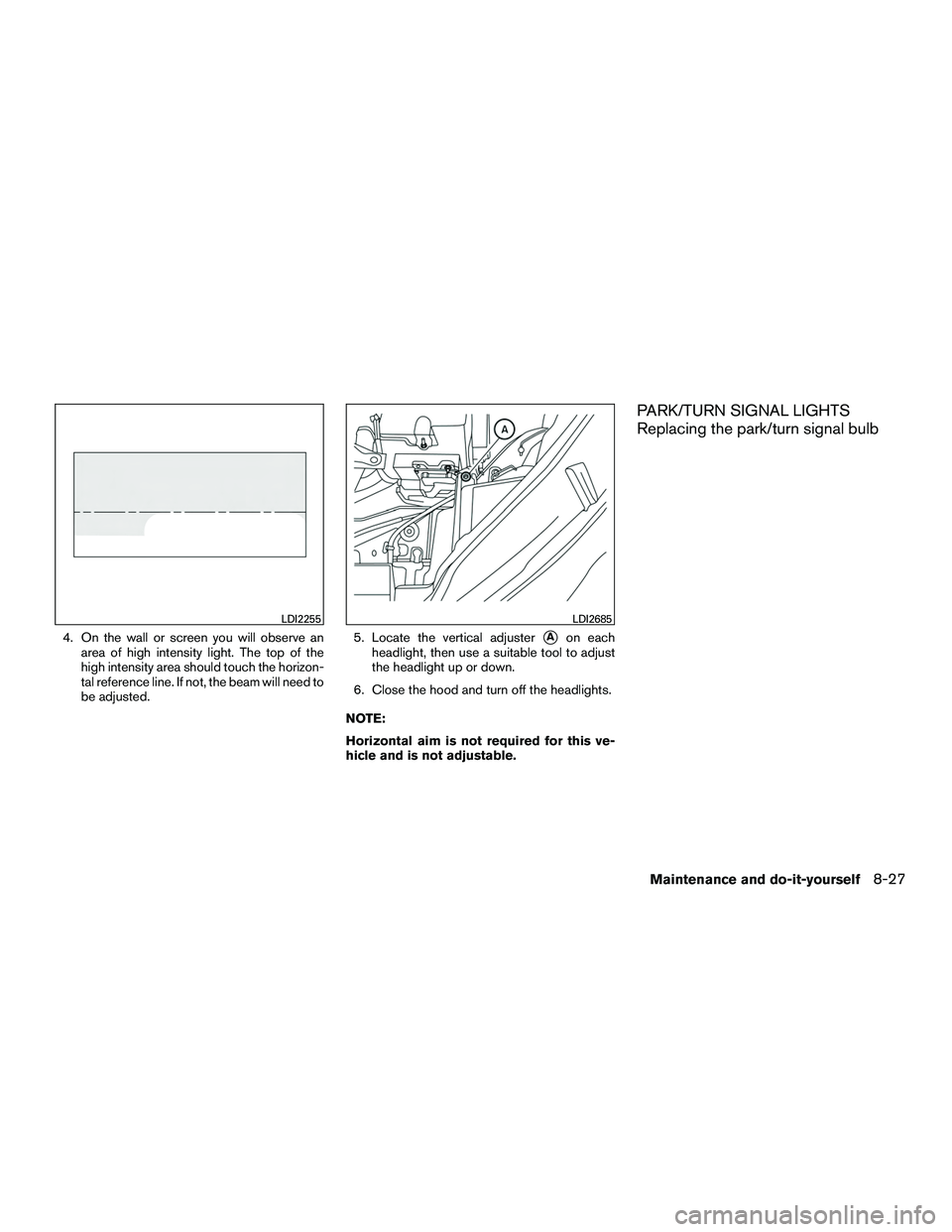
4. On the wall or screen you will observe anarea of high intensity light. The top of the
high intensity area should touch the horizon-
tal reference line. If not, the beam will need to
be adjusted. 5. Locate the vertical adjuster�Aon each
headlight, then use a suitable tool to adjust
the headlight up or down.
6. Close the hood and turn off the headlights.
NOTE:
Horizontal aim is not required for this ve-
hicle and is not adjustable.
PARK/TURN SIGNAL LIGHTS
Replacing the park/turn signal bulb
LDI2255LDI2685
Maintenance and do-it-yourself8-27