Page 308 of 380
2. Start the engine and let it idle until it reachesoperating temperature, then turn it off.
3. Remove the oil filler cap
�Aby turning it
counterclockwise.
4. Place a large drain pan under the drain plug
�B.
5. Remove the drain plug
�Bwith a wrench by
turning it counterclockwise and completely
drain the oil.
If the oil filter is to be changed, remove and
replace it at this time. For additional informa-
tion, refer to “Changing engine oil filter” in
this section.
● Waste oil must be disposed of prop-
erly.
● Check your local regulations.
WARNING
●Prolonged and repeated contact with
used engine oil may cause skin cancer.
● Try to avoid direct skin contact with
used oil. If skin contact is made, wash
thoroughly with soap or hand cleaner as
soon as possible.
● Keep used engine oil out of reach of
children.
CAUTION
Be careful not to burn yourself. The engine
oil may be hot.
6. Clean and reinstall the drain plug and a new washer. Securely tighten the drain plug with
a wrench. Do not use excessive force.
Drain plug tightening torque: 25 ft-lb (34 N·m)
7. Refill engine with recommended oil through the oil filler opening, then install the oil filler
cap securely.
For additional information, refer to “Recom-
mended fluids/lubricants and capacities” in
the “Technical and consumer information”
section of this manual for drain and refill
capacity.
The drain and refill capacity depends on the
oil temperature and drain time. Use these
specifications for reference only. Always use
the dipstick to determine when the proper
amount of oil is in the engine.
8. Start the engine. Check for leakage around the drain plug and oil filter. Correct as re-
quired. 9. Turn the engine off and wait more than
10 minutes. Check the oil level with the
dipstick. Add engine oil if necessary.
Maintenance and do-it-yourself8-13
Page 340 of 380
9 Technical and consumer information
Recommended fluids/lubricants and capacities.......9-2
Fuel recommendation ...........................9-4
Engine oil and oil filter recommendations ..........9-6
Air conditioner system refrigerant and oil
recommendations ..............................9-7
Specifications .....................................9-8
Engine ........................................9-8
Wheels and tires ...............................9-9
Dimensions and weights ........................9-9
When traveling or registering in another country ......9-10
Vehicle identification .............................. 9-10
Vehicle identification number (VIN) plate .........9-10
Vehicle identification number
(chassis number) .............................. 9-10
Engine serial number ........................... 9-11
F.M.V.S.S./C.M.V.S.S. certification label ..........9-11
Emission control information label ...............9-12
Tire and loading information label ................9-12Air conditioner specification label
................9-12
Installing front license plate ........................9-13
Vehicle loading information ........................9-13
Terms ........................................ 9-13
Vehicle load capacity .......................... 9-14
Loading tips .................................. 9-16
Measurement of weights .......................9-16
Towing a trailer ................................... 9-17
Maximum load limits ........................... 9-17
Towing load/specification .......................9-20
Towing safety ................................. 9-21
Flat towing for rear wheel drive vehicle ...........9-28
Uniform tire quality grading ........................9-28
Emission control system warranty ..................9-29
Reporting safety defects .......................... 9-30
Readiness for inspection/maintenance (I/M) test .....9-31
Event Data Recorders (EDR) .......................9-31
Owner’s Manual/Service Manual order information . . . 9-32
Page 341 of 380
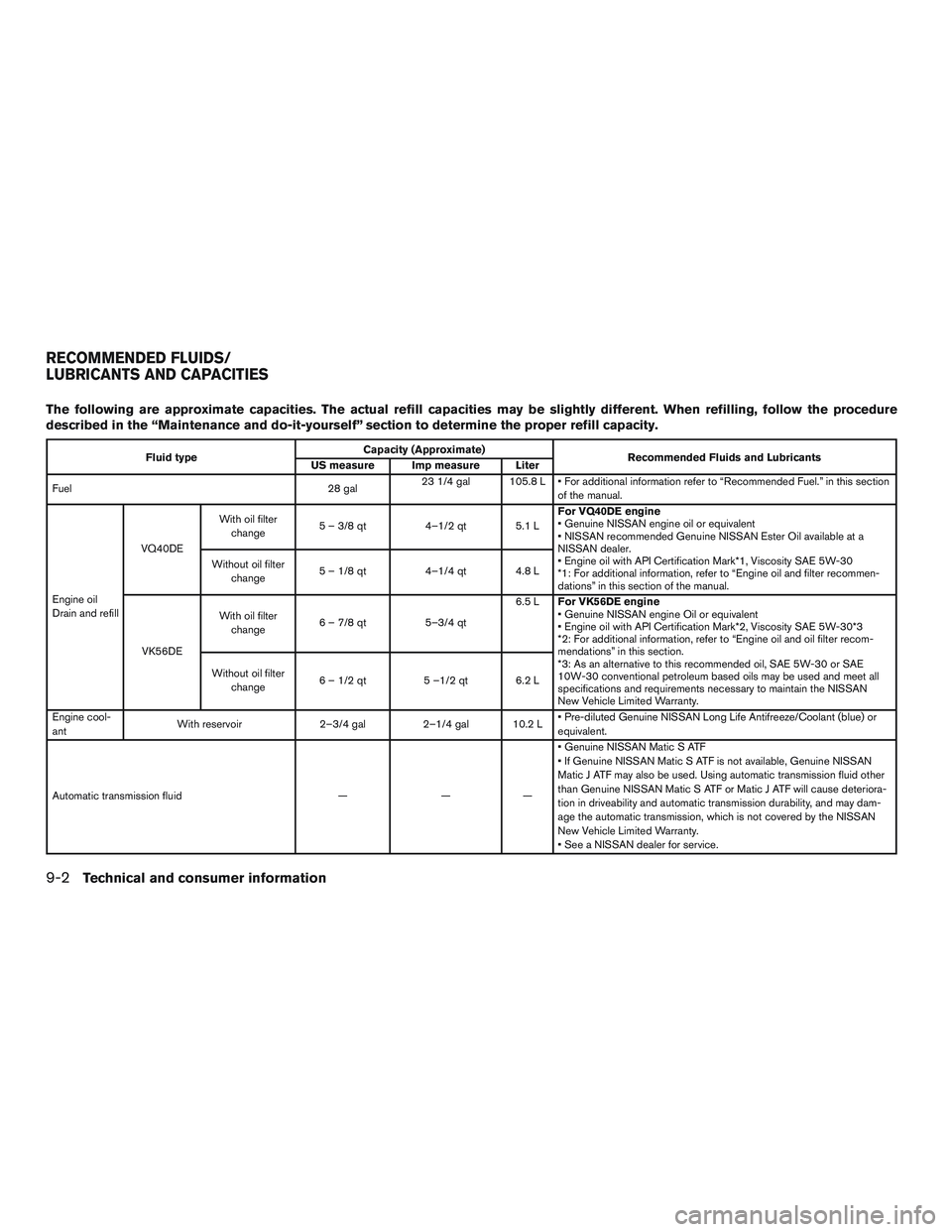
The following are approximate capacities. The actual refill capacities may be slightly different. When refilling, follow the procedure
described in the “Maintenance and do-it-yourself” section to determine the proper refill capacity.
Fluid typeCapacity (Approximate)
Recommended Fluids and Lubricants
US measure Imp measure Liter
Fuel 28 gal23 1/4 gal 105.8 L • For additional information refer to “Recommended Fuel.” in this section
of the manual.
Engine oil
Drain and refill VQ40DE
With oil filter
change 5 – 3/8 qt
4–1/2 qt 5.1 L For VQ40DE engine
• Genuine NISSAN engine oil or equivalent
• NISSAN recommended Genuine NISSAN Ester Oil available at a
NISSAN dealer.
• Engine oil with API Certification Mark*1, Viscosity SAE 5W-30
*1: For additional information, refer to “Engine oil and filter recommen-
dations” in this section of the manual.
Without oil filter
change 5 – 1/8 qt
4–1/4 qt 4.8 L
VK56DE With oil filter
change 6 – 7/8 qt
5–3/4 qt6.5 L
For VK56DE engine
• Genuine NISSAN engine Oil or equivalent
• Engine oil with API Certification Mark*2, Viscosity SAE 5W-30*3
*2: For additional information, refer to “Engine oil and oil filter recom-
mendations” in this section.
*3: As an alternative to this recommended oil, SAE 5W-30 or SAE
10W-30 conventional petroleum based oils may be used and meet all
specifications and requirements necessary to maintain the NISSAN
New Vehicle Limited Warranty.
Without oil filter
change 6–1/2qt
5–1/2qt 6.2L
Engine cool-
ant With reservoir
2–3/4 gal2–1/4 gal 10.2 L • Pre-diluted Genuine NISSAN Long Life Antifreeze/Coolant (blue) or
equivalent.
Automatic transmission fluid ———• Genuine NISSAN Matic S ATF
• If Genuine NISSAN Matic S ATF is not available, Genuine NISSAN
Matic J ATF may also be used. Using automatic transmission fluid other
than Genuine NISSAN Matic S ATF or Matic J ATF will cause deteriora-
tion in driveability and automatic transmission durability, and may dam-
age the automatic transmission, which is not covered by the NISSAN
New Vehicle Limited Warranty.
• See a NISSAN dealer for service.
RECOMMENDED FLUIDS/
LUBRICANTS AND CAPACITIES
9-2Technical and consumer information