2016 MITSUBISHI OUTLANDER check engine
[x] Cancel search: check enginePage 88 of 464

Free-hand Advanced
Security Transmitter (F.A.S
.T.-key) (if so equipped)
5-12 Features and controls
5
N00544100064
1. Before replacing the
battery, remove static
electricity from your body by touching a metal grounded object. 2. With the Mitsubishi mark facing you,insert the cloth-cov-ered tip of a flat blade screwdriver into the notch in the remote control transmitter case and use it to open the case.
3. Remove the remote control transmitter from the remote control transmitter case.Then, open the remote control transmitter using the method described in step 1. 4. Remove the old battery. 5. Install a new battery with the +side (A) down. 6. Close the remote control transmitter firmly.
7. Place the remote control transmitter in the remote control transmitter case, thensecurely close the remote control trans- mitter case. 8. Check the keyless entry system to see thatit works.
N00503101121
The Free-hand Advanced Security Transmit-ter (F.A.S.T.-key) enables the doors and the liftgate to be locked and unlocked, the engine to be started and the operation mode to bechanged simply by carrying it.
Procedure for replacing the remote control transmitter bat-tery
NOTE
Be sure to perform the procedure with the Mitsubishi mark faci
ng you. If the Mitsubi-
shi mark is not facing you when you open the remote control transm
itter case, the buttons
may come out.
+ side - side
Coin type bat- tery CR1620
NOTE
You may purchase a replacement battery at an electric appliance store. An authorized Mitsubishi Motors dealer can replace the battery for you if you prefer.CAUTION When the remote control transmitter case is opened, be careful to
keep water, dust, etc.
out. Also, do not touch the internal compo- nents.
Free-hand Advanced Secu- rity Transmitter (F.A.S.T.-key)
(if so equipped)
BK0223400US.book 12 ページ 2015年2月13日 金曜日 午後12時15分
Page 89 of 464
Free-hand Advanced Securi
ty Transmitter (F.A.S.T.-key) (if so equipped)
Features and controls 5-13
5
The F.A.S.T.-key can also be used as the remote control transmitter of the keylessentry system. Refer to “Free-hand
Advanced Security
Transmitter (F.A.S.T.-key): Keyless entrysystem” on page 5-29.
The operations possible with the F.A.S.T.- key can be modified as stated below.(Keyless entry operations are possible.) For details, contact an
authorized Mitsubi-
shi Motors dealer.• Enabling only the locking and unlocking of the doors and the liftgate • Enabling only the starting of the engine• Deactivating the F.A.S.T.-key
The F.A.S.T.-key must be carried by the driver. The F.A.S.T.-key is required for vehicle operations su
ch as locking and
unlocking the doors and the liftgate, starting the engine
and changing the
operation mode. When
leaving the vehi-
cle, make sure you are carrying the F.A.S.T.-key and then lock the vehicle.
WA R N I N G Individuals who use
implantable pace-
makers or implanta
ble cardiovascular-
defibrillators
should keep away from the
external and internal
transmitters. The
electromagnetic w
aves used in the
F.A.S.T.-key may affect the operation ofimplantable pacemakers and implantable cardiovascular-defibrillators.
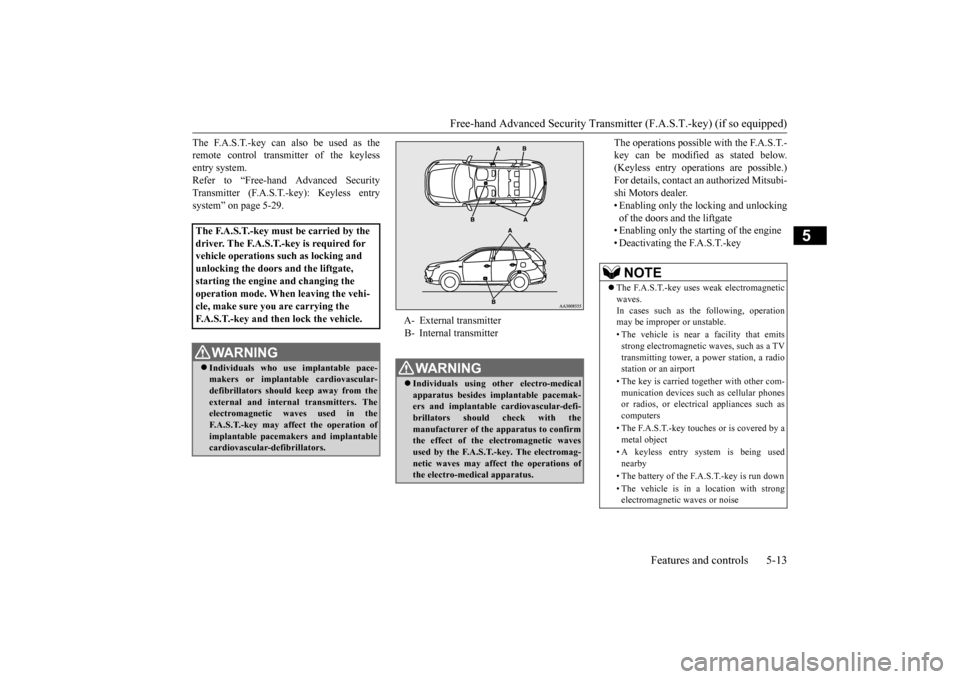
A- External transmitter B- Internal transmitterWA R N I N G Individuals using ot
her electro-medical
apparatus besides implantable pacemak- ers and implantable
cardiovascular-defi-
brillators should check with themanufacturer of the apparatus to confirm the effect of the electromagnetic waves used by the F.A.S.T.-key. The electromag-netic waves may affect
the operations of
the electro-medical apparatus.
NOTE
The F.A.S.T.-key uses weak electromagnetic waves.In cases such as the following, operation may be imprope
r or unstable.
• The vehicle is near a facility that emits strong electroma
gnetic waves, such as a TV
transmitting tower, a po
wer station, a radio
station or an airport • The key is carried t
ogether with other com-
munication devices such
as cellular phones
or radios, or electric
al appliances such as
computers • The F.A.S.T.-key touches or is covered by a metal object • A keyless entry system is being used nearby • The battery of the F.A.S.T.-key is run down • The vehicle is in a location with strong electromagnetic
waves or noise
BK0223400US.book 13 ページ 2015年2月13日 金曜日 午後12時15分
Page 129 of 464
Parking brake
Features and controls 5-53
5
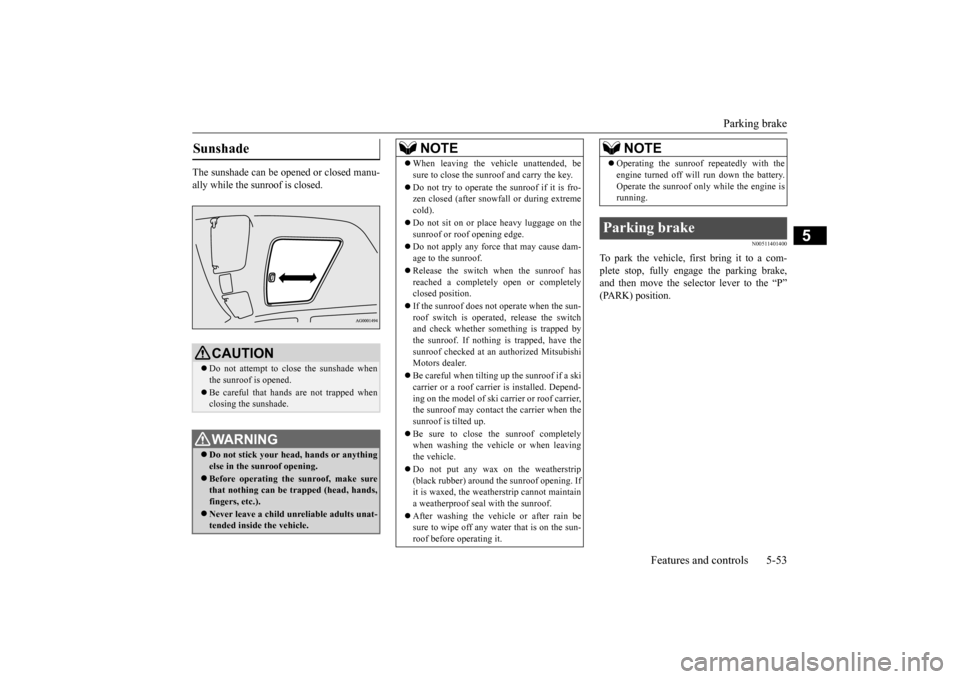
The sunshade can be opened or closed manu- ally while the sunroof is closed.
N00511401400
To park the vehicle, fi
rst bring it to a com-
plete stop, fully engage the parking brake,and then move the selector lever to the “P” (PARK) position.
Sunshade
CAUTION Do not attempt to close the sunshade when the sunroof is opened. Be careful that hands are not trapped when closing the sunshade.WA R N I N G Do not stick your head
, hands or anything
else in the su
nroof opening.
Before operating the sunroof, make sure that nothing can be trapped (head, hands, fingers, etc.). Never leave a child unr
eliable adults unat-
tended inside the vehicle.
NOTE
When leaving the vehicle unattended, be sure to close the sunroof and carry the key. Do not try to operate the sunroof if it is fro- zen closed (after snowfall or during extreme cold). Do not sit on or plac
e heavy luggage on the
sunroof or roof opening edge. Do not apply any forc
e that may cause dam-
age to the sunroof. Release the switch when the sunroof has reached a completely open or completelyclosed position. If the sunroof does not operate when the sun- roof switch is operated, release the switch and check whether something is trapped by the sunroof. If nothing is trapped, have thesunroof checked at an authorized Mitsubishi Motors dealer. Be careful when tilting up the sunroof if a ski carrier or a roof carrie
r is installed. Depend-
ing on the model of ski carrier or roof carrier,the sunroof may contact
the carrier when the
sunroof is tilted up. Be sure to close the sunroof completely when washing the vehicle or when leaving the vehicle. Do not put any wax on the weatherstrip (black rubber) around the sunroof opening. Ifit is waxed, the weat
herstrip cannot maintain
a weatherproof seal with the sunroof. After washing the vehicle or after rain be sure to wipe off any water that is on the sun- roof before operating it.
Operating the sunroof repeatedly with the engine turned off will run down the battery.Operate the sunroof only while the engine isrunning.
Parking brake
NOTE
BK0223400US.book 53 ページ 2015年2月13日 金曜日 午後12時15分
Page 141 of 464
Automatic transaxle (if so equipped)
Features and controls 5-65
5
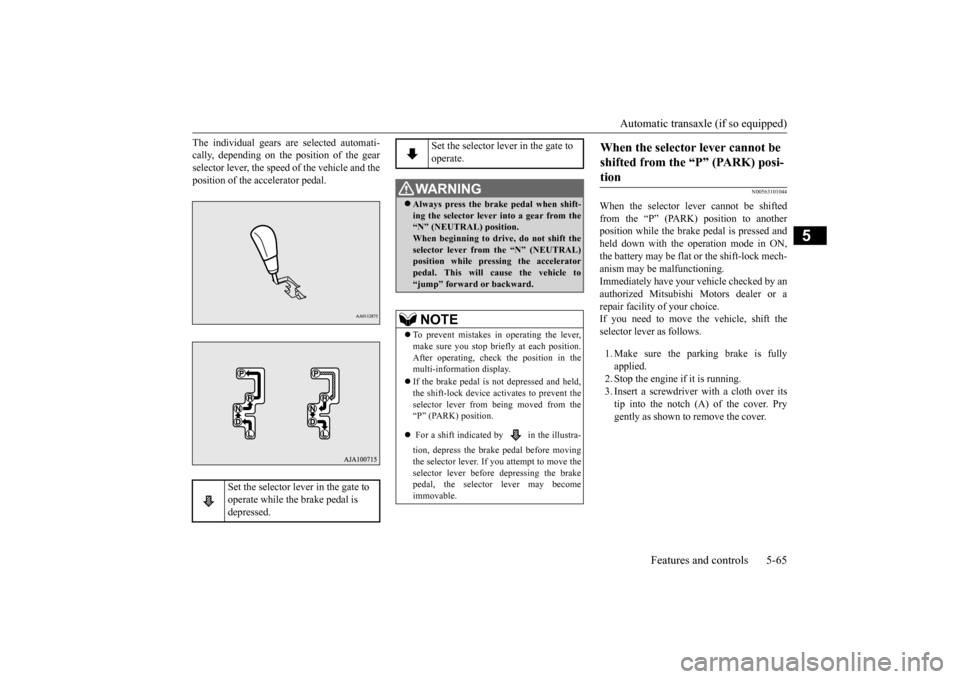
The individual gears are selected automati- cally, depending on the position of the gearselector lever, the speed of the vehicle and the position of the accelerator pedal.
N00563101044
When the selector lever cannot be shifted from the “P” (PARK) position to anotherposition while the brake
pedal is pressed and
held down with the operation mode in ON, the battery may be flat or the shift-lock mech-anism may be malfunctioning. Immediately have your
vehicle checked by an
authorized Mitsubishi Motors dealer or a repair facility
of your choice.
If you need to move the vehicle, shift theselector lever as follows. 1. Make sure the parking brake is fully applied. 2. Stop the engine if it is running.3. Insert a screwdrive
r with a cloth over its
tip into the notch (A) of the cover. Pry gently as shown to remove the cover.
Set the selector lever in the gate to operate while the brake pedal is depressed.
Set the selector lever in the gate to operate.
WA R N I N G Always press the brak
e pedal when shift-
ing the selector
lever into a gear from the
“N” (NEUTRAL) position. When beginning to drive, do not shift theselector lever from
the “N” (NEUTRAL)
position while pressing the accelerator pedal. This will cause the vehicle to“jump” forward or backward.NOTE
To prevent mistakes in operating the lever, make sure you stop brie
fly at each position.
After operating, check
the position in the
multi-information display. If the brake pedal is not depressed and held, the shift-lock device activates to prevent theselector lever from being moved from the “P” (PARK) position. For a shift indicated by in the illustra- tion, depress the brake pedal before moving the selector lever. If you attempt to move theselector lever before
depressing the brake
pedal, the selector
lever may become
immovable.
When the selector lever cannot be shifted from the “P” (PARK) posi-tion
BK0223400US.book 65 ページ 2015年2月13日 金曜日 午後12時15分
Page 147 of 464
Continuously variable transmission (CVT) (if so equipped)
Features and controls 5-71
5
For short waiting periods, such as at traffic lights, the vehicle can be
left in gear and held
stationary with the service brake.For longer waiting periods with the engine running, place th
e selector lever in the “N”
(NEUTRAL) position and apply the parkingbrake, while holding th
e vehicle stationary
with the service brake. Prior to moving off after having stopped the vehicle, make sure that the selector lever is in “D” (DRIVE) position or Sports mode posi-tion. To park the vehicle, fi
rst bring it to a com-
plete stop, fully engage the parking brake,
and then move the selector lever to the “P” (PARK) position. If the transaxle does not change gears while driving, or your vehicle does not pick up enough speed when starting on an uphillslope, it may be that there is something unusual happening in the transaxle, causing a safety device to acti
vate. Have your vehicle
checked at an authoriz
ed Mitsubishi Motors
dealer or a repair facility of your choice assoon as possible.
N00560201060
The CVT will automatically and continuouslychange its gear ratio depending on road anddriving conditions. This helps achieve smooth driving and excellent fuel efficiency. If your vehicle is equipped with the spor- tronic steering wheel paddle shifter, you can manually shift up and shift down the trans-mission. Refer to “Sports mode” on page 5-76. The transmission prevents unnecessary upshifts even when the accelerator pedal is released and ensures smooth driving. According to the conditions, the transmission will automatically shift to a lower gear ratioto achieve stronger engine braking. This may help reduce your need
to use the service
brake.
Waiting
CAUTION To avoid transaxle overheating, never try to keep your vehicle stationary on a hill by using the accelerator
pedal. Always apply
the parking brake and/or service brake. Do not rev the engine unnecessarily while the vehicle is stationary. Unexpected acceler-ation may occur if the se
lector lever is in a
position other than “P” (PARK) or “N” (NEUTRAL).
Parking
When the automatic transaxle makes no gear change
NOTE
When the warning display and “SLOW DOWN” or the wa
rning display and
“SERVICE REQUIRED” appear on the information screen in the multi-information display, there could be
a malfunction in the
automatic transaxle. Refer to “Automatic transaxle: Warning di
splay” on page 5-66.
Continuously variable transmission (CVT)
(if so
equipped)DRIVING UPHILL
DRIVING DOWNHILL
BK0223400US.book 71 ページ 2015年2月13日 金曜日 午後12時15分
Page 149 of 464
Continuously variable transmission (CVT) (if so equipped)
Features and controls 5-73
5
N00563301059
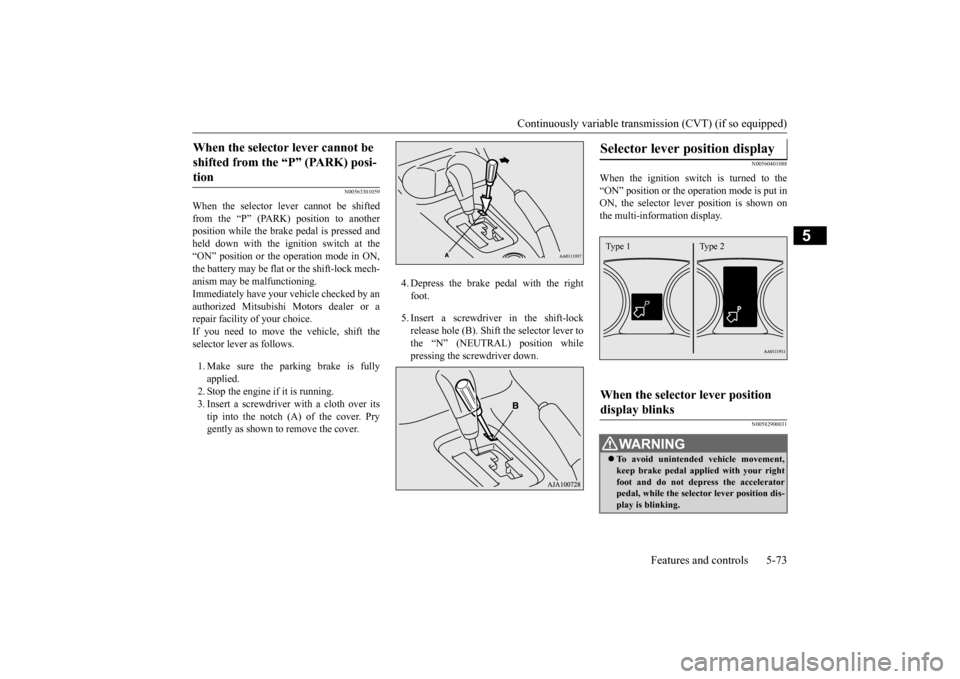
When the selector lever cannot be shifted from the “P” (PARK) position to anotherposition while the brake
pedal is pressed and
held down with the i
gnition switch at the
“ON” position or the operation mode in ON,the battery may be flat or the shift-lock mech- anism may be malfunctioning. Immediately have your
vehicle checked by an
authorized Mitsubishi Motors dealer or a repair facility
of your choice.
If you need to move the vehicle, shift the selector lever as follows. 1. Make sure the parking brake is fully applied.2. Stop the engine if it is running. 3. Insert a screwdrive
r with a cloth over its
tip into the notch (A) of the cover. Prygently as shown to remove the cover.
4. Depress the brake pedal with the right foot. 5. Insert a screwdriver in the shift-lock release hole (B). Shift the selector lever to the “N” (NEUTRAL) position while pressing the screwdriver down.
N00560401088
When the ignition switch is turned to the “ON” position or the operation mode is put in ON, the selector lever position is shown onthe multi-information display.
N00582900031
When the selector lever cannot be shifted from the “P” (PARK) posi-tion
Selector lever position display
When the selector lever position display blinks
WA R N I N G To avoid unintended
vehicle mo
vement,
keep brake pedal applied with your right foot and do not depress the accelerator pedal, while the selector lever position dis-play is blinking.Type 1 Type 2
BK0223400US.book 73 ページ 2015年2月13日 金曜日 午後12時15分
Page 154 of 464
Continuously variable transmission (CVT) (if so equipped) 5-78 Features and controls
5
To gain extra acceleration in “D” (DRIVE) position (when passing an
other vehicle) push
the accelerator to the floor. The CVT willautomatically downshift.
For short waiting periods, such as at traffic lights, the vehicle can be
left in selector lever
position and held stationary with the servicebrake. For longer waiting periods with the engine running, place th
e selector lever in the “N”
(NEUTRAL) position and apply the parking brake, while holding the vehicle stationary with the service brake.Prior to moving off after having stopped the vehicle, make sure that the selector lever is in “D” (DRIVE) position or Sports mode posi-tion.
To park the vehicle, first bring it to a com- plete stop, fully engage the parking brake, and then move the selector lever to the “P”(PARK) position. If the CVT does not shift while driving, or your vehicle does not pick up enough speed when starting on an uphill slope, it may be that there is something unusual happening inthe transmission, causi
ng a safety device to
activate. Have your ve
hicle checked at an
authorized Mitsubishi Motors dealer or arepair facility of your choice as soon as possi- ble.
Operating the accelerator pedal while the other foot is resting
on the brake pedal will
affect braking efficien
cy and may cause pre-
mature wear of brake pads. Use the selector lever in the correct shift position in accordance
with driving condi-
tions. Never coast downhill backward in the driv-ing shift position {“D” (DRIVE), “DS” (DOWN SHIFT & SPORTY DRVING), “L” (LOW) position or sports mode} or coastforward in the “R” (REVERSE) position. Engine stopping and in
creased brake pedal
and steering effort could
lead to an accident.
Do not rev the engine
with the brake pedal
pressed when the vehi
cle is stationary.
This can damage the CVT. Also, when you depress
the accelera
tor pedal
while holding down the brake pedal with theselector lever in the “D” (DRIVE) position, the engine revolutions
may not rise as high
as when performing the same operation withthe selector lever in the “N” (NEUTRAL) position.
Passing acceleration
CAUTION
NOTE
In sports mode, downshi
fts do not take place
when the accelerator is depressed all the wayto the floor.
Wa i t in g
CAUTION To avoid transmission overheating, never try to keep your vehicle stationary on a hill byusing the accelerator
pedal. Always apply
the parking brake and/or service brake. Do not rev the engine unnecessarily while the vehicle is stationary. Unexpected acceler- ation may occur if the se
lector lever is in a
position other than “P” (PARK) or “N” (NEUTRAL).
Parking
When the CVT makes no speed change
BK0223400US.book 78 ページ 2015年2月13日 金曜日 午後12時15分
Page 163 of 464
Inspection and maintenance following rough road operation
Features and controls 5-87
5
Your vehicle may not provide sufficient hill climbing ability and engine braking on steep slope. Avoid driving on steep slopes even though the vehicle is an 4-wheel drive vehi-cle.
N00537800085
If the electrical circuits become wet, furtheroperation of the vehi
cle will be impossible;
therefore, avoid drivi
ng through water unless
absolutely necessary. If driving through wateris unavoidable, use the following procedure:
Check the depth of the water and the terrain before attempting to drive through it. Driveslowly to avoid creating excessive water splashing.
N00530700085
After operating the vehicle in rough road con- ditions, be sure to perform the followinginspection and maintenance procedures:
Check that the vehicle has not been dam- aged by rocks, gravel, etc. Carefully wash the
vehicle with water.
Drive the vehicle sl
owly while lightly
depressing the brake pedal in order to dryout the brakes. If the brakes still do not function properly, contact an authorized Mitsubishi Motors dealer or a repair facil-ity of your choice as soon as possible to have the brakes checked. Remove the insects, dr
ied grass, etc. clog-
ging the radiator core. After driving through water, check the engine, transaxle and
differential oil. If
the oil or grease is milky or cloudy because of water cont
amination, it must
be replaced with new oil. Check the inside of the vehicle. If water entry is found, dry the carpet etc. Inspect the headlights. If water is in the headlight housing, have it drained at an authorized Mitsubishi Motors dealer or arepair facility of your choice.
NOTE
Avoid sudden braking,
sudden acceleration
and sharp turning; such operations couldresult in the vehicle becoming stuck. If the vehicle become
s stuck in sandy or
muddy roads, it can often be moved with arocking motion. Move the selector lever alternately between the “D” (DRIVE) and “R” (REVERSE) positi
ons while pressing
lightly on the ac
celerator pedal.
Driving on rough road can cause rust on the vehicle; wash the vehi
cle thoroughly as soon
as possible after such use.
Climbing/descending sharp grades Driving through water
CAUTION Never drive through water that is deep enough to cover wheel hubs, axles or exhaust pipe. Do not change th
e selector lever posi-
tion while driving through water. Frequent driving through water can adversely affect the life
span of the vehicle;
consult an authorized Mitsubishi Motors dealer or a repair facili
ty of your choice and
take the necessary measures to prepare,inspect, and repair the vehicle. After driving through water, apply the brakes to be sure they are
functioning properly. If
the brakes are wet a
nd not functioning prop-
erly, dry them out by driving slowly whilelightly depressing the brake pedal. Inspect each part of the vehicle carefully.
Inspection and maintenance following rough road opera-tion
BK0223400US.book 87 ページ 2015年2月13日 金曜日 午後12時15分