2016 MERCEDES-BENZ METRIS oil stick
[x] Cancel search: oil stickPage 12 of 310

Important safety notes .................... 74
Obstacle detection ........................... 74
Opening/closing from the inside .....75
Problem (malfunction) ..................... 77
Programmingt he key button ........... 76
Resettin g......................................... 77
Reversing feature ............................. 74
Electrical fuses
see Fuses
Electrical sliding door
Opening/closing from the out-
side .................................................. 75
Electronic brakef orce distribution
see EBD (electronic brake force
distribution)
Electronic Stability Program
see ESP
®(Electronic Stability Program)
Emergency
Automatic measures after an acci-
dent .................................................5 6
Emergency braking
see BA S(Brake Assist System)
Emergency release
Vehicle ............................................ .69
Emergency Tensioning Devices
Activatio n......................................... 54
Emission scontrol
Service and warranty information .... 25
Engine
Altitud elim it (diesel engine) .......... 140
Changing the power output. ............ 29
Check Engine warning lamp ........... 223
Cleaning instructions ..................... 255
Displa ymessages (vehicle with
steering wheelb uttons) ................. 211
Displa ymessages (vehicle with-
outs teering wheelb uttons) ........... 197
ECO start/stop function ................ 122
Engine number ............................... 295
Irregula rrunning ............................ 125
Jump-starting ................................. 262
Operating safety .............................. 29
Starting .......................................... 121
Starting problems .......................... 125
Switching off .................................. 134
Tow-starting (vehicle )..................... 266
Engine electronics
Note s............................................. 294 Problem (malfunction) ................... 125
Engine jump s
tarting
se
e Jump starting (engine)
Engine oil
Adding ........................................... 243
Additives ........................................ 299
Checking the oill evel using the
dipstick .......................................... 242
Displa ymessages (vehicle with
steering wheelb uttons) ................. 212
Displa ymessages (vehicle with-
outs teering wheelb uttons) ........... 198
Filling capacity ............................... 298
Information abouto ilconsump-
tion ................................................ 299
Note sabout oilgrade s................... 298
Oil change ...................................... 299
Oil level (note )............................... 242
Viscosity ........................................ 299
ES C( Elec tronicS tability Control)
see ESP
®(Electronic Stability Program)
ESP®(ElectronicS tability Pro-
gram)
Activating/deactivating (vehicle
with steering wheelb uttons) ......... 183
Activating/deactivating (vehicle
withou tsteering wheelb uttons) .... 173
Crosswind Assist ............................. 65
Deactivating/activating ................... 64
Displa ymessage (vehicle with
steering wheelb uttons) ................. 207
Displa ymessage (vehicle without
steering wheelb uttons) ................. 193
Function/note s................................ 64
Important safety information ........... 64
Trailer stabilization ........................... 65
Warning lamp ................................. 221
Exhaustc heck................................... 135
Exterior lighting
see Lights
Exterior mirrors
Adjusting ......................................... 91
Outofp osition (troubleshooting )..... 91
Eyeglassesc ompartment ................. 228
F
First-aidkit......................................... 262
10Index
Page 24 of 310

Permissible trailer loads and
drawbar noseweights ..................... 166
Transmission
see Automatic transmission
Transmission oil ........................ 299, 300
Transmission positions
Automatic transmission ................. 127
Display (DIRECT SELECT lever) ...... 127
Transmission programs
Automatic transmission ................. 128
Display (DIRECT SELECT lever) ...... 127
Transport
Lashing straps ...............................2 35
Loading guidelines ......................... 232
Stickers ......................................... 235
Vehicle ...........................................2 66
Transport by rail ................................ 136
Transportation
Rail ................................................ 136
Transportation aids
Load protectio nnet ....................... 237
Transporting
Cargo compartment variations ...... 234
Load distribution ............................ 233
Securing aloa d. ............................. 234
Trim pieces (cleaning instruc-
tions) ..................................................2 59
Trip computer
Displaying (vehicle with steering
wheel buttons) ............................... 178
Displaying (vehicle without steer-
ing wheel buttons) ......................... 171
Resetting (vehicle with steering
wheel buttons) ............................... 178
Resetting (vehicle without steer-
ing wheel buttons) ......................... 171
Selecting the displa yunits (vehi-
cle with steering wheel buttons) .... 185
Selecting the displa yunits (vehi-
cle without steering wheel but-
tons) .............................................. 174
Trip odometer
Displaying (vehicle with steering
wheel buttons) ............................... 177
Displaying (vehicle without steer-
ing wheel buttons) ......................... 171
Resetting (vehicle with steering
wheel buttons) ............................... 178 Resetting (vehicle without steer-
ing wheel buttons) ......................... 171
Setting the displa
yunit (vehicle
wi th steering w
he
el buttons) ......... 185
Setting the displa yunit (vehicle
without steering wheel buttons) .... 174
Turn signal
Changing bulbs (additional turn
signals) .......................................... 100
Turn signals
Display messages (vehicle with
steering wheel buttons) ................. 209
Display messages (vehicle with-
out steering wheel buttons) ........... 195
Replacing bulbs (front) ................... 100
Replacing bulbs (rear) .................... 101
Switching on/off .............................. 94
Trailer displa ymessages (vehicle
with steering wheel buttons) ......... 208
Trailer displa ymessages (vehicle
without steering wheel buttons) .... 194
Two-way radios
Typeapproval/frequency .............. 294
TWR (Tongue Weight Rating) (defi-
nition) ................................................. 286
Type identification plate
see Vehicle identification plate
U
UnlockingEmergency unlocking ....................... 69
From insid ethe vehicle (central
unlocking button) .............................7 2
With emergency key element ........... 68
USB (audio)
Playing ...........................................1 81
V
Vanity mirror
Changing abulb( mirror lamp) ......... 97
Sun viso r........................................ 229
Vehicle
Data acquisition ............................... 32
Display messages (vehicle with
steering wheel buttons) ................. 217
Display messages (vehicle with-
out steering wheel buttons) ........... 200
22Index
Page 29 of 310

Proper use
Observe the following information when oper-
ating your vehicle:
Rthe safety notes in these operating instruc-
tions
Rthe technical data in these Operating Instruc-
tions
Rtraffic laws and regulations
Rmotor vehicle laws and safety standards
There are various warning stickers affixed to the
vehicle. If you remove warning stickers, you and
others may fail to recognizet he dangers. Leave
the warning stickers in their original position.
GWARNING
Modifications to electronic components, their software as well as wiring can impair their
function and/or the function of other net-
worked components. In particular, systems
relevant to safety could also be affected. As a
result, these may no longer function as inten-
ded and/or jeopardize the operating safety of
the vehicle. There is an increased risk of an
accident and injury.
Never tamper with the wiring as well as elec-
tronic components or their software. You
should have all work to electrical and elec-
tronic equipment carried out at aqualified
specialist workshop.
The general operating permit for your vehicle
could be rendered invalid if you carry out mod-
ifications to electronic components, their soft-
ware as well as wiring.
GWARNING
Gases and fluids from substances that con-
stitute ahealth hazard or react aggressively
can escape even from securely closed con-
tainers. When transporting such substances
in the vehicle interior, your ability to concen-
trate or your health could be affected during
the journey. Malfunctions, short circuits or
electrical components ystem failures may
also result. There is arisk of an accident and
fire.
Do not store or transport any substances in
the vehicle interior which are hazardous to
health or react aggressively.
These instructions must also be observed for
vehicles where the cargo compartmentisn ot
fully separated from the driver's cab.
Partition with door/window: always keep the
door/window in the partition closed during
transport.
Examples of substances that are hazardous to
health and/or react aggressively:
RSolvents
RFuel
ROil and grease
RCleaning agents
RAcids
Protection of the environment
Economic and environmentally aware
driving
HEnvironmental note
Daimler's declared policy is one of compre-
hensive environmental protection.
The objectives are for the natural resources
that form the basis of our existence on this
planet to be used sparingly and in amanner
that takes the requirements of both nature
and humanity into account.
You too can help to protect the environment
by operating your vehicle in an environmen-
tally responsible manner.
Fuel consumption and the rate of engine,
transmission, brake and tire wear are affected
by these factors:
Roperating conditionsofy our vehicle
Ryour personal driving style
You can influence both factors. You should
bear the following in mind:
Introduction27
Z
Page 242 of 310

Useful information
This Operator's Manual describes all models as
well as standard and optional equipment of your
vehicle that were available at the time of going
to print.Country-specific variation sare possi-
ble. Note that your vehicle may not be equipped
with all of the described functions. This also
applies to system sand function srelevantt o
safety.
Read the information on qualified specialist
workshops (
Ypage 29).
Engine compartment
Hood
Important safetyn otes
GWARNING
If the hood is unlatched, it may open up when the vehicle is in motion and block your view.
There is arisk of an accident.
Never unlatc hthe hood while driving. Before
every trip, ensure that the hood is locked.
GWARNING
Openin gthe hood when the engin eisover-
heated or when ther eisafire in the engine
compartmen tcould expose you to hot gases
or other servicep roducts. There isarisk of
injury.
Let an overheated engin ecool down before
openin gthe hood. If ther eisafire in the
engin ecompartment, keep the hood closed
and contact the fire department.
GWARNING
The engin ecompartmen tcontains moving
components. Certain components, such as
the radiator fan, may continue to run or start
again suddenly when the ignition is off. There is ar isk of injury.
If you need to do any work inside the engine
compartment:
Rswitc hoff the ignition
Rneve rreach int othe area where ther eisa
risk of danger from movingc omponents,
such as the fan rotation area
Rremovej ewelry and watches
Rkeep items of clothing and hair, for exam-
ple, away from movingp arts
GWARNING
The ignition system operate swithahigh volt-
age. If you touc hthe live components, you
could receiv eanelectric shock.T here is an
increased risk of injury.
Never touc hcomponents of the ignition sys-
tem if:
Rthe engin eisrunning or being started
Rthe key is in radio position or drive position
in the ignition lock
The live components of the ignition system are,
for example:
Rignition coils
Rspark plug connectors
Rdiagnostic sockets
GWARNING
Certain components in the engin ecompart-
ment ,such as the engine, radiator and parts
of the exhaust system ,can becomev ery hot.
Working in the engin ecompartmen tposes a
risk of injury.
Where possible, let the engin ecool down and
touc honly the components described in the
following.
If you have to carry out work in the engin ecom-
partment ,only touc hthe following components:
RHood
ROil dipstick
REngine oil filler nec kcap
RWasher fluid reservoir cap
RCoolant expansion tan kcap
240Engine compartment
Maintenance and care
Page 244 of 310

or other service products. There isarisk of
injury.
Let an overheated engine cool down before
opening the hood. If there is afire in the
engine compartment, keep the hood closed
and contact the fire department.
GWARNING
Certain components in the engine compart-
ment,s uch as the engine, radiator and parts
of the exhaust system, can become very hot.
Working in the engine compartment poses a
risk of injury.
Where possible, let the engine cool down and touch only the components described in the
following.
!Do not use your hands to push the hood
down. You could damage it otherwise.
XHold support strut ?and lift the hood
slightly.
XGuide support strut ?towards retainer =
and apply slight pressure to make it engage.
XLower the hood and allow it to fall with
momentum from aheight of approximately
1ft( 30 cm).
The hood locks audibly.
XCheck that the hood is correctly locked.
If the hood can be raised slightly, it is not
properly engaged. If the hood is not correctly
engaged, open the hood again. Let the hood
fall with alittle more momentum.
Overview of the engine compartment
Engin ecompartment (example)
:
Engin eoil filler neck cap (Ypage 242)
;Brake fluid reservoir cap (Ypage 245)
=Coolant expansion tank cap (Ypage 244)
?Washer fluid reservoir cap (Ypage 246)
Regularly check the fluid level and the assembly
for leaks. If you detect fluid loss, e.g. oil flecks on the vehicle parking space, consult aqualified
specialist workshop immediately.
Engine oil
General notes
!Engin eoil gets dirty in the course of opera-
tion and its quality and volume are gradually
diminished. Regularly check the oil level, and top up or have it replaced as needed.
Observe the information on approved engine
oils and oil consumption under "Service prod-
ucts and capacities" (
Ypage 298).
You can check the oil level in the engine:
Rwith the oil dipstick
Checking the oil level using the oil dip-
stick
GWARNING
Opening the hood when the engine is over-
heated or when there is afire in the engine
compartment could expose you to hot gases
or other service products. There is arisk of
injury.
Let an overheated engine cool down before
opening the hood. If there is afire in the
242Engine compartment
Maintenance and care
Page 245 of 310

engine compartment,keep the hood closed
and contact the fire department.
GWARNING
Certain component sinthe engine compart-
ment ,such as the engine, radiator and parts
of the exhaust system, can become very hot.
Workin ginthe engine compartment poses a
risk of injury.
Where possible, let the engine cool down and touch only the component sdescribed in the
following.
Oil dipstick and engine oil filler neck
Only check the oil level when the engine is at
normal operatin gtemperature.
XStop your vehicle as far away from traffic as
possible on level ground.
XSecure the vehicle to preventitf rom rolling
away.
XSwitc hoff the engine.
XWait 5minutes.
XOpen the hood (Ypage 241).
XPull out oil dipstick :.
XWipe oil dipstick:using alint-free cloth.
XInserto il dipstick :back into the guide tube
as far as it will go and remove it again.
If the level is between MIN mark =and MAX
mark ;,the oil level is adequate.
XIf the oil level has dropped to or below mini-
mum mark =,open cap ?and add engine oil
(
Ypage 243).
The difference in quantit ybetween marks ;
and =is approximately 2USquarts (2 liters).
XClose the hood.
Add engine oil
GWARNING
Openingt he hood when the engine is over-
heated or when there is afire in the engine
compartment could expose you to hot gases
or other servicep roducts. There isarisk of
injury.
Let an overheated engine cool down before
opening the hood. If there is afire in the
engine compartment ,keep the hood closed
and contact the fire department.
GWARNING
Certain component sinthe engine compart-
ment ,such as the engine, radiator and parts
of the exhaust system, can become very hot.
Workin ginthe engine compartment poses a
risk of injury.
Where possible, let the engine cool down and touch only the component sdescribed in the
following.
GWARNING
If engine oil comes into contact with hot com- ponents in the engine compartment ,itmay
ignite. There is arisk of fire and injury.
Make sure that engine oil is not spilled nex tto
the filler neck .Let the engine cool down and
thoroughly clean the engine oil off the com-
ponents before starting the engine.
HEnvironmental note
When adding oil, take care not to spill any. If
oil enters the soil or waterways, it is harmful to
the environment.
!Do not add too much oil. adding too much
engine oil can result in damage to the engine
or to the catalytic converter. Have excess
engine oil siphoned off.
!Do not use any additives in the engine oil.
This could damage the engine.
Engine compartment243
Maintenance and care
Z
Page 246 of 310
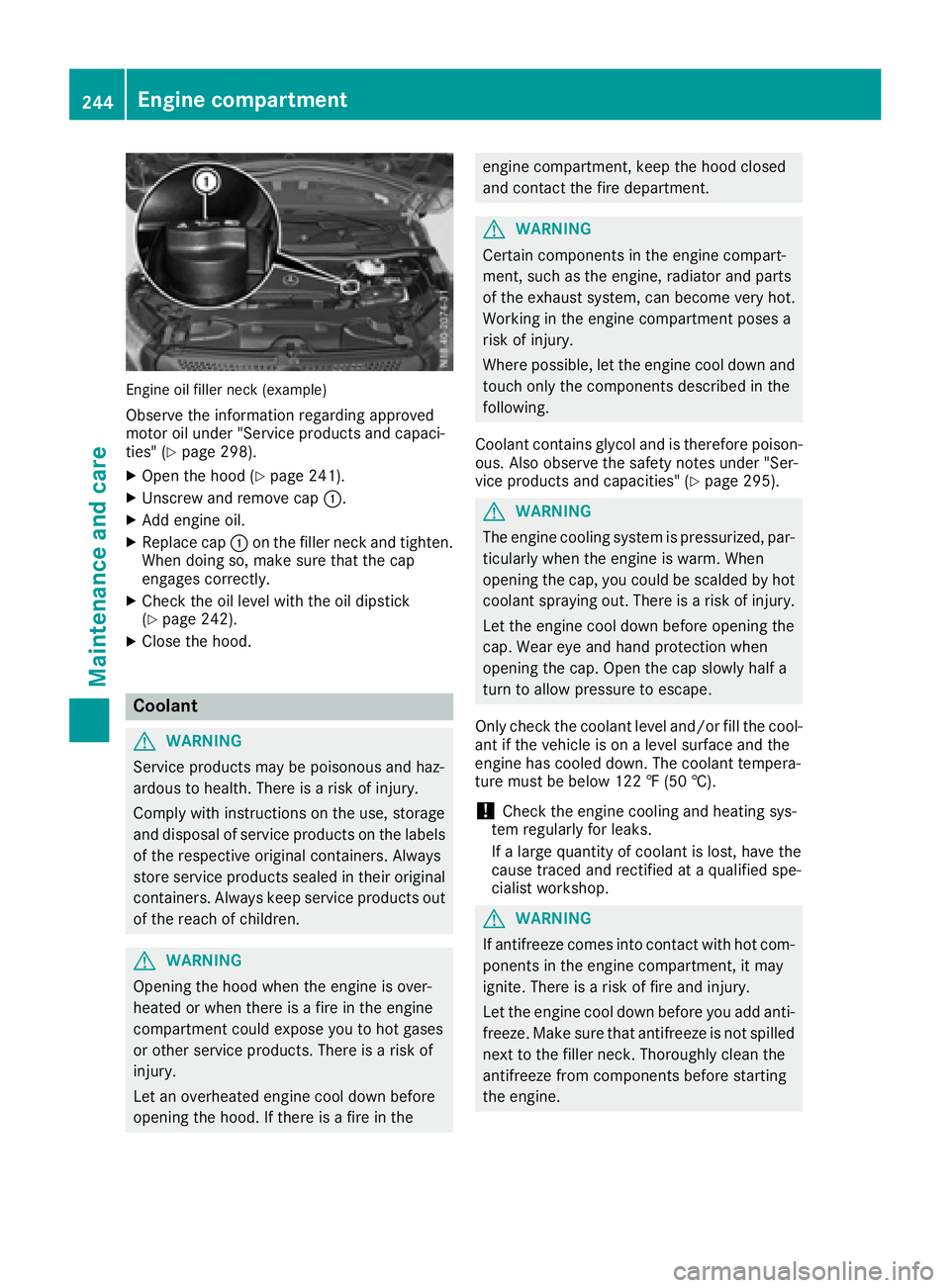
Engine oilfille rneck (example)
Observ ethe informatio nregarding approved
moto roilunder "Service products and capaci-
ties" (
Ypage 298).
XOpe nthe hoo d(Ypage 241).
XUnscrew and remove cap :.
XAdd engine oil.
XReplace cap:on the fille rneck and tighten.
Whe ndoing so, make sure thatt he cap
engages correctly.
XCheck the oill evel with the oild ipstick
(Ypage 242).
XClose the hood.
Coolant
GWARNING
Service products maybep oisonousand haz-
ardous to health .There is ariskofi njury.
Compl ywithi nstructions on the use, storage
and disposalofs erviceproducts on the labels
of the respective original containers. Always
stor eservic eproducts seale dintheiroriginal
containers. Alway skeeps ervic eproducts out
of the reach of children.
GWARNING
Opening the hoo dwhent he engine is over-
heated or when ther eisafireint he engine
compartment could expose yo utohot gases
or othe rservic eproducts. There is arisko f
injury.
Let an overheate dengine coo ldow nb efore
opening the hood. If ther eisafireint he
engine compartment, kee pthe hoo dclosed
and contact the fir edepart ment.
GWARNING
Certai ncomponents in the engine compart-
ment, such as the engine ,radiator and parts
of the exhaust system ,can become ver yhot.
Working in the engine compartment poses a
ris kofi njury.
Where possible, le tthe engine coo ldow na nd
touch onl ythe components describe dinthe
following.
Coolant contains glyco land is therefore poison-
ous. Als oobserve the safety notes under "Ser-
vic ep roducts and capacities" (
Ypage 295).
GWARNING
The engine cooling system is pressurized, par-
ticularly when the engine is warm. When
opening the cap ,you could be scalded by hot
coolant spraying out. There is ariskofi njury.
Let the engine coo ldow nb efore opening the
cap .Weare ye and hand protection when
opening the cap .Opent he cap slowly half a
tur ntoa llowpressure to escape.
Onlyc heck the coolant level and/or fil lthe cool-
ant if the vehicl eisonalevel surface and the
engine hasc ooleddown. The coolant tempera-
tur em ustbeb elow122‡(50 †).
!Check the engine cooling and heating sys-
tem regularly for leaks.
If al arge quantity of coolant is lost, have the
cause traced and rectifie dataqualified spe-
cialist workshop.
GWARNING
If antifreeze come sinto contact with hot com-
ponents in the engine compartment, it may
ignite .There is ariskoff irea nd injury.
Let the engine coo ldow nb efore yo uadd anti-
freeze .Makes uret hata ntifreeze is not spilled
next to the fille rneck. Thoroughl yclean the
antifreeze from components before starting
the engine.
244Engine compartment
Maintenance and care
Page 260 of 310

Cleaning thesliding door
The car einstructionsdon otapply to electric
slidingd oors.
XRemove foreign object sfromt hevicinity of
contac tsurfaces ;and contac tpins :of
th es lidingd oor.
XClean contac tsurfaces ;and contact
pins :witham ild cleanin gagenta ndasoft
cloth.
Do no toil or grease contac tplates ;and
contac tpins :.
Cleaning th etrailer tow hitch
HEnvironmental note
Dispose of rags soaked in oil and grease in an
environmentall yresponsible manner.
!Do no tclean th eball couplingw ithapower
washer. Do no tuse solvents.
!Observ ethe note sona dditional car efor the
trailer to whitch (see th emanufacturer'so per-
atin ginstructions).
You can also have th emaintenance work on the
ball couplinga nd thetrailer to whitch carried out
by aq ualified specialist workshop.
Interior
Cleaning th einterior
!When usingl iquids to clean th evehicle inte-
rior ,observ ethe followingp oints:
RUnder no circumstances use power wash-
ers.
RMakesure that no fluid senter or remain in
gaps and cavities.
REnsure sufficient ventilatio nwhen clean-
ing.
RMakes ure that th evehicle interiorisc om-
pletely dry after cleaning.
Cleaning th edisplay
!For cleaning, do no tuse any of th efollowing:
Ralcohol-based thinner or gasoline
Rabrasive cleanin gagents
Rcommercially-available householdc leaning
agents
Thesem ay damag ethe display surface. Do
no tp ut pressure on th edisplay surface when
cleaning. This coul dlead to irreparable dam-
age to th edisplay.
XSwitch off th edisplay and let it coo ldown.
XClean th edisplay surface withac ommercially
available microfiber cloth and cleane rfor
TFT/LCD displays.
XDr yt he display surface usingad ry microfiber
cloth.
Cleaning th eplastic trim
GWARNING
Care product sand cleanin gagents containing
solvents caus esurfaces in th ecockpit to
become porous. As aresult, plastic part smay
com elooseint heevent of air bag deploy-
ment. Thereisar iskofi njury.
Do no tuse any car eproduct sand cleaning
agents to clean th ecockpit.
!Do no taffix th efollowingtop lastic surfaces:
Rstickers
Rfilms
Rscentedoil bottle sorsimilar items
You can otherwise damaget heplastic.
!Do no tallow cosmetics ,insect repellento r
sunscree ntocomeintoc ontac twitht heplas-
tic trim. This maintain sthe high-quality look of
th es urfaces.
XWipe th eplastic trim and th ecockpit witha
damp, lint-free cloth ,e.g.am icrofiber cloth.
XHeavy soiling: useamild detergentorc are
product sand cleanin gagents recommended
and approved by Mercedes-Benz.
258Care
Maintenance and care