2016 MERCEDES-BENZ GLC-Class child restraint
[x] Cancel search: child restraintPage 64 of 418
Removingth echild restrain tsystem and
deactivatin gth especial seat belt retractor:
XMak esur eyou observ eth echild restrain t
system manufacturer' sinstallation instruc -
tions.
XPress th erelease butto nof th eseat belt
buckl eand guide th eseat belt tongue bac k
toward sth ebelt sash guide .
The special seat belt retracto ris deactiva-
ted.
Chil drestraint system
The use of seat belt sand child restrain tsys-
tems is require dby law in :
Rall 50 state s
RtheU.S. territories
Rth eDistric tof Columbia
Rall Canadian province s
You can obtain further information about th e
correc tchild restrain tsystem from any
authorize dMercedes-Ben zCenter.
GWARNIN G
If th echild restrain tsystem is installed incor-
rectl yon asuitable seat ,it canno tprotect as
intended. The child canno tthen be restrained
in th eevent of an accident, heav ybrakin gor
sudden changes of direction .There is an
increase dris kof injury, possibl yeve nfatal.
Mak esur ethat you observ eth echild restrain t
system manufacturer' sinstallation instruc -
tion sand th enote son use. Pleas eensure,
that th ebase of th echild restrain tsystem is
always resting completely on th eseat cush-
ion .Never plac eobjects ,e.g. cushions, under
or behin dth echild restrain tsystem. Only use
child restrain tsystems wit hth eoriginal cover
designed for them. Only replac edamaged
cover swit hgenuin ecovers.
GWARNIN G
If th echild restrain tsystem is installed incor-
rectl yor is no tsecured ,it can come loos ein
th eevent of an accident, heav ybrakin gor a
sudden chang ein direction .The child
restrain tsystem could be throw nabout ,strik -
in g vehicl eoccupants. There is an increase d
ris kof injury, possibl yeve nfatal.
Always install child restrain tsystems prop-
erly, eve nif they are no tbein gused .Mak e
sur ethat you observ eth echild restrain tsys-
te m manufacturer' sinstallation instructions.
You will fin dfurther information on stowin g
objects ,luggag eor loads under "Loadin g
guidelines" (
Ypage 306).
GWARNING
Child restrain tsystems or their securin gsys-
tems whic hhav ebeen damaged or subjecte d
to aload in an acciden tcan no longer protect
as intended. The child canno tthen be
restrained in th eevent of an accident, heav y
brakin gor sudden changes of direction .There
is an increase dris kof injury, possibl yeve n
fatal.
Replac echild restrain tsystems whic hhav e
been damaged or subjecte dto aload in an
acciden tas soo nas possible. Hav eth esecur-
in g systems on th echild restrain tsystem
checke dat aqualified specialist workshop ,
before you install achild restrain tsystem
again .
The securin gsystems of child restrain tsys-
tems are:
Rth eseat belt system
Rth eLATCH-type (ISOFIX) securin grings
Rth eTop Tether anchorages
If it is absolutely necessar yto carry achild on
th efront-passenger seat ,be sur eto observ e
th einformation on th e"Occupant Classifica-
tion Syste m(OCS)" (
Ypage 51). There you
will also fin dinformation on deactivatin gth e
front-passenger fron tair bag.
62Children in the vehicle
Safety
Page 65 of 418
All child restraint systems must meet the fol-
lowing standards:
RU.S. Federal Motor Vehicle Safety Stand-
ards 213 and 225
RCanadian Motor Vehicle Safety Standards
213 and 210.2
Confirmation that the child restraint system
corresponds to the standards can be found
on an instruction label on the child restraint
system. This confirmation can also be found
in the installation instructions that are inclu-
ded with the child restraint system.
Observe the warning labels in the vehicle inte- rior and on the child restraint system.
LATCH-type (ISOFIX) child seat secur-
ing system
GWARNING
LATCH-type (ISOFIX) child restraint systems
do not offer sufficient protective effect for
children whose weight is greater than 48 lbs
(22 kg) who are secured using the safety belt integrated in the child restraint system. In the
event of an accident, a child might not be
restrained correctly. This poses an increased
risk of injury or even fatal injury.
If the child weighs more than 48 lbs (22 kg),
only use LATCH-type (ISOFIX) child restraint
systems with which the child is also secured
with the vehicle seat belt. Also secure the
child restraint system with the Top Tether
belt, if available.
Always comply with the manufacturer's
installation and operating instructions for the
child restraint system used.
Before every trip, make sure that the LATCH-
type (ISOFIX) child restraint system is
engaged correctly in both LATCH-type (ISO-
FIX) securing rings
!When installing the child restraint system,
make sure that the seat belt for the middle
seat does not get trapped. The seat belt
could otherwise be damaged.
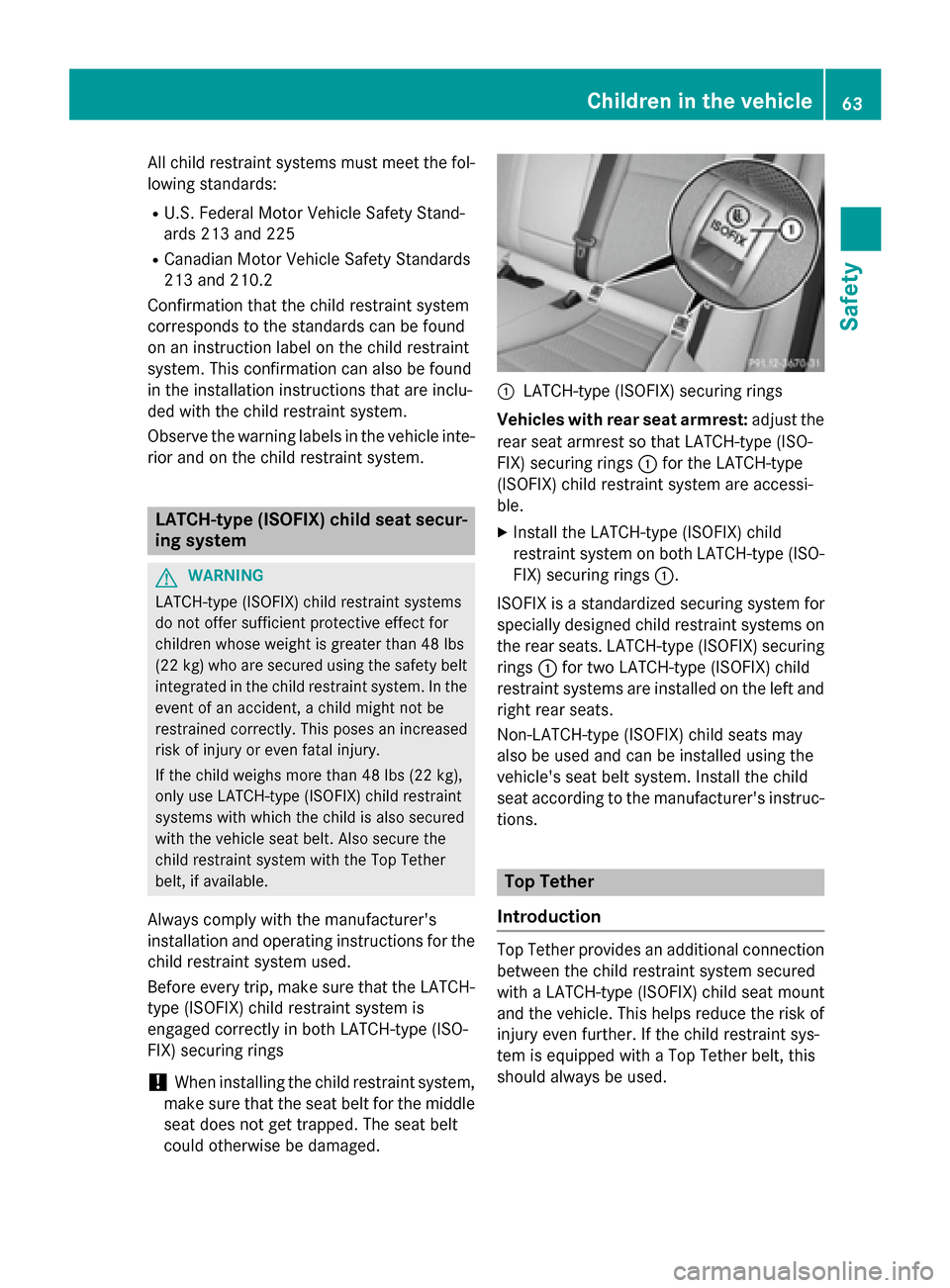
:LATCH-type (ISOFIX) securing rings
Vehicles with rear seat armrest: adjust the
rear seat armrest so that LATCH-type (ISO-
FIX) securing rings :for the LATCH-type
(ISOFIX) child restraint system are accessi-
ble.
XInstall the LATCH-type (ISOFIX) child
restraint system on both LATCH-type (ISO-
FIX) securing rings :.
ISOFIX is a standardized securing system for
specially designed child restraint systems on
the rear seats. LATCH-type (ISOFIX) securing
rings :for two LATCH-type (ISOFIX) child
restraint systems are installed on the left and
right rear seats.
Non-LATCH-type (ISOFIX) child seats may
also be used and can be installed using the
vehicle's seat belt system. Install the child
seat according to the manufacturer's instruc-
tions.
Top Tether
Introduction
Top Tether provides an additional connection
between the child restraint system secured
with a LATCH-type (ISOFIX) child seat mount
and the vehicle. This helps reduce the risk of
injury even further. If the child restraint sys-
tem is equipped with a Top Tether belt, this
should always be used.
Children in the vehicle63
Safety
Z
Page 66 of 418

Important safety notes
GWARNING
If th erear seat backrest sare no tlocked, they
could fol dforwards in th eevent of an acci-
dent, heav ybraking or sudde nchanges of
direction .As aresult ,child restrain tsystems
canno tperfor mtheir intended protective
function .Rear seat backrest sthat are no t
locke dcan also caus eadditional injuries, e.g.
in th eevent of an accident. This poses an
increased ris kof injury or eve nfatal injury.
Always loc krear seat backrest safter instal -
lin g a Top Tether belt .Observ eth eloc kveri-
fication indicator.
If the rear seat backrest isnot engaged and
locke d,this will be shownin the multifunction
disp layinthe instrument cluster. A warning
tone also sounds.
Top Tether anchorages
Top Tether anchorage points ?are located
on the rear sideof the backrests on both
outer rear seats.
XMove head restraint :upwards.
XInstall the LATCH-type (ISOFIX) child
restraint system with Top Tether. Always
co mply wit h the child restraint system
manufacturer's installation instructions
when doing so.
XRoute Top Tether beltBunder head
restraint :between the two head restraint
bars.
XGuide Top Tether belt Bdown between
cargo compartment cover =and rear seat
backrest ;.
XHook Top Tether hook Ainto Top Tether
anchorage ?on the back of rear seat
backrest ;.
XMake sure that Top Tether belt Bisnot
twisted.
XTension Top Tether belt B. Always comply
wit h the ch ildrestraint system manufactur-
er's installation instructions when doing so.
XIfnecessary, move head restraint :back
down again slightly. Make sure that you do
not interfere with the correct routing of Top
Tether beltB.
Child restraint system on the front-
passenger seat
General notes
Accident statistics show that ch ildren
secured inthe rear seats are safer than ch il-
dren secured inthe front-passenger seat. For
th is reason, Mercedes-Benz strongly advises
that you install the ch ildrestraint system on a
rear seat.
If it is absolutely necessary to install a ch ild
restraint system on the front-passenger seat,
always observe the instructions and safety
notes on the "Occupant Classific ation System
(OCS)" (
Ypage 51).
64Children in the vehicle
Safety
Page 67 of 418

You can thus avoid the risks that could arise
as a result of:
Ran incorrectly categorized person in the
front-passenger seat
Rthe unintentional deactivation of the front-
passenger front air bag
Rthe unsuitable positioning of the child
restraint system, e.g. too close to the dash-
board
Rearward-facing child restraint system
If it is absolutely necessary to install a rear-
ward-facing child restraint system on the
front-passenger seat, always make sure that
the front-passenger front air bag is deactiva-
ted. Only if the PASSENGER AIR BAG OFF
indicator lamp is permanently lit (
Ypage 43)
is the front-passenger front air bag deactiva-
ted.
Always observe the child restraint system
manufacturer's installation and operating
instructions.
Forward-facing child restraint system
If it is absolutely necessary to install a
forward-facing child restraint system on the
front-passenger seat, always move the front-
passenger seat as far back as possible. Fully
retract the seat cushion length. The entire
base of the child restraint system must
always rest on the seat cushion of the front-
passenger seat. The backrest of the child
restraint system must lie as flat as possible
against the backrest of the front-passenger
seat. The child restraint system must not
touch the roof or be subjected to a load by the
head restraint. Adjust the angle of the seat
backrest and the head restraint position
accordingly. Always make sure that the shoul- der belt strap is correctly routed from the
vehicle belt outlet to the shoulder belt guide
on the child restraint system. The shoulder
belt strap must be routed forwards and down-
wards from the vehicle belt outlet. If neces-
sary, adjust the vehicle belt outlet and the
front-passenger seat accordingly. Always observe the child restraint system
manufacturer's installation and operating
instructions.
Child-proof locks
Important safety notes
GWARNING
If children are traveling in the vehicle, they
could:
Ropen doors, thus endangering other people
or road users
Rexit the vehicle and be caught by oncoming
traffic
Roperate vehicle equipment and become
trapped
There is a risk of an accident and injury.
Always activate the child-proof locks and
override feature if children are traveling in the vehicle. When leaving the vehicle, always take
the key with you and lock the vehicle. Never
leave children unattended in the vehicle.
Override feature for:
Rthe rear doors (Ypage 66)
Rthe rear side windows (Ypage 66)
GWARNING
If you leave children unsupervised in the vehi-
cle, they could set it in motion by, for example:
Rrelease the parking brake.
Rshift the automatic transmission out of the
parking position P.
Rstart the engine.
In addition, they may operate vehicle equip-
ment and become trapped. There is a risk of
an accident and injury.
When leaving the vehicle, always take the
SmartKey with you and lock the vehicle. Never
leave children unsupervised in the vehicle.
Children in the vehicle65
Safety
Z
Page 68 of 418

GWARNING
If persons, particularly children are subjected to prolonged exposure to extreme heat or
cold, there is a risk of injury, possibly even
fatal. Never leave children unattended in the
vehicle.
GWARNING
If the child restraint system is subjected to
direct sunlight, parts may get very hot. Chil-
dren may burn themselves on these parts,
particularly on the metal parts of the child
restraint system. There is a risk of injury.
If you leave the vehicle, taking the child with
you, always ensure that the child restraint
system is not exposed to direct sunlight. Pro- tect it with a blanket, for example. If the child
restraint system has been exposed to direct
sunlight, let it cool down before securing the
child in it. Never leave children unattended in
the vehicle.
Child-proof locks for the rear doors
You secure each door individually with the
child-proof locks on the rear doors. A door
secured with a child-proof lock cannot be
opened from inside the vehicle. When the
vehicle is unlocked, the door can be opened
from the outside.
XTo activate: press the child-proof lock
lever up in the direction of arrow :.
XMake sure that the child-proof locks are
working properly.
XTo deactivate:press the child-proof lock
lever down in the direction of arrow ;.
Override feature for the rear side win-
dows
XTo activate/deactivate:press button;.
If indicator lamp :is lit, operation of the
rear side windows is disabled. Operation is
only possible using the switches in the driv-
er's door. If indicator lamp :is off, oper-
ation is possible using the switches in the
rear compartment.
Pets in the vehicle
GWARNING
If you leave animals unattended or unsecured
in the vehicle, they could press buttons or
switches, for example.
As a result, they could:
Ractivate vehicle equipment and become
trapped, for example
Ractivate or deactivate systems, thereby
endangering other road users
Unsecured animals could also be flung around
the vehicle in the event of an accident or sud-
den steering or braking, thereby injuring vehi-
cle occupants. There is a risk of an accident
and injury.
66Pets in the vehicle
Safety
Page 111 of 418

The seat belt should:
Rfit snugly across your body
Rbe routed across the middle of your shoul-
der
Rbe routed in your pelvic area across the hip
joints
XBefore starting off, adjust the rear-view mir-
ror and the exterior mirrors in such a way
that you have a good view of road and traf-
fic conditions (
Ypage 119).
XVehicles with memory function:you can
store the seat, steering wheel, exterior mir-
ror and head-up display settings with the
memory function (
Ypage 122).
Seats
Important safety notes
GWARNING
Children could become trapped if they adjust
the seats, particularly when unattended.
There is a risk of injury.
When leaving the vehicle, always take the
SmartKey with you and lock the vehicle. Never
leave children unsupervised in the vehicle.
The seats can still be adjusted when there is
no SmartKey in the ignition lock.
GWARNING
When you adjust a seat, you or other vehicle
occupants could become trapped, e.g. on the seat guide rail. There is a risk of injury.
Make sure when adjusting a seat that no one
has any body parts in the sweep of the seat.
Observe the safety notes on "Air bags"
(
Ypage 48) and "Children in the Vehicle"
(
Ypage 60).
GWARNING
If the driver's seat is not engaged, it could
move unexpectedly while the vehicle is in
motion. This could cause you to lose control of the vehicle. There is a risk of an accident.
Always make sure that the driver's seat is
engaged before starting the vehicle.
GWARNING
You could lose control of your vehicle if you do the following while driving:
Radjust the driver's seat, head restraint,
steering wheel or mirrors
Rfasten the seat belt
There is a risk of an accident.
Adjust the driver's seat, head restraint, steer-
ing wheel and mirror and fasten your seat belt before starting the engine.
GWARNING
If you adjust the seat height carelessly, you or
other vehicle occupants could be trapped and
thereby injured. Children in particular could
accidentally press the electrical seat adjust-
ment buttons and become trapped. There is a
risk of injury.
While moving the seats, make sure that your
hands or other body parts do not get under the
lever assembly of the seat adjustment sys-
tem.
GWARNING
If the head restraints are not installed or not
adjusted correctly, they cannot provide pro-
tection as intended. There is an increased risk
of injury in the head and neck area, e.g. in the event of an accident or when braking.
Always drive with the head restraints instal-
led. Before driving off, make sure for every
vehicle occupant that the center of the head
restraint supports the back of the head at
about eye level.
GWARNING
The seat belt does not offer the intended level of protection if you have not moved the back-
rest to an almost vertical position. When brak-
ing or in the event of an accident, you could
slide underneath the seat belt and sustain
abdomen or neck injuries, for example. This
Seats109
Seats, steering wheel and mirrors
Z
Page 112 of 418
poses an increased risk of injury or even fatalinjury.
Adjust the seat properly before beginning
your journey. Always ensure that the backrest
is in an almost vertical position and that the
shoulder section of your seat belt is routed
across the center of your shoulder.
!To avoid damage to the seats and the seat
heating, observe the following information:
Rkeep liquids from spilling on the seats. If
liquid is spilled on the seats, dry them as
soon as possible.
Rif the seat covers are damp or wet, do not
switch on the seat heating. The seat
heating should also not be used to dry
the seats.
Rclean the seat covers as recommended;
see "Interior care".
Rdo not transport heavy loads on the
seats. Do not place sharp objects on the
seat cushions, e.g. knives, nails or tools. The seats should only be occupied by
passengers, if possible.
Rwhen the seat heating is in operation, donot cover the seats with insulating mate-
rials, e.g. blankets, coats, bags, seat cov-
ers, child seats or booster seats.
!Make sure that there are no objects in the
footwell under or behind the seats when
moving the seats back. There is a risk that
the seats and/or the objects could be dam- aged.
iThe rear-compartment head restraints
can be removed (
Ypage 112).
Vehicles without the through-loading fea-
ture: the head restraints cannot be
removed from the rear compartment seats.
For more information, contact a qualified
specialist workshop.
iFurther related subjects:
REASY-PACK quickfold rear bench seat
(
Ypage 309)
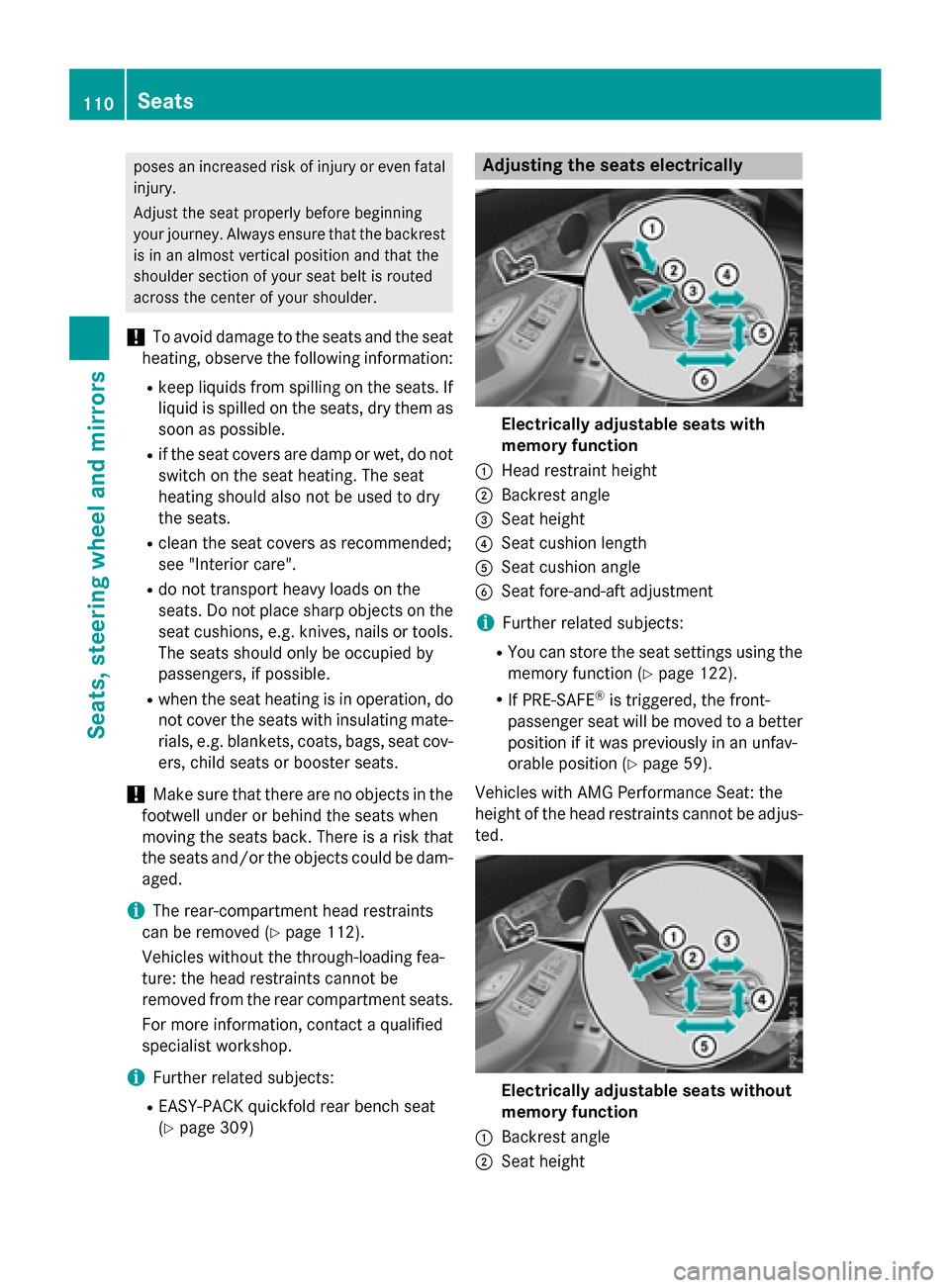
Adjusting the seats electrically
Electrically adjustable seats with
memory function
:Head restraint height
;Backrest angle
=Seat height
?Seat cushion length
ASeat cushion angle
BSeat fore-and-aft adjustment
iFurther related subjects:
RYou can store the seat settings using the
memory function (
Ypage 122).
RIf PRE-SAFE®is triggered, the front-
passenger seat will be moved to a better
position if it was previously in an unfav-
orable position (
Ypage 59).
Vehicles with AMG Performance Seat: the
height of the head restraints cannot be adjus-
ted.
Electrically adjustable seats without
memory function
:Backrest angle
;Seat height
110Seats
Seats, steering wheel and mirrors
Page 117 of 418

Problems with the seat ventilation
ProblemPossible causes/consequences andMSolutions
The seat ventilation has
switched off prema-
turely or cannot be
switched on.The on-board voltage is too low because too many electrical con-
sumers are switched on.
XSwitch off electrical consumers that you do not need, such as
the rear window defroster or interior lighting.
Once the battery is sufficiently charged, the seat ventilation can
be switched back on.
Steering wheel
Important safety notes
GWARNING
You could lose control of your vehicle if you do the following while driving:
Radjust the driver's seat, head restraint,
steering wheel or mirrors
Rfasten the seat belt
There is a risk of an accident.
Adjust the driver's seat, head restraint, steer-
ing wheel and mirror and fasten your seat belt before starting the engine.
GWARNING
Children could injure themselves if they
adjust the steering wheel. There is a risk of
injury.
When leaving the vehicle, always take the
SmartKey with you and lock the vehicle. Never
leave children unsupervised in the vehicle.
The electrically adjustable steering wheel can
still be adjusted when there is no key in the
ignition lock.
Adjusting the steering wheel man-
ually
:Release lever
;To adjust the steering wheel height
=To adjust the steering wheel position
(fore-and-aft adjustment)
XPush release lever :down completely.
The steering column is unlocked.
XAdjust the steering wheel to the desired
position.
XPush release lever :up completely.
The steering column is locked.
XCheck if the steering column is locked.
When doing so, try to push the steering
wheel up or down or try to move it in the
fore-and-aft direction.
Steering wheel115
Seats, steering wheel and mirrors
Z