2016 MERCEDES-BENZ GL-Class ECU
[x] Cancel search: ECUPage 211 of 462

However, the vehicle is only accelerated up to
the speed you have stored.
If you depress the brake, DISTRONIC PLUS is
deactivated unless your vehicle is stationary.
Changing lanes
If you change to the passing lane, DISTRONIC
PLUS supports you when:
Ryou are driving faster than 40 mph
(60 km/h)
RDISTRONIC PLUS is maintaining the dis-
tance to a vehicle in front
Ryou switch on the appropriate turn signal
RDISTRONIC PLUS does not detect a danger
of collision
If these conditions are fulfilled, your vehicle is
accelerated. Acceleration will be interrupted
if changing lanes takes too long or if the dis-
tance between your vehicle and the vehicle in
front becomes too small.
iWhen you change lanes, DISTRONIC
PLUS monitors the left lane on left-hand-
drive vehicles or the right lane on right-
hand-drive vehicles.
Stopping
GWARNING
When leaving the vehicle, even if it is braked
only by DISTRONIC PLUS, it could roll away if:
Rthere is a malfunction in the system or in
the voltage supply.
RDISTRONIC PLUS has been deactivated
with the cruise control lever, e.g. by a vehi-
cle occupant or from outside the vehicle.
Rthe electrical system in the engine com-
partment, the battery or the fuses have
been tampered with.
Rthe battery is disconnected.
Rthe accelerator pedal has been depressed, e.g. by a vehicle occupant.
There is a risk of an accident.
If you wish to exit the vehicle, always turn off
DISTRONIC PLUS and secure the vehicle
against rolling away.
If DISTRONIC PLUS detects that the vehicle in
front is stopping, it brakes your vehicle until it
is stationary.
Once your vehicle is stationary, it remains
stationary and you do not need to depress the
brake.
After a time, the electric parking brake
secures the vehicle and relieves the service
brake.
Depending on the specified minimum dis-
tance, your vehicle will come to a standstill at
a sufficient distance behind the vehicle in
front. The specified minimum distance is set
using the control on the cruise control lever.
The electric parking brake automatically
secures the vehicle if DISTRONIC PLUS is
activated and:
Rthe driver's door is open and the driver's
seat belt is unfastened.
Rthe engine is switched off, unless it is auto-
matically switched off by the ECO start/
stop function.
Ra system malfunction occurs.
Rthe power supply is not sufficient.
On steep uphill or downhill inclines or if there
is a malfunction, the transmission may also
automatically be shifted into position P.
Setting a speed
Keep in mind that it may take a brief moment
until the vehicle has accelerated or braked to
the speed set.
Driving systems209
Driving and parking
Z
Page 213 of 462

speed stored after you have finished over-
taking.
DISTRONIC PLUS is automatically deactiva-
ted if:
Ryou engage the electric parking brake or if
the vehicle is automatically secured with
the electric parking brake
Ryou are driving slower than 15 mph
(25 km/h) and there is no vehicle in front,
or if the vehicle in front is no longer detec-
ted
RESP®intervenes or you deactivate ESP®
Rthe transmission is in the P,Ror Nposition
Ryou pull the cruise control lever towards
you in order to pull away and the front-
passenger door or one of the rear doors is
open
Ryou activate DSR
Ryou activate off-road program 2 on vehicles
with the ON&OFFROAD package
Rthe vehicle has skidded
If DISTRONIC PLUS is deactivated, you will
hear a warning tone. You will see the
DISTRONIC PLUS Off
message in the multi-
function display for approximately five sec-
onds.
Displays in the instrument cluster
Displays in the speedometer
Example: DISTRONIC PLUS displays in the speed-
ometer
When DISTRONIC PLUS is activated, one or
two segments ;in the set speed range light
up.
If DISTRONIC PLUS detects a vehicle in front,
segments ;between speed of the vehicle in
front =and stored speed :light up.
iFor design reasons, the speed displayed
in the speedometer may differ slightly from
the speed set for DISTRONIC PLUS.
Assistance graphic display when
DISTRONIC PLUS is deactivated
:Vehicle in front, if detected
;Distance indicator, current distance to
the vehicle in front
=Specified minimum distance to the vehi-
cle in front; adjustable
?Own vehicle
XSelect the Distance Displayfunction
using the on-board computer
(
Ypage 281).
Driving systems211
Driving and parking
Z
Page 219 of 462
You can select from the following:
ROff-road level 1 at speeds up to 60 mph
(100 km/h)
ROff-road level 2 at speeds up to 40 mph
(65 km/h)
ROff-road level 3 at speeds up to 12 mph
(20 km/h)
If you are driving above 50 mph (80 km/h) or
drive between 40 mph (65 km/h) and 50 mph (80 km/h) for longer than 20 seconds, off-
road level 2 will be canceled. The vehicle is
lowered to off-road level 1.
You will see a message in the multifunction
display, for example: Lowering
.
If you are driving above 70 mph (115 km/h) or
drive between 62 mph (100 km/h) and
70 mph (115 km/h) for longer than
20 seconds, off-road level 1 will be canceled.
Depending on the vehicle's speed and the
ADS mode selected (
Ypage 218), the vehicle
is automatically lowered to highway or high-
speed level.
You will see a message in the multifunction
display, for example: Lowering
.
HOLD function
General notes
The HOLD function can assist the driver in the
following situations:
Rwhen pulling away, especially on steep
slopes
Rwhen maneuvering on steep slopes
Rwhen waiting in traffic
The vehicle is kept stationary without the
driver having to depress the brake pedal.
The braking effect is canceled and the HOLD
function deactivated when you depress the
accelerator pedal to pull away.
iDo not use the HOLD function when driv-
ing off-road, on steep uphill or downhill gra-
dients or on slippery or loose surfaces. The HOLD function cannot hold the vehicle on
such surfaces.
Important safety notes
GWARNING
When leaving the vehicle, it can still roll away despite being braked by the HOLD function if:
Rthere is a malfunction in the system or in
the voltage supply.
Rthe HOLD function has been deactivated by
pressing the accelerator pedal or the brake
pedal, e.g. by a vehicle occupant.
Rthe electrical system in the engine com-
partment, the battery or the fuses have
been tampered with.
Rthe battery is disconnected
There is a risk of an accident.
If you wish to exit the vehicle, always turn off the HOLD function and secure the vehicle
against rolling away.
!If DISTRONIC PLUS or the HOLD function
is activated, the vehicle brakes automati-
cally in certain situations.
To prevent damage to the vehicle, deacti-
vate DISTRONIC PLUS and the HOLD func-
tion in the following or other similar situa-
tions:
Rwhen towing the vehicle
Rin the car wash
Deactivate the HOLD function (
Ypage 218).
Activation conditions
You can activate the HOLD function if:
Rthe vehicle is stationary
Rthe engine is running or if it has been auto- matically switched off by the ECO start/
stop function
Rthe driver's door is closed or your seat belt
is fastened
Rthe electric parking brake is released
Rthe transmission is in position D,Ror N
RDISTRONIC PLUS is deactivated
Driving systems217
Driving and parking
Z
Page 220 of 462

Activating the HOLD function
XMakesur ethat th eactivation condition s
are met .
XDepress th ebrak epedal .
XQuickl ydepress th ebrak epedal further
until :appear sin th emultifunction dis-
play.
The HOLD function is activated. You can
release th ebrak epedal .
iIf depressing th ebrak epedal th efirst
time does no tactivat eth eHOLD function ,
wait briefly and then tr yagain .
Deactivating the HOLD function
The HOLD function is deactivated automati-
callyif:
Ryou accelerate and th etransmission is in
position Dor R.
Ryou shif tth etransmission to position P.
Ryou depress thebrak epedal again wit h a
certain amoun tof pressur euntil :disap -
pear sfrom th emultifunction display.
Ryou secure th evehicl eusin gth eelectric
parking brake.
Ryou activat eDISTRONI CPLUS.
iAfte r atime, th eelectric parking brak e
secures th evehicl eand relieves th eservic e
brake.
The electric parking brak esecures th evehicl e
automatically if th eHOLD function is activa-
te dwhen th evehicl eis stationary and :
Rthedriver' sdoor is open and th edriver' s
seat belt is unfastened.
Rth eengin eis switched off ,unless it is auto -
matically switched off by th eECO start /
stop function .
Rasystem malfunction occurs.
Rth epower suppl yis no t sufficient.
On steep uphill or downhill inclines or if there
is amalfunction ,th etransmission may also
be automatically shifte dint oposition P.
AIRMATIC package
Genera l notes
AIRMATIC regulates th elevel of your vehicle.
As well as level control (
Ypage 219), your
vehicl ecan be equipped wit hAD S(Adaptive
Dampin gSystem) (
Ypage 218) and ACTIVE
CURVE SYSTE M (
Ypage 219).
Observ eth enote son driving wit h atrailer
(
Ypage 264).
ADS (Adaptive Damping System)
Genera lnotes
AD Sadapt sth edamping characteristics to
th ecurren toperating and driving situation.
This depend son :
Ryour driving style
Rtheroad surfac econdition s
RtheAD Ssetting
Rth evehicl elevel setting
Your selection remain s storedeve nif you
remove th eSmartKey from th eignition lock.
218Driving systems
Driving and parking
Page 256 of 462

Ryou switch on thetur nsignals. In this
event ,th ewarnings are suppressed fo r a
certain period of time.
Ra drivin gsafet ysystem intervenes, e.g.
ABS, BA Sor ES P®.
Ryou accelerat ehard, e.g. kickdown .
Ryou brakehard.
Ryou steer actively, e.g. swerve to avoid an
obstacle or chang elanes quickly.
Ryou cut th ecorner on ashar pbend.
Towing atrailer
Whe nyou attach atrailer ,mak esur eyou hav e
correctl yestablished th eelectrica lconnec -
tion .This can be accomplished by checking
th etrailer lighting .Lane-correcting brak e
application doe sno ttake plac ewhen towin g
a trailer .Active Lan eKeepin gAssis tis no t
activated and th elines in th eassistanc e
graphi care gray.
On-road program s(vehicles wit hth e
ON&OFFROAD package)
General notes
The on-road programs assist you during on -
road drivin gand th eoff-road programs when
drivin goff-road (
Ypage 258).
The following program message sremain in
th emultifunction display until th ecorre-
spondin gvehicl elevel has been set .Up to off-
road level 2, you can hide th eprogram mes -
sage susin gth e% ora buttonon th e
multifunction steerin gwheel.
AUT Oprogram
Selec tth eAUTO program fo r amor ecom-
fortable rid eunder all normal drivin gcondi-
tions.
Your selection remain sstored eve nif you
remov eth eSmartKey from th eignition lock.
XSelecto rwheel :engaged :briefl ypress
selector whee l:.
Selecto rwhee l: extends.
XTo select :tur nselector whee l: until indi-
cator lamp ;comes on .
AUTO indicator =appears in th emulti-
function display.
RHighway level is set .
RADS(Adaptive Damping System) adapt s
comfortable dampin gcharacteristics to
th ecurren toperatin gand drivin gcondi-
tions.
RThe automati ctransmissio nselect sth e
automati cdrive program fo r acomforta -
ble drivin gstyle that provides fo ropti-
mum fue lconsumption .
254Driving systems
Driving and parking
Page 265 of 462

RUphill or downhill gradient in percentage
ROn-road/off-road program selected
RCondition of the differential lock for the
transfer case
RLOW RANGE off-road gear is selected
RCondition of the LOW RANGE off-road
gear
ROn-road trailer program is selected
Towing a trailer
Important safety notes
GWARNING
Installing an unsuitable ball coupling may
result in overloading of the trailer tow hitch
and the rear axle. This applies especially if the ball coupling in question is longer or angled
differently. This could seriously impair the
driving characteristics and the trailer can
come loose. There is a risk of an accident.
You should only ever install a ball coupling
that has the permissible dimensions and that
is designed to meet your trailer-towing
requirements. Do not modify the ball coupling
or the trailer tow hitch.
You will find the values approved by the man-
ufacturer on the vehicle identification plates
and those for the towing vehicle under "Tech-
nical data" (
Ypage 458).
GWARNING
If the ball coupling is not installed correctly or not secured with the bolt provided and the
corresponding spring cotter, the trailer may
come loose. There is a risk of an accident.
Always install and secure the ball coupling as
described. Before every journey, ensure that
the ball coupling is secured with the bolt and
the corresponding spring cotter.
GWARNING
When the vehicle/trailer combination begins
to lurch, you could lose control of it. The vehi-
cle/trailer combination could even rollover.
There is a risk of an accident.
On no account should you attempt to
straighten up the vehicle/trailer combination by increasing the speed. Reduce vehicle
speed and do not countersteer. Apply the
brake as necessary.
Please observe the manufacturer's operating
instructions for the trailer coupling if a
detachable trailer coupling is used.
Couple and uncouple the trailer carefully. If
you do not couple the trailer to the towing
vehicle correctly, the trailer could become
detached.
Make sure that the following values are not
exceeded:
Rthe permissible trailer drawbar noseweight
Rthe permissible trailer load
Rthe permissible rear axle load of the towing
vehicle
Rthe maximum permissible gross vehicle
weight of both the towing vehicle and the
trailer
The applicable permissible values, which
must not be exceeded, can be found:
Rin the vehicle documents
Ron the identification plates for the trailer
tow hitch and the trailer
Ron the vehicle identification plate
If the values differ, the lowest value applies.
When towing a trailer, your vehicle's handling
characteristics will be different in comparison
with when driving without a trailer.
The vehicle/trailer combination:
Ris heavier
Ris restricted in its acceleration and gradi-
ent-climbing capability
Rhas an increased braking distance
Ris affected more by strong crosswinds
Rdemands more sensitive steering
Rhas a larger turning radius
Towing a trailer263
Driving and parking
Z
Page 267 of 462

Drivingtips
If th etrailer swings from sid eto side:
XDo no taccelerate.
XDo no tcounter-steer .
XBrakeif necessary.
RMaintain agreater distanc efrom th evehi-
cl e in fron tthan when drivin gwithout a
trailer .
RAvoid braking abruptly. If possible, brake
gentlyat first to allow th etrailer to run on .
Then, increase th ebraking forc erapidly.
RThe values given fo rgradient-climbin g
capabilities from astandstill refer to sea
level. Whe ndrivin gin mountainous areas,
note that th epowe routput of th eengin e
and ,consequently, th evehicle' sgradient-
climbin gcapability, decreases wit h
increasing altitude.
Installing th eball coupling
GWARNING
If th eball couplin gis no tcorrectl yinstalled
and secured, it can come loose durin gth e
journey and endanger other road users. There is aris kof an acciden tand injury.
Always install and secure th eball couplin gas
described .Before every journey, ensur ethat
th eball couplin gis secure dwit hth ebolt and
th ecorrespondin gsprin gcotter.
GWARNING
If th eball couplin gis no tinstalled correctl yor
no tsecure dwit hth ebolt provided and th e
correspondin gsprin gcotter, th etrailer may
come loose. There is aris kof an accident.
Always install and secure th eball couplin gas
described .Before every journey, ensur ethat
th eball couplin gis secure dwit hth ebolt and
th ecorrespondin gsprin gcotter.
GWARNING
If th eball couplin gis no tinstalled and secure d
correctl yth etrailer may come loose. There is
a ris kof an accident.
Install and secure th eball couplin gas descri-
bed in th eball couplin ginstallation instruc -
tions. Mak esur ethat th eball couplin gis
installed and secure dcorrectl ybefor eevery
journey.
XPull protective cap :in th edirection of th e
arrow, out of th eball couplin grecess .
XStow protective cap :so that it canno tbe
thrown around .
Observ eth eloadin gguidelines
(
Ypage 340) and th esafet ynote sregard -
in g stowag espaces (
Ypage 341).
Towing a trailer265
Driving and parking
Z
Page 268 of 462
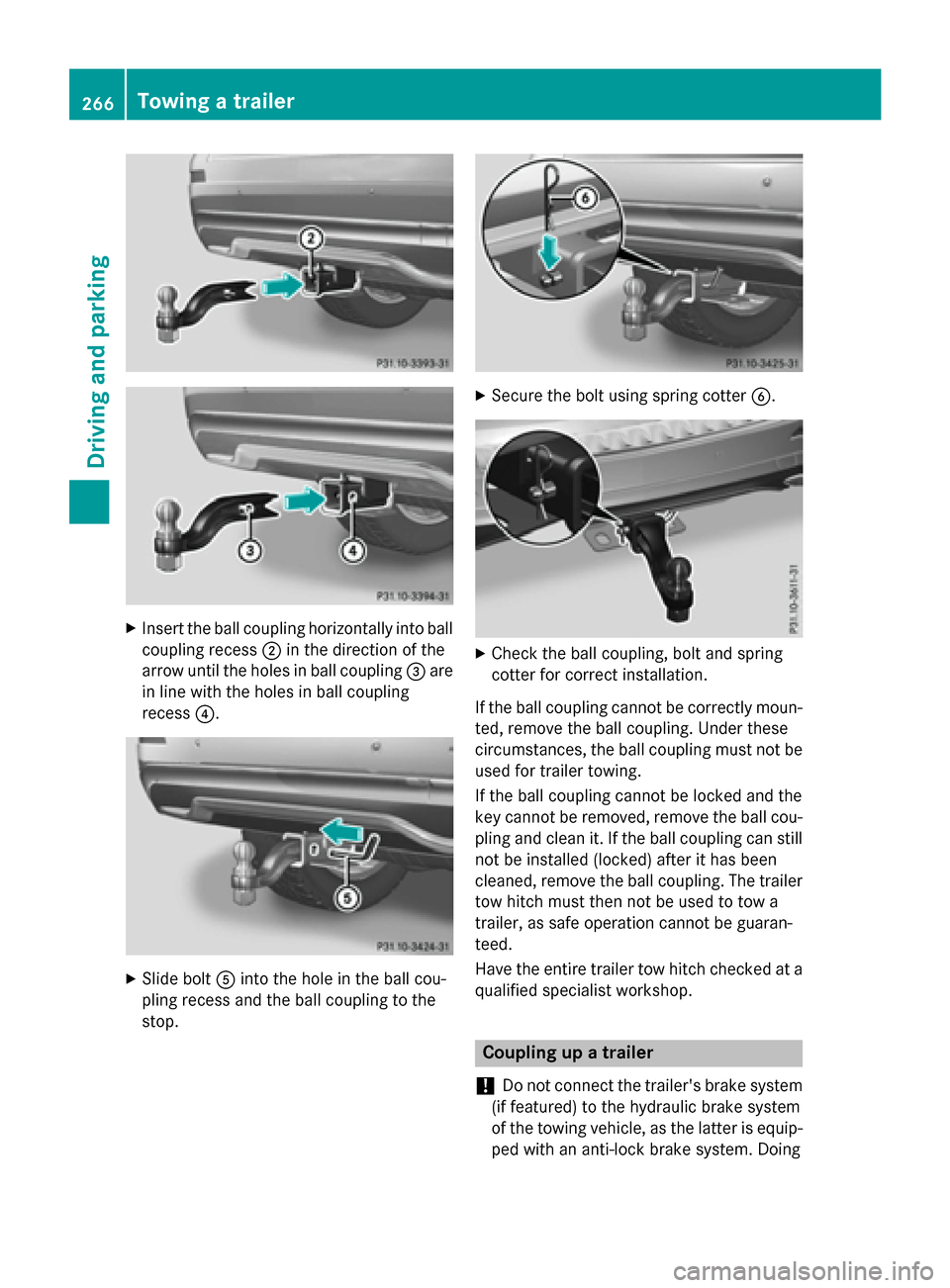
XInsert the ball coupling horizontally into ballcoupling recess ;in the direction of the
arrow until the holes in ball coupling =are
in line with the holes in ball coupling
recess ?.
XSlide bolt Ainto the hole in the ball cou-
pling recess and the ball coupling to the
stop.
XSecure the bolt using spring cotter B.
XCheck the ball coupling, bolt and spring
cotter for correct installation.
If the ball coupling cannot be correctly moun- ted, remove the ball coupling. Under these
circumstances, the ball coupling must not be
used for trailer towing.
If the ball coupling cannot be locked and the
key cannot be removed, remove the ball cou- pling and clean it. If the ball coupling can still
not be installed (locked) after it has been
cleaned, remove the ball coupling. The trailertow hitch must then not be used to tow a
trailer, as safe operation cannot be guaran-
teed.
Have the entire trailer tow hitch checked at a
qualified specialist workshop.
Coupling up a trailer
!
Do not connect the trailer's brake system
(if featured) to the hydraulic brake system
of the towing vehicle, as the latter is equip-
ped with an anti-lock brake system. Doing
266Towing a trailer
Driving and parking