2016 MERCEDES-BENZ GL-Class ECU
[x] Cancel search: ECUPage 178 of 462

Transmission positions
BPark position
Only shift the transmission into
positionPwhen the vehicle is sta-
tionary (
Ypage 189). The parking
lock should not be used as a brake
when parking. Always apply the
electronic parking brake in addi-
tion to the parking lock in order to
secure the vehicle.
If the vehicle electronics are mal-
functioning, the transmission may
be locked in position P. Have the
vehicle electronics checked imme-
diately at a qualified specialist
workshop.
Park position Pis automatically
engaged if:
Ryou switch off the engine using
the SmartKey and remove the
SmartKey
Ryou switch off the engine using
the SmartKey or using the Start/ Stop button and open the driv-
er's door or front-passenger
door
Rthe driver's door is opened when
the vehicle is stationary or driv-
ing at very low speed and the
transmission is in position Dor R
CReverse gear
Only shift the transmission into
position Rwhen the vehicle is sta-
tionary.
ANeutral
Do not shift the transmission to N
while driving. Otherwise, the auto-
matic transmission could be dam-
aged.
No power is transmitted from the
engine to the drive wheels.
Releasing the brakes will allow you
to move the vehicle freely, e.g. to
push it or tow it.
If ESP
®is deactivated or faulty:
shift the transmission to position N
if the vehicle is in danger of skid-
ding, e.g. on icy roads.
If you switch the engine off with the
transmission in position Ror D, the
automatic transmission shifts to N
automatically.
!Rolling in neutral Ncan damage
the drive train.
7Drive
The automatic transmission
changes gear automatically. All
forward gears are available.
Driving tips
Changing gear
The automatic transmission shifts to the indi-
vidual gears automatically when it is in trans-
mission position D. This automatic gear shift-
ing behavior is determined by:
Rthe selected drive program (Ypage 177)
Rthe position of the accelerator pedal
(
Ypage 176)
Rthe road speed
Accelerator pedal position
Your style of driving influences how the auto-
matic transmission shifts gear:
Rlittle throttle: early upshifts
Rmore throttle: late upshifts
176Automatic transmission
Driving an d parking
Page 183 of 462

Downshifting
XPull theleft-han dsteerin gwhee lpaddle
shifter (
Ypage 178).
The automatic transmissio nshift sdown to
th enext gear .
Maximum acceleration
XPull th eleft-han dsteerin gwhee lpaddle
shifter until th etransmissio nselects th e
optimum gear fo rth ecurren tspeed.
iIf you slo wdown or stop without shiftin g
down ,th eautomatic transmissio nauto-
matically shift sdown .
Kickdown
You can also use kickdown fo rmaximum
acceleration in manual drive program M.
XDepress th eaccelerator peda lbeyond th e
pressure point.
The automatic transmissio nshift sto a
lowe rgear dependin gon th eengin espeed.
XShift bac kup once th edesire dspeed is
reached.
iAll vehicles (except Mercedes-AMG
vehicles): if you apply full throttle, th e
automatic transmissio nshift sup to th e
next gear when th emaximum engin espeed
is reached. Thi sprevents th eengin efrom
overrevving.
iMercedes-AMG vehicles :it is no tpossi-
ble to use kickdown in manual drive pro -
gram M.
Switchin goff th emanual drive program
XVehicles wit hth eON&OFFROAD pack-
age :press th eprogram selecto rbutto n
(
Ypage 177).
The Mmessage in th emultifunction display
goe sout .
XMercedes-AMG vehicles :press th epro -
gram selecto rbutto n (
Ypage 177) repeat -
edly until Cor Sappears in th emultifunc-
tion display.
Automatic transmission181
Driving and parking
Z
Page 189 of 462

water. Seek medical assistance without
delay.
RChange out of clothing contaminated with
DEF immediately.
!Only use DEF in accordance with
ISO 22241. Do not mix any additives with
DEF, and do not dilute DEF with water. This
may destroy the BlueTEC exhaust gas after-
treatment system.
!The vehicle must be parked on level
ground to fill the DEF tank. The DEF tank
can only be filled as intended with the vehi-
cle parked on a level surface. This avoids
false level readings. Filling the tank is not
permitted if the vehicle is not parked on a
level surface. There is a danger of overfill-
ing, which could result in damage to com-
ponents of the BlueTEC exhaust gas after-
treatment.
!Rinse surfaces that have come into con-
tact with DEF immediately with water or
remove DEF using a damp cloth and cold
water. If the DEF has already crystallized,
use a sponge and cold water to clean it. DEF
residues crystallize after time and contam-
inate the affected surfaces.
!DEF is not a fuel additive and must not be
added to the fuel tank. If DEF is added to
the fuel tank, this can lead to engine dam-
age.
For further information on DEF, see
(
Ypage 450).
Opening the DEF filler cap
The fuel filler flap is unlocked or locked auto-
matically when you open or close the vehicle
with the SmartKey or with KEYLESS-GO.
XSwitch the ignition off.
XPress the fuel filler flap in the direction of
arrow :.
The fuel filler flap swings up.
XTurn blue DEF fuel filler cap ;counter-
clockwise and remove it.
DEF filler cap ;is secured with a plastic
strip.
DEF refill canisters
!Do not tighten the disposable hose with
too much force. The disposable hose may
otherwise be destroyed.
XUnscrew the cap from the opening on top of
DEF refill canister ;.
XPlace disposable hose :on the opening of
DEF refill canister ;and screw it on clock-
wise until hand-tight.
Refueling187
Driving and parking
Z
Page 190 of 462

iDisposable hose:remains closed until
you fasten disposable hose :to the DEF
filler neck of the vehicle.
XPlace disposable hose :on the filler neck
on the vehicle and screw it on clockwise
until hand-tight. When you feel resistance,
disposable hose :is sufficiently secured.
XLift up and tip DEF refill canister ;.
iFilling stops when the DEF tank is com-
pletely filled. Do not fill the DEF tank any
further. DEF refill canister ;can be
removed when it has been only partially
emptied.
XTurn disposable hose :on the filler neck
of the vehicle counter-clockwise and
remove it.
XTurn disposable hose :on the opening of
DEF refill canister ;counter-clockwise
and remove it.
XReseal DEF refill canister ;with the cap.
DEF refill canisters can be obtained at many
gas stations or at an authorized Mercedes-
Benz Center. DEF refill canisters are often
sold with a filler hose. A filler hose that does
not exactly fit the vehicle's DEF tank offers no protection against overfilling. DEF may leak if
overfilled. Mercedes-Benz offers a special
disposable hose with overfill protection. You
can obtain this from any auth
orized
Mercedes-Benz Center. DEF is available in a
variety of containers and receptacles. Only
use the disposable hose with the Mercedes-
Benz DEF refill canisters.
DEF refill bottle
!Only screw on the DEF refill bottle hand-
tight. It could otherwise be damaged.
XUnscrew the protective cap from DEF refill bottle :.
XPlace DEF refill bottle :on the filler neck
as shown and screw it on clockwise until
hand-tight.
XPress DEF refill bottle :towards the filler
neck.
The DEF tank is filled. This may take up to
one minute.
iWhen DEF refill bottle :is no longer
pressed, filling stops and the bottle may be
taken off again after being only partially
emptied.
XRelease DEF refill bottle :.
XTurn DEF refill bottle:counter-clockwise
and remove it.
XScrew the protective cap onto DEF refill
bottle :again.
DEF refill bottles can be obtained at many gas
stations or at an authorized Mercedes-Benz
Center. Refill bottles without a threaded cap
do not provide overfill protection. DEF may
leak if overfilled. Mercedes Benz offers spe-
cial refill bottles with a threaded seal. These
are available at any authorized Mercedes-
Benz Center.
188Refueling
Driving an d parking
Page 191 of 462
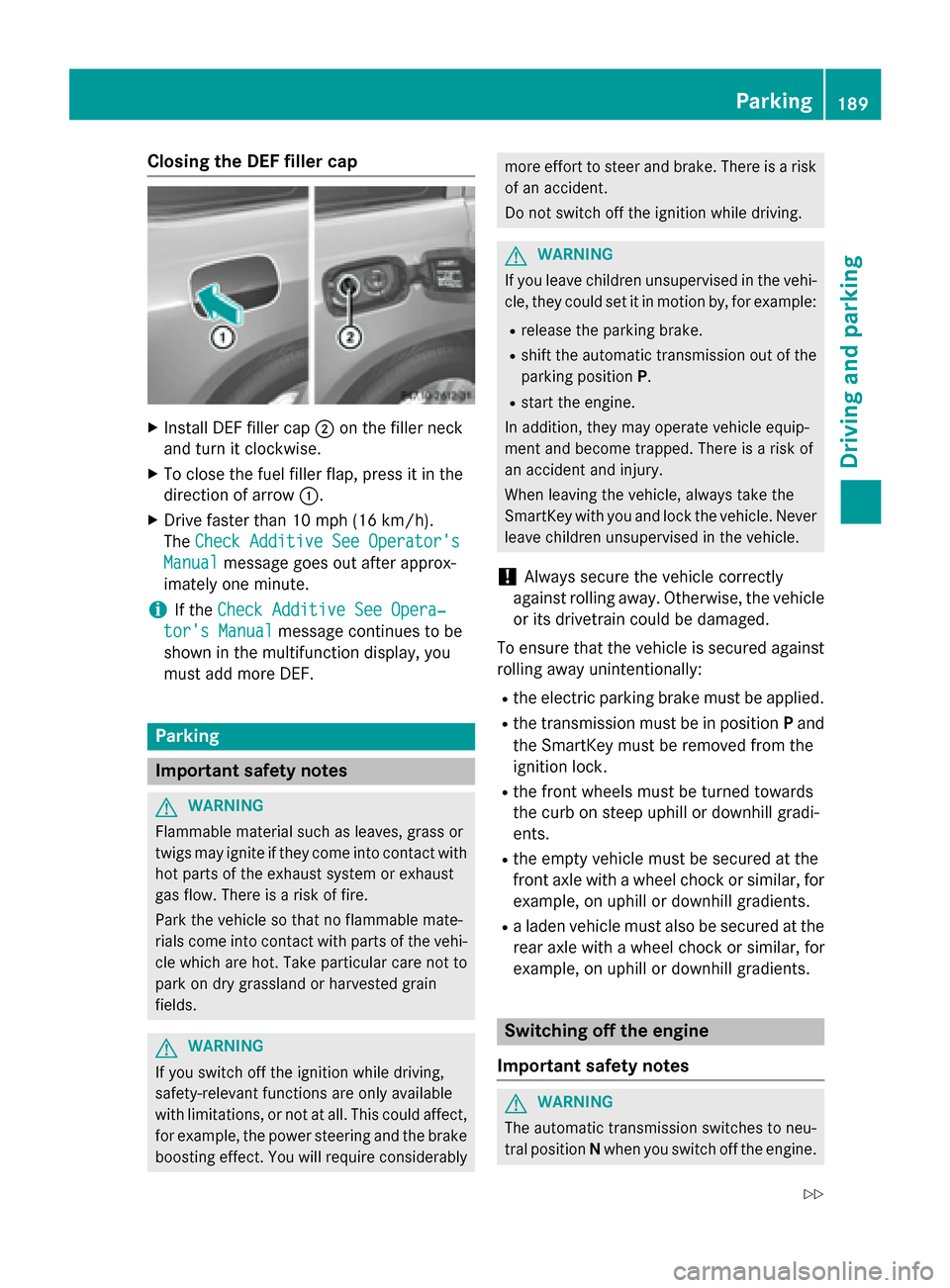
Closing the DEF filler cap
XInstall DEF filler cap;on the filler neck
and turn it clockwise.
XTo close the fuel filler flap, press it in the
direction of arrow :.
XDrive faster than 10 mph (16 km/h).
TheCheck Additive See Operator's
Manualmessage goes out after approx-
imately one minute.
iIf the Check Additive See Opera‐
tor's Manualmessage continues to be
shown in the multifunction display, you
must add more DEF.
Parking
Important safety notes
GWARNING
Flammable material such as leaves, grass or
twigs may ignite if they come into contact with
hot parts of the exhaust system or exhaust
gas flow. There is a risk of fire.
Park the vehicle so that no flammable mate-
rials come into contact with parts of the vehi-
cle which are hot. Take particular care not to
park on dry grassland or harvested grain
fields.
GWARNING
If you switch off the ignition while driving,
safety-relevant functions are only available
with limitations, or not at all. This could affect, for example, the power steering and the brake
boosting effect. You will require considerably
more effort to steer and brake. There is a risk
of an accident.
Do not switch off the ignition while driving.
GWARNING
If you leave children unsupervised in the vehi-
cle, they could set it in motion by, for example:
Rrelease the parking brake.
Rshift the automatic transmission out of the
parking position P.
Rstart the engine.
In addition, they may operate vehicle equip-
ment and become trapped. There is a risk of
an accident and injury.
When leaving the vehicle, always take the
SmartKey with you and lock the vehicle. Never
leave children unsupervised in the vehicle.
!Always secure the vehicle correctly
against rolling away. Otherwise, the vehicle
or its drivetrain could be damaged.
To ensure that the vehicle is secured against
rolling away unintentionally:
Rthe electric parking brake must be applied.
Rthe transmission must be in position Pand
the SmartKey must be removed from the
ignition lock.
Rthe front wheels must be turned towards
the curb on steep uphill or downhill gradi-
ents.
Rthe empty vehicle must be secured at the
front axle with a wheel chock or similar, for
example, on uphill or downhill gradients.
Ra laden vehicle must also be secured at the
rear axle with a wheel chock or similar, for
example, on uphill or downhill gradients.
Switching off the engine
Important safety notes
GWARNING
The automatic transmission switches to neu-
tral position Nwhen you switch off the engine.
Parking189
Driving and parking
Z
Page 193 of 462

The function of the electric parking brake is
dependent on the on-board voltage. If the on-
board voltage is low or there is a malfunction
in the system, it may not be possible to apply
the released parking brake.
XIf this is the case, only park the vehicle on
level ground and secure it to prevent it roll-
ing away.
XShift the automatic transmission to posi-
tionP.
It may not be possible to release an applied
parking brake if the on-board voltage is low or
there is a malfunction in the system. Contact
a qualified specialist workshop.
iThe electric parking brake performs a
function test at regular intervals while the
engine is switched off. The sounds that can
be heard while this is occurring are normal.
Applying or releasing manually
XTo engage: push handle :.
When the electric parking brake is
engaged, the F(USA only) or !
(Canada only) red indicator lamp lights up
in the instrument cluster.
iThe electric parking brake can also be
applied when the SmartKey is removed.
XTo release: pull handle:.
The red F(USA only) or !(Canada
only) indicator lamp in the instrument clus- ter goes out.
iThe electric parking brake can only be
released:
Rif the SmartKey is in position 1in the
ignition lock (
Ypage 165) or
Rif the ignition was switched on using the
Start/Stop button
To ensure that you do not roll backwards
when pulling away on an uphill slope, engage
the electric parking brake (
Ypage 168).
Applying automatically
The electric parking brake is applied auto-
matically:
Rif DISTRONIC PLUS brings the vehicle to a
standstill or
Rif the HOLD function is keeping the vehicle
stationary
In addition, at least one of the following con-
ditions must be fulfilled:
Rthe engine is switched off.
Rthe driver's door is open and the seat belt is not fastened.
Rthe vehicle is stationary for a lengthy
period.
The red F(USA only) or !(Canada
only) indicator lamp in the instrument cluster
lights up.
The electric parking brake is not automati-
cally engaged if the engine is switched off by the ECO start/stop function.
Releasing automatically
The electric parking brake is released auto-
matically when all of the following conditions
are fulfilled:
Rthe engine is running.
Rthe transmission is in position Dor R.
Rthe seat belt has been fastened.
Ryou depress the accelerator pedal.
Parking191
Driving and parking
Z
Page 201 of 462

specialist workshop as soon as possible.
Adapt your driving style to the different brak-
ing characteristics.
Driving off-road increases the likelihood of
damage to the vehicle, which, in turn, can lead
to failure of the mechanical assembly or sys-
tems. Adapt your driving style to suit the ter-
rain conditions. Drive carefully. Have damage
to the vehicle rectified immediately at a quali-
fied specialist workshop.
Do not switch to transmission positionN
when driving off-road. If you try to brake the
vehicle using the service brake, you could
lose control of the vehicle. If the gradient is
too steep for your vehicle, drive back down in
reverse gear.
General notes
Read this section carefully before driving your
vehicle off-road. Practice by driving over more
gentle off-road terrain first.
Familiarize yourself with the characteristics
of your vehicle and the gear shift operation
before driving through difficult terrain.
The following driving systems are specially
adapted to off-road driving:
ROff-road program 1 and 2 (vehicles with the
ON&OFFROAD package) (
Ypage 258)
RLOW RANGE off-road gear (vehicles with
the ON&OFFROAD package)
(
Ypage 259)
RDifferential lock (vehicles with the
ON&OFFROAD package) (
Ypage 259)
ROff-road ABS (Ypage 69)
ROff-road 4ETS (Ypage 73)
RAIRMATIC package (vehicle level)
(
Ypage 218)
RDSR (Downhill Speed Regulation)
(
Ypage 257)
Observe the following notes:
RStop the vehicle before starting to drive
along an off-road route.
RSelect a vehicle level that is suitable for the
terrain. To avoid damaging the vehicle, make sure there is always sufficient ground
clearance.
RCheck that items of luggage and loads are
stowed safely and are well secured
(
Ypage 345).
RAlways keep the engine running and in gear
when driving on a downhill gradient. Acti-
vate DSR (
Ypage 257).
RAlways keep the engine running and in gear
when driving on a slope.
RAdapt your speed to the terrain. The
rougher, steeper or more ruts on the ter-
rain, the slower your speed should be.
RDo not jump with the vehicle as this will
interrupt the vehicle's propulsion.
RDrive with extreme care on unfamiliar off-
road routes where visibility is poor. For
safety reasons, get out of the vehicle first
and survey the off-road route.
RLook out for obstacles, such as rocks,
holes, tree stumps and furrows.
RAlways keep the doors, the tailgate, the
side windows and the sliding sunroof
closed while the vehicle is in motion.
RDo not shift the automatic transmission to
transmission position N.
RObserve the notes on off-road fording
(
Ypage 197).
iDo not use the HOLD function when driv-
ing off-road, on steep uphill or downhill gra-
dients or on slippery or loose surfaces. The
HOLD function cannot hold the vehicle on
such surfaces.
Checklist before driving off-road
!If the engine oil warning lamp lights up
while the vehicle is in motion, stop the vehi- cle in a safe place as soon as possible.
Check the engine oil level. The engine oil
warning lamp warning must not be ignored.
Continuing the journey while the symbol is
displayed could lead to engine damage.
XEngine oil level: check the engine oil level
and add oil if necessary.
Driving tips199
Driving and parking
Z
Page 210 of 462

Activating
XBrieflypullthe cruise control lever towards
you =, up :ordown ?.
DI ST RONIC PLUS isselected.
XTo ad just the set speed in 1 mph incre-
ments (1 km/h increments): briefly
press the cruise control lever up :to the
pressure point for a higher speed, or
down ?for a lower speed.
Every time the cruise control lever is
pressed up or down, the last speed stored
is increased or reduced.
or
XTo ad just the set speed in 5 mph incre-
ments (10 km/h increments): briefly
press the cruise control lever up :past
the pressure point for a higher speed, or
down ?for a lower speed.
Every time the cruise control lever is
pressed up or down, the last speed stored
is increased or reduced.
XRemove your foot from the accelerator
pedal.
Your veh icleadapts its speed to that of the
veh icle in front, but only up to the desired
stored speed.
When driving at speeds below 20 mph
(30 km /h), you can only activate DISTRONIC
PLUS ifthe vehicle infront has been detected
and isshown in the multifunction display. If
the veh icle infrontisno longer detected and
disp layed, for example because ithas
changed lanes, DI STRONIC PLUS isdeactiva-
te d. You willhear a warning tone ifth is is the
case.
iIf you donot fully release the accelerator
pedal, theDISTRONIC
PLUSPassivemes-
sage appears inthe multifunction display.
The set distance to a slower-moving vehicle
in front willthen not bemaintaine d.You will
be driv ing at the speed you determine by
the position of the accelerator pedal. Activating at
the current speed/last
stored speed
GWARNIN G
If you call up th estore dspee dand it differs
from th ecurren tspeed, th evehicl eacceler -
ate sor decelerates. If you do no tknow th e
store dspeed, th evehicl ecould accelerate or
brak eune xpectedly. Ther eis aris kof an acci-
dent.
Pay attentio nto th eroad and traffic condi-
tions before calling up th estore dspeed. If you
do no tknow th estore dspeed, store th e
desired spee dagain .
XBriefly pullthe cruise control lever towards
you =.
XRemo veyour foot from the accelerator
pedal.
DI ST RONIC PLUS isoperational and when
first activated accepts the current speed or adjusts the vehicle's speed to the last
speed store d.
Driving with DISTRONIC PLUS
Pulling away and driving
XIfyou want topull away with
DISTRO NIC PLUS: remove your foot from
the brake pedal.
XBriefly pull the cruise control lever towards
you =, up :or down ?.
or
XAccelerate briefly.
Your veh iclepulls away and adapts its
speed to that of the vehicle infront.
If there isno vehicle infront, DI STRONIC
PLUS operates inthe same way as cruise
control.
If DI ST RONIC PLUS detects that the vehicle in
front has slowed down,it brakes your vehicle.
In this way, the distance you have selected is
maintaine d.
If DI ST RONIC PLUS detects a faster-moving
vehicle infront, itincreases the driving speed.
208Driving systems
Driving and parking