2016 MERCEDES-BENZ G-Class towing capacity
[x] Cancel search: towing capacityPage 18 of 302

Warning message .......................... 270
Tires
Aspect ratio (definition) ................. 280
Average weight of the vehicle
occupants (definition) .................... 279
Bar (definition) ...............................2 79
Changing a wheel .......................... 281
Characteristics .............................. 279
Checking ........................................ 262
Curb weight (definition) ................. 280
Definition of terms ......................... 279
Direction of rotation ...................... 282
Display message ............................ 198
Distribution of the vehicle occu-
pants (definition) ............................ 281
DOT (Department of Transporta-
tion) (definition) ............................. 279
DOT, Tire Identification Number
(TIN) ............................................... 278
GAWR (Gross Axle Weight Rating)
(definition) ..................................... 279
GTW (Gross Trailer Weight) (defi-
nition) ............................................ 279
GVW (Gross Vehicle Weight) (def-
inition) ........................................... 279
GVWR (Gross Vehicle Weight Rat-
ing) (definition) .............................. 280
Important safety notes .................. 262
Increased vehicle weight due to
optional equipment (definition) ...... 279
Kilopascal (kPa) (definition) ........... 280
Labeling (overview) ........................ 275
Load bearing index (definition) ...... 281
Load index ..................................... 277
Load index (definition) ................... 280
Maximum load on a tire (defini-
tion) ............................................... 280
Maximum loaded vehicle weight
(definition) ..................................... 280
Maximum permissible tire pres-
sure (definition) ............................. 280
Maximum tire load ......................... 278
Maximum tire load (definition) ....... 280
Optional equipment we ight (
defi-
nition) ............................................ 281
PSI (pounds per square inch) (def-
inition) ........................................... 280
Replacing ....................................... 281 Service life ..................................... 263
Sidewall (definition) ....................... 280
Speed rating (definition) ................ 279
Storing ........................................... 282
Structure and characteristics
(definition) ..................................... 279
Technical data ............................... 284
Temperature .................................. 275
TIN (Tire Identification Number)
(definition) ..................................... 281
Tire bead (definition) ...................... 280
Tire pressure (definition) ................ 280
Tire pressures (recommended) ...... 279
Tire size (data) ............................... 284
Tire size designation, load-bearing
capacity, speed rating .................... 276
Tire tread ....................................... 263
Tire tread (definition) ..................... 280
Total load limit (definition) ............. 281
Traction ......................................... 275
Traction (definition) ....................... 281
Tread wear ..................................... 274
TWR (permissible trailer drawbar
noseweight) (definition) ................. 281
Uniform Tire Quality Grading
Standards ...................................... 274
Uniform Tire Quality Grading
Standards (definition) .................... 279
Wear indicator (definition) ............. 281
Wheel rim (definition) .................... 279
see Flat tire
Top Tether ............................................ 49
Tow-starting
Emergency engine starting ............ 259
Important safety notes .................. 256
Towing a trailer
Axle load, permissible .................... 298
Driving tips .................................... 166
Lights display message .................. 189
Mounting dimensions .................... 297
Shift range ..................................... 122
Trailer loads ................................... 298
Trailer tow hitch ............................. 297
Towing away
Important safety guidelines ........... 256
In the eve nt o
f malfunctions .......... 258
With both axles on the ground ....... 257
16Index
Page 274 of 302
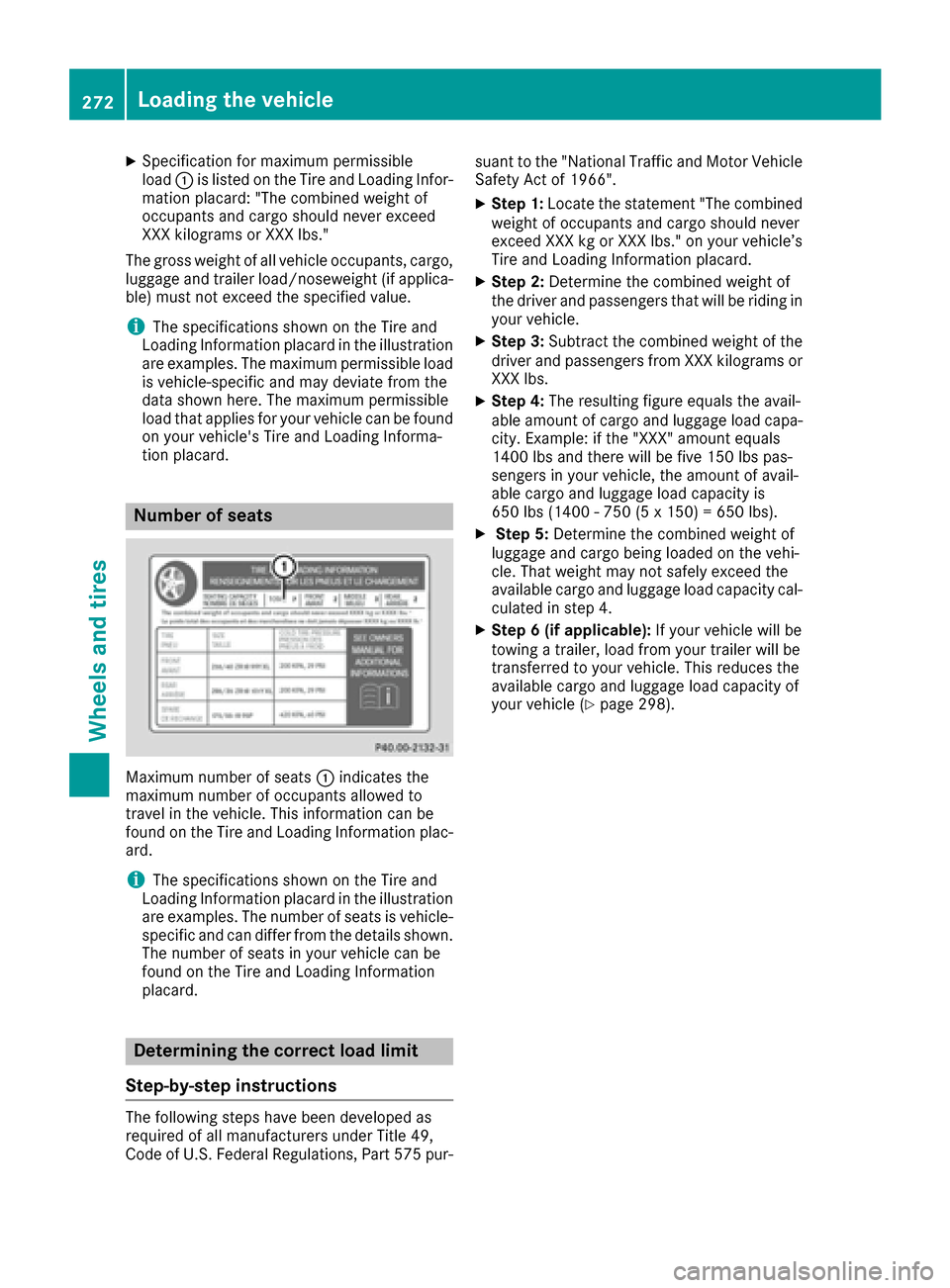
XSpecification for maximum permissible
load:is listed on the Tire and Loading Infor-
mation placard: "The combined weight of
occupants and cargo should never exceed
XXX kilograms or XXX lbs."
The gross weight of all vehicle occupants, cargo,
luggage and trailer load/noseweight (if applica-
ble) must not exceed the specified value.
iThe specifications shown on the Tire and
Loading Information placard in the illustration are examples. The maximum permissible load
is vehicle-specific and may deviate from the
data shown here. The maximum permissible
load that applies for your vehicle can be found
on your vehicle's Tire and Loading Informa-
tion placard.
Number of seats
Maximum number of seats :indicates the
maximum number of occupants allowed to
travel in the vehicle. This information can be
found on the Tire and Loading Information plac-
ard.
iThe specifications shown on the Tire and
Loading Information placard in the illustration
are examples. The number of seats is vehicle-
specific and can differ from the details shown.
The number of seats in your vehicle can be
found on the Tire and Loading Information
placard.
Determining the correct load limit
Step-by-step instructions
The following steps have been developed as
required of all manufacturers under Title 49,
Code of U.S. Federal Regulations, Part 575 pur- suant to the "National Traffic and Motor Vehicle
Safety Act of 1966".
XStep 1: Locate the statement "The combined
weight of occupants and cargo should never
exceed XXX kg or XXX lbs." on your vehicle’s
Tire and Loading Information placard.
XStep 2: Determine the combined weight of
the driver and passengers that will be riding in your vehicle.
XStep 3: Subtract the combined weight of the
driver and passengers from XXX kilograms or
XXX lbs.
XStep 4: The resulting figure equals the avail-
able amount of cargo and luggage load capa-
city. Example: if the "XXX" amount equals
1400 lbs and there will be five 150 lbs pas-
sengers in your vehicle, the amount of avail-
able cargo and luggage load capacity is
650 lbs (1400 - 750 (5 x 150) = 650 lbs).
XStep 5: Determine the combined weight of
luggage and cargo being loaded on the vehi-
cle. That weight may not safely exceed the
available cargo and luggage load capacity cal- culated in step 4.
XStep 6 (if applicable): If your vehicle will be
towing a trailer, load from your trailer will be
transferred to your vehicle. This reduces the
available cargo and luggage load capacity of
your vehicle (
Ypage 298).
272Loading the vehicle
Wheels and tires
Page 294 of 302
The vehicle will use more fuel than usual in the
following situations:
Rat very low outside temperatures
Rin city traffic
Ron short journeys
Rin mountainous terrain
Rwhen towing a trailer
Engine oil
General notes
!Never use engine oil or an oil filter of a spec-
ification other than is necessary to fulfill the
prescribed service intervals. Do not change
the engine oil or oil filter in order to achieve
longer replacement intervals than those pre-
scribed. You could otherwise cause engine
damage or damage to the exhaust gas after-
treatment.
Follow the instructions in the service interval display regarding the oil change. Otherwise,
you may damage the engine and the exhaust
gas aftertreatment.
When handling engine oil, observe the important
safety notes on service products (
Ypage 289).
The engine oils are matched to the performance
of Mercedes-Benz engines and service intervals.
For this reason, only use engine oils and oil fil-
ters that are approved for vehicles with a service
system.
For a list of approved engine oils and oil filters,
consult an authorized Mercedes-Benz Center or
go to the Internet site
http://bevo.mercedes-benz.com (USA only).
The table shows which engine oils have been
approved for your vehicle.
ModelMB-Freigabe or MB
Approval
G 550229.3 / 229.5
G 63 AMG229.5
iThe MB-Freigabe or MB Approval is stated
on the oil containers.
Filling capacities
The following values refer to an oil change
including the oil filter.
Vehicle modelCapacity including oil filter
G 5502.4 US gal (9.0 l)
G 63 AMG2.25 US gal (8.5 l)
Additives
!Do not use any additives in the engine oil.
This could damage the engine.
Engine oil viscosity
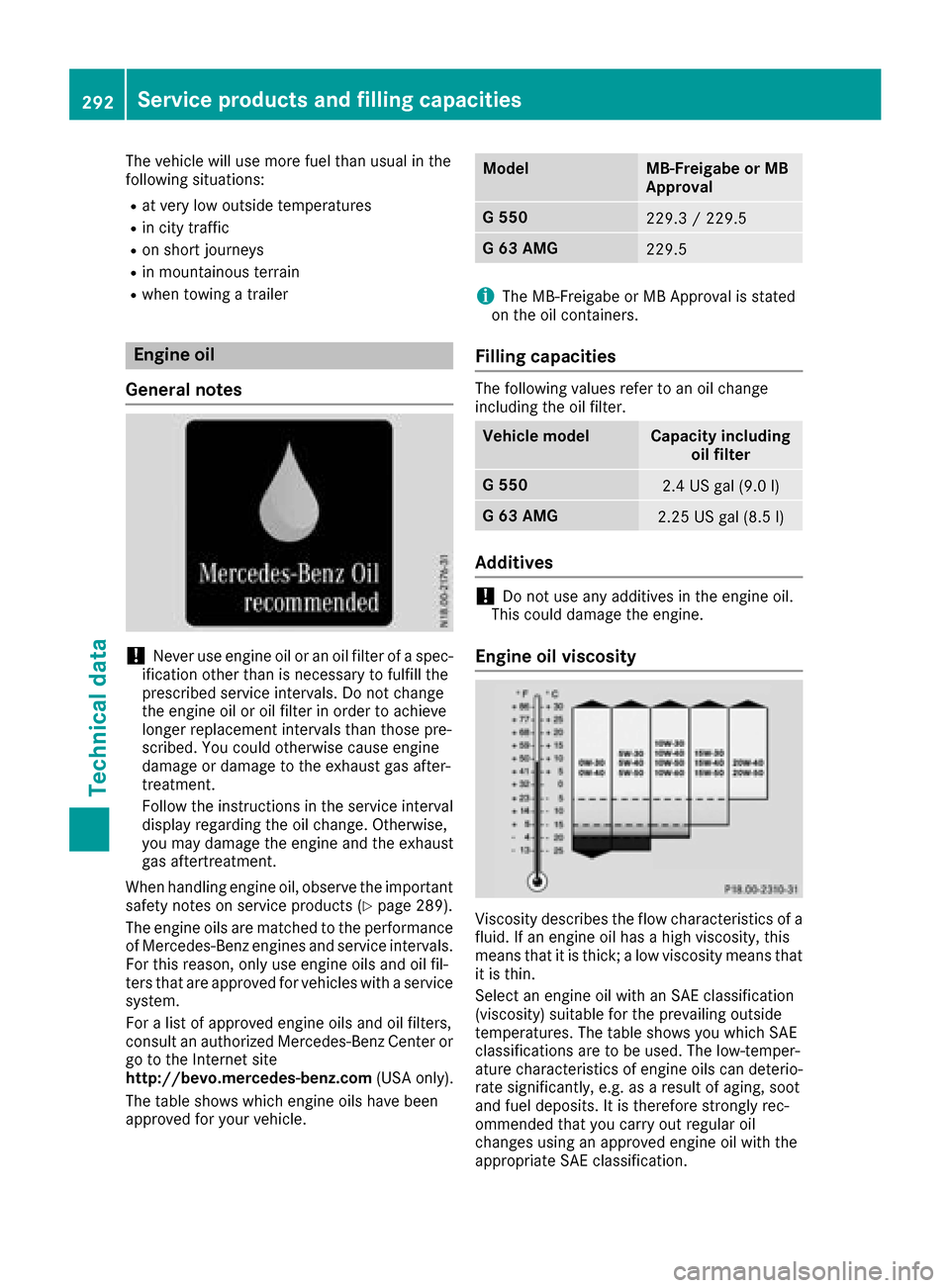
Viscosity describes the flow characteristics of a
fluid. If an engine oil has a high viscosity, this
means that it is thick; a low viscosity means that it is thin.
Select an engine oil with an SAE classification
(viscosity) suitable for the prevailing outside
temperatures. The table shows you which SAE
classifications are to be used. The low-temper-
ature characteristics of engine oils can deterio-
rate significantly, e.g. as a result of aging, soot
and fuel deposits. It is therefore strongly rec-
ommended that you carry out regular oil
changes using an approved engine oil with the
appropriate SAE classification.
292Service products and filling capacities
Technical data