2016 MERCEDES-BENZ G-Class lock
[x] Cancel search: lockPage 17 of 302

Steering wheel heating .................... 78
Storing settings (memory func-
tion) ................................................. 82
Steering wheel heating
Indicator lamp (malfunction) ............ 79
Steering wheel paddle shifters ........ 123
Stopwatch (RACETIMER) ................... 182
Stowage areas ................................... 215
Stowage compartment
Door stowage compartment .......... 216
Stowage compartments
Armrest (under) ............................. 216
Cup holders ................................... 220
Glove box ....................................... 215
Important safety information ......... 215
Stowage pockets ........................... 216
Summer tires ..................................... 264
Sun visor ............................................ 221
Surround lighting (on-board com-
puter) .................................................. 179
SUV
(Sport Utility Vehicle) ....................... 22
Switching air-recirculation mode
on/off ................................................. 107
Switching off the alarm (ATA) ............ 59
T
Tachometer........................................ 171
Tail lamps
Display message ............................ 191
see Lights
Tank content
Fuel gauge ..................................... 171
Technical data
Capacities ...................................... 289
Tires ............................................... 284
Tires/wheels ................................. 284
Trailer loads ................................... 298
Vehicle data ................................... 295
Wheels ........................................... 284
TELEAID
Call priority .................................... 228
Downloading destinations
(COMAND) ..................................... 228
Downloading routes ....................... 230
Emergency call .............................. 225
Geo fencing ................................... 230 Important safety notes .................. 224
Locating a stolen vehicle ............... 229
MB info call button ........................ 227
Remote vehicle locking .................. 229
Roadside Assistance button .......... 226
Self-test ......................................... 225
Speed alert .................................... 230
System .......................................... 225
Triggering the vehicle alarm ........... 231
Vehicle remote malfunction diag-
nosis .............................................. 229
Vehicle remote unlocking .............. 228
Telephone
Accepting a call ............................. 177
Display message ............................ 202
Menu (on-board computer) ............ 177
Number from the phone book ........ 177
Redialing ........................................ 178
Rejecting/ending a call ................. 177
Telephone compartment .................. 216
Temperature
Coolant .......................................... 171
Coolant (on-board computer) ......... 182
Engine oil (on-board computer) ...... 182
Outside temperature ...................... 171
Setting (climate control) ................ 105
Theft deterrent systems
ATA (Anti-Theft Alarm system) ......... 59
Immobilizer ...................................... 59
Tilt/sliding sunroof
see Sliding sunroof
Time
see separate operating instructions
Timing (RACETIMER) ......................... 182
Tire pressure
Calling up (on-board computer) ..... 268
Checking manually ........................ 268
Display messa ge ............................ 198
Ma
ximum ....................................... 268
Notes ............................................. 266
Recommended ............................... 265
Table (single tires) ......................... 266
Tire pressure monitor
Checking the tire pressure elec-
tronically ........................................ 270
Function/notes ............................. 268
Restarting ...................................... 270
Warning lamp ................................. 213
Index15
Page 19 of 302

Towing eyeFront .............................................. 257
Rear ...............................................2 57
Trailer
7-pin connector .............................1 69
Power supply ................................. 168
Trailer coupling (cleaning instruc-
tions) ..................................................2 45
Trailer loads
Technical data ............................... 298
Trailer tow hitch
Ball position ................................... 298
Trailer towing
ESP
®................................................ 58
PARKTRONIC ................................. 160
Transfer case
General notes ................................ 162
Shift range ..................................... 162
Shifting .......................................... 162
Shifting (general notes) .................. 162
Shifting (important safety notes) ... 162
Shifting to neutral .......................... 163
Switching off the off-road gear
ratio ............................................... 163
Switching on the off-road gear
ratio ............................................... 163
Transmission
see Automatic transmission
Transmission positions .................... 121
Transporting the vehicle .................. 258
Traveling uphill
Brow of hill ..................................... 140
Trip computer (on-board com-
puter) .................................................. 173
Trip odometer
Calling up ....................................... 173
Resetting (on-board computer) ...... 174
Turn signals
Changing bulbs (front) ..................... 94
Display message ............................ 190
Switching on/off .............................. 88
TWR (Tongue Weight Rating) (defi-
nition) ................................................. 281
Type identification plate
see Vehicle identification plate
U
UnlockingEmergency unlocking ....................... 66
From inside the vehicle (central
unlocking button) ............................. 65
V
Vanity mirrorSun visor ........................................ 221
Variable SPEEDTRONIC
Function/notes ............................. 145
Vehicle
Correct use ...................................... 23
Data acquisition ............................... 24
Display message ............................ 201
Emergency locking ........................... 66
Emergency unlocking ....................... 66
Equipment ....................................... 20
Individual settings .......................... 178
Limited Warranty ............................. 24
Loading .......................................... 271
Locking (SmartKey) .......................... 60
Lowering ........................................ 284
Maintenance .................................... 21
Parking for a long period ................ 132
Pulling away ................................... 113
Raising ........................................... 282
Reporting problems ......................... 23
Securing from rolling away ............ 282
Tow-starting ................................... 256
Towing away .................................. 256
Transporting .................................. 258
Unlocking (SmartKey) ...................... 60
Vehicle data ................................... 295
Vehicle data ....................................... 295
Vehicle data (off-road driving)
Approach/departure angle ............ 296
Fording depth ................................ 296
Maximum gradient climbing abil-
ity .................................................. 297
Vehicle dimensions ........................... 295
Vehicle identification number
see VIN
Vehicle identification plate .............. 288
Vehicle tool kit .................................. 248
Index17
Page 28 of 302
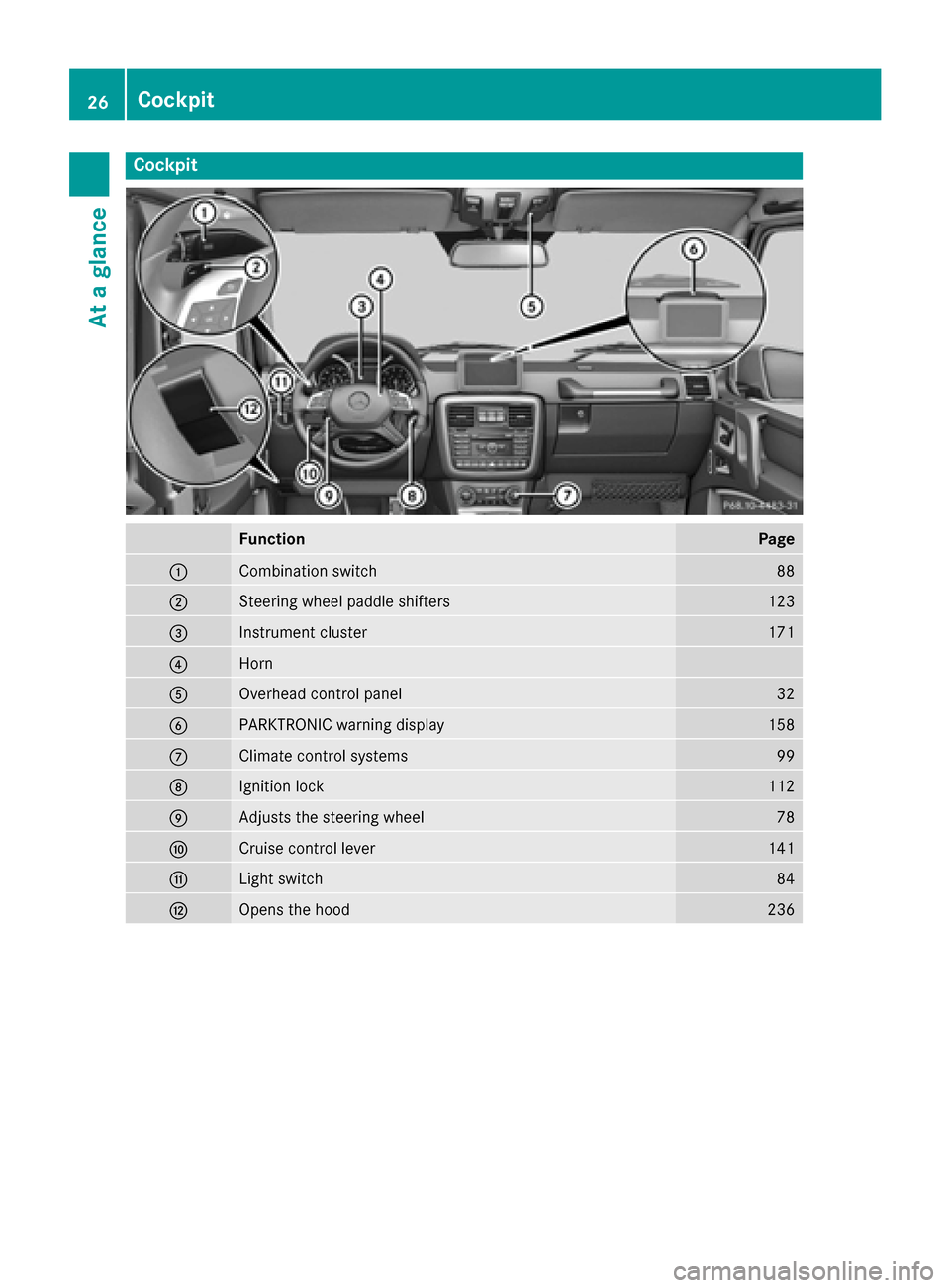
Cockpit
FunctionPage
:Combination switch88
;Steering wheel paddle shifters123
=Instrument cluster171
?Horn
AOverhead control panel32
BPARKTRONIC warning display158
CClimate control systems99
DIgnition lock112
EAdjusts the steering wheel78
FCruise control lever141
GLight switch84
HOpens the hood236
26Cockpit
At a glance
Page 35 of 302

Door controlpanel
FunctionPage
:n Activates/deactivates
th eoverride feature fo rth e
sid ewindows in th erea r
compartmen t
54
;WOpens/closes th esid e
windows68
=7Z ö\
Adjust sand folds th eexterio r
mirrors in/out electrically
80
FunctionPage
?r 45 =Stores
setting sfo rth eseat ,exterio r
mirrors and steerin gwhee l
(memory function )
82
AAdjuststh eseat s74
B%&Unlocks/locks
the vehicle65
COpens the door64
Door control panel33
At a glance
Page 36 of 302
Useful information
i
This Operator's Manual describes all models
and all standard and optional equipment of
your vehicle available at the time of publica-
tion of the Operator's Manual. Country-spe-
cific differences are possible. Please note
that your vehicle may not be equipped with all
features described. This also applies to
safety-related systems and functions.
iRead the information on qualified specialist
workshops: (Ypage 23).
Panic alarm
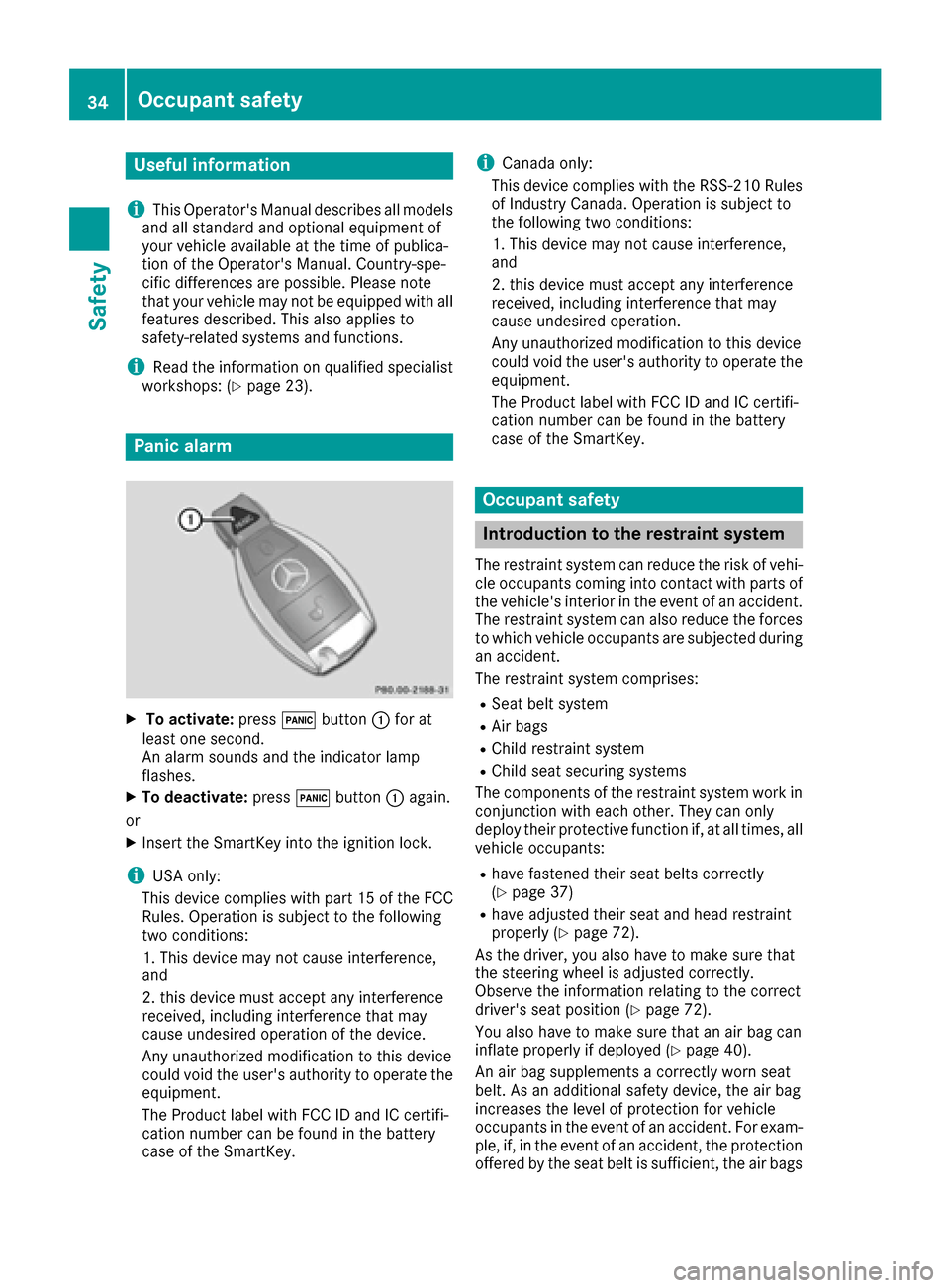
XTo activate: press!button :for at
least one second.
An alarm sounds and the indicator lamp
flashes.
XTo deactivate: press!button :again.
or
XInsert the SmartKey into the ignition lock.
iUSA only:
This device complies with part 15 of the FCC
Rules. Operation is subject to the following
two conditions:
1. This device may not cause interference,
and
2. this device must accept any interference
received, including interference that may
cause undesired operation of the device.
Any unauthorized modification to this device
could void the user's authority to operate the
equipment.
The Product label with FCC ID and IC certifi-
cation number can be found in the battery
case of the SmartKey.
iCanada only:
This device complies with the RSS-210 Rules
of Industry Canada. Operation is subject to
the following two conditions:
1. This device may not cause interference,
and
2. this device must accept any interference
received, including interference that may
cause undesired operation.
Any unauthorized modification to this device
could void the user's authority to operate the equipment.
The Product label with FCC ID and IC certifi-
cation number can be found in the battery
case of the SmartKey.
Occupant safety
Introduction to the restraint system
The restraint system can reduce the risk of vehi-
cle occupants coming into contact with parts of
the vehicle's interior in the event of an accident.
The restraint system can also reduce the forces
to which vehicle occupants are subjected during
an accident.
The restraint system comprises:
RSeat belt system
RAir bags
RChild restraint system
RChild seat securing systems
The components of the restraint system work in
conjunction with each other. They can only
deploy their protective function if, at all times, all
vehicle occupants:
Rhave fastened their seat belts correctly
(Ypage 37)
Rhave adjusted their seat and head restraint
properly (Ypage 72).
As the driver, you also have to make sure that
the steering wheel is adjusted correctly.
Observe the information relating to the correct
driver's seat position (
Ypage 72).
You also have to make sure that an air bag can
inflate properly if deployed (
Ypage 40).
An air bag supplements a correctly worn seat
belt. As an additional safety device, the air bag
increases the level of protection for vehicle
occupants in the event of an accident. For exam-
ple, if, in the event of an accident, the protection
offered by the seat belt is sufficient, the air bags
34Occupant safety
Safety
Page 38 of 302
led child restraint system, and the age and
size of the child. Therefore, always observe
the information on "Children in the vehicle"
(
Ypage 46). There you will also find instruc-
tions on rearward and forward-facing child
restraint systems on the front-passenger
seat.
RAll other persons: the PASSENGER AIR BAG
OFF indicator lamp must be off. Be sure to
observe the notes on "Seat
belts“ (
Ypage 36) and "Air bags"
(Ypage 40). There you can also find infor-
mation on the correct seat position.
Observe the information on the BabySmart™ air
bag deactivation system in the front-passenger
seat (
Ypage 50).
Seat belts
Introduction
Seat belts are the most effective means of
restricting the movement of vehicle occupants
in the event of an accident or the vehicle rolling
over. This reduces the risk of vehicle occupants coming into contact with parts of the vehicle
interior or being ejected from the vehicle. Fur-
thermore, the seat belt helps to keep the vehicle
occupant in the best position in relation to the
air bag.
The seat belt system comprises:
RSeat belts
REmergency Tensioning Devices for the front
seat belts and the outer seat belts in the rear
RBelt force limiters
If the seat belt is pulled out at the belt sash guide
quickly or with a jerky movement, the belt
retractor locks. The belt strap cannot be extrac-
ted any further.
The Emergency Tensioning Device tightens the
seat belt in an accident, pulling the belt close
against the body. However it does not pull the
vehicle occupant back in the direction of the
backrest.
The Emergency Tensioning Device does not cor-
rect an incorrect seat position or the routing of
an incorrectly fastened seat belt.
When triggered, a belt force limiter helps to
reduce the force exerted by the seat belt on the
vehicle occupant.
The belt force limiters for the front seats are
synchronized with the front air bags, which absorb part of the deceleration force. This can
reduce the force exerted on the vehicle occu-
pants during an accident.
!If the front-passenger seat is unoccupied,
do not insert the belt tongue into the buckle of
the front-passenger seat. This may otherwise
lead to the triggering of the Em ergenc
y Ten-
sioning Device in the event of an accident,
which will then need to be replaced.
Important safety notes
The use of seat belts and child restraint systems is required by law in:
Rall 50 states
Rthe U.S. territories
Rthe District of Columbia
Rall Canadian provinces
Even where this is not required by law, all vehicle
occupants should correctly fasten their seat
belts before starting the journey.
GWARNING
If the seat belt is incorrectly fastened, it can-
not protect as intended. Furthermore, an
incorrectly fastened seat belt can cause addi-
tional injury, for example, in an accident, dur-
ing braking or when abruptly changing direc-
tion. This poses an increased risk of injury or
even fatal injury.
Make sure that all vehicle occupants are
seated properly with a correctly fastened seat belt.
GWARNING
The seat belt does not offer the intended level of protection if you have not moved the back-
rest to an almost vertical position. When brak-
ing or in the event of an accident, you could
slide underneath the seat belt and sustain
abdomen or neck injuries, for example. This
poses an increased risk of injury or even fatal injury.
Adjust the seat properly before beginning
your journey. Always ensure that the backrest
is in an almost vertical position and that the
shoulder section of your seat belt is routed
across the center of your shoulder.
36Occupant safety
Safety
Page 46 of 302
Method of operation
During the first stage of a collision, the restraint
system control unit evaluates important physi-
cal data relating to vehicle deceleration or accel-
eration, such as:
Rduration
Rdirection
Rintensity
Based on the evaluation of this data, the
restraint system control unit triggers the Emer-
gency Tensioning Devices during a frontal or
rear collision.
An Emergency Tensioning Device can only be
triggered, if:
Rthe ignition is switched on
Rthe components of the restraint system are
operational; see "Restraint system warning
lamp" (
Ypage 35)
Rthe belt tongue is engaged in the buckle on
the respective front-passenger seat
The Emergency Tensioning Devices in the rear
compartment are triggered independently of the
lock status of the seat belts.
If the restraint system control unit detects a
more severe accident, further components of
the restraint system are activated independ-
ently of each other in certain frontal collision
situations:
RDriver's air bag
RFront-passenger front air bag
The front-passenger front air bag is activated or
deactivated depending on the person on the
front-passenger seat. The front-passenger front
air bag can only deploy in an accident if the
PASSENGER AIR BAG OFF indicator lamp is off.
Observe the information on the PASSENGER AIR
BAG OFF indicator lamp (
Ypage 35).
Your vehicle has a two-stage driver's air bag.
During the first deployment stage the driver's air
bag fills with sufficient propellant gas to reduce
the risk of injuries. The front air bag is fully
deployed with the maximum amount of propel-
lant gas if a second deployment threshold is
reached within a few milliseconds.
The activation threshold of the Emergency Ten-
sioning Devices and the air bag are determined
by evaluating the rate of vehicle deceleration or
acceleration which occurs at various points in
the vehicle. This process i
s pre-emptive in
nature. Deployment should take place in good
time at the start of the collision. The rate of vehicle deceleration or acceleration
and the direction of the force are essentially
determined by:
Rthe distribution of forces during the collision
Rthe collision angle
Rthe deformation characteristics of the vehicle
Rthe characteristics of the object with which
the vehicle has collided
Factors which can only be seen and measured
after a collision has occurred do not play a deci-
sive role in the deployment of an air bag. Nor do
they provide an indication of air bag deploy-
ment.
The vehicle can be deformed considerably, with-
out an air bag being deployed. This is the case if
only parts which are relatively easily deformed
are affected and the rate of deceleration is not
high. Conversely, air bags may be deployed even
though the vehicle suffers only minor deforma-
tion. This is the case if, for example, very rigid
vehicle parts such as longitudinal body mem-
bers are hit, and sufficient deceleration occurs
as a result.
If the restraint system control unit detects a side impact or if the vehicle rolls over, the applicable
components of the restraint system are activa-
ted independently of each other depending on
the apparent type of accident.
RSide impact air bag and pelvis air bag on the
side of impact, independently of the Emer-
gency Tensioning Device and the use of the
seat belt
The side impact air bag on the front-
passenger side deploys under the following
conditions:
-BabySmart™ detects that the front-
passenger seat is occupied or
-the belt tongue is engaged in the belt
buckle of the front-passenger seat
RWindow curtain air bag on the side of impact,
independently of the use of the seat belt and
independently of whether the front-
passenger seat is occupied
REmergency Tensioning Devices, if the system determines that deployment can offer addi-
tional protection in this situation
RWindow curtain air bags on the driver's and
front-passenger side in certain situations
when the vehicle rolls over, if the system
determines that deployment can offer addi-
tional protection to that provided by the seat
belt
44Occupant safety
Safety
Page 48 of 302
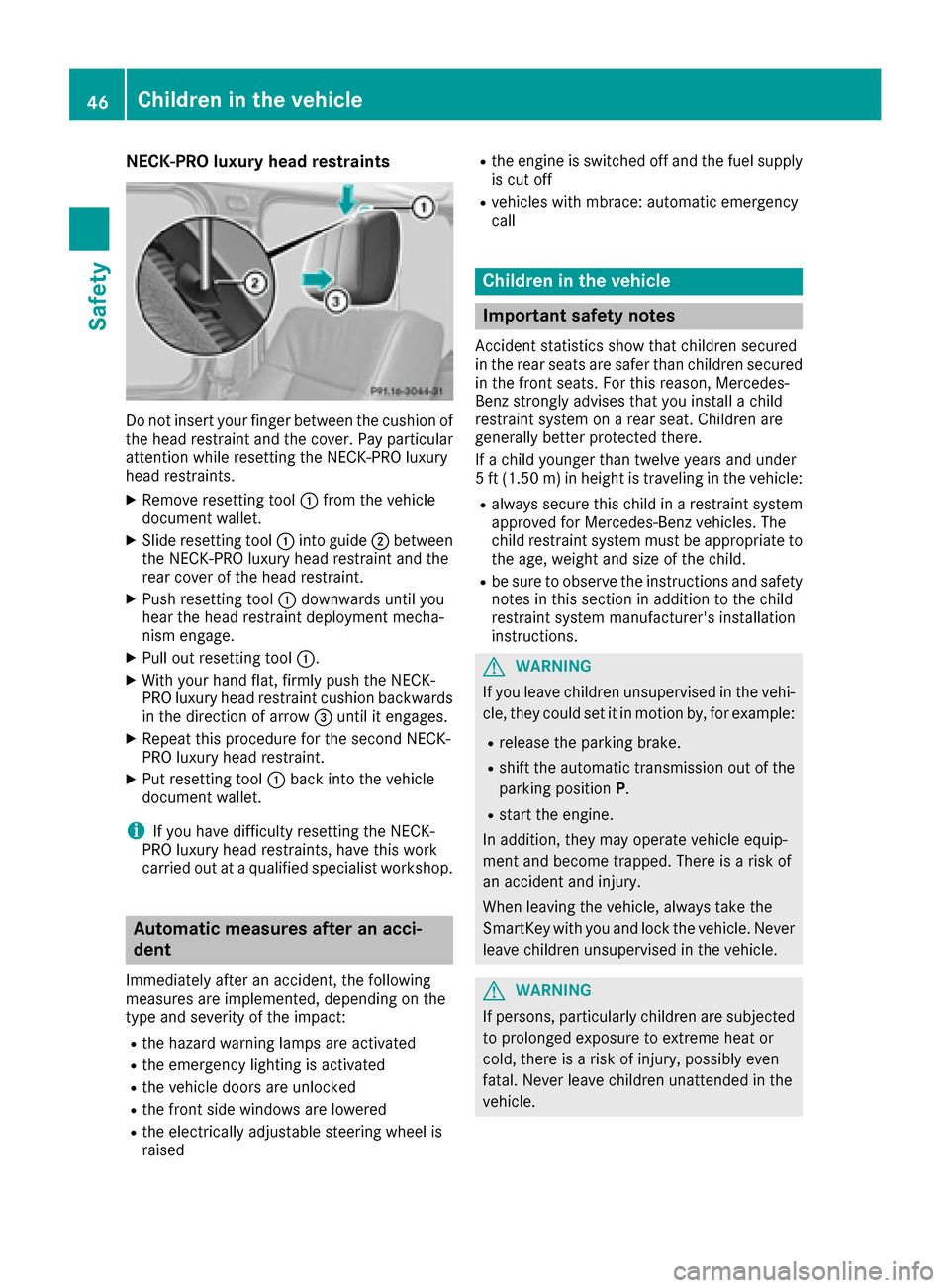
NECK-PRO luxury head restraints
Do not insert your finger between the cushion of
the head restraint and the cover. Pay particular
attention while resetting the NECK-PRO luxury
head restraints.
XRemove resetting tool:from the vehicle
document wallet.
XSlide resetting tool :into guide ;between
the NECK-PRO luxury head restraint and the
rear cover of the head restraint.
XPush resetting tool :downwards until you
hear the head restraint deployment mecha-
nism engage.
XPull out resetting tool :.
XWith your hand flat, firmly push the NECK-
PRO luxury head restraint cushion backwards
in the direction of arrow =until it engages.
XRepeat this procedure for the second NECK-
PRO luxury head restraint.
XPut resetting tool :back into the vehicle
document wallet.
iIf you have difficulty resetting the NECK-
PRO luxury head restraints, have this work
carried out at a qualified specialist workshop.
Automatic measures after an acci-
dent
Immediately after an accident, the following
measures are implemented, depending on the
type and severity of the impact:
Rthe hazard warning lamps are activated
Rthe emergency lighting is activated
Rthe vehicle doors are unlocked
Rthe front side windows are lowered
Rthe electrically adjustable steering wheel is
raised
Rthe engine is switched off and the fuel supply
is cut off
Rvehicles with mbrace: automatic emergency
call
Children in the vehicle
Important safety notes
Accident statistics show that children secured
in the rear seats are safer than children secured
in the front seats. For this reason, Mercedes-
Benz strongly advises that you install a child
restraint system on a rear seat. Children are
generally better protected there.
If a child younger than twelve years and under
5 ft (1.50 m) in height is traveling in the vehicle:
Ralways secure this child in a restraint system
approved for Mercedes-Benz vehicles. The
child restraint system must be appropriate to
the age, weight and size of the child.
Rbe sure to observe the instructions and safety
notes in this section in addition to the child
restraint system manufacturer's installation
instructions.
GWARNING
If you leave children unsupervised in the vehi-
cle, they could set it in motion by, for example:
Rrelease the parking brake.
Rshift the automatic transmission out of the
parking position P.
Rstart the engine.
In addition, they may operate vehicle equip-
ment and become trapped. There is a risk of
an accident and injury.
When leaving the vehicle, always take the
SmartKey with you and lock the vehicle. Never
leave children unsupervised in the vehicle.
GWARNING
If persons, particularly children are subjected to prolonged exposure to extreme heat or
cold, there is a risk of injury, possibly even
fatal. Never leave children unattended in the
vehicle.
46Children in the vehicle
Safety