2016 LEXUS RX350 weight
[x] Cancel search: weightPage 217 of 748

2174-1. Before driving
4
Driving
RX350_U_OM48E90U WA R N I N G ■
Hitch
Trailer hitch assemblies have different weight capacities established by the hitch manu-
facturer. Even though the vehicle may be physically capable of towing a higher weight,
the operator must determine the maximum weig ht rating of the particular hitch assem-
bly and never exceed the maximum weight rating specified for the trailer-hitch.
Exceeding the maximum weight rating set by the trailer-hitch manufacturer can cause
an accident resulting in death or serious personal injuries.■
When towing a trailer
Lexus recommends trailers with brakes that conform to any applicable federal and
state/provincial regulations. ●
If the gross trailer weight exceeds unbraked TWR, trailer brakes are required. Lexus
recommends trailers with brakes that conform to all applicable federal and state/pro-
vincial regulations. ●
Never tap into your vehicle’s hydraulic system, as this will lower the vehicle’s braking
effectiveness. ●
Never tow a trailer without using a safety ch ain securely attached to both the trailer
and the vehicle. If damage occurs to the coupling unit or hitch ball, there is danger of
the trailer wandering into another lane.
NOTICE ■
When installing a trailer hitch
Use only the position recommended by your Lexus dealer. Do not install the trailer
hitch on the bumper; this may cause body damage.■
Do not directly splice trailer lights
Do not directly splice trailer lights. Dire ctly splicing trailer lights may damage your
vehicle’s electrical system and cause a malfunction.
Page 587 of 748

5877-3. Do-it-yourself maintenance
7
Maintenance and care
RX350_U_OM48E90U ■
When to replace your vehicle’s tires
Tires should be replaced if: ●
The treadwear indicators are showing on a tire. ●
You have tire damage such as cuts, splits, cracks deep enough to expose the fabric, and
bulges indicating internal damage. ●
A tire goes flat repeatedly or cannot be prop erly repaired due to the size or location of
a cut or other damage.
If you are not sure, consult with your Lexus dealer. ■
Replacing tires and wheels
If the ID code of the tire pressure warning valve and transmitter is not registered, the tire
pressure warning system will not work proper ly. After driving for about 20 minutes, the
tire pressure warning light blinks for 1 minute and stays on to indicate a system malfunc-
tion. ■
Tire life
Any tire over 6 years old must be checked by a qualified technician even if it has seldom
or never been used or damage is not obvious. ■
Routine tire inflation pressure checks
The tire pressure warning system does not replace routine tire inflation pressure checks.
Make sure to check tire inflation pressure as part of your routine of daily vehicle checks.■
Maximum load of tire
Check that the maximum load of the replacem ent tire is greater than 1 /2 of the Gross
Axle Weight Ratings (GAWR) of either the front axle or the rear axle, whichever is
greater.
For the GAWR, see the Certification Label. For
the maximum load of the tire, see the load limit
at maximum cold tire inflation pressure men-
tioned on the sidewall of the tire. ( P. 686)
Page 595 of 748

5957-3. Do-it-yourself maintenance
7
Maintenance and care
RX350_U_OM48E90U ■
Instructions for checking tire inflation pressure
When checking tire inflation pressure, observe the following: ●
Check only when the tires are cold.
If your vehicle has been parked for at least 3 hours or has not been driven for more than
1 mile or 1.5 km, you will get an accurate cold tire inflation pressure reading. ●
Always use a tire pressure gauge.
It is difficult to judge if a tire is prop erly inflated based only on its appearance.●
It is normal for the tire inflation pressure to be higher after driving as heat is generated
in the tire. Do not reduce tire inflation pressure after driving. ●
Never exceed the vehicle capacity weight.
Passengers and luggage weight should be placed so that the vehicle is balanced.
WA R N I N G ■
Proper inflation is critical to save tire performance
Keep your tires properly inflated.
If the tires are not properly inflated, the following conditions may occur which could
lead to an accident resulting in death or serious injury: ●
Excessive wear ●
Uneven wear ●
Poor handling ●
Possibility of blowouts result ing from overheated tires●
Air leaking from between tire and wheel ●
Wheel deformation and/or tire damage ●
Greater possibility of tire damage while driving (due to road hazards, expansion
joints, sharp edges in the road, etc.)
NOTICE ■
When inspecting and adjust ing tire inflation pressure
Be sure to put the tire valve caps back on.
If a valve cap is not installed, dirt or moisture may get into the valve and cause an air
leak, resulting in decreased tire inflation pressure.
Page 596 of 748

596 7-3. Do-it-yourself maintenance
RX350_U_OM48E90U When replacing wheels, care should be taken to ensure that they are equivalent
to those removed in load capacity , diameter, rim width and inset
* .
Replacement wheels are available at your Lexus dealer.
* : Conventionally referred to as “offset”.
Lexus does not recommend using the following: ●
Wheels of different sizes or types ●
Used wheels ●
Bent wheels that have been straightened ●
Use only Lexus wheel nuts and wrenches designed for use with your alumi-
num wheels. ●
When rotating, repairing or changing your tires, check that the wheel nuts are
still tight after driving 1000 miles (1600 km). ●
Be careful not to damage the aluminum wheels when using tire chains. ●
Use only Lexus genuine balance weights or equivalent and a plastic or rubber
hammer when balancing your wheels. ■
When replacing wheels
The wheels of your vehicle are equipped with tire pressure warning valves and transmit-
ters that allow the tire pressure warning system to provide advance warning in the event
of a loss in tire inflation pressure. Whenever wheels are replaced, tire pressure warning
valves and transmitters must be installed. ( P. 5 8 5 )Wheels If a wheel is bent, cracked or heavily corroded, it should be replaced. Other-
wise, the tire may separate from the whee l or cause a loss of handling control.
Wheel selection
Aluminum wheel precautions
Page 674 of 748

674
RX350_U_OM48E90U 9-1. Specifications
* 1
: Unladen vehicle
* 2
: Vehicles with towing package
* 3
: For GGL25L-BWZGBA models
* 5
* 4
:Except for GGL25L-BWZGBA models
* 5
* 5
: The model code is indicated on the Certification Label. ( P. 6 7 5 )Maintenance data (fuel, oil level, etc.) Dimensions and weight Overall length 192.5 in. (4890 mm)
Overall width 74 . 6 i n . ( 1 8 9 5 m m )
Overall height
* 1
67.7 in. (1720 mm)
Wheelbase 109.8 in. (2790 mm)
Tr e a d Front 64.4 in. (1635 mm)
Rear 64.0 in. (1625 mm)
Vehicle capacity weight
(Occupants + luggage) 1050 lb. (480 kg)
* 3
920 lb. (420 kg)
* 4
Trailer Weight Rating
* 2
(Trailer weight + cargo weight) 3500 lb. (1588 kg)
Page 693 of 748

6939-1. Specifications
9
Vehicle specifications
RX350_U_OM48E90U Glossary of tire terminology Tire related term Meaning
Cold tire inflation pressure Tire pressure when the vehicle has been parked for
three hours or more, or has not been driven more than 1
mile or 1.5 km un der that condition
Maximum inflation pres-
sure The maximum cold inflated pressure to which a tire may
be inflated, shown on the sidewall of the tire
Recommended inflation
pressure Cold tire inflation pressure recommended by a manu-
facturer
Accessory weight The combined weight (in excess of those standard items
which may be replaced) of automatic transmission,
power steering, power brakes, power windows, power
seats, radio and heater, to the extent that these items are
available as factory-installed equipment (whether
installed or not)
Curb weight The weight of a motor vehicle with standard equipment,
including the maximum capacity of fuel, oil and coolant,
and if so equipped, air co nditioning and additional
weight optional engine
Maximum loaded vehicle
weight The sum of:
(a) Curb weight
(b) Accessory weight
(c) Vehicle capacity weight
(d) Production options weight
Normal occupant weight 150 lb. (68 kg) times the numb er of occupa nts specified
in the second column of Table 1
* that follows
Occupant distribution Distribution of occupants in a vehicle as specified in the
third column of Table 1
* below
Page 694 of 748

694 9-1. Specifications
RX350_U_OM48E90U Production options weight The combined weight of installed regular production
options weighing over 5 lb. (2.3 kg) in excess of the
standard items which they replace, not previously con-
sidered in curb weight or accessory weight, including
heavy duty brakes, ride levelers, roof rack, heavy duty
battery, and special trim
Rim A metal support for a tire or a tire and tube assembly
upon which the tire beads are seated
Rim diameter
(Wheel diameter) Nominal diameter of the bead seat
Rim size designation Rim diameter and width
Rim type designation The industry manufacturer’s designation for a rim by
style or code
Rim width Nominal distance between rim flanges
Vehicle capacity weight
(Total load capacity) The rated cargo and luggage load plus 150 lb. (68 kg)
times the vehicle’s designated seating capacity
Vehicle maximum load on
the tire The load on an individual tire that is determined by dis-
tributing to each axle its share of the maximum loaded
vehicle weight, and dividing by two
Vehicle normal load on the
tire The load on an individual tire that is determined by dis-
tributing to each axle its sh are of curb weight, accessory
weight, and normal occupant weight (distributed in
accordance with Table 1
* below), and dividing by two
We a t h e r s i d e The surface area of the rim not covered by the inflated
tire
Bead The part of the tire that is made of steel wires, wrapped
or reinforced by ply cords and that is shaped to fit the
rimTire related term Meaning
Page 696 of 748
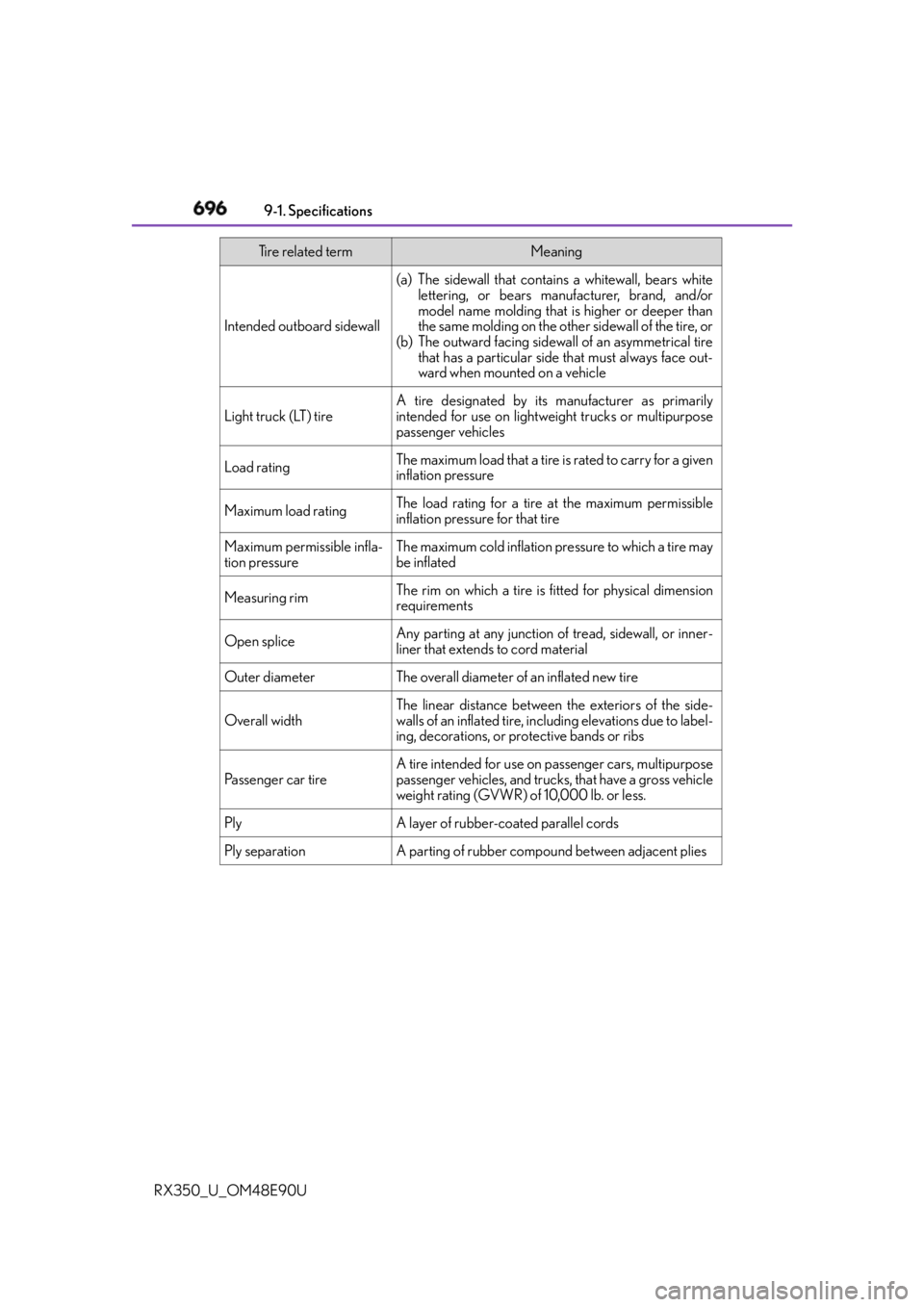
696 9-1. Specifications
RX350_U_OM48E90U Intended outboard sidewall (a) The sidewall that contains a whitewall, bears white
lettering, or bears manu facturer, brand, and/or
model name molding that is higher or deeper than
the same molding on the other sidewall of the tire, or
(b) The outward facing sidewall of an asymmetrical tire
that has a particular side that must always face out-
ward when mounted on a vehicle
Light truck (LT) tire A tire designated by its manufacturer as primarily
intended for use on lightweight trucks or multipurpose
passenger vehicles
Load rating The maximum load that a tire is rated to carry for a given
inflation pressure
Maximum load rating The load rating for a tire at the maximum permissible
inflation pressure for that tire
Maximum permissible infla-
tion pressure The maximum cold inflation pressure to which a tire may
be inflated
Measuring rim The rim on which a tire is fitted for physical dimension
requirements
Open splice Any parting at any junction of tread, sidewall, or inner-
liner that extends to cord material
Outer diameter The overall diameter of an inflated new tire
Overall width The linear distance between the exteriors of the side-
walls of an inflated tire, incl uding elevations due to label-
ing, decorations, or pr otective bands or ribs
Passenger car tire A tire intended for use on passenger cars, multipurpose
passenger vehicles, and trucks, that have a gross vehicle
weight rating (GVWR) of 10,000 lb. or less.
Ply A layer of rubber-coated parallel cords
Ply separation A parting of rubber compou nd between adjacent pliesTire related term Meaning