Page 39 of 644
323
Safety features of your vehicle
7. Pull up the catch release leverunder the front of the seat cushion
while reclining the folded seat
rearward slightly to release the
front catches from the anchors.
8. Remove the entire seat from the floor.
Installing the tumble seat
(for 8 passenger vehicle)
1. Put the front anchor strikers along the front anchors on the floor.
2. Insert two front anchor strikers into the front anchors. 3. Lift the rear portion of the seat
cushion then push down firmly to
lock the catches into the rear
anchors until an audible “click” is
heard.
OYP034225NOYP034227N
OYP034228N
Page 40 of 644
Safety features of your vehicle
24
3
4. Make sure the green mark on the
rear seat cushion frame is visible
and the catches are locked in posi-
tion by moving the seat forward
and backward or lifting the front
portion of the seat. If the green
mark is invisible and the seat
moves, it is not locked properly.
5. Pull up the seatback recline strap.
6. Lift and push the seatback back- ward firmly until it clicks into place.
Make sure the seatback is locked
in place.
7. Return the seat belt to the proper position. If the rear catches of the seat are
locked into the rear anchors (2) while
the front catches are not locked into
the front anchors (1), do the follow-
ings to release the rear catches from
the rear anchors.
OYP034232N
WARNING - Installing or
removing the tumble seat
Do not install or remove the
tumble (2nd row center) seat, if
there are occupants in the 3rd
row seats, as this may injure
occupants.
OYP034233N
OYP034235N
Page 43 of 644
327
Safety features of your vehicle
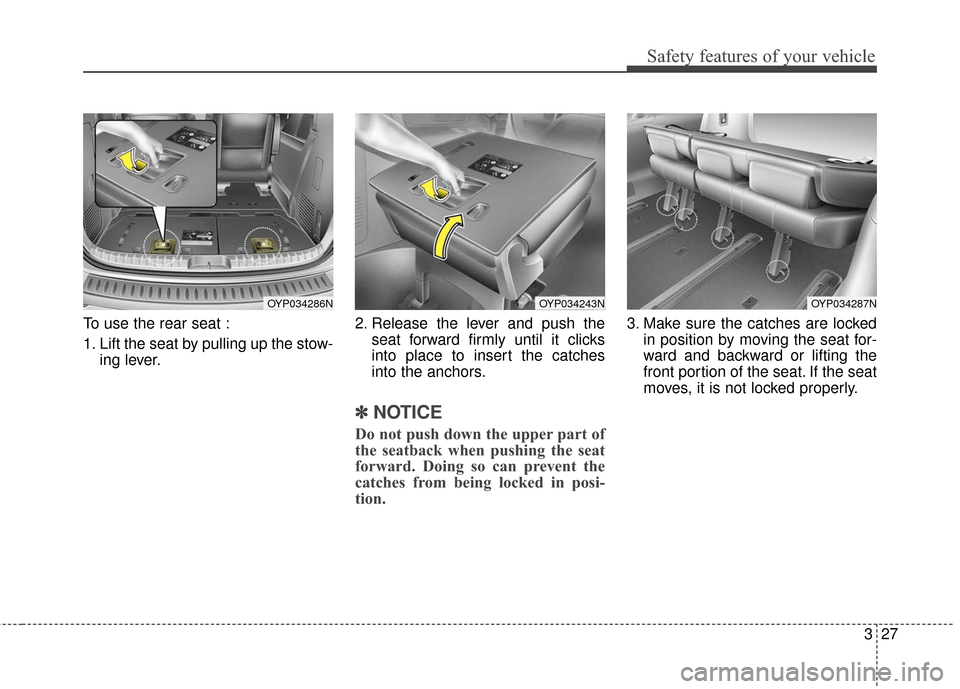
To use the rear seat :
1. Lift the seat by pulling up the stow-ing lever. 2. Release the lever and push the
seat forward firmly until it clicks
into place to insert the catches
into the anchors.
✽ ✽NOTICE
Do not push down the upper part of
the seatback when pushing the seat
forward. Doing so can prevent the
catches from being locked in posi-
tion.
3. Make sure the catches are locked
in position by moving the seat for-
ward and backward or lifting the
front portion of the seat. If the seat
moves, it is not locked properly.
OYP034243NOYP034286NOYP034287N
Page 44 of 644
Safety features of your vehicle
28
3
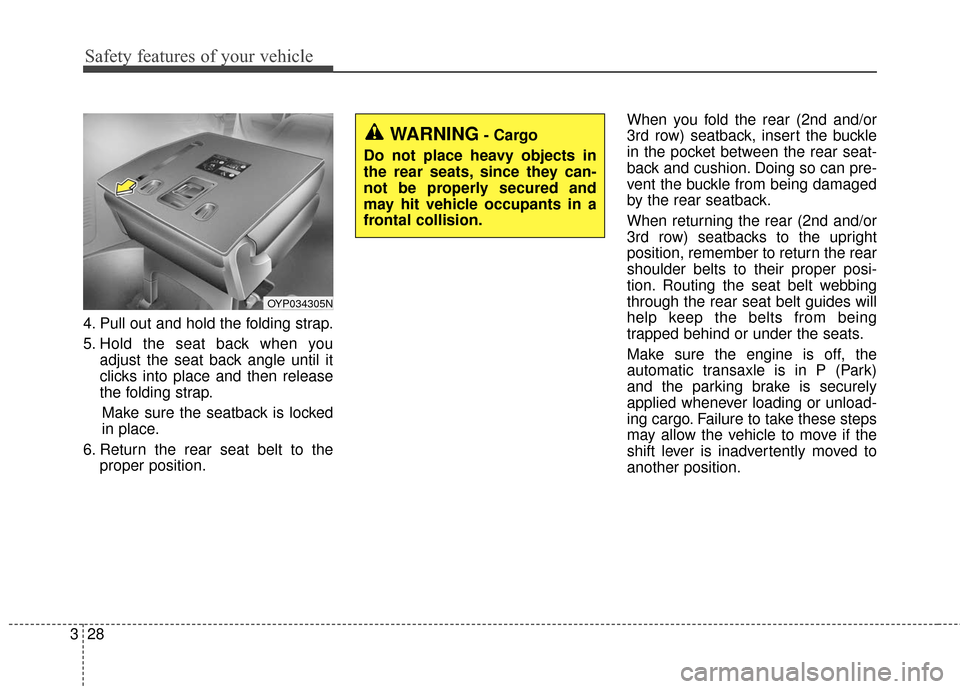
4. Pull out and hold the folding strap.
5. Hold the seat back when you
adjust the seat back angle until it
clicks into place and then release
the folding strap.
Make sure the seatback is locked
in place.
6. Return the rear seat belt to the proper position. When you fold the rear (2nd and/or
3rd row) seatback, insert the buckle
in the pocket between the rear seat-
back and cushion. Doing so can pre-
vent the buckle from being damaged
by the rear seatback.
When returning the rear (2nd and/or
3rd row) seatbacks to the upright
position, remember to return the rear
shoulder belts to their proper posi-
tion. Routing the seat belt webbing
through the rear seat belt guides will
help keep the belts from being
trapped behind or under the seats.
Make sure the engine is off, the
automatic transaxle is in P (Park)
and the parking brake is securely
applied whenever loading or unload-
ing cargo. Failure to take these steps
may allow the vehicle to move if the
shift lever is inadvertently moved to
another position.
WARNING- Cargo
Do not place heavy objects in
the rear seats, since they can-
not be properly secured and
may hit vehicle occupants in a
frontal collision.
OYP034305N
Page 50 of 644

Safety features of your vehicle
34
3
SEAT BELTS
Seat belt restraint system
For maximum restraint system pro-
tection, the seat belts must always
be used whenever the vehicle is
moving. A properly positioned
shoulder belt should be positioned
midway over your shoulder across
your collarbone.
Never allow children to ride in the front passenger seat. See child
restraint system section for further
discussion. Seat belts are designed to bear upon
the bony structure of the body, and
should be worn low across the front
of the pelvis, chest and shoulders, as
applicable; wearing the lap section of
the belt across the abdominal area
must be avoided.
Seat belts should be adjusted as
firmly as possible, consistent with
comfort, to provide the protection for
which they have been designed.
A slack belt will greatly reduce the
protection afforded to the wearer.
Care should be taken to avoid con-
tamination of the webbing with pol-
ishes, oils and chemicals, and partic-
ularly battery acid. Cleaning may
safely be carried out using mild soap
and water. The belt should be
replaced if webbing becomes frayed,
contaminated or damaged.
WARNING- Damaged
seat belt
Replace the entire seat belt
assembly if any part of the web-
bing or hardware is damaged as
you can no longer be sure that a
damaged seat belt will provide
protection in a crash.WARNING- Twisted seat belt
Make sure your seat belt is not
twisted when worn. A twisted
seat belt may not properly pro-
tect you in an accident and
could even cut into your body.
WARNING- Shoulder Belt
Never wear the shoulder belt under your arm or behind
your back. An improperly
positioned shoulder belt can-
not protect the occupant in a
crash.
Always wear both the shoul- der portion and lap portion of
the lap/shoulder belt.
Page 52 of 644

Safety features of your vehicle
36
3
*1Warning pattern repeats 11 times with
an interval of 24 seconds. If the driver's
seat belt is buckled, the light will stop
within 6 seconds and chime will stop
immediately.
*
2The light will stop within 6 seconds and
chime will stop immediately.
Seat belt warning (for front passenger’s seat)
The front passenger's seat belt
warning light will activate to the fol-
lowing table when the ignition switch
is in "ON" position.
*1The seat belt warning light will go off if
the vehicle speed decreases below 5
km/h (3 mph). If the vehicle speed
increases above 5 km/h (3 mph), the
warning light will blink again.
ConditionsWarning Pattern
Seat BeltVehicle
SpeedLight-Blink
Unbuckled6 seconds
UnbuckledAbove 10 km/h (6mph)Continuously
Buckled6 seconds
Buckled →
Unbuckled
Above 10 km/h (6mph)Continuously *1
Below 10 km/h(6mph)None
OYP034258N
OYP034257N
■Type A
■Type B
ConditionsWarning Pattern
Seat BeltVehicle
SpeedLight-BlinkChime-Sound
Unbuckled6 seconds
Buckled6 secondsNone
Buckled →
Unbuckled
Below 5 km/h (3 mph)6 secondsNone
5 km/h~
10 km/h6 seconds
Above 10 km/h (6 mph)6 sec. on / 24 sec. off (11 times)
Unbuckled
Above 10 km/h(6 mph)
↓
Below 5 km/h (3 mph)
6 seconds *1
↓
Stop *
2
Page 53 of 644

337
Safety features of your vehicle
You can find the front passenger'sseat belt warning light on the cen-
ter fascia panel.
Although the front passenger seat is not occupied, the seat belt warn-
ing light will blink for 6 seconds.
The seat belt warning light can blink when a briefcase or purse is
placed on the front passenger
seat.
Riding in an improper position
adversely affects the front passen-
ger's seat belt warning system. It is
important for the driver to instruct the
passenger as to the proper seating
instructions as contained in this
manual.Seat belt - Driver's 3-point system with emergency locking retractor
To fasten your seat belt :
To fasten your seat belt, pull it out of
the retractor and insert the metal tab
(1) into the buckle (2). There will be
an audible "click" when the tab locks
into the buckle. The seat belt automatically adjusts to
the proper length only after the lap
belt portion is adjusted manually so
that it fits snugly around your hips. If
you lean forward in a slow, easy
motion, the belt will extend and let
you move around. If there is a sud-
den stop or impact, however, the belt
will lock into position. It will also lock
if you try to lean forward too quickly.
B180A01NF-1
B200A02NF
Page 54 of 644
Safety features of your vehicle
38
3
✽
✽
NOTICE
If you are not able to pull out the
seat belt from the retractor, firmly
pull the belt out and release it. Then
you will be able to pull the belt out
smoothly.
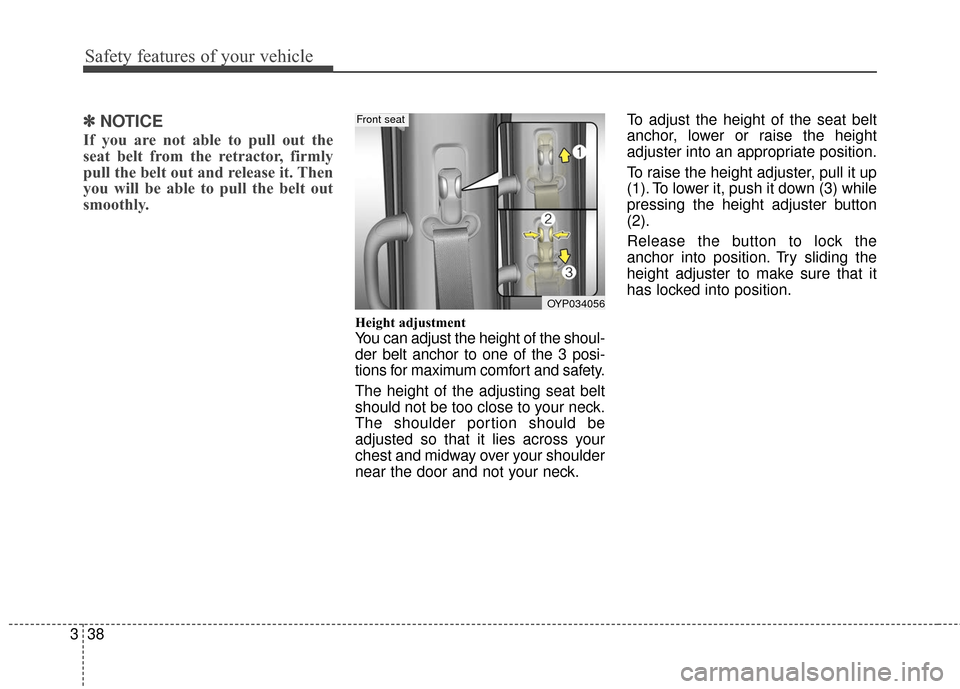
Height adjustment
You can adjust the height of the shoul-
der belt anchor to one of the 3 posi-
tions for maximum comfort and safety.
The height of the adjusting seat belt
should not be too close to your neck.
The shoulder portion should be
adjusted so that it lies across your
chest and midway over your shoulder
near the door and not your neck. To adjust the height of the seat belt
anchor, lower or raise the height
adjuster into an appropriate position.
To raise the height adjuster, pull it up
(1). To lower it, push it down (3) while
pressing the height adjuster button
(2).
Release the button to lock the
anchor into position. Try sliding the
height adjuster to make sure that it
has locked into position.
OYP034056
Front seat