Page 64 of 688
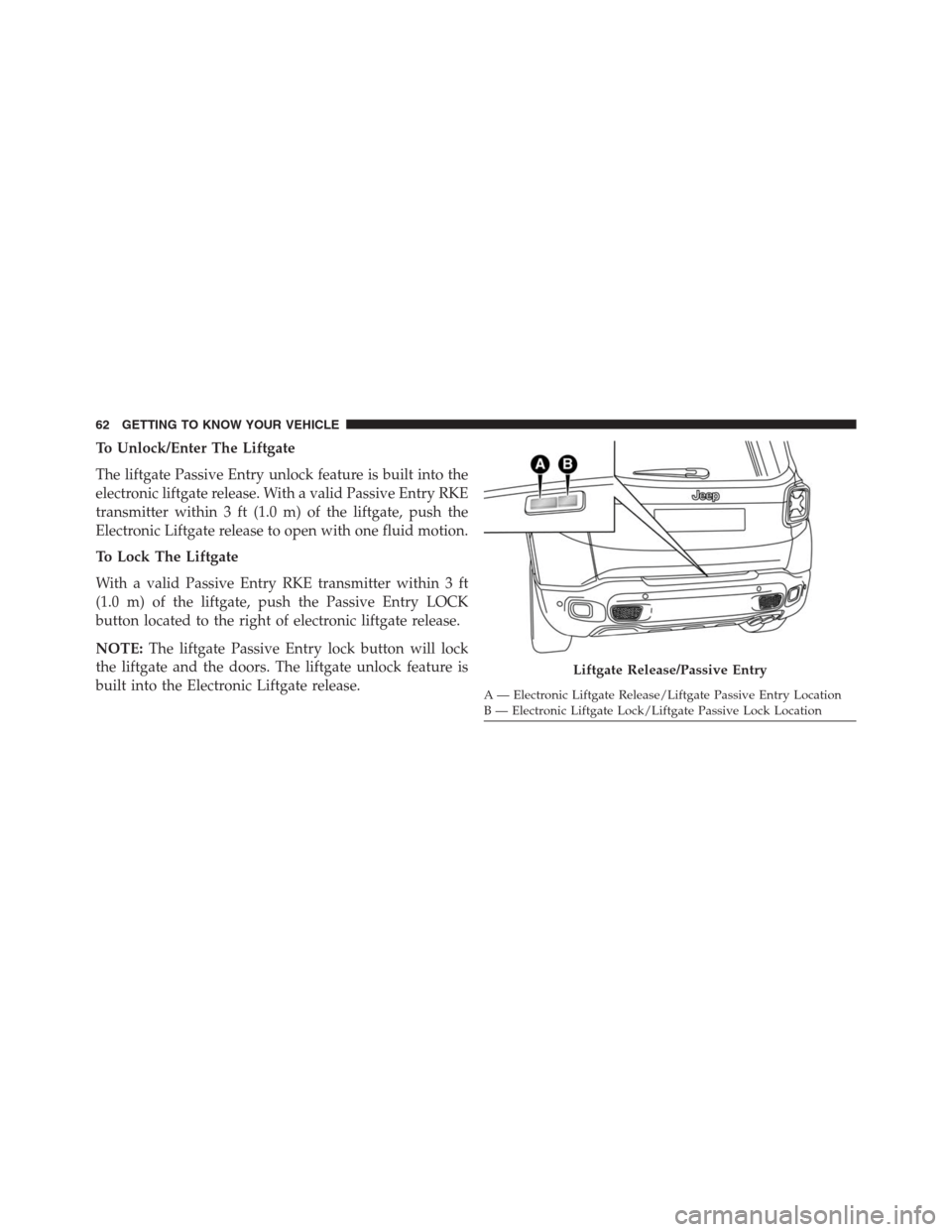
To Unlock/Enter The Liftgate
The liftgate Passive Entry unlock feature is built into the
electronic liftgate release. With a valid Passive Entry RKE
transmitter within 3 ft (1.0 m) of the liftgate, push the
Electronic Liftgate release to open with one fluid motion.
To Lock The Liftgate
With a valid Passive Entry RKE transmitter within 3 ft
(1.0 m) of the liftgate, push the Passive Entry LOCK
button located to the right of electronic liftgate release.
NOTE:The liftgate Passive Entry lock button will lock
the liftgate and the doors. The liftgate unlock feature is
built into the Electronic Liftgate release.
Liftgate Release/Passive Entry
A — Electronic Liftgate Release/Liftgate Passive Entry Location
B — Electronic Liftgate Lock/Liftgate Passive Lock Location 62 GETTING TO KNOW YOUR VEHICLE
Page 65 of 688
NOTE:If “Unlock All Doors 1st Press” is programmed in
EVIC/DID, if equipped, only the liftgate will unlock
when you push the Electronic Release. If�Unlock Driver
Door 1st Press�is programmed in Uconnect, the liftgate
will unlock when you push the electronic lock/unlock
button on the liftgate. For further information, refer to
“Uconnect SETTINGS” in “Multimedia.”
Emergency Unlocking Driver Door
If the Remote Keyless Entry (RKE) transmitter battery is
low or dead, the emergency key can be used to unlock the
driver side door lock cylinder.
To release the emergency key, proceed as follows:
1. Slide the emergency key release button to the side.
2. Remove the emergency key from the Key Fob with
Remote Control housing.NOTE:The Emergency Key can be inserted into the door
lock cylinder from either direction.
Emergency Key Release
1 — Emergency Key Release Button
2 — Emergency Key
4
GETTING TO KNOW YOUR VEHICLE 63
Page 66 of 688

WARNING!
•Never leave children alone in a vehicle, or with
access to an unlocked vehicle. Allowing children to
be in a vehicle unattended is dangerous for a
number of reasons. A child or others could be
severely injured or killed. Children should be
warned not to touch the parking brake, brake
pedal, or the gear selector. Do not leave the Key Fob
in or near the vehicle, or in a location accessible to
children, and do not leave the ignition of a vehicle
equipped with Keyless Enter- N-Go in the MAR/
RUN mode. A child could start the vehicle, operate
power windows, other controls, or move the ve-
hicle.
•Do not leave children or animals inside parked
vehicles in hot weather. Interior heat build-up may
cause them to be severely injured or killed.
General Information
The following regulatory statement applies to all radio
frequency (RF) devices equipped in this vehicle:
This device complies with Part 15 of the FCC Rules and
with Industry Canada licence-exempt RSS standard(s).
Operation is subject to the following two conditions:
1. This device may not cause harmful interference, and
2. This device must accept any interference received,
including interference that may cause undesired op-
eration.
NOTE:Changes or modifications not expressly approved
by the party responsible for compliance could void the
user ’s authority to operate the equipment.
64 GETTING TO KNOW YOUR VEHICLE
Page 67 of 688
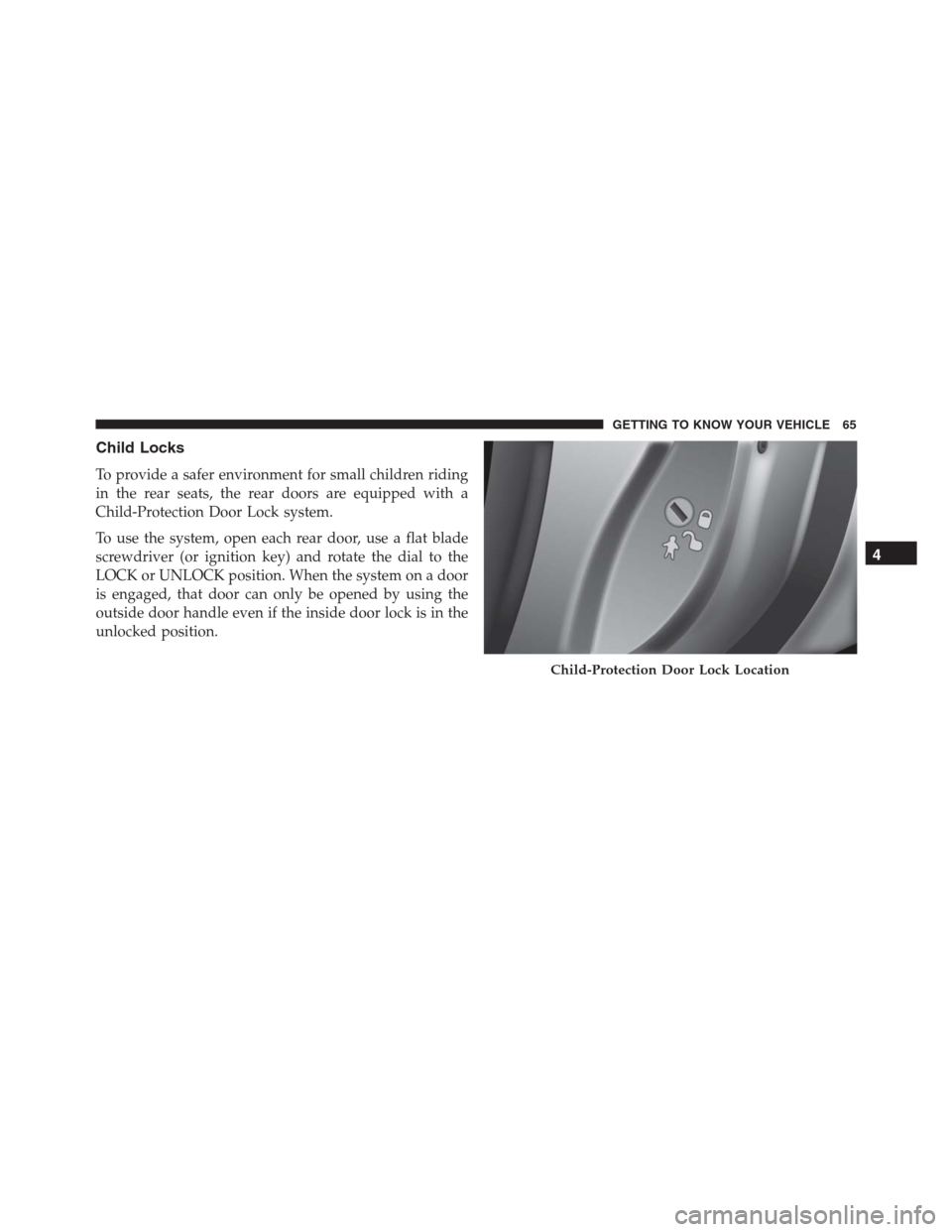
Child Locks
To provide a safer environment for small children riding
in the rear seats, the rear doors are equipped with a
Child-Protection Door Lock system.
To use the system, open each rear door, use a flat blade
screwdriver (or ignition key) and rotate the dial to the
LOCK or UNLOCK position. When the system on a door
is engaged, that door can only be opened by using the
outside door handle even if the inside door lock is in the
unlocked position.
Child-Protection Door Lock Location
4
GETTING TO KNOW YOUR VEHICLE 65
Page 68 of 688
NOTE:
•When the child lock system is engaged, the door can
only be opened by using the outside door handle even
though the inside door lock is in the unlocked position.
•After disengaging the Child-Protection Door Lock
system, always test the door from the inside to make
certain it is in the desired position.
•After engaging the Child-Protection Door Lock sys-
tem, always test the door from the inside to make
certain it is in the desired position.
•For emergency exit with the system engaged, rotate
the lock button to the unlocked position, roll down the
window, and open the door with the outside door
handle.WARNING!
Avoid trapping anyone in a vehicle in a collision.
Remember that the rear doors can only be opened
from the outside when the Child-Protection locks are
engaged.
SEATS
Seats are a part of the Occupant Restraint System of the
vehicle.
WARNING!
•It is dangerous to ride in a cargo area, inside or
outside of a vehicle. In a collision, people riding in
these areas are more likely to be seriously injured
or killed.
(Continued)
66 GETTING TO KNOW YOUR VEHICLE
Page 78 of 688
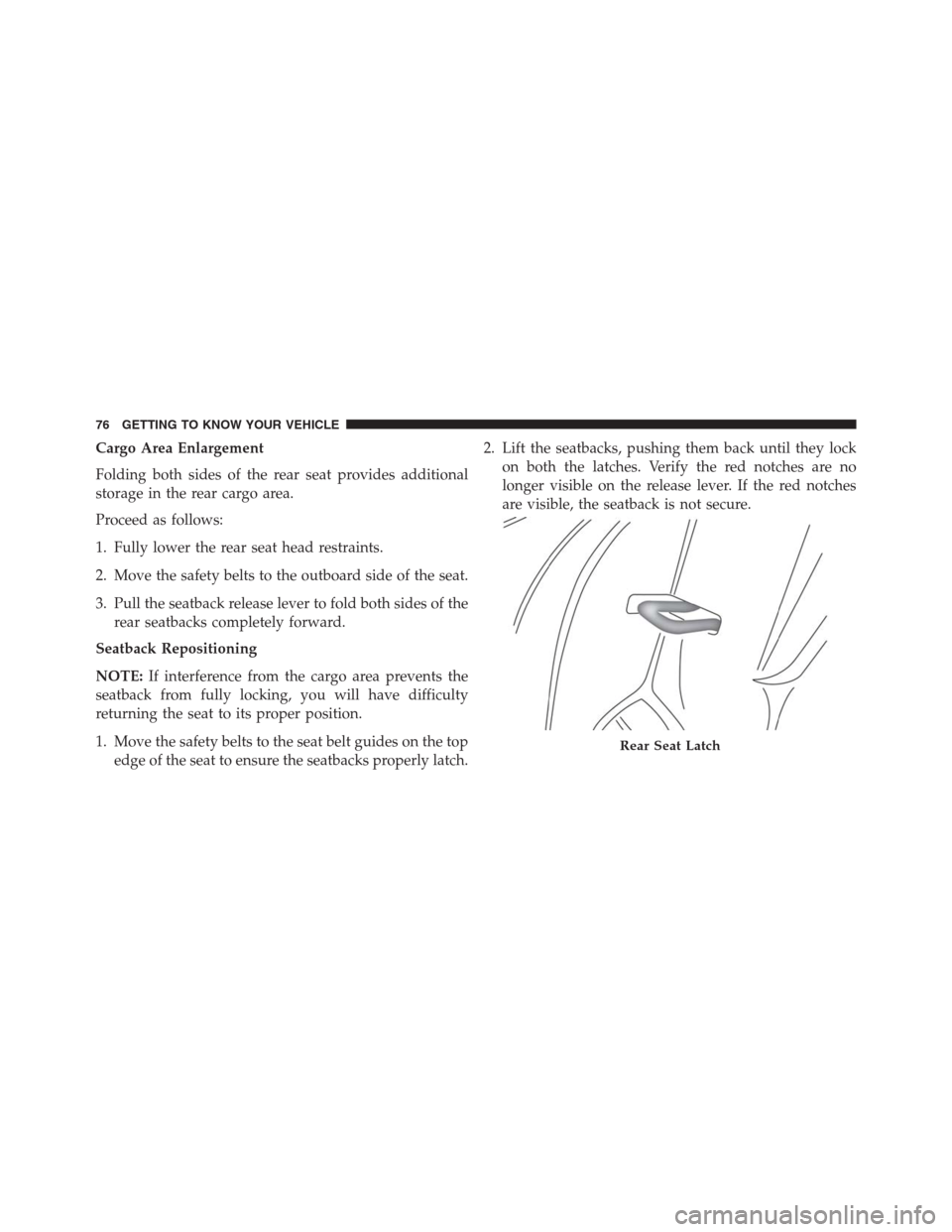
Cargo Area Enlargement
Folding both sides of the rear seat provides additional
storage in the rear cargo area.
Proceed as follows:
1. Fully lower the rear seat head restraints.
2. Move the safety belts to the outboard side of the seat.
3. Pull the seatback release lever to fold both sides of the
rear seatbacks completely forward.
Seatback Repositioning
NOTE:If interference from the cargo area prevents the
seatback from fully locking, you will have difficulty
returning the seat to its proper position.
1. Move the safety belts to the seat belt guides on the top
edge of the seat to ensure the seatbacks properly latch.2. Lift the seatbacks, pushing them back until they lock
on both the latches. Verify the red notches are no
longer visible on the release lever. If the red notches
are visible, the seatback is not secure.
Rear Seat Latch
76 GETTING TO KNOW YOUR VEHICLE
Page 80 of 688
WARNING!
Be certain that the seatback is securely locked into
position. If the seatback is not securely locked into
position the seat will not provide the proper stability
for child seats and/or passengers. An improperly
latched seat could cause serious injury.
HEAD RESTRAINTS
Head restraints are designed to reduce the risk of injury
by restricting head movement in the event of a rear
impact. Head restraints should be adjusted so that the top
of the head restraint is located above the top of your ear.
WARNING!
The head restraints for all occupants must be prop-
erly adjusted prior to operating the vehicle or occu-
pying a seat. Head restraints should never be ad-
justed while the vehicle is in motion. Driving a
vehicle with the head restraints improperly adjusted
or removed could cause serious injury or death in the
event of a collision.
78 GETTING TO KNOW YOUR VEHICLE
Page 83 of 688
NOTE:The head restraints should only be removed by
qualified technicians, for service purposes only. If either
of the head restraints require removal, see your autho-
rized dealer.
STEERING WHEEL
Tilt/Telescoping Steering Column
This feature allows you to tilt the steering column
upward or downward. It also allows you to lengthen or
shorten the steering column. The tilt/telescoping lever is
located below the steering wheel at the end of the
steering column.
To unlock the steering column, push the tilt/telescoping
lever downward (toward the floor). To tilt the steering
column, move the steering wheel upward or downward
as desired. To lengthen or shorten the steering column,
pull the steering wheel outward or push it inward as
desired.
Tilt Steering Wheel Lever
4
GETTING TO KNOW YOUR VEHICLE 81