Page 312 of 688
9. Test that the child restraint is installed tightly by
pulling back and forth on the child seat at the belt
path. It should not move more than 1 inch (25.4 mm)
in any direction.
Any seat belt system will loosen with time, so check the
belt occasionally, and pull it tight if necessary.
Installing Child Restraints Using The Top Tether
Anchorage:
WARNING!
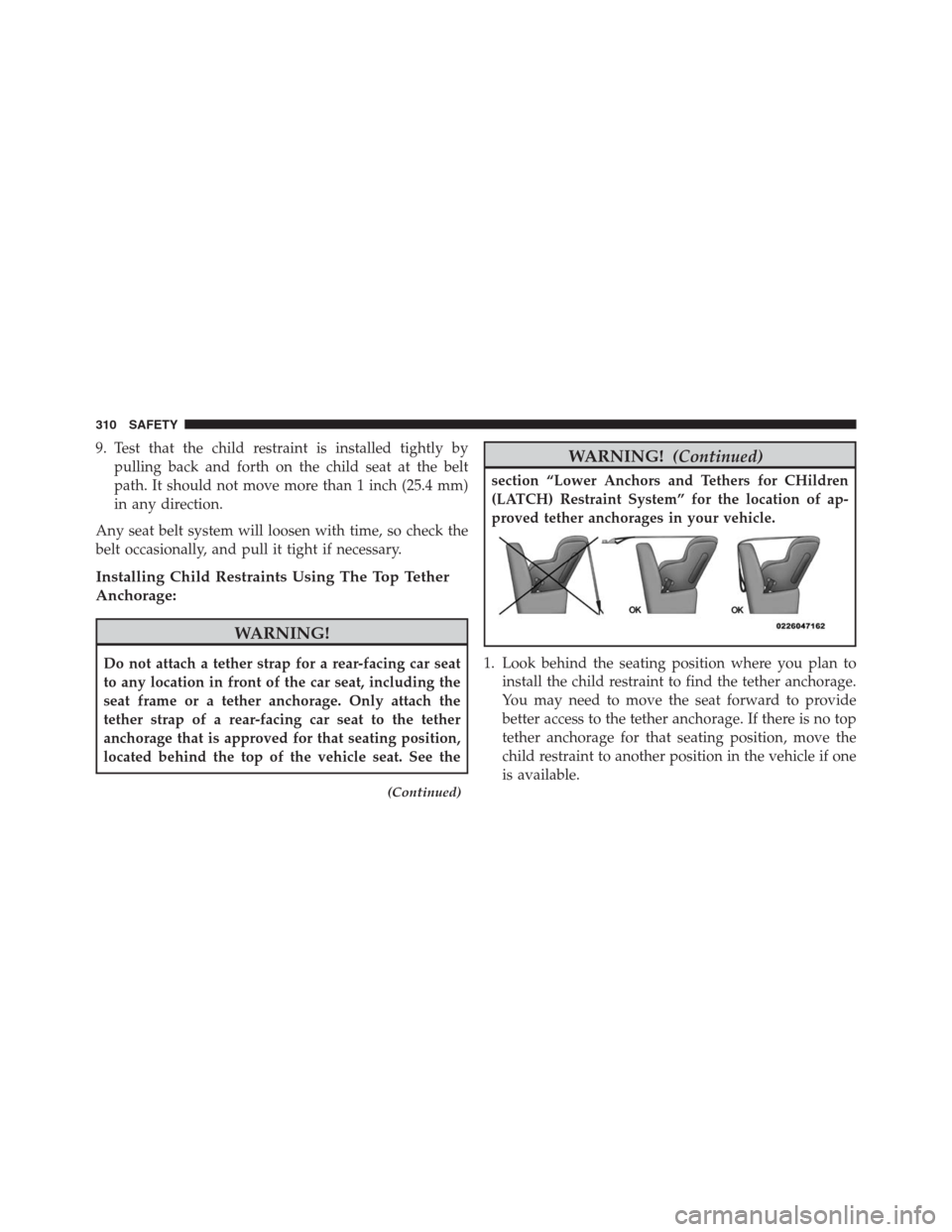
Do not attach a tether strap for a rear-facing car seat
to any location in front of the car seat, including the
seat frame or a tether anchorage. Only attach the
tether strap of a rear-facing car seat to the tether
anchorage that is approved for that seating position,
located behind the top of the vehicle seat. See the
(Continued)
WARNING!(Continued)
section “Lower Anchors and Tethers for CHildren
(LATCH) Restraint System” for the location of ap-
proved tether anchorages in your vehicle.
1. Look behind the seating position where you plan to
install the child restraint to find the tether anchorage.
You may need to move the seat forward to provide
better access to the tether anchorage. If there is no top
tether anchorage for that seating position, move the
child restraint to another position in the vehicle if one
is available.
310 SAFETY
Page 314 of 688

WARNING!
•An incorrectly anchored tether strap could lead to
increased head motion and possible injury to the
child. Use only the anchorage position directly
behind the child seat to secure a child restraint top
tether strap.
•If your vehicle is equipped with a split rear seat,
make sure the tether strap does not slip into the
opening between the seatbacks as you remove
slack in the strap.
Transporting Pets
Air Bags deploying in the front seat could harm your pet.
An unrestrained pet will be thrown about and possibly
injured, or injure a passenger during panic braking or in
a collision.
Pets should be restrained in the rear seat in pet harnesses
or pet carriers that are secured by seat belts.
SAFETY TIPS
Transporting Passengers
NEVER TRANSPORT PASSENGERS IN THE CARGO
AREA.
WARNING!
•Do not leave children or animals inside parked
vehicles in hot weather. Interior heat build-up may
cause serious injury or death.
•It is extremely dangerous to ride in a cargo area,
inside or outside of a vehicle. In a collision, people
riding in these areas are more likely to be seriously
injured or killed.
•
Do not allow people to ride in any area of your vehicle
that is not equipped with seats and seat belts.
•Be sure everyone in your vehicle is in a seat and
using a seat belt properly.
312 SAFETY
Page 315 of 688

Exhaust Gas
WARNING!
Exhaust gases can injure or kill. They contain carbon
monoxide (CO), which is colorless and odorless.
Breathing it can make you unconscious and can
eventually poison you. To avoid breathing (CO),
follow these safety tips:
•Do not run the engine in a closed garage or in
confined areas any longer than needed to move
your vehicle in or out of the area.
•If you are required to drive with the trunk/liftgate/
rear doors open, make sure that all windows are
closed and the climate control BLOWER switch is
set at high speed. DO NOT use the recirculation
mode.
(Continued)
WARNING!(Continued)
•If it is necessary to sit in a parked vehicle with the
engine running, adjust your heating or cooling
controls to force outside air into the vehicle. Set the
blower at high speed.
The best protection against carbon monoxide entry into
the vehicle body is a properly maintained engine exhaust
system.
Whenever a change is noticed in the sound of the exhaust
system, when exhaust fumes can be detected inside the
vehicle, or when the underside or rear of the vehicle is
damaged, have a competent mechanic inspect the com-
plete exhaust system and adjacent body areas for broken,
damaged, deteriorated, or mispositioned parts. Open
seams or loose connections could permit exhaust fumes
to seep into the passenger compartment. In addition,
inspect the exhaust system each time the vehicle is raised
for lubrication or oil change. Replace as required.
6
SAFETY 313
Page 316 of 688

Safety Checks You Should Make Inside The
Vehicle
Seat Belts
Inspect the seat belt system periodically, checking for
cuts, frays, and loose parts. Damaged parts must be
replaced immediately. Do not disassemble or modify the
system.
Front seat belt assemblies must be replaced after a
collision. Rear seat belt assemblies must be replaced after
a collision if they have been damaged (i.e., bent retractor,
torn webbing, etc.). If there is any question regarding seat
belt or retractor condition, replace the seat belt.
Air Bag Warning Light
The Air Bag warning lightwill turn on for four to
eight seconds as a bulb check when the ignition switch
is first turned to ON/RUN. If the light is either not on
during starting, stays on, or turns on while driving,have the system inspected at an authorized dealer as
soon as possible. This light will illuminate with a
single chime when a fault with the Air Bag Warning
Light has been detected, it will stay on until the fault
is cleared. If the light comes on intermittently or
remains on while driving, have an authorized dealer
service the vehicle immediately. Refer to “Occupant
Restraints” in “Things To Know Before Starting Your
Vehicle” for further information.
Defroster
Check operation by selecting the defrost mode and place
the blower control on high speed. You should be able to
feel the air directed against the windshield. See your
authorized dealer for service if your defroster is inoper-
able.
Floor Mat Safety Information
Always use floor mats designed to fit the footwell of your
vehicle. Use only floor mats that leave the pedal area
314 SAFETY
Page 317 of 688
unobstructed and that are firmly secured so that they
cannot slip out of position and interfere with the pedals
or impair safe operation of your vehicle in other ways.
WARNING!
Pedals that cannot move freely can cause loss of
vehicle control and increase the risk of serious per-
sonal injury.
•Always make sure that floor mats are properly
attached to the floor mat fasteners.
•Never place or install floor mats or other floor
coverings in the vehicle that cannot be properly
secured to prevent them from moving and interfer-
ing with the pedals or the ability to control the
vehicle.
•Never put floor mats or other floor coverings on top
of already installed floor mats. Additional floor
(Continued)
WARNING!(Continued)
mats and other coverings will reduce the size of the
pedal area and interfere with the pedals.
•Check mounting of mats on a regular basis. Always
properly reinstall and secure floor mats that have
been removed for cleaning.
•Always make sure that objects cannot fall into the
driver footwell while the vehicle is moving. Ob-
jects can become trapped under the brake pedal
and accelerator pedal causing a loss of vehicle
control.
•If required, mounting posts must be properly in-
stalled, if not equipped from the factory.
Failure to properly follow floor mat installation or
mounting can cause interference with the brake
pedal and accelerator pedal operation causing loss of
control of the vehicle.
6
SAFETY 315
Page 320 of 688

▫Transmission Limp Home Mode...........349
▫Key Ignition Park Interlock...............350
▫Brake/Transmission Shift Interlock System. . . .350
�SPEED CONTROL — IF EQUIPPED.........351
▫Activation...........................352
▫Setting A Desired Speed.................352
▫Deactivation.........................353
▫Resume Speed........................353
▫Varying The Speed.....................353
▫Accelerating For Passing................355
�FOUR WHEEL DRIVE — JEEP ACTIVE DRIVE
(4WD) AND JEEP ACTIVE DRIVE LOW
(4WD LOW)...........................355
▫Four Wheel Drive (4x4).................356�SELEC-TERRAIN.......................358
▫Mode Selection Guide..................358
�FORWARD COLLISION WARNING (FCW)
WITH MITIGATION — IF EQUIPPED.......360
▫Forward Collision Warning (FCW) With
Mitigation Operation — If Equipped.......360
▫Turning FCW ON Or OFF...............363
▫Changing FCW Sensitivity...............364
▫FCW Limited Warning..................364
▫Service FCW Warning..................365
▫Precautions While Driving With FCW.......366
▫General Information...................370
�LANESENSE — IF EQUIPPED.............370
▫LaneSense Operation...................370
318 STARTING AND OPERATING
Page 321 of 688

▫Turning LaneSense ON Or OFF............371
▫LaneSense Warning Message..............372
▫Changing LaneSense Status..............380
�REAR PARKSENSE — IF EQUIPPED........381
▫Rear ParkSense Sensors.................381
▫Enabling And Disabling Rear ParkSense.....383
▫Service The Rear ParkSense System.........384
▫ParkSense System Usage Precautions........385
�REAR BACK UP CAMERA — IF EQUIPPED . . .386
�TIRE PRESSURE MONITOR SYSTEM (TPMS) . .389
▫Base System.........................392
▫Premium System — If Equipped...........395
▫General Information....................400�FUEL REQUIREMENTS..................400
▫1.4L Turbo Engine.....................400
▫2.4L Engine..........................401
▫Reformulated Gasoline.................401
▫Gasoline/Oxygenate Blends..............402
▫E-85 Usage In Non-Flex Fuel Vehicles.......402
▫MMT In Gasoline.....................403
▫Materials Added To Fuel................403
▫Fuel System Cautions...................404
▫Carbon Monoxide Warnings.............405
�ADDING FUEL........................405
�VEHICLE LOADING....................409
▫Certification Label....................409
7
STARTING AND OPERATING 319
Page 323 of 688
STARTING THE ENGINE
Before starting your vehicle, adjust your seat, adjust the
inside and outside mirrors, fasten your seat belt, and if
present, instruct all other occupants to buckle their seat
belts.
WARNING!
•Never leave children alone in a vehicle, or with
access to an unlocked vehicle.
•Allowing children to be in a vehicle unattended is
dangerous for a number of reasons. A child or
others could be seriously or fatally injured. Chil-
dren should be warned not to touch the parking
brake, brake pedal or the gear selector.
•Do not leave the Key Fob in or near the vehicle (or
in a location accessible to children), and do not
leave the ignition of a vehicle equipped with
(Continued)
WARNING!(Continued)
Keyless Enter-N-Go in the MAR/RUN mode. A
child could operate power windows, other controls,
or move the vehicle.
Start the engine with the shift lever in the NEUTRAL or
PARK position. Apply the brake before shifting to any
driving range.
Manual Transmission
Proceed as follows:
1. Set the Electric Park Brake (EPB) and put the shift
lever in the NEUTRAL position.
2. Press the clutch pedal to the floor, without pressing the
accelerator.
3. Cycle the ignition to the AVV/START position and
release it as soon as the engine is started.
7
STARTING AND OPERATING 321