Page 75 of 117
mark. The total capacity from the MIN mark to the MAX
mark is 1.7 qts (1.6L).
CAUTION!
Overfilling or underfilling the crankcase will cause
oil aeration or loss of oil pressure. This could damage
your engine.
NOTE: It is possible for your oil level to be slightly
higher than a previous check. This would be due to diesel
fuel that may temporarily be in the crankcase due to
operation of the diesel particulate filter regeneration
strategy. This fuel will evaporate out under normal
operation.
Never operate the engine with oil level below the “MIN”
mark or above the upper “MAX” mark.
Change Engine Oil
Refer to the “Maintenance Schedule” for the proper
maintenance intervals.
Engine Oil Viscosity (SAE Grade)
CAUTION!
Your vehicle is equipped with an advanced technol-
ogy Diesel Engine and an emission device designed
to limit Diesel Particulate Emissions from being
released into the atmosphere. The durability of your
engine and life expectancy of this diesel particulate
filter emission device is highly dependent on the use
of the correct engine oil.
Only use ACEA C3 SAE 5W-30 Synthetic Low Ash engine
oil meeting FCA Material Standard MS-11106 or Pennzoil
Ultra Euro L full synthetic 5W-30 motor oil, which is5
MAINTAINING YOUR VEHICLE 73
Page 76 of 117
recommended for all operating temperatures. This en-
gine oil improves low temperature starting and vehicle
fuel economy.
Materials Added To Engine Oil
The manufacturer strongly recommends against the ad-
dition of any additives (other than leak detection dyes) to
the engine oil. Engine oil is an engineered product and
its performance may be impaired by supplemental addi-
tives.
Engine Oil Filter
Refer to “Fluids, Lubricants, And Genuine Parts” in
“Maintaining Your Vehicle” for further information. The
engine oil filter should be changed at every engine oil
change.
Disposing Of Used Engine Oil And Oil Filters
Care should be taken in disposing of used engine oil and
oil filters from your vehicle. Used oil and oil filters,
indiscriminately discarded, can present a problem to the
environment. Contact your authorized dealer, service
station or governmental agency for advice on how and
where used oil and oil filters can be safely discarded in
your area.
Engine Air Cleaner Filter
Refer to the “Maintenance Schedule” for the proper
maintenance intervals.
CAUTION!
All air entering the engine intake must be filtered.
The abrasive particles in unfiltered air will cause
rapid wear to engine components.
74 MAINTAINING YOUR VEHICLE
Page 83 of 117
1. Ensure engine is turned off.
2. Place drain pan under the fuel filter assembly.
3. Open the water drain valve, and let any accumulatedwater drain.
4. Close the water drain valve.
5. Remove using a socket. Rotate counterclockwise for removal.
6. Remove the used filter cartridge from the housing and dispose of according to your local regulations.
7. Wipe clean the sealing surfaces of the lid and housing.
8. Lubricate o-ring on new filter with clean engine oil.
9. Repeat steps 5 through 8 to service second filter in fuel filter assembly.Priming If The Engine Has Run Out Of Fuel
WARNING!
Do not open the high pressure fuel system with the
engine running. Engine operation causes high fuel
pressure. High pressure fuel spray can cause serious
injury or death.
1. Add a substantial amount of fuel to the tank, approxi- mately 2 to 5 gal (8L to 19L).
2. Press ignition switch twice without your foot on brake to put vehicle in Run position. This will activate the in
tank fuel pump for approximately 30 seconds. Repeat
this process twice.
3. Start the engine using the “Normal Starting” proce- dure. Refer to “Starting Procedures” in “Starting and
Operating” for further information.
5
MAINTAINING YOUR VEHICLE 81
Page 94 of 117
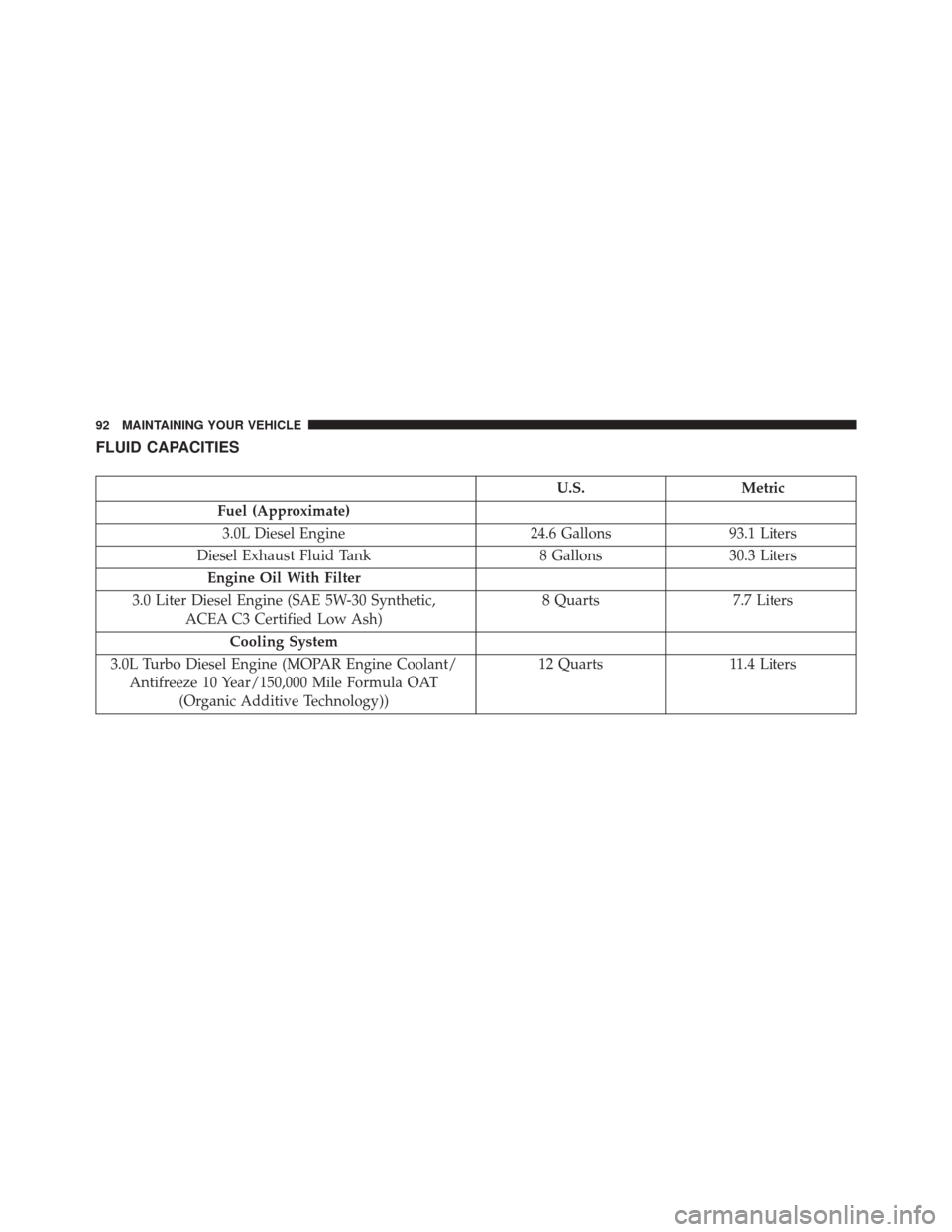
FLUID CAPACITIES
U.S.Metric
Fuel (Approximate) 3.0L Diesel Engine 24.6 Gallons93.1 Liters
Diesel Exhaust Fluid Tank 8 Gallons30.3 Liters
Engine Oil With Filter
3.0 Liter Diesel Engine (SAE 5W-30 Synthetic, ACEA C3 Certified Low Ash) 8 Quarts
7.7 Liters
Cooling System
3.0L Turbo Diesel Engine (MOPAR Engine Coolant/ Antifreeze 10 Year/150,000 Mile Formula OAT (Organic Additive Technology)) 12 Quarts
11.4 Liters
92 MAINTAINING YOUR VEHICLE
Page 95 of 117
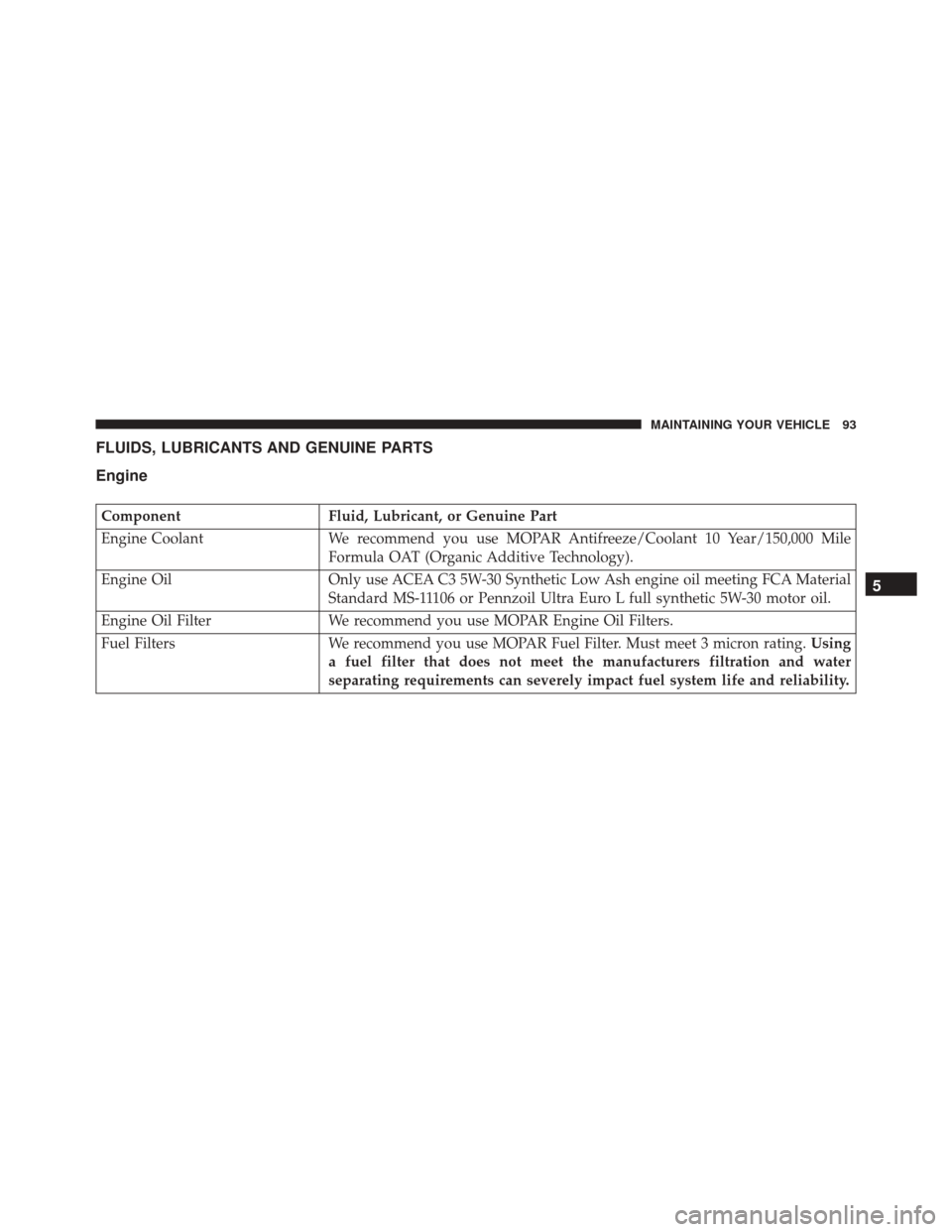
FLUIDS, LUBRICANTS AND GENUINE PARTS
Engine
ComponentFluid, Lubricant, or Genuine Part
Engine Coolant We recommend you use MOPAR Antifreeze/Coolant 10 Year/150,000 Mile
Formula OAT (Organic Additive Technology).
Engine Oil Only use ACEA C3 5W-30 Synthetic Low Ash engine oil meeting FCA Material
Standard MS-11106 or Pennzoil Ultra Euro L full synthetic 5W-30 motor oil.
Engine Oil Filter We recommend you use MOPAR Engine Oil Filters.
Fuel Filters We recommend you use MOPAR Fuel Filter. Must meet 3 micron rating. Using
a fuel filter that does not meet the manufacturers filtration and water
separating requirements can severely impact fuel system life and reliability.
5
MAINTAINING YOUR VEHICLE 93
Page 101 of 117
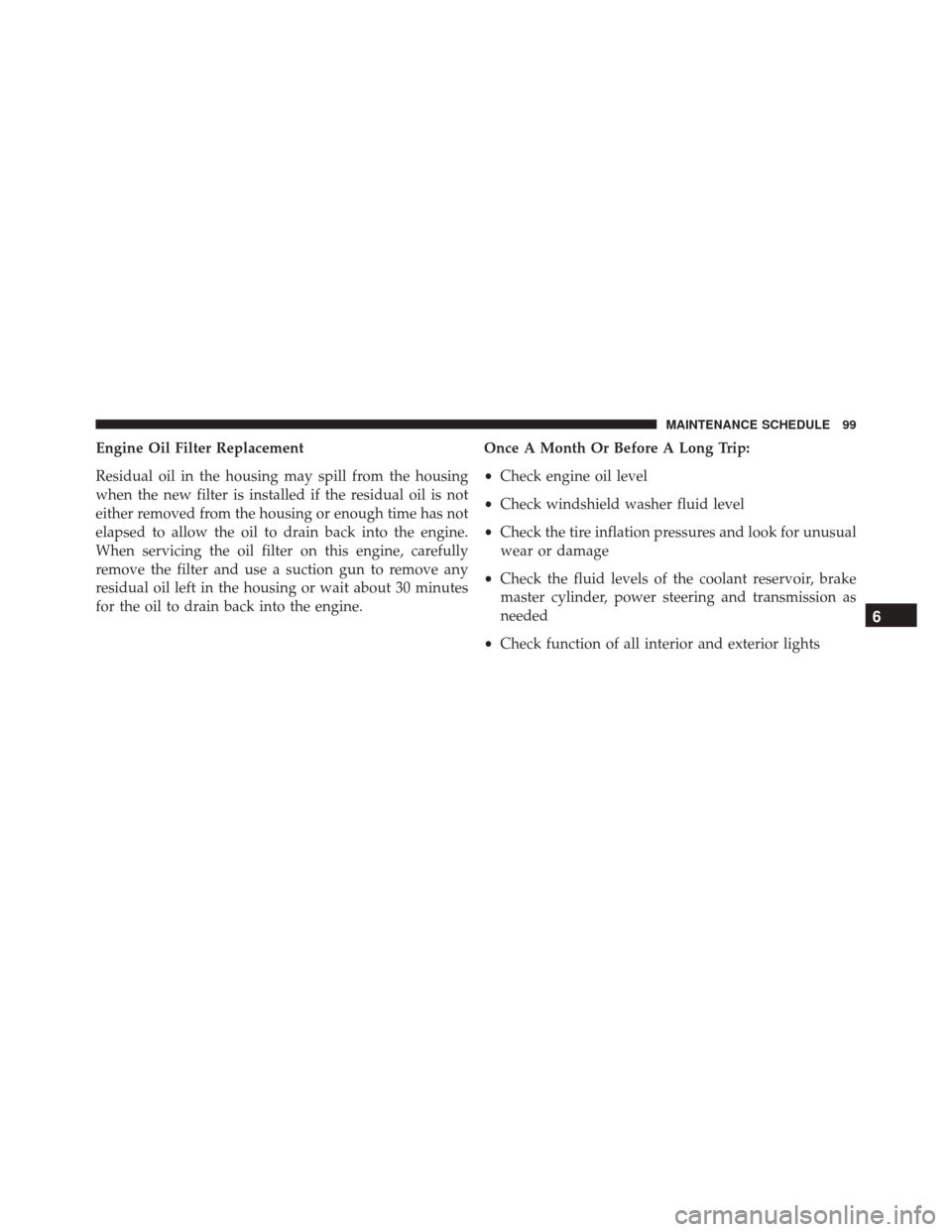
Engine Oil Filter Replacement
Residual oil in the housing may spill from the housing
when the new filter is installed if the residual oil is not
either removed from the housing or enough time has not
elapsed to allow the oil to drain back into the engine.
When servicing the oil filter on this engine, carefully
remove the filter and use a suction gun to remove any
residual oil left in the housing or wait about 30 minutes
for the oil to drain back into the engine.Once A Month Or Before A Long Trip:
•
Check engine oil level
• Check windshield washer fluid level
• Check the tire inflation pressures and look for unusual
wear or damage
• Check the fluid levels of the coolant reservoir, brake
master cylinder, power steering and transmission as
needed
• Check function of all interior and exterior lights
6
MAINTENANCE SCHEDULE 99
Page 102 of 117
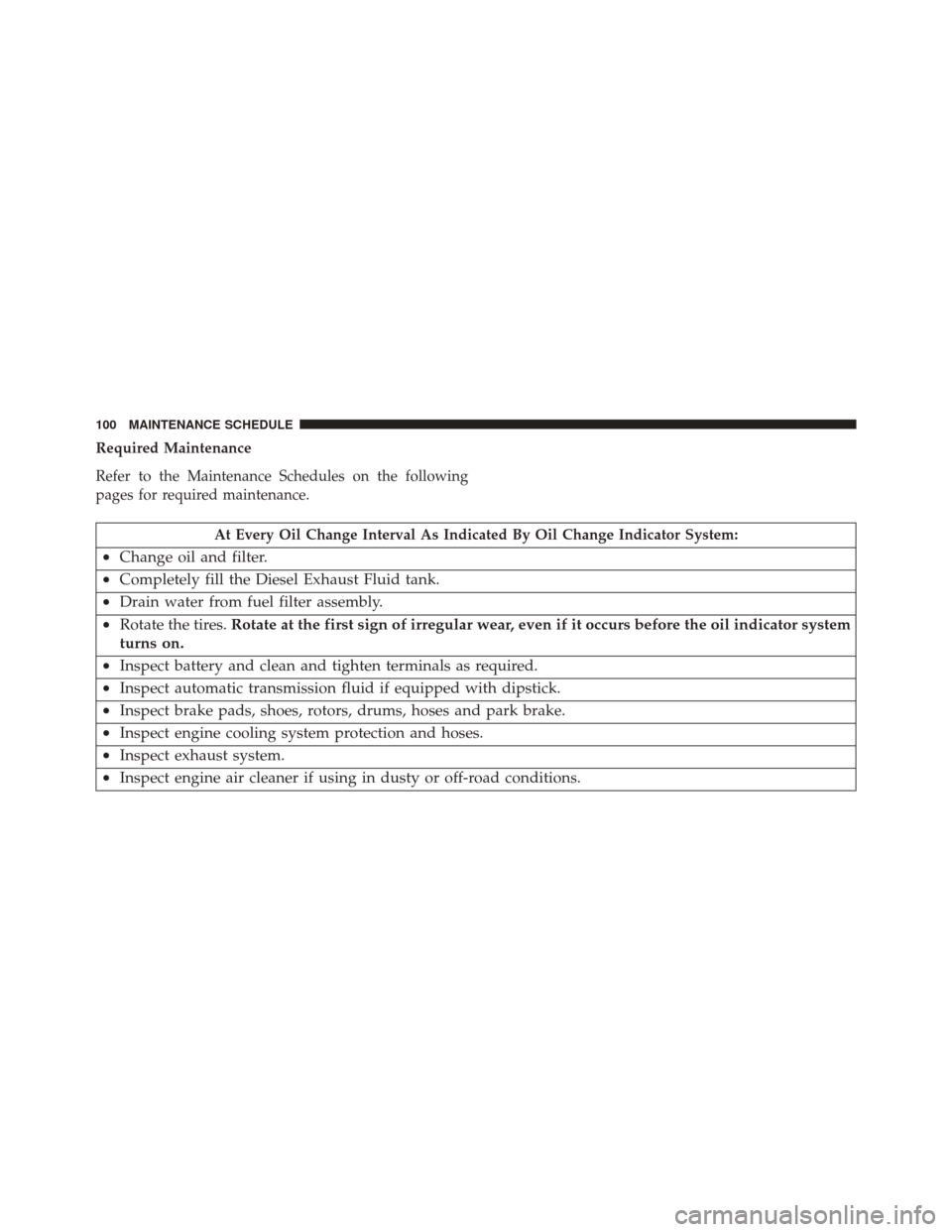
Required Maintenance
Refer to the Maintenance Schedules on the following
pages for required maintenance.
At Every Oil Change Interval As Indicated By Oil Change Indicator System:
•Change oil and filter.
• Completely fill the Diesel Exhaust Fluid tank.
• Drain water from fuel filter assembly.
• Rotate the tires. Rotate at the first sign of irregular wear, even if it occurs before the oil indicator system
turns on.
• Inspect battery and clean and tighten terminals as required.
• Inspect automatic transmission fluid if equipped with dipstick.
• Inspect brake pads, shoes, rotors, drums, hoses and park brake.
• Inspect engine cooling system protection and hoses.
• Inspect exhaust system.
• Inspect engine air cleaner if using in dusty or off-road conditions.
100 MAINTENANCE SCHEDULE
Page 110 of 117
Adding Engine Coolant (Antifreeze).............86
Adding Fuel ..............................62
Air Cleaner, Engine (Engine Air Cleaner Filter) .....74
Air Conditioning Filter ......................75
Antifreeze (Engine Coolant) ...................85
Capacities .............................92
Disposal ..............................88
Automatic Transmission Fluid Type .............................95
Axle Fluid ...............................95
Battery .................................83
Brake Fluid ..............................95
Brake System .............................90
Fluid Check ............................90
Master Cylinder .........................90
Capacities, Antifreeze (Engine Coolant) ...........92
Capacities, Fluid ...........................92 Caps, Filler
Oil (Engine) ............................73
Radiator (Coolant Pressure) .................88
Charge Air Cooler .........................90
Coolant Pressure Cap (Radiator Cap) ............88
Cooling System ...........................84
Adding Coolant (Antifreeze) ................86
Coolant Capacity ........................92
Coolant Level ...........................84
Disposal Of Used Coolant ..................88
Drain, Flush, And Refill ...................85
Points To Remember ......................89
Pressure Cap ...........................88
Radiator Cap ...........................88
Selection Of Coolant (Antifreeze) ..........85, 93
Diesel Fuel ...............................42
Diesel Fuel Requirements ....................42
Bulk Storage Of .........................65
108 INDEX