Page 12 of 117
NOTE:Light duty operation such as light trailer towing
or no load operation will extend the time before the
engine is at full efficiency. Reduced fuel economy and
power may be seen at this time.
The engine oil installed in the engine at the factory is a
high-quality energy conserving type lubricant. Oil
changes should be consistent with anticipated climate
conditions under which vehicle operations will occur.
The recommended viscosity and quality grades are
shown under “Fluids, Lubricants and Genuine Parts”,
under “Maintaining Your Vehicle” in this manual. NON-
DETERGENT OR STRAIGHT MINERAL OILS MUST
NEVER BE USED.
10 THINGS TO KNOW BEFORE STARTING YOUR VEHICLE
Page 33 of 117
STARTING AND OPERATING
CONTENTS
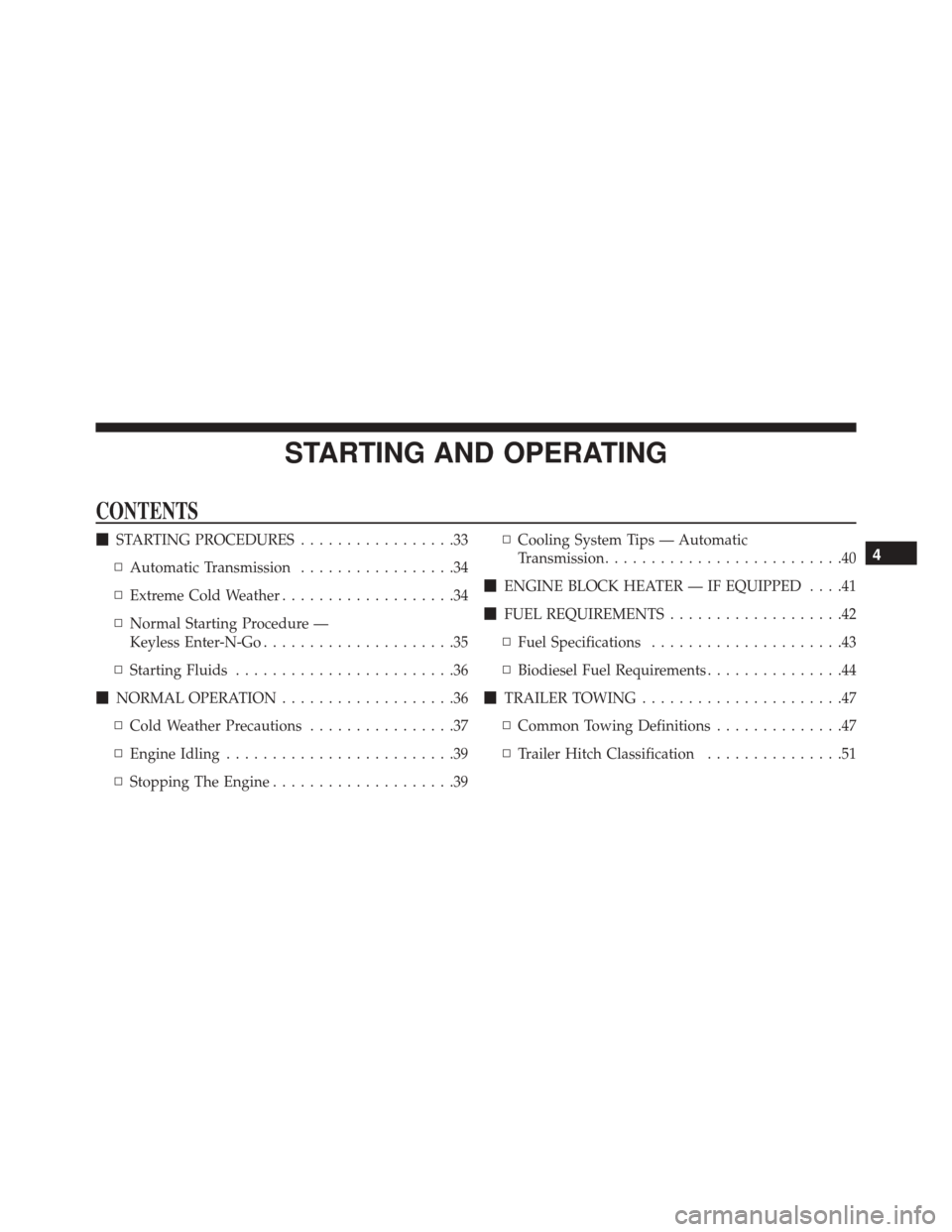
�STARTING PROCEDURES .................33
▫ Automatic Transmission .................34
▫ Extreme Cold Weather ...................34
▫ Normal Starting Procedure —
Keyless Enter-N-Go .....................35
▫ Starting Fluids ........................36
� NORMAL OPERATION ...................36
▫ Cold Weather Precautions ................37
▫ Engine Idling .........................39
▫ Stopping The Engine ....................39 ▫
Cooling System Tips — Automatic
Transmission ..........................40
� ENGINE BLOCK HEATER — IF EQUIPPED ....41
� FUEL REQUIREMENTS ...................42
▫ Fuel Specifications .....................43
▫ Biodiesel Fuel Requirements ...............44
� TRAILER TOWING ......................47
▫ Common Towing Definitions ..............47
▫ Trailer Hitch Classification ...............514
Page 34 of 117
▫Trailer Towing Weights (Maximum Trailer
Weight Ratings) .......................52
▫ Trailer And Tongue Weight ...............53
▫ Towing Requirements ...................54
▫ Towing Tips ..........................59
� DIESEL EXHAUST FLUID .................60
▫ System Overview ......................61 �
ADDING FUEL .........................62
▫ Avoid Using Contaminated Fuel ............65
▫ Bulk Fuel Storage — Diesel Fuel ...........65
▫ Diesel Exhaust Fluid Storage ..............65
▫ Adding Diesel Exhaust Fluid ..............66
32 STARTING AND OPERATING
Page 49 of 117
TRAILER TOWING
In this section you will find safety tips and information
on limits to the type of towing you can reasonably do
with your vehicle. Before towing a trailer, carefully
review this information to tow your load as efficiently
and safely as possible.
To maintain the New Vehicle Limited Warranty coverage,
follow the requirements and recommendations in this
manual concerning vehicles used for trailer towing.
Common Towing Definitions
The following trailer towing related definitions will assist
you in understanding the following information:
Gross Vehicle Weight Rating (GVWR)
The GVWR is the total allowable weight of your vehicle.
This includes driver, passengers, cargo and tongue
weight. The total load must be limited so that you do not
exceed the GVWR. Refer to “Vehicle Loading/Vehicle
Certification Label” in “Starting And Operating” for
further information.
Gross Trailer Weight (GTW)
The GTW is the weight of the trailer plus the weight of all
cargo, consumables and equipment (permanent or tem-
porary) loaded in or on the trailer in its�loaded and
ready for operation� condition.
4
STARTING AND OPERATING 47
Page 50 of 117
The recommended way to measure GTW is to put your
fully loaded trailer on a vehicle scale. The entire weight
of the trailer must be supported by the scale.
WARNING!
If the gross trailer weight is 5,000 lbs (2 267 kg) or
more, it is mandatory to use a weight-distributing
hitch to ensure stable handling of your vehicle. If
you use a standard weight-carrying hitch, you could
lose control of your vehicle and cause a collision.
Gross Combination Weight Rating (GCWR)
The GCWR is the total permissible weight of your vehicle
and trailer when weighed in combination.
Gross Axle Weight Rating (GAWR)
The GAWR is the maximum capacity of the front and rear
axles. Distribute the load over the front and rear axles
evenly. Make sure that you do not exceed either front or
rear GAWR. Refer to “Vehicle Loading/Vehicle Certifica-
tion Label” in “Starting And Operating” for further
information.
WARNING!
It is important that you do not exceed the maximum
front or rear GAWR. A dangerous driving condition
can result if either rating is exceeded. You could lose
control of the vehicle and have a collision.
48 STARTING AND OPERATING
Page 51 of 117
Tongue Weight (TW)
The tongue weight is the downward force exerted on the
hitch ball by the trailer. The recommended tongue weight
is 10% to 15% of the vehicle’s GTW for a conventional
hitch. You must consider this as part of the load on your
vehicle.
Frontal Area
The frontal area is the maximum height multiplied by the
maximum width of the front of a trailer.
Trailer Sway Control
The trailer sway control can be a mechanical telescoping
link that can be installed between the hitch receiver and
the trailer tongue that typically provides adjustable fric-
tion associated with the telescoping motion to dampen
any unwanted trailer swaying motions while traveling.If equipped, the electronic Trailer Sway Control (TSC)
recognizes a swaying trailer and automatically applies
individual wheel brakes and/or reduces engine power to
attempt to eliminate the trailer sway.
Weight-Carrying Hitch
A weight-carrying hitch supports the trailer tongue
weight, just as if it were luggage located at a hitch ball or
some other connecting point of the vehicle. These kinds
of hitches are the most popular on the market today and
they are commonly used to tow small and medium sized
trailers.
Weight-Distributing Hitch
A weight-distributing system works by applying lever-
age through spring (load) bars. They are typically used
for heavier loads to distribute trailer tongue weight to the
4
STARTING AND OPERATING 49
Page 52 of 117
tow vehicle’s front axle and the trailer axle(s). When used
in accordance with the manufacturer’s directions, it pro-
vides for a more level ride, offering more consistent
steering and brake control thereby enhancing towing
safety. The addition of a friction/hydraulic sway control
also dampens sway caused by traffic and crosswinds and
contributes positively to tow vehicle and trailer stability.
Trailer sway control and a weight distributing (load
equalizing) hitch are recommended for heavier Tongue
Weights (TW) and may be required depending on vehicle
and trailer configuration/loading to comply with Gross
Axle Weight Rating (GAWR) requirements.WARNING!
•An improperly adjusted Weight Distributing Hitch
system may reduce handling, stability, braking
performance, and could result in a collision.
• Weight Distributing Systems may not be compat-
ible with Surge Brake Couplers. Consult with your
hitch and trailer manufacturer or a reputable Rec-
reational Vehicle dealer for additional information.
50 STARTING AND OPERATING
Page 53 of 117
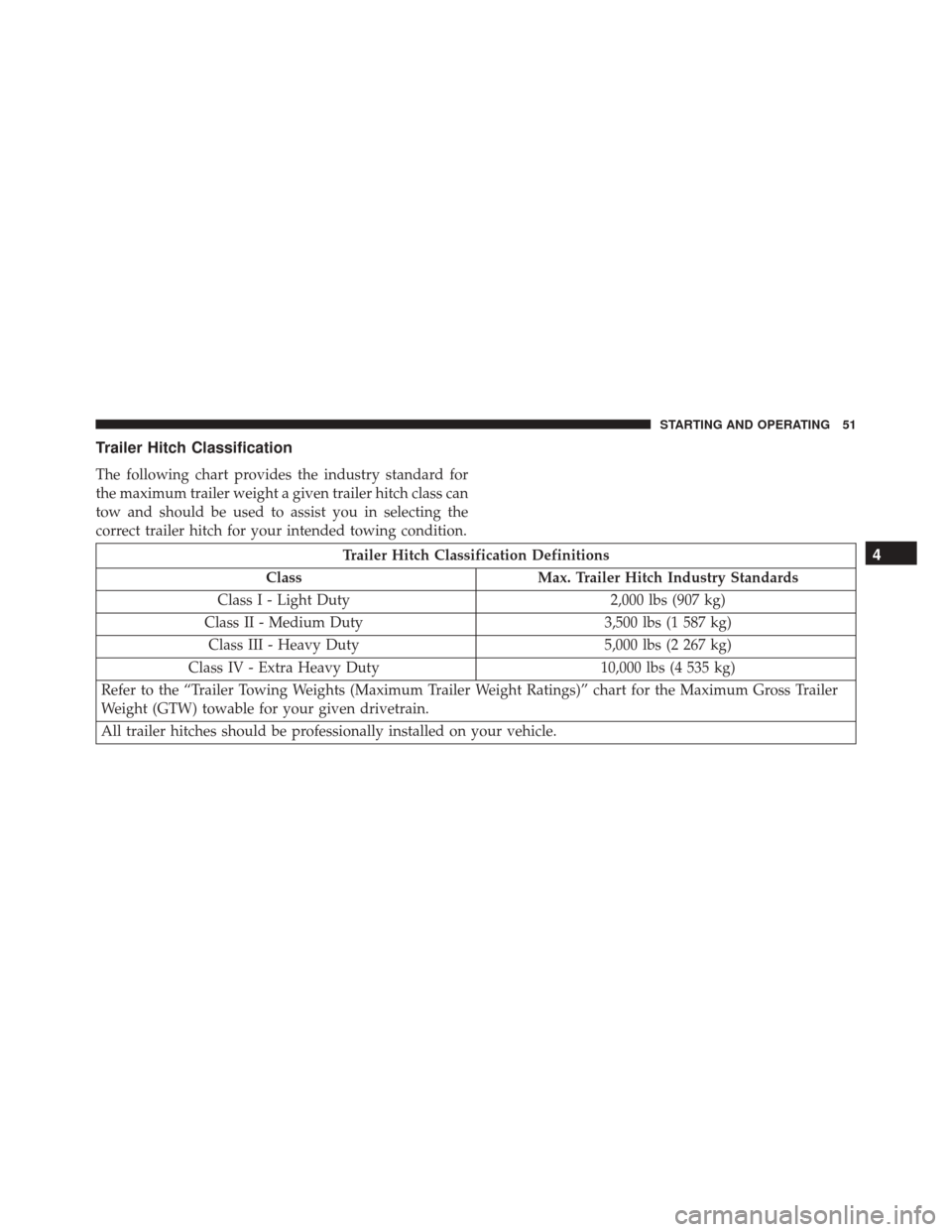
Trailer Hitch Classification
The following chart provides the industry standard for
the maximum trailer weight a given trailer hitch class can
tow and should be used to assist you in selecting the
correct trailer hitch for your intended towing condition.
Trailer Hitch Classification Definitions
Class Max. Trailer Hitch Industry Standards
Class I - Light Duty 2,000 lbs (907 kg)
Class II - Medium Duty 3,500 lbs (1 587 kg)
Class III - Heavy Duty 5,000 lbs (2 267 kg)
Class IV - Extra Heavy Duty 10,000 lbs (4 535 kg)
Refer to the “Trailer Towing Weights (Maximum Trailer Weight Ratings)” chart for the Maximum Gross Trailer
Weight (GTW) towable for your given drivetrain.
All trailer hitches should be professionally installed on your vehicle.4
STARTING AND OPERATING 51