2016 HYUNDAI I40 automatic
[x] Cancel search: automaticPage 443 of 534

Downloaded from www.Manualslib.com manuals search engine Maintenance
38
7
NORMAL MAINTENANCE SCHEDULE - FOR DIESEL ENGINE (EXCEPT EUROPE) (CONT.)
120,000 km (80,000 miles) or 96months
❑ Inspect air cleaner filter - Except Middle East
❑ Inspect air conditioner refrigerant/compressor (if equipped)
❑ Inspect battery condition
❑ Inspect brake lines, hoses and connections
❑ Inspect brake/clutch(if equipped) fluid
❑ Inspect disc brakes and pads
❑ Inspect drive shafts and boots
❑ Inspect exhaust system
❑ Inspect front suspension ball joints
❑ Inspect fuel filler cap
❑ Inspect fuel lines, hoses and connections
❑ Inspect parking brake
❑ Inspect steering gear rack, linkage and boots
❑ Inspect tire (pressure & tread wear)
❑ Inspect manual transaxle fluid *6(if equipped)
(Continued)
(Continued)
❑ Replace air cleaner filter - For Middle East
❑ Replace climate control air filter (if equipped)
❑ Replace fuel filter cartridge *3
❑ Replace fuel tank air filter
❑ Replace coolant *8
(At first, 210,000 km (120,000 miles) or 120months
after that, every 30,000 km (20,000 miles) or 24months *10)
❑ Replace engine oil and filter *1 *2 *3 *4
(Every 10,000 km (6,500 miles) or 12months)
❑ Inspect cooling system
(At first, 60,000 km (40,000 miles) or 48months
after that, every 30,000 km (20,000 miles) or 24months)
❑ Inspect drive belt *9
(At first, 80,000 km (50,000 miles) or 48months
after that, every 20,000 km (12,500 miles) or 24months)
No check, No service required
❑ Automatic transaxle fluid
Page 444 of 534

Downloaded from www.Manualslib.com manuals search engine 739
Maintenance
MAINTENANCE UNDER SEVERE USAGE CONDITIONS - FOR DIESEL ENGINE (EXCEPT EUROPE)
The following items must be serviced more frequently on cars mainly used under severe driving conditions.
Refer to the chart below for the appropriate maintenance intervals.
R : Replace I : Inspect and if necessary, adjust, correct, clean or replace
Maintenance itemMaintenanceoperationMaintenance intervalsDriving condition
Engine oil and engine oil filterREvery 5,000 km (3,000 miles) or 6 monthsA, B, C, F, G, H, I, J, K, L
Air cleaner filterRReplace more frequently
depending on the conditionC, E
Manual transaxle fluid (if equipped)REvery 120,000 km (80,000 miles)C, D, E, G, H, I, K
Automatic transaxle fluid (if equipped)REvery 100,000 km (62,000 miles)A, C, D, E, F, G, H, I, K
Steering gear rack, linkage and bootsIInspect more frequently
depending on the conditionC, D, E, F, G
Front suspension ball jointsIInspect more frequently
depending on the conditionC, D, E, F, G
Page 447 of 534

Downloaded from www.Manualslib.com manuals search engine Maintenance
42
7
Vapor hose and fuel filler cap
The vapor hose and fuel filler cap should
be inspected at those intervals specified
in the maintenance schedule. Make sure
that a new vapor hose or fuel filler cap is
correctly replaced.
Vacuum crankcase ventilation
hoses (if equipped)
Inspect the surface of hoses for evidence
of heat and/or mechanical damage. Hard
and brittle rubber, cracking, tears, cuts,
abrasions, and excessive swelling indi-
cate deterioration. Particular attention
should be paid to examine those hose
surfaces nearest to high heat sources,
such as the exhaust manifold.
Inspect the hose routing to assure that
the hoses do not come in contact with
any heat source, sharp edges or moving
component which might cause heat dam-
age or mechanical wear. Inspect all hose
connections, such as clamps and cou-
plings, to make sure they are secure, and
that no leaks are present. Hoses should
be replaced immediately if there is any
evidence of deterioration or damage.
Air cleaner filter
A Genuine HYUNDAI air cleaner filter is
recommended when the filter is replaced.
Spark plugs (for gasoline engine)
Make sure to install new spark plugs of
the correct heat range.
Valve clearance
(for gasoline engine 1.6L)
Inspect excessive valve noise and/or
engine vibration and adjust if necessary.
An authorized HYUNDAI dealer should
perform the operation.
Cooling system
Check the cooling system parts, such as
radiator, coolant reservoir, hoses and
connections for leakage and damage.
Replace any damaged parts.
Coolant
The coolant should be changed at the
intervals specified in the maintenance
schedule.
Manual transaxle fluid
(if equipped)
Inspect the manual transaxle fluid
according to the maintenance schedule.
Automatic transaxle fluid
(if equipped)
Automatic transaxle fluid should not be
checked under normal usage conditions.
But in severe conditions, the fluid should
be changed at an authorized HYUNDAI
dealer in accordance to the scheduled
maintenance at the beginning of this
chapter.
✽ ✽
NOTICE
Automatic transaxle fluid color is basi-
cally red.
As the vehicle is driven, the automatic
transaxle fluid will begin to look darker.
It is normal condition and you should
not judge the need to replace the fluid
based upon the changed color.
Page 448 of 534

Downloaded from www.Manualslib.com manuals search engine 743
Maintenance
Brake hoses and lines
Visually check for proper installation,
chafing, cracks, deterioration and any
leakage. Replace any deteriorated or
damaged parts immediately.
Brake fluid
Check brake fluid level in the brake fluid
reservoir. The level should be between
“MIN” and “MAX” marks on the side of
the reservoir. Use only hydraulic brake
fluid conforming to DOT 3 or DOT 4
specification.
Brake pads, calipers and rotors
Check the pads for excessive wear, discs
for run out and wear, and calipers for fluid
leakage.
For more information on checking the
pads or lining wear limit, refer to the
Hyundai web site.
(http://brakeman
ual.hmc.co.kr)
Suspension mounting bolts
Check the suspension connections for
looseness or damage. Retighten to the
specified torque.
Parking brake
Inspect the parking brake system
including the EPB actuator, wiring
and connectors.Steering gear box, linkage &
boots/lower arm ball joint
With the vehicle stopped and engine off,
check for excessive free-play in the
steering wheel.
Check the linkage for bends or damage.
Check the dust boots and ball joints for
deterioration, cracks, or damage.
Replace any damaged parts.
Drive shafts and boots
Check the drive shafts, boots and clamps
for cracks, deterioration, or damage.
Replace any damaged parts and, if nec-
essary, repack the grease.
Air conditioning refrigerant/
compressor (if equipped)
Check the air conditioning lines and con-
nections for leakage and damage.
CAUTION
The use of a non-specified fluid
could result in transaxle malfunc-tion and failure.
Use only specified automatictransaxle fluid. (Refer to“Recommended lubricants andcapacities” in section 8.)
Page 451 of 534

Downloaded from www.Manualslib.com manuals search engine Maintenance
46
7
Check the condition and connections of
all cooling system hoses and heater
hoses. Replace any swollen or deterio-
rated hoses.
The coolant level should be filled
between F (MAX) and L (MIN) marks on
the side of the coolant reservoir when the
engine is cool.
If the coolant level is low, add enough
distilled (deionized) water. Bring the level
to F (MAX), but do not overfill. If frequent
coolant refill is required, see an author-
ized HYUNDAI dealer for a cooling sys-
tem inspection.
Recommended engine coolant
When adding coolant, use only deion-
ized water or soft water for your vehicle
and never mix hard water in the
coolant filled at the factory. An improp-
er coolant mixture can result in serious
malfunction or engine damage.
The engine in your vehicle has alu- minum engine parts and must be pro-
tected by an ethylene-glycol-based
coolant to prevent corrosion and freez-
ing.
DO NOT USE alcohol or methanol coolant or mix them with the specified
coolant.
Do not use a solution that contains more than 60% antifreeze or less than
35% antifreeze, which would reduce
the effectiveness of the solution.
For mixture percentage, refer to the fol-
lowing table.
OVF071006
Ambient
Temperature Mixture Percentage
(volume)
Antifreeze Water
-15°C (5°F) 35 65
-25°C (-13°F) 40 60
-35°C (-31°F) 50 50
-45°C (-49°F) 60 40
WARNING
The electric motor (cool-
ing fan) is controlled by
engine coolant tempera-
ture, refrigerant pres-
sure and vehicle speed.
It may sometimes operate even
when the engine is not running.
Use extreme caution when working
near the blades of the cooling fan
so that you are not injured by a
rotating fan blades. As the engine
coolant temperature decreases, the
electric motor will automatically
shut off. This is a normal condition.
If your vehicle is equipped with
GDI, the electric motor (cooling fan)
may operate until you disconnect
the negative battery cable.
(Continued)
Even if the engine is not operat- ing, do not remove the radiator
cap or the drain plug while the
engine and radiator are hot. Hot
coolant and steam may still blow
out under pressure, causing seri-
ous injury.
Page 512 of 534
Downloaded from www.Manualslib.com manuals search engine 7107
Maintenance
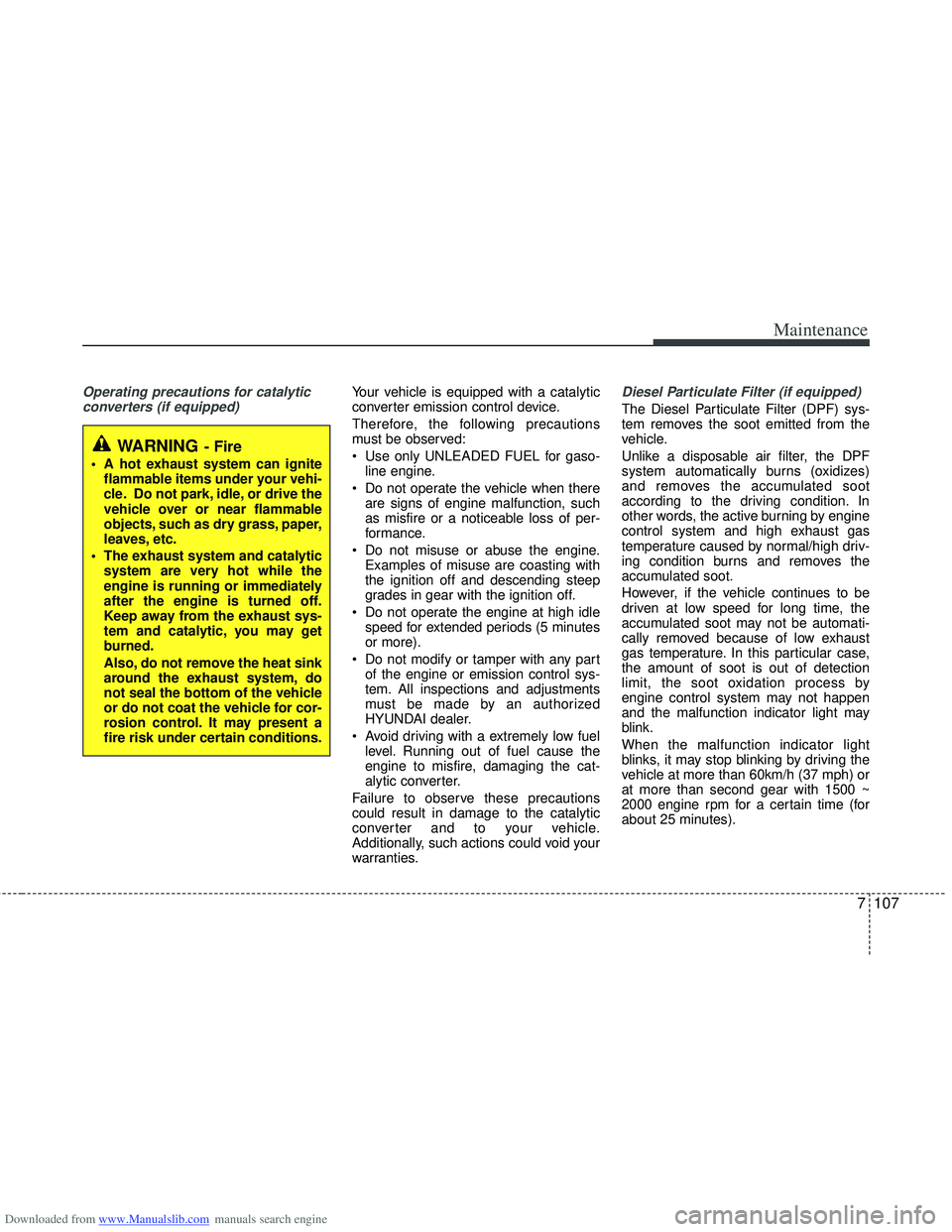
Operating precautions for catalyticconverters (if equipped)Your vehicle is equipped with a catalytic
converter emission control device.
Therefore, the following precautions
must be observed:
Use only UNLEADED FUEL for gaso- line engine.
Do not operate the vehicle when there are signs of engine malfunction, such
as misfire or a noticeable loss of per-
formance.
Do not misuse or abuse the engine. Examples of misuse are coasting with
the ignition off and descending steep
grades in gear with the ignition off.
Do not operate the engine at high idle speed for extended periods (5 minutes
or more).
Do not modify or tamper with any part of the engine or emission control sys-
tem. All inspections and adjustments
must be made by an authorized
HYUNDAI dealer.
Avoid driving with a extremely low fuel level. Running out of fuel cause the
engine to misfire, damaging the cat-
alytic converter.
Failure to observe these precautions
could result in damage to the catalytic
converter and to your vehicle.
Additionally, such actions could void your
warranties.Diesel Particulate Filter (if equipped)
The Diesel Particulate Filter (DPF) sys-
tem removes the soot emitted from the
vehicle.
Unlike a disposable air filter, the DPF
system automatically burns (oxidizes)
and removes the accumulated soot
according to the driving condition. In
other words, the active burning by engine
control system and high exhaust gas
temperature caused by normal/high driv-
ing condition burns and removes the
accumulated soot.
However, if the vehicle continues to be
driven at low speed for long time, the
accumulated soot may not be automati-
cally removed because of low exhaust
gas temperature. In this particular case,
the amount of soot is out of detection
limit, the soot oxidation process by
engine control system may not happen
and the malfunction indicator light may
blink.
When the malfunction indicator light
blinks, it may stop blinking by driving the
vehicle at more than 60km/h (37 mph) or
at more than second gear with 1500 ~
2000 engine rpm for a certain time (for
about 25 minutes).
WARNING- Fire
A hot exhaust system can ignite flammable items under your vehi-
cle. Do not park, idle, or drive the
vehicle over or near flammable
objects, such as dry grass, paper,
leaves, etc.
The exhaust system and catalytic system are very hot while the
engine is running or immediately
after the engine is turned off.
Keep away from the exhaust sys-
tem and catalytic, you may get
burned.
Also, do not remove the heat sink
around the exhaust system, do
not seal the bottom of the vehicle
or do not coat the vehicle for cor-
rosion control. It may present a
fire risk under certain conditions.
Page 517 of 534
Downloaded from www.Manualslib.com manuals search engine Specifications & Consumer information
48
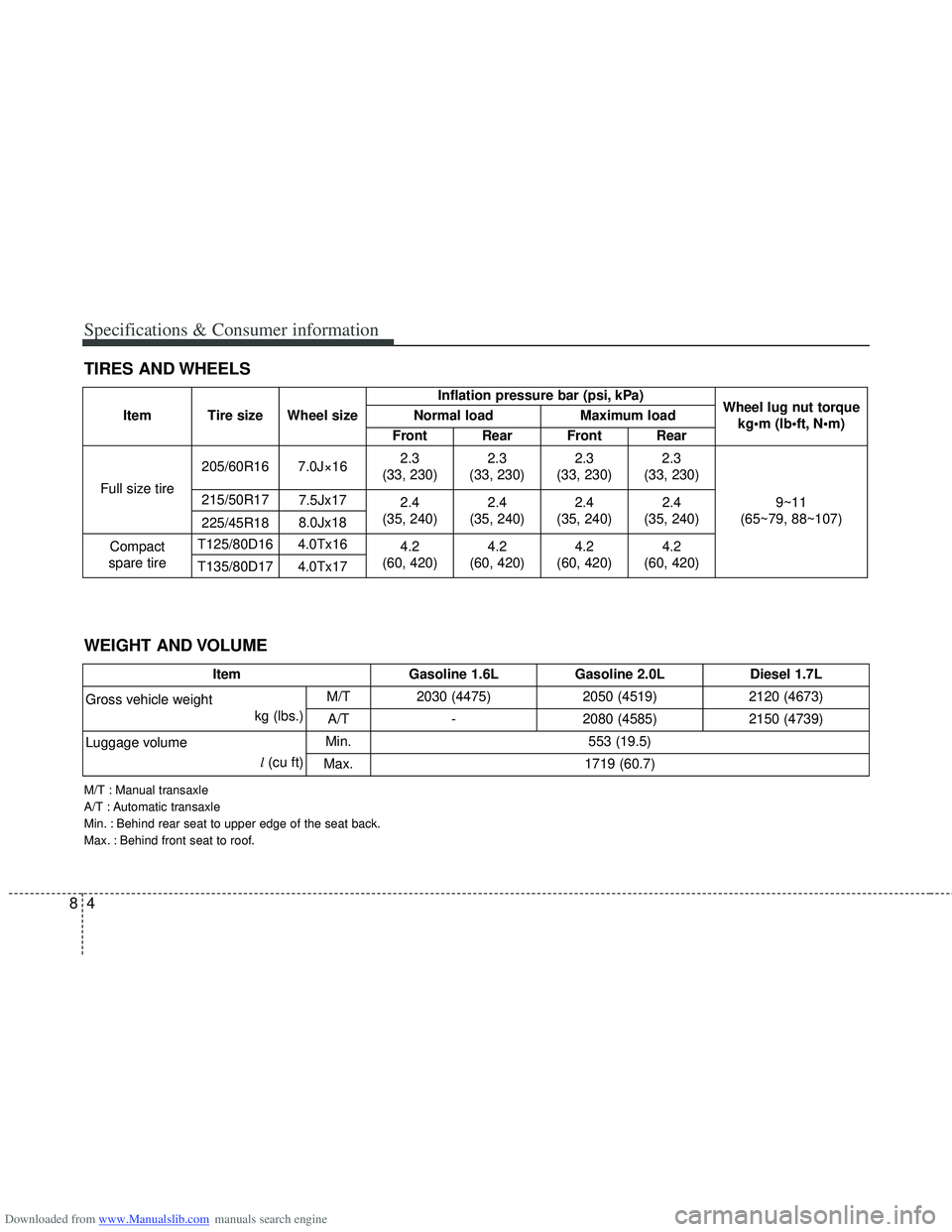
TIRES AND WHEELS
Item Tire size Wheel sizeInflation pressure bar (psi, kPa)
Wheel lug nut torque
Normal load Maximum load
Front Rear Front Rear
Full size tire 205/60R16 7.0J×16
2.3
(33, 230) 2.3
(33, 230) 2.3
(33, 230) 2.3
(33, 230)
9~11
(65~79, 88~107)
215/50R17
225/45R18 7.5Jx17
8.0Jx18
2.4
(35, 240) 2.4
(35, 240) 2.4
(35, 240) 2.4
(35, 240)
Compact
spare tire T125/80D16
T135/80D17 4.0Tx16
4.0Tx17
4.2
(60, 420) 4.2
(60, 420) 4.2
(60, 420) 4.2
(60, 420)
WEIGHT AND VOLUME
Item Gasoline 1.6LGasoline 2.0L Diesel 1.7L
Gross vehicle weight kg (lbs.)M/T 2030 (4475)
2050 (4519)2120 (4673)
A/T-2080 (4585)2150 (4739)
Luggage volume l(cu ft) Min. 553 (19.5)
Max. 1719 (60.7)
M/T : Manual transaxle
A/T : Automatic transaxle
Min. : Behind rear seat to upper edge of the seat back.
Max. : Behind front seat to roof.
Page 518 of 534
Downloaded from www.Manualslib.com manuals search engine 85
Specifications & Consumer information
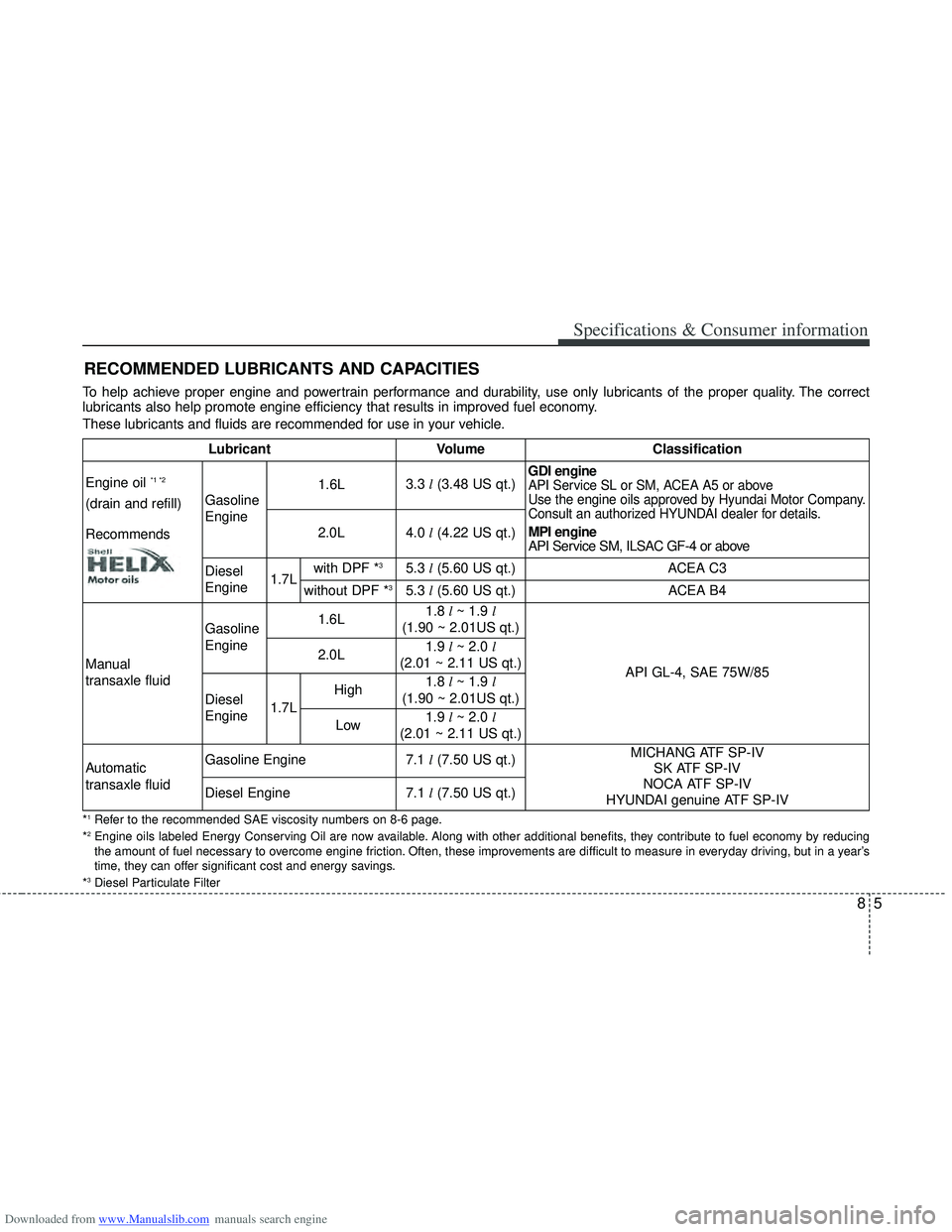
To help achieve proper engine and powertrain performance and durability, use only lubricants of the proper quality. The correct
lubricants also help promote engine efficiency that results in improved fuel economy.
These lubricants and fluids are recommended for use in your vehicle.
RECOMMENDED LUBRICANTS AND CAPACITIES
*1Refer to the recommended SAE viscosity numbers on 8-6 page.
*2Engine oils labeled Energy Conserving Oil are now available. Along with other additional benefits, they contribute to fuel economy by reducing
the amount of fuel necessary to overcome engine friction. Often, these improvements are difficult to measure in everyday driving, but in a year’s
time, they can offer significant cost and energy savings.
*
3Diesel Particulate Filter
Lubricant Volume Classification
Engine oil
*1 *2
(drain and refill)
Recommends Gasoline
Engine
1.6L
3.3
l(3.48 US qt.) GDI engine
API Service SL or SM, ACEA A5 or above
Use the engine oils approved by Hyundai Motor Company.
Consult an authorized HYUNDAI dealer for details.
MPI engine
API Service SM, ILSAC GF-4 or above
2.0L
4.0
l(4.22 US qt.)
Diesel
Engine 1.7Lwith DPF *
35.3
l(5.60 US qt.)
ACEA C3
without DPF *
35.3 l(5.60 US qt.)
ACEA B4
Manual
transaxle fluid Gasoline
Engine
1.6L
1.8
l ~ 1.9 l
(1.90 ~ 2.01US qt.)
API GL-4, SAE 75W/85
2.0L
1.9
l ~ 2.0 l
(2.01 ~ 2.11 US qt.)
Diesel
Engine 1.7LHigh
1.8
l ~ 1.9 l
(1.90 ~ 2.01US qt.)
Low 1.9
l ~ 2.0 l
(2.01 ~ 2.11 US qt.)
Automatic
transaxle fluid Gasoline Engine
7.1
l(7.50 US qt.) MICHANG ATF SP-IV
SK ATF SP-IV
NOCA ATF SP-IV
HYUNDAI genuine ATF SP-IV
Diesel Engine7.1 l(7.50 US qt.)