2016 Hyundai H350 check
[x] Cancel search: checkPage 372 of 473

7-9
7
Maintenance
At least monthly:
Check coolant level in the enginecoolant reservoir.
Check the operation of all exterior lights, including the stoplights, turn
signals and hazard warning flash-
ers.
Check the inflation pressures of all tires including the spare.
At least twice a year
(i.e., every Spring and Fall) :
Check radiator, heater and air con- ditioning hoses for leaks or dam-
age.
Check windshield washer spray and wiper operation. Clean wiper
blades with clean cloth dampened
with washer fluid.
Check headlight alignment.
Check muffler, exhaust pipes, shields and clamps.
Check the lap/shoulder belts for wear and function.
Check for worn tires and loose wheel lug nuts.
At least once a year :
Clean body, door and hood drainholes.
Clean and lubricate door hinges and checks, and hood hinges.
Clean and lubricate door and hood locks and latches.
Clean and lubricate door rubber weatherstrips.
Check the air conditioning system.
Check the power steering fluid level.
Clean battery and terminals.
Check the brake and clutch fluid level.
Page 374 of 473

7-11
7
Maintenance
NORMAL MAINTENANCE SCHEDULE (FOR EUROPE)
I : Inspect and if necessary, adjust, correct, clean or replace.
R : Replace or change.*1
: Adjust alternator and power steering (and water pump drive belt) and air conditioner drive belt (if equipped).
Inspect and if necessary correct or replace.
* 2
: Check the engine oil level and leak every 500 km (350 miles) or before starting a long trip.
* 3
: This maintenance schedule depends on fuel quality. It is applicable only when using a qualified fuel <"EN590 or equivalent">.
If the diesel fuel specification doesn't meet the EN590, it must be replaced more frequently. If there are some important safety
matters like fuel flow restriction, surging, loss of power, hard starting problem etc, replace the fuel filter immediately rega rdless
of maintenance schedule and we recommend that you consult an authorized HYUNDAI dealer.
* 4
: Fuel filter warning light comes on, you should replace fuel filter before the next scheduled service.
Number of months or driving distance, whichever comes first
Months24487296120144168192
Miles×1,0002037.5607590110130150
Km×1,000306090120150180210240
Drive Belts * 1
and idlerAt first, inspect 60,000 km (37,500 miles) or 48 months
After that, inspect every 30,000 km (20,000 miles) or 24 months
Engine oil and engine oil filter * 2Except RussiaReplace every 30,000 km (20,000 miles) or 24 months
For RussiaReplace every 15,000 km (1,000 miles) or 12 months
Air cleaner filterIRIRIRIR
Vapor hose and fuel filter capIIIIIIII
Vacuum hose (for EGR & throttle body) (if equipped)IIIIIIII
Fuel Filter Cartridge *3
* 4IRIRIRIR
Fuel line hoses and connectionsIIIIIIII
MAINTENANCE
INTERVALS
MAINTENANCE ITEM
Page 377 of 473

7-14
Maintenance
NORMAL MAINTENANCE SCHEDULE (EXCEPT EUROPE)
Number of months or driving distance, whichever comes first
Months1224364860728496
Miles×1,00012.52537.55062.57587.5100
Km×1,000204060801001120140160
Drive belts *1
and idlerAt first, inspect 60,000 km (37,500 miles) or 48 months
After that, inspect every 30,000 km (20,000 miles) or 24 months
Engine oil and engine oil filter * 2Replace every 10,000 km (6,200 miles) or 12 months
Air cleaner filterIRIRIRIR
Vapor hose and fuel filler capIIIIIIII
Vacuum hose (for EGR & throttle body) (if equipped)IIIIIIII
Fuel filter cartridge *3
* 4IRIRIRIR
MAINTENANCE
INTERVALS
MAINTENANCE ITEM
I : Inspect and if necessary, adjust, correct, clean or replace.
R : Replace or change.* 1
: Adjust alternator and power steering (and water pump drive belt) and air conditioner drive belt (if equipped).
Inspect and if necessary correct or replace.
* 2
: Check the engine oil level and leak every 500 km (350 miles) or before starting a long trip.
* 3
: This maintenance schedule depends on fuel quality. It is applicable only when using a qualified fuel < "EN590 or equivalent">.
If the diesel fuel specification doesn't meet the EN590, it must be replaced more frequently. If there are some important safety
matters like fuel flow restriction, surging, loss of power, hard starting problem etc, replace the fuel filter immediately rega rdless
of maintenance schedule and we recommend that you consult an authorized HYUNDAI dealer.
* 4
: Fuel filter warning light comes on, you should replace fuel filter before the next scheduled service.
Page 382 of 473

7-19
7
Maintenance
EEXX PPLLAA NN AATTIIOO NN OO FF SS CC HH EEDD UU LLEE DD MM AAIINN TTEENN AANN CCEE IITT EEMM SS
Engine oil and filter
The engine oil and filter should be
changed at the intervals specified in
the maintenance schedule. If the
vehicle is being driven in severe con-
ditions, more frequent oil and filterchanges are required.
Drive belts
Inspect all drive belts for evidence of
cuts, cracks, excessive wear or oil
saturation and replace if necessary.
Drive belts should be checked peri-
odically for proper tension and
adjusted as necessary.
Fuel filter (cartridge)
A clogged filter can limit the speed at
which the vehicle may be driven,damage the emission system and
cause multiple issues such as hard
starting. If an excessive amount of
foreign matter accumulates in the
fuel tank, the filter may require
replacement more frequently.
After installing a new filter, run the
engine for several minutes, and
check for leaks at the connections.
We recommend that the fuel filter be
replaced by an authorized HYUNDAI
dealer.
Fuel lines, fuel hoses and con- nections
Check the fuel lines, fuel hoses and
connections for leakage and dam-
age. We recommend that the fuel
lines, fuel hoses and connection be
replaced by an authorized HYUNDAI
dealer.
When you are inspecting the
belt, place the ignition switch in
the LOCK/OFF or ACC position.
CAUTION
In case the fuel filter is clogged
due to not conforming to the
maintenance period, the fuel
injection equipment may supply
the fuel insufficiently, which
may damage the fuel injectionequipment and cause the
engine to stall at worst cases.
CAUTION
Diesel only
Never work on injection system with engine running or within 30seconds after shutting off
engine. High pressure pump,
rail, injectors and high pressurepipes are subject to high pres-
sure even after the engine
stopped. The fuel jet produced
by fuel leaks may cause serious
injury, if it touch the body.
People using pacemakers
should not move than 30cm
closer to the ECU or wiring har-
ness within the engine room
while engine is running, sincethe high currents in the
Common Rail system produce
considerable magnetic fields.
WARNING
Page 383 of 473
7-20
Maintenance
Vapor hose and fuel filler cap
The vapor hose and fuel filler cap should be inspected at those inter-
vals specified in the maintenance
schedule. Make sure that a new
vapor hose or fuel filler cap is cor-rectly replaced.
Vacuum crankcase ventilation hoses (if equipped)
Inspect the surface of hoses for evi- dence of heat and/or mechanical
damage. Hard and brittle rubber,
cracking, tears, cuts, abrasions, and
excessive swelling indicate deterio-
ration. Particular attention should be
paid to examine those hose surfaces
nearest to high heat sources, such
as the exhaust manifold. Inspect the hose routing to assure that the hoses do not come in con-
tact with any heat source, sharp
edges or moving component whichmight cause heat damage or
mechanical wear. Inspect all hose
connections, such as clamps and
couplings, to make sure they are
secure, and that no leaks are pres-
ent. Hoses should be replaced
immediately if there is any evidence
of deterioration or damage.
Air cleaner filter
We recommend that the air cleaner
filter be replaced by an authorized
HYUNDAI dealer.
Cooling system
Check cooling system components,
such as radiator, coolant reservoir,
hoses and connections for leakage
and damage. Replace any damaged
parts.
Page 384 of 473
7-21
7
Maintenance
Coolant
The coolant should be changed at
the intervals specified in the mainte-
nance schedule.
Manual transmission fluid (if equipped)
Inspect the manual transmission fluid according to the maintenance
schedule.
Brake hoses and lines
Visually check for proper installation,
chafing, cracks, deterioration and
any leakage. Replace any deteriorat-
ed or damaged parts immediately.
Brake fluid
Check brake fluid level in the brake
fluid reservoir. The level should be
between “MIN” and “MAX” marks on
the side of the reservoir. Use only
hydraulic brake fluid conforming to
DOT 4 specification.
Parking brake
Inspect the parking brake system
including the parking brake lever and
cables.
Brake discs, pads, calipers
and rotors
Check the pads for excessive wear,
discs for run out and wear, and
calipers for fluid leakage.
For more information on checking
the pads or lining wear limit, refer to
the HYUNDAI web site. (http://brakeman
ual.hmc.co.kr)
Suspension mounting bolts
Check the suspension connections
for looseness or damage. Retighten
to the specified torque.
Steering gear box, linkage &
boots/lower arm ball joint
With the vehicle stopped and engine
off, check for excessive free-play in
the steering wheel.
Check the linkage for bends or dam-
age. Check the dust boots and ball
joints for deterioration, cracks, or
damage. Replace any damaged
parts.
Power steering pump, belt and hoses
Check the power steering pump and
hoses for leakage and damage.
Replace any damaged or leaking
parts immediately. Inspect the power
steering belt (or drive belt) for evi-
dence of cuts, cracks, excessive
wear, oiliness and proper tension.
Replace or adjust it if necessary.
Air conditioning refrigerant (if equipped)
Check the air conditioning lines and
connections for leakage and dam-
age.
Page 385 of 473
7-22
Maintenance
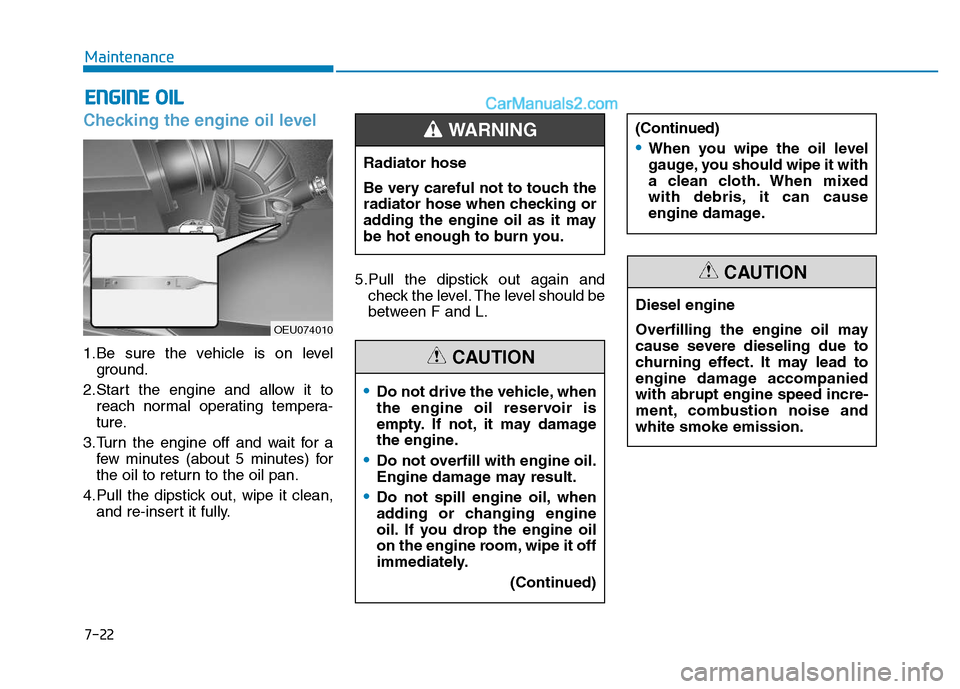
Checking the engine oil level
1.Be sure the vehicle is on levelground.
2.Start the engine and allow it to reach normal operating tempera-
ture.
3.Turn the engine off and wait for a few minutes (about 5 minutes) for
the oil to return to the oil pan.
4.Pull the dipstick out, wipe it clean, and re-insert it fully. 5.Pull the dipstick out again and
check the level. The level should be
between F and L.
EENN GGIINN EE OO IILL
OEU074010 Radiator hose
Be very careful not to touch the
radiator hose when checking or
adding the engine oil as it may
be hot enough to burn you.
WARNING
Do not drive the vehicle, when
the engine oil reservoir is
empty. If not, it may damage
the engine.
Do not overfill with engine oil.
Engine damage may result.
Do not spill engine oil, when
adding or changing engine
oil. If you drop the engine oil
on the engine room, wipe it off
immediately.
(Continued)
(Continued)
When you wipe the oil level
gauge, you should wipe it with
a clean cloth. When mixed
with debris, it can cause
engine damage.
CAUTION
Diesel engine
Overfilling the engine oil may
cause severe dieseling due to
churning effect. It may lead to
engine damage accompaniedwith abrupt engine speed incre-
ment, combustion noise andwhite smoke emission.
CAUTION
Page 387 of 473
7-24
Maintenance
The high-pressure cooling system
has a reservoir filled with year-round
antifreeze coolant. The reservoir is
filled at the factory. Check the
antifreeze protection and coolant
level at least once a year, at thebeginning of the winter season, and
before traveling to a colder climate.Checking the coolant level
EENN GGIINN EE CC OO OOLLAA NN TT
Do not drive with no engine
coolant. It may cause waterpump failure and engine
seizure, etc.
When the engine overheats
from low engine coolant, sud-
denly adding engine coolant
may cause cracks in the
engine. To prevent damage,
add engine coolant slowly insmall quantities.
CAUTION
Removing radiator
cap
Never attempt to remove the radiator cap while the engine
is operating or hot. Doing somight lead to cooling system
and engine damage and could
result in serious personal
injury from escaping hotcoolant or steam.
Turn the engine off and wait
until it cools down. Use
extreme care when removing
the radiator cap. Wrap a thick
towel around it, and turn it
counterclockwise slowly to
the first stop. Step back while
the pressure is released fromthe cooling system.
(Continued)
WARNING (Continued)When you are sure all the pressure has been released,
press down on the cap, using
a thick towel, and continue
turning counterclockwise to
remove it.
Even if the engine is not oper-
ating, do not remove the radi-ator cap or the drain plugwhile the engine and radiator
are hot. Hot coolant and
steam may still blow out
under pressure, causing seri-
ous injury.